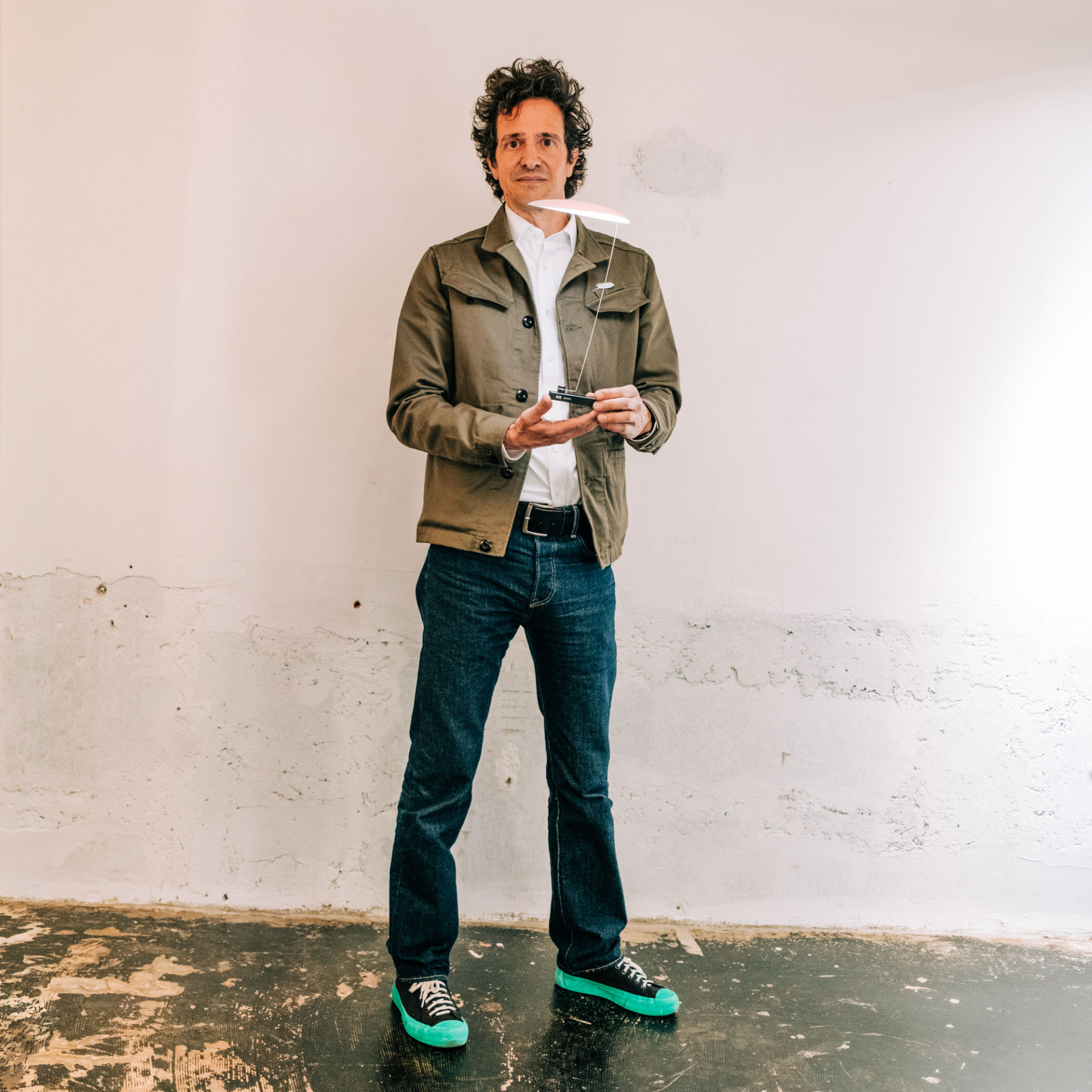
The creative director Axel Schmid is testing switches when I walk in, and an electrician is somewhere behind the wall, working out why the system wouldn’t shut off the day before.
The room is narrow and long, 24 meters end to end, rented from the Italian designer Michele De Lucchi, whose office sits next door. Two thin parallel cables run the full length of the ceiling. Between them hangs everything I came here to see: roughly 30 lighting elements in glass, paper, silicone, and metal. Some were designed in 1984. Some were designed six months ago. From the doorway I cannot tell which is which.
This is the YaYaHo. Ingo Maurer designed it in 1984 as a low-voltage halogen wire system, the idea being that you separate the positive and negative into two cables, run electricity across the length of a room, and hang light wherever you want it. It became one of his signature objects within a year of its release. The Centre Pompidou installed it. The Villa Medici installed it. It was, at the time, a small revolution in how a fixture could behave: not one lamp in one place, but a set of movable parts on a wire. Nearly 42 years later, it is still in production.
Axel has been running design at Ingo Maurer for almost three decades. He met Ingo in Stuttgart in 1994 as a student of Richard Sapper, then started in Munich in 1998. He turned out to be the person who would carry the company through Ingo’s death in 2019 and Foscarini’s 2022 acquisition of the studio. He had not, until now, opened the YaYaHo back up.
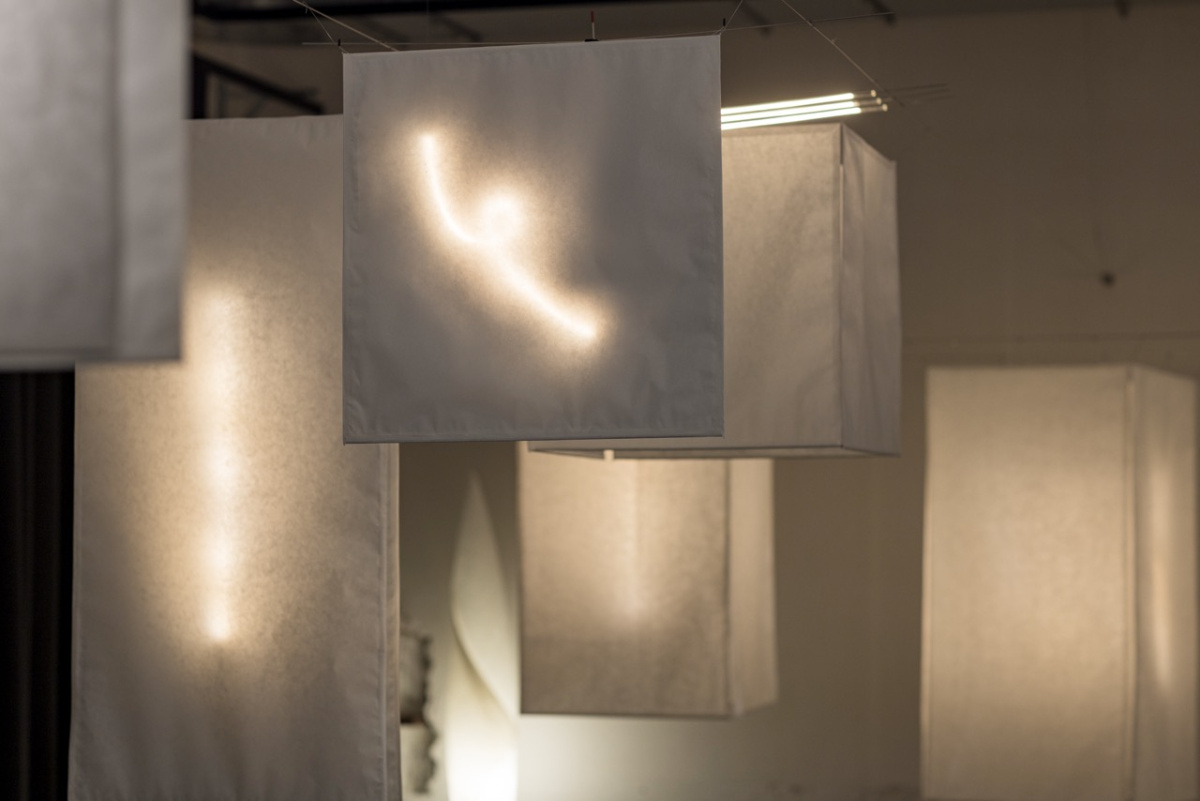
One of the new YaYaHo paper pieces, with the curve of light on its surface drawn by an LED strand routed through a template inside the bag. The template can be reconfigured to make different shapes, so no two pieces in the room display the same graphic. Photos by Giuliano Koren, courtesy of Ingo Maurer
“We made different attempts to get into ‘the now’ with that system,” he tells me, walking past one of the original 1984 spotlights, which still has the halogen-shaped glass even though the bulb inside is an LED retrofit. “I started on it several times, but it never felt like the right moment to do it.” Until last year. The studio decided to take this temporary Milan space, and a narrow 24-meter rental forces a question: What do you put on a 24-meter wire?
The answer took a five-person team most of the year. We start at the front of the room, where one of the new elements sits. It looks at first like a glass tube hanging from the cable, but a single straight line of light runs through it. “It’s an LED strand that is normally used in LED bars,” Axel says. They sourced one in a specific length, slid it inside a glass tube, and hung it. It is the most graphic piece in the room, and it could not have existed in 1984.
A few meters along, we get to the paper. Axel pulls down a small object that looks like a paper bag, open at the top. He shows me a template inside, paper with cuts in different directions, threaded through small slits. “You can draw different designs on it,” he says, sliding the template into a new shape. The closer the LED sits to the paper, the sharper the line on the surface. The further away, the more diffused. There are several of these in the room, and each one looks unique.
The wires turn out to be sturdy enough to hold considerably larger objects. Axel points up to a square of Japanese long-fiber paper the studio uses for its MaMo Nouchies and Lampampe lamps, made in a small workshop in Munich. They doubled the size and rigged it with loops on all four sides, which means it can hang vertically, horizontally, or as a paper roof above a table. Three of the larger volumes, similarly oversized, hold 400 lumens each. Standing under them, you get the effect of a floor lamp with no base.
-
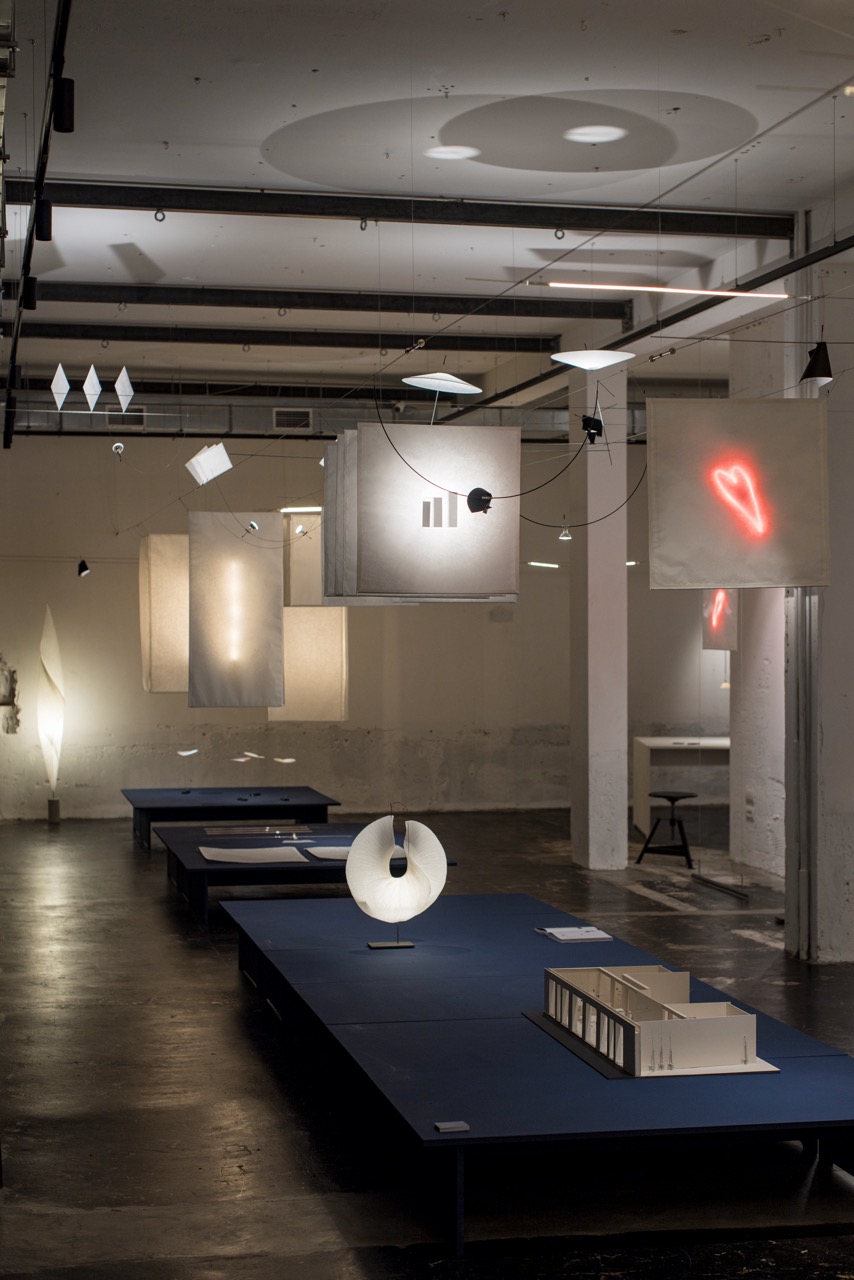
- The full Milan installation, with the YaYaHo running 24 meters end to end. Photos by Giuliano Koren courtesy Ingo Maurer across two parallel cables and an architectural model of the room sitting on the blue plinth in the foreground. The red heart on the right shows what an LED strand can draw when threaded through one of the new paper squares
-
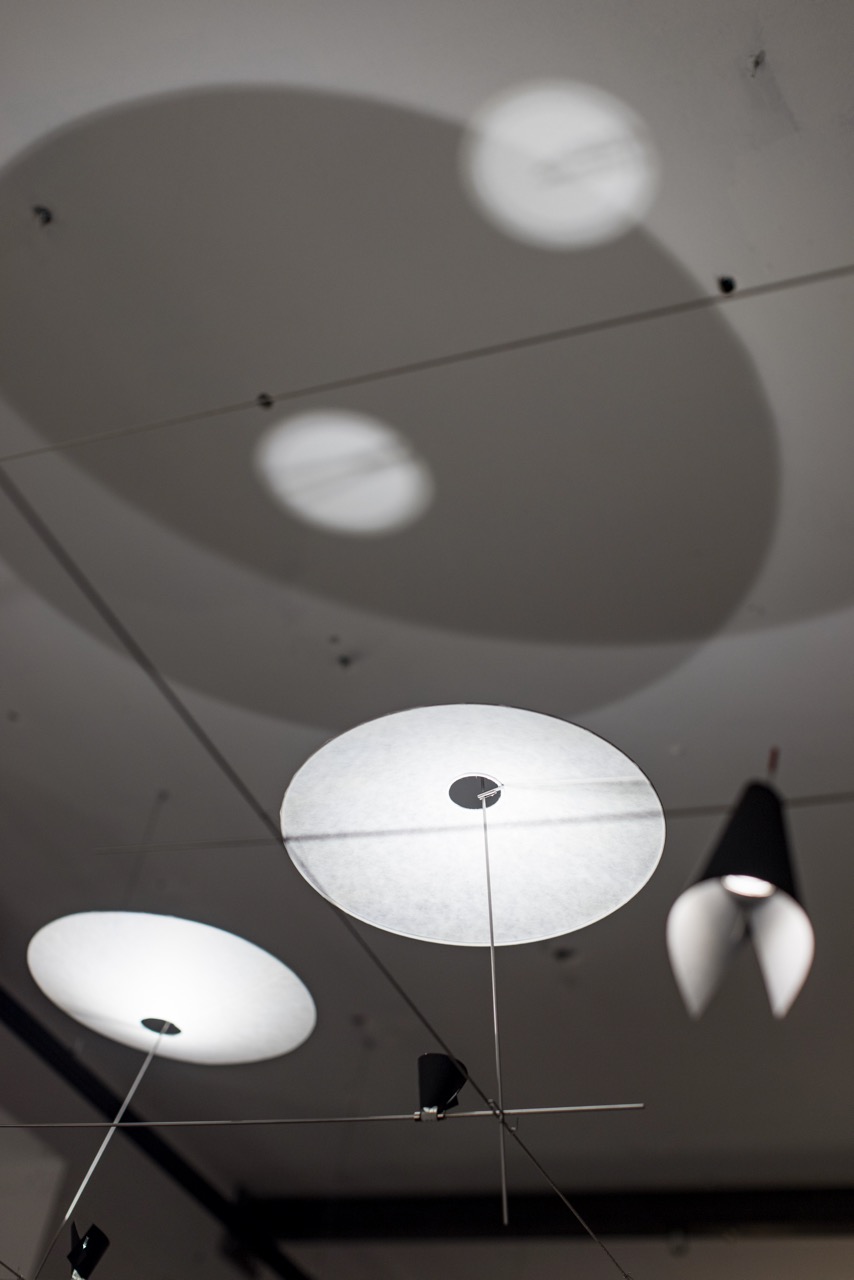
- Two of the new disc elements that sit upright on the YaYaHo cable rather than hanging from it, casting light onto the ceiling above. The discs can be slid along the cable and tilted in either direction, while the spotlight beside them is one of the original 1984 fixtures still in production. Photos by Giuliano Koren courtesy Ingo Maurer
Axel and his team also designed two new elements that sit upright on the cable instead of hanging from it. The spot points up from underneath, casting shadow onto the paper umbrella shade above. The shade can be slid up and down, tilted one way or another. “A sense of play,” he says, sliding it.
There is also, on a far wire, an umbrella shape from 1982. It used to be made of glass fiber, because halogen would get too hot. With the LED retrofits, that’s no longer necessary, so they switched to a heavy transparent paper from France, and while they were at it, they softened the angles and curved the edges. The 2026 versions look like the 1982 versions if you squint, but they are not the same. “We have the grandparents and the grandchildren in one system,” Axel says.
The studio also decided to mix two shades of white. The original spotlights run at 2,700 Kelvin, the new flexible LED strands run at 2,200. “That’s actually something architects and designers said not to do,” Axel says. “You choose just one color.” But they put both in the same fixture, on purpose, and over the course of the week, the lighting designers walking in have apparently come around. “They are like, ‘I see. I see now.'”
He keeps emphasizing that this is not finished. The pieces don’t have prices yet. The studio will figure that out over the summer. They want to put together a look book. “Configuration A, configuration B,” so a client can start somewhere instead of staring at 24 meters of wire. The system was always supposed to be open, which means there is no version of it that arrives complete.
Like other beautifully designed objects, the install does not look like a museum piece getting dusted off for an anniversary, it looks modern, futuristic even, like it’s best configuration is still to come.