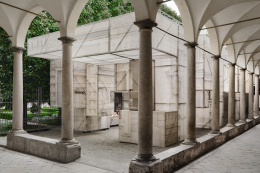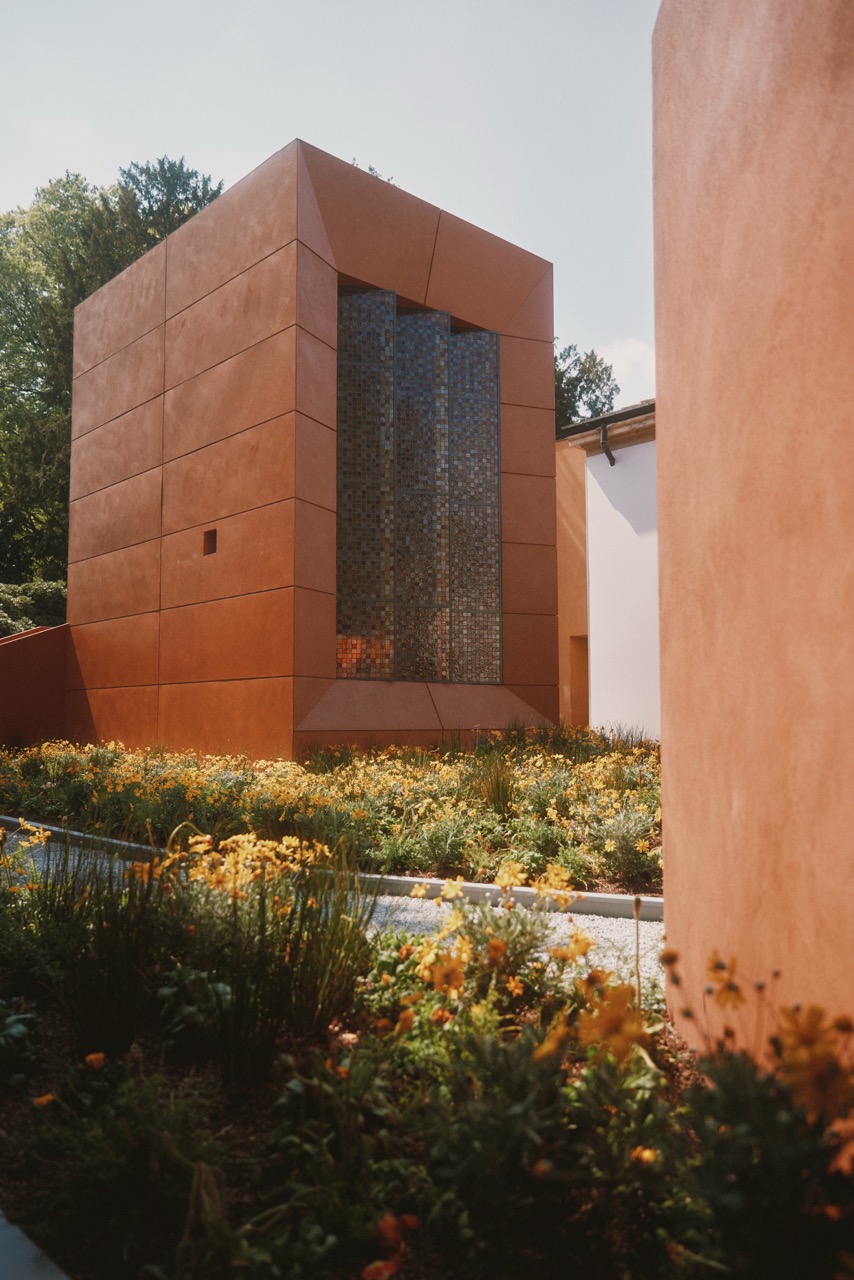
The classical courtyard at Padiglione d’Arte Contemporanea is quiet, which is the first thing I notice. It also looks, somewhat, like rural Illinois, about as unexpected a view as you could imagine in the center of Milan during Design Wkek. Seven species of wildflowers, untamed, form a central meadow, with a 247-square-foot brutalist monolith rising out of the middle of it. Stained-glass windows pull terracotta light across the facade. This is The Flamingo Estate Bathhouse by Kohler, the brand’s contribution to Fuorisalone 2026, conceived in partnership with Richard Christiansen, the founder of the Los Angeles wellness-and-pleasure house Flamingo Estate. I look over and see Martha Stewart admiring the flowers. Kohler continues to deliver the unexpected.
Inside the bathhouse, set on a plinth and washed in candlelight, sits Reverie. It’s the project’s reason for being, a new freestanding enameled cast iron bath, made with at least 80 percent recycled materials, wrapped in a copper shroud that Kohler hand-formed and welded at its 153-year-old foundry in Wisconsin. The company says this is the first time it has used copper as a defining material in bath design. A small line is forming to take selfies with it.
Outside scattered through the wildflowers are four one-of-a-kind cast iron pollinator baths. These were Richard’s idea: small sculptural vessels, brutalist on the outside, organic and patterned on the inside, designed as drinking and resting stations for birds, bees, and other pollinators. Each was cast at the same Wisconsin foundry that makes the tub.
“The cast iron pollinator baths within our Milan installation act as a bridge between architecture and landscape,” Michael Seum, Kohler’s VP of Global Design, tells me. “Working collaboratively, we translated a Brutalist design language into sculptural vessels that feel grounded in the environment, while the interiors introduce textures and patterns created specifically for birds and pollinators. It’s an exploration of how design can move beyond human-centered thinking to support a more reciprocal relationship with nature.”
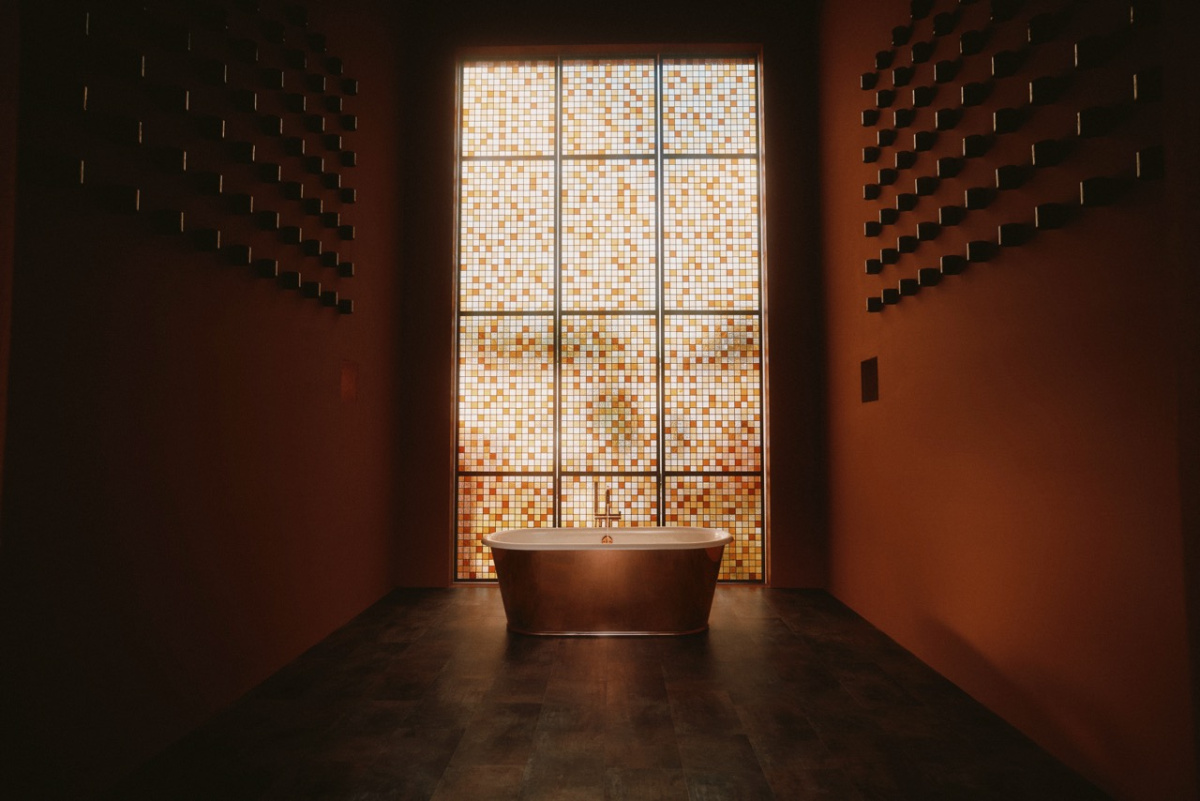
Inside the bathhouse, the Reverie bath stands at the center of a candlelit chamber. The walls hold 200 Flamingo Estate candles scented with Wild Linden Blossom and Bergamot, a fragrance Richard Christiansen created for the installation. Photo courtesy of Kohler
I have spent enough time around Kohler at fairs to know what a Kohler activation usually feels like. In 2021, the brand showed up at Design Miami with Daniel Arsham’s Rock.01, a 3D-printed ceramic sink that he and Kohler’s engineers essentially had to invent a manufacturing process to produce. Two years later, Samuel Ross built Terminal 02 inside Palazzo del Senato during Milan Design Week, a brutalist maze of orange industrial piping that funneled visitors toward Formation 02, his Haptic Orange smart toilet for Kohler. Last December, the brand came back to Design Miami with David Franklin’s Pearlized finish, a pearlescent coating that came out of an experiment running ceramic fish through a PVD machine usually reserved for metal faucet parts. David Kohler once told me the artist program exists to demonstrate the company is both a “left brain and right brain” operation.
Each of those activations was, on some level, an R&D announcement dressed up in a gallery context. The work was the technology. The story was the breakthrough.
-
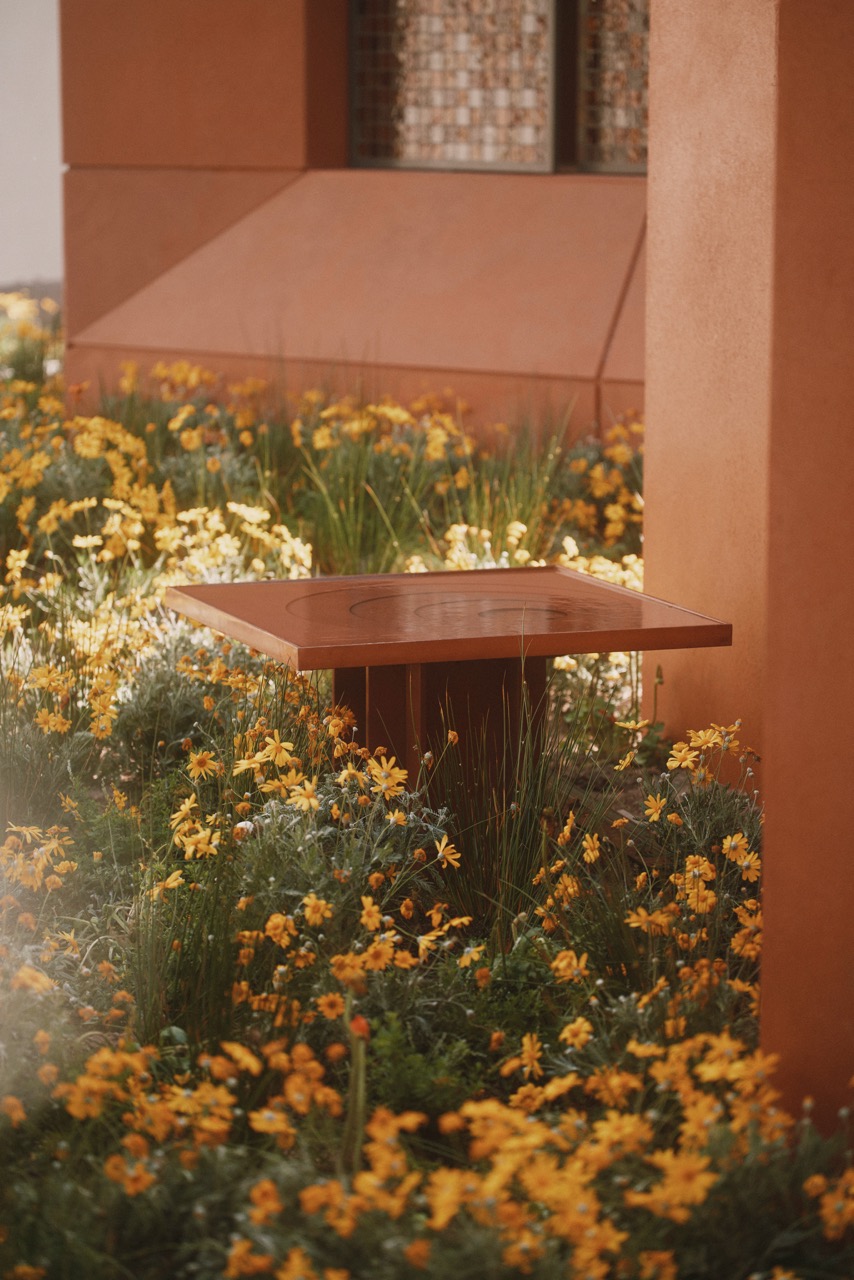
- A pollinator bath in the wildflower meadow outside Padiglione d’Arte Contemporanea. Kohler cast four unique vessels for the installation, each topped with a different ringed pattern.
-
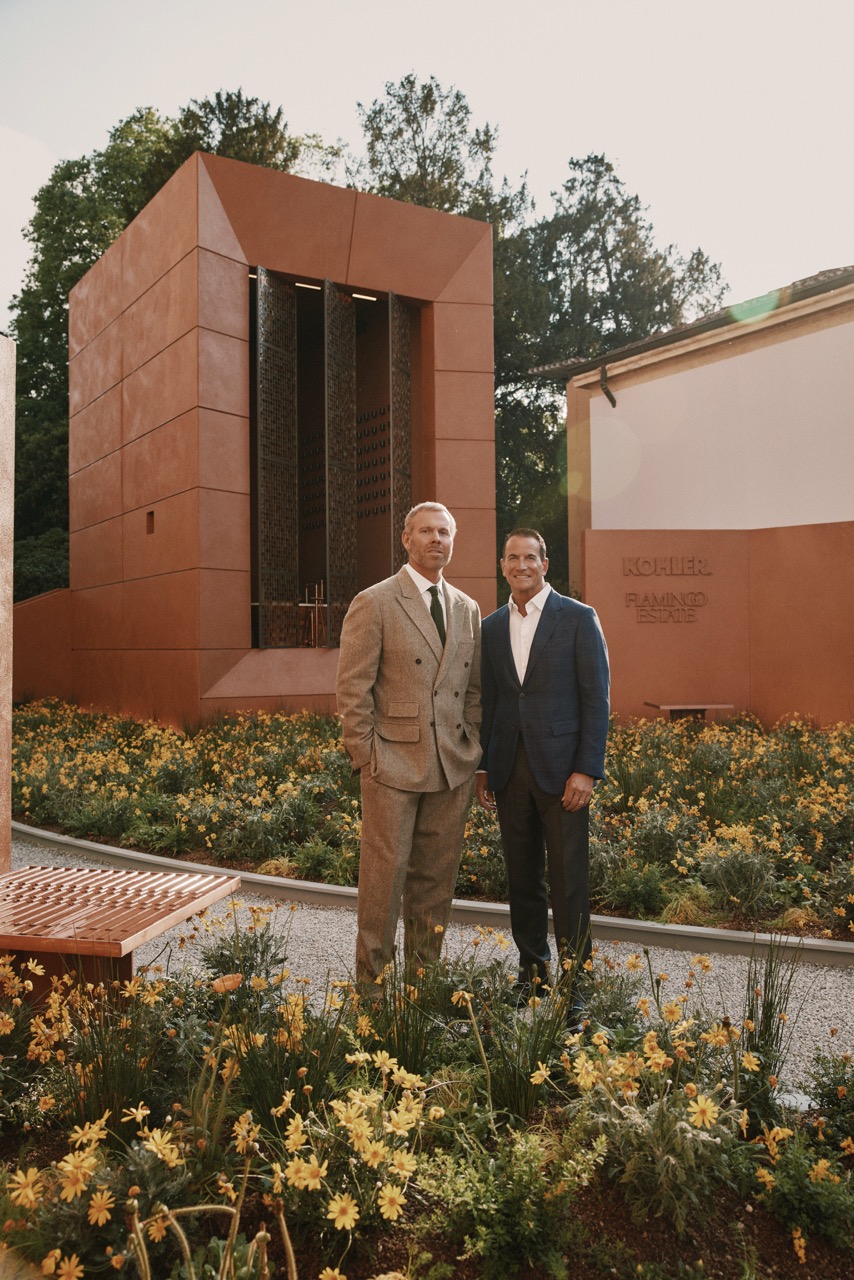
- Flamingo Estate founder Richard Christiansen (left) with David Kohler, chair and CEO of Kohler and the fourth generation of his family to lead the company. The pair unveiled the bathhouse together at PAC during Fuorisalone 2026. Photo courtesy of Kohler
The Flamingo Estate Bathhouse is decidedly not that. The copper shroud is a craft flex, and Kohler can rightfully claim it as a first. But the center of gravity here is all “vibe,” the candles, the stained glass, the pollinator vessels, the ritual. Richard, who has spent the last several years turning Flamingo Estate into a kind of secular wellness brand built on garden-grown candles, oils, soaps, and tomato sauce, is operating squarely in his lane. The bathhouse smells like the candles he made for it (Wild Linden Blossom, an olfactory portrait of Milan’s tiglio trees in bloom). The pollinator baths are, in his words, places “where wildflowers, water, and light come together to create a sensory experience that reconnects us to the rhythms of the earth.”
It is, by Kohler’s own historical standard, a softer activation. A more traditional one. The decision to lean into a lifestyle partner instead of a left-brain headline, to put sculpture and ritual ahead of a manufacturing first, reads as a deliberate pivot. Whether that is a smart move for a heritage company in a year when several heritage brands are quietly retreating from technical fireworks toward mood, or a temporary breath before the next R&D push, is a fair question. The room does what it sets out to do. It slows you down. It puts a copper bathtub in front of you and dares you not to want to climb in.