Most of the “material story” pitches you hear on a NeoCon show floor start with a rendering. Patcraft’s Wanderwood, which picked up a Silver Award at Best of NeoCon and landed a feature in Interior Design’s 2026 HiP Awards, started with a walk around a backyard in Massachusetts.
That’s how designer Mada Jones tells the story. Mada works as a Hard Surface Designer for Patcraft, but her path there runs through fine art rather than a traditional product design track. She studied illustration at the Savannah College of Art and Design, with a minor in printmaking, and still keeps an active personal practice in illustration, pattern work, and printmaking outside of her day job. That background shows up in how she approaches a flooring collection, like a print waiting to be pulled.
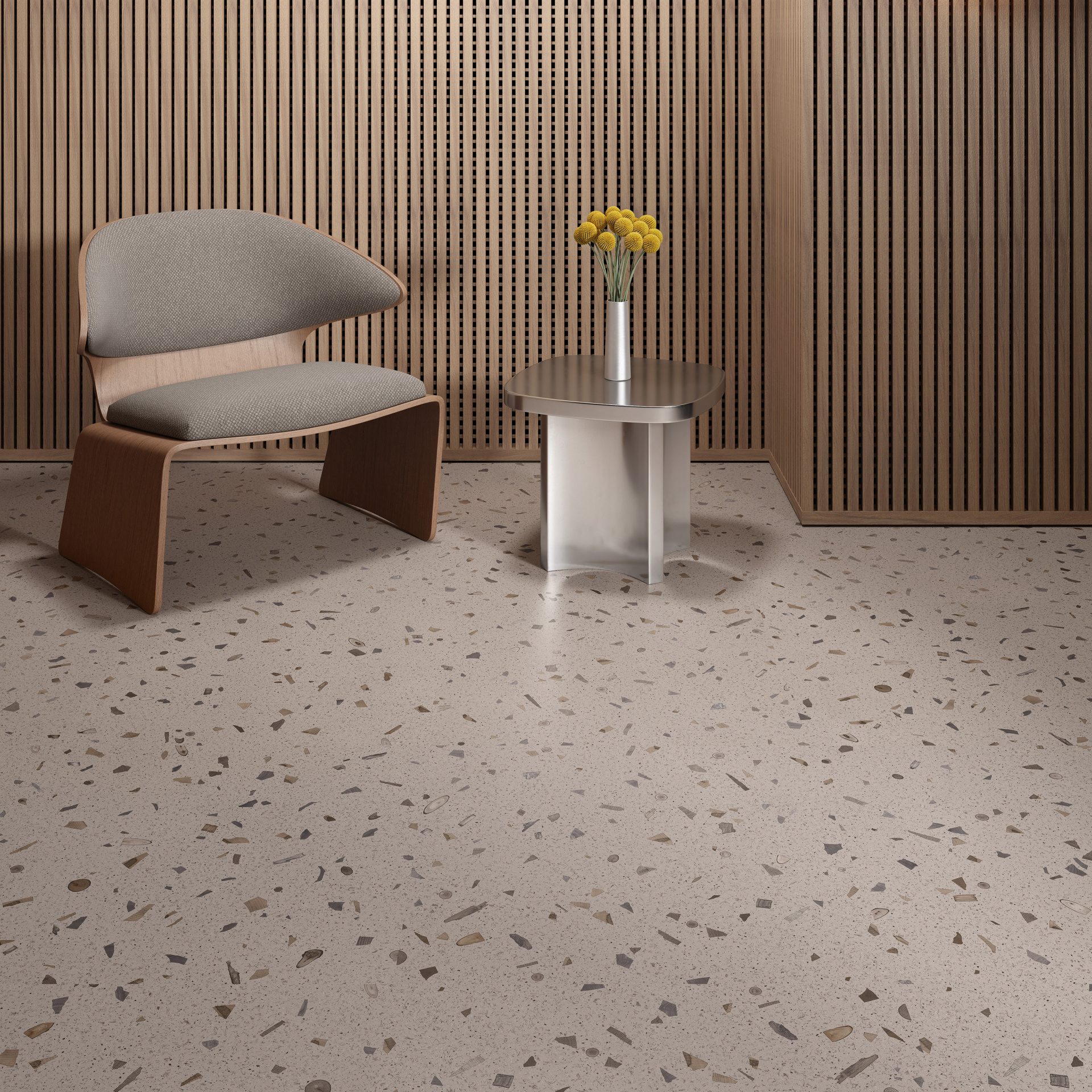
Wanderwood takes the basic logic of terrazzo, in which fragments of something are suspended and polished into a pattern, and swaps out the usual stone or glass aggregate for wood. It’s not milled lumber ordered off a spec sheet. It’s foraged, in the literal sense, then sliced into chips by hand.
Designed by Mada Jones, Wanderwood takes its inspiration from a walk through a Massachusetts backyard, turning collected branches and cut-offs into a wood-based take on terrazzo flooring.
“We were able to use all these materials, their variety in color, and in wood species,” Mada says, describing collecting cut-offs and fallen branches, mostly maple, from the property itself. “It really allowed me to connect sustainability to the manufacturing portion, but also in what we are designing.”
Wanderwood is manufactured in the USA and is fully recyclable, and it’s built into Patcraft’s In the Loop program, which means it can eventually be reclaimed and recycled through the company’s re[TURN] program rather than heading to a landfill at the end of its life. The wood-chip concept carries all the way through, in other words, applying not just at the design stage but at the disposal stage too.
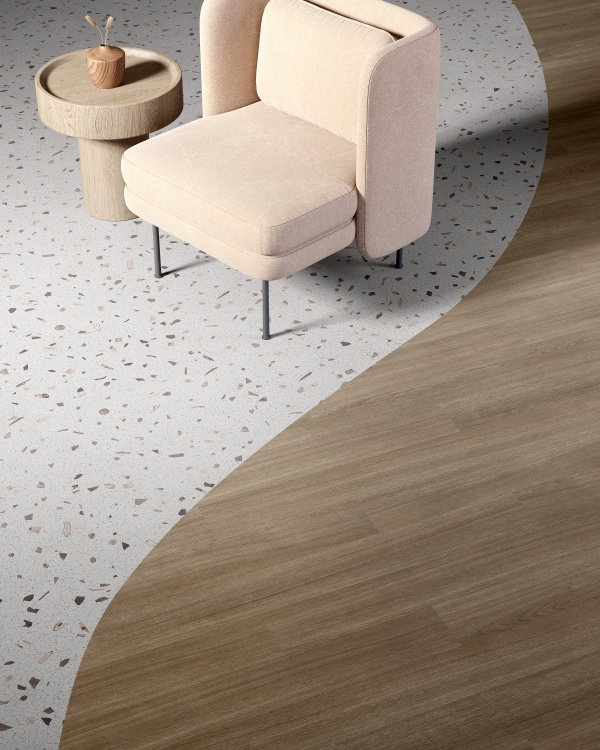
Sustainability isn’t an add-on for Wanderwood, it’s baked into the sourcing, the material, and the end of its life cycle.
Mada also let the wood do what it wanted throughout the design process.
“You only have so much control over how the chips break, so you kind of just let the material take control,” she says. That unpredictability is the central appeal of terrazzo. Some fragments land as abstraction, while others start to look like something.
“You can look at the pieces and be like, ‘oh, that one looks like a certain shape,'” she says. Once the woodchips were cut, they were sanded down to expose the grain, then scanned to build the repeatable pattern that actually makes it to production. It’s the step that turns a pile of foraged branches into something an A&D firm can actually spec.
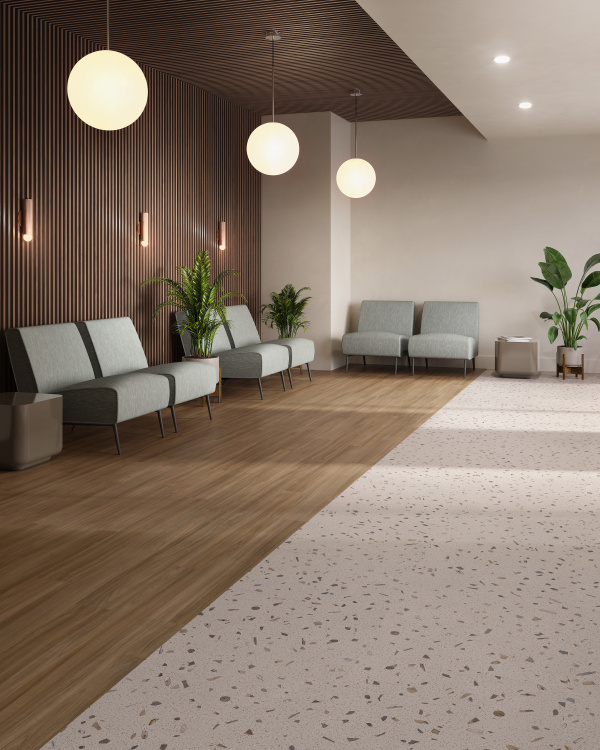
Launching this Fall, Wanderwood is Patcraft’s newest terrazzo-inspired LVT collection, built from foraged wood instead of stone.
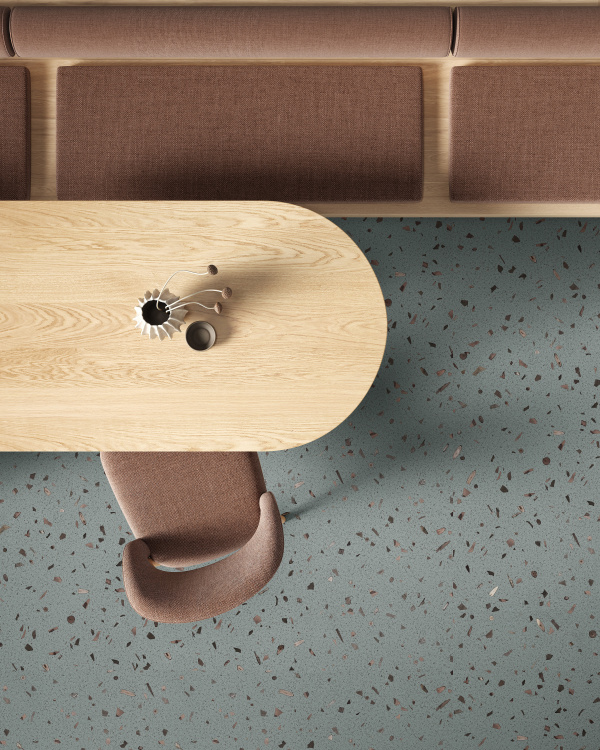
Wanderwood comes in 2.5mm and 4mm thicknesses, and the 4mm version is built to install flush alongside carpet tile. It also comes in two formats: a larger-scale version and a tighter, more compressed take with a denser, almost concrete-like texture. Each ships in around 10 colorways, meant to be mixed and coordinated rather than treated as one-off options.
Mada described the range as swinging between quiet, moody neutrals and richer, deeper tones, with grays sitting next to darker plums and warm neutrals, calibrated so the chip patterning stays legible instead of getting swallowed by the field color.
Wanderwood is set to launch commercially this Fall.