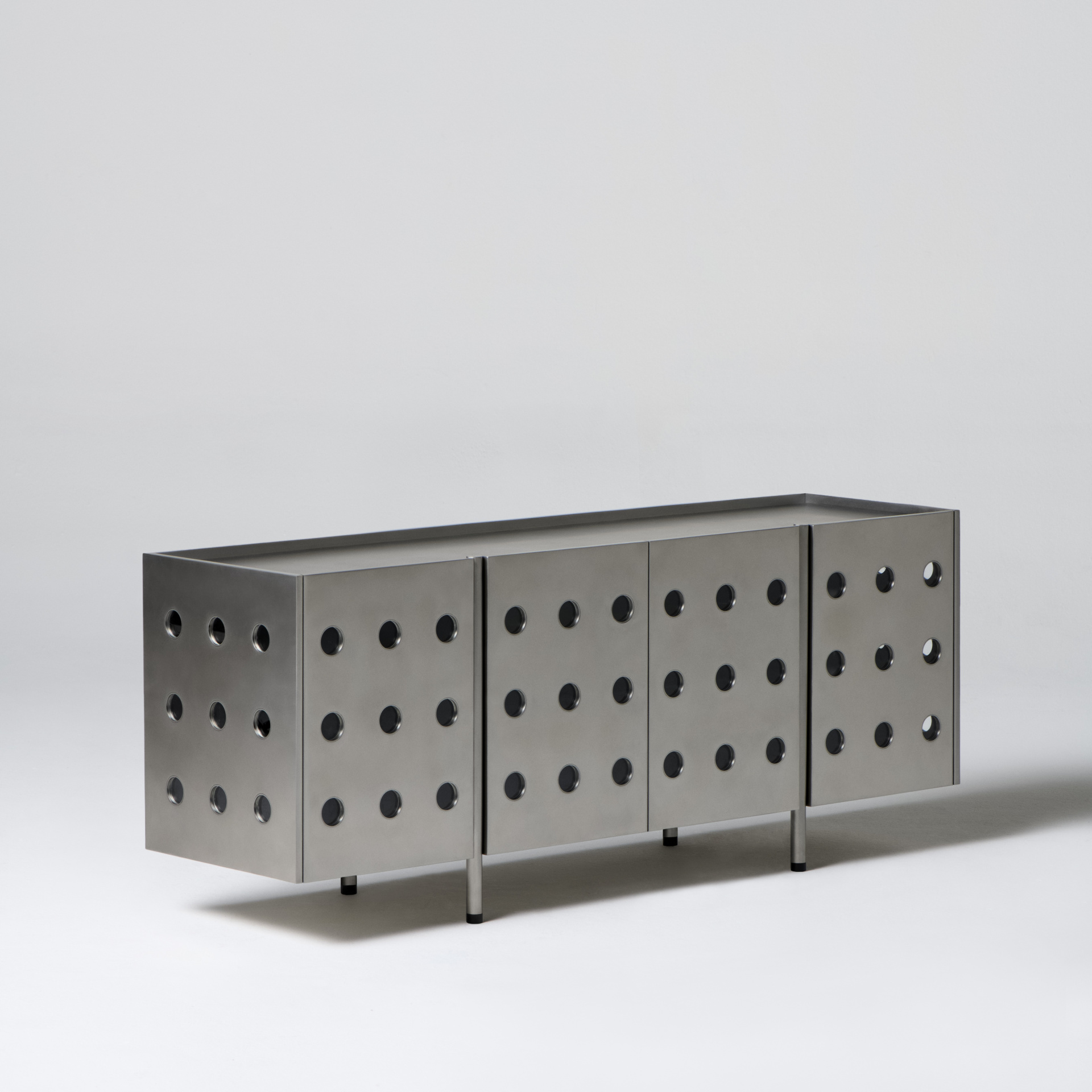
Maiden Home’s Louis cabinet is cold-rolled steel and glass with circular portholes set into the doors, a piece of furniture that borrows its visual language directly from designer Jean Prouvé’s architectural façade panels. It’s storage that wants to be architecture, translating mid-century building elements into something meant to anchor a domestic room.
Jean worked in France from the 1930s through the 1950s, designing prefabricated building systems that took industrial materials seriously in a way most designers didn’t at the time. His façade panels, developed alongside architects and engineers, used modular glazing to bring light into interiors while creating repeating rhythmic patterns across metal surfaces.
“Those elements struck us as both utilitarian and poetic, industrial in origin but deeply human in execution,” says Nidhi Kapur, Maiden Home founder and CEO. “The portholes on the Louis doors are a direct nod to that language, reinterpreted in a way that feels contemporary while honoring the integrity of mid-century modernist thinking.”
Though getting there required serious metalwork, according to Nidhi. Master artisans hand-welded the cold-rolled steel frame, then burnished and coated it to preserve both strength and surface. Each circular glass porthole was then inlaid individually along with the interior shelving. Some steps used precision machinery, but the details that defined the piece were shaped by hand.
“We wanted to create a storage piece that felt architectural rather than purely functional, something that could anchor a room visually while still being incredibly useful,” Nidhi says. “The challenge was balancing visual strength with refinement, so it never feels heavy or overbearing in a space.”
Cold-rolled steel has a presence that wood and aluminum don’t quite match, grounded and serious in a way that reads immediately in a room. Paired with glass, it sets up a tension between opacity and transparency, solid and void.
“We believe in slow craft, allowing time for precision, problem-solving, and care at every stage,” Nidhi says. “Our goal is for someone to look at it in their home 20 years from now and feel the same emotional pull they felt on day one.”
A version of this article originally appeared in Sixtysix Issue 16.