There’s a particular trick that Japanese temple roofs pull off, one that designer Laura Lange has been thinking about for years. From a distance they look weightless, curving up and outward with ease. Get closer, though, and you’ll find a heavy, exacting structure built to hold real weight.
That weightlessness is engineered. The deep, overhanging eaves on temples like those in Nara and Kyoto are a defining feature of Japanese architecture.
Supporting an eave that size without it sagging or collapsing called for a solution that predates modern fasteners. Carpenters developed tokyō (also called kumimono), a bracket system that stacks blocks and arms to carry the load out and down through the pillars, letting the roofline extend and curve without extra visible support. It’s part of a broader tradition of interlocking wood joinery, built on the idea that the strength of the structure lives in the wood and the joint itself, not in something bolted on afterward. The compression, tension, and precise fit do the work that a nail or bracket would elsewhere.
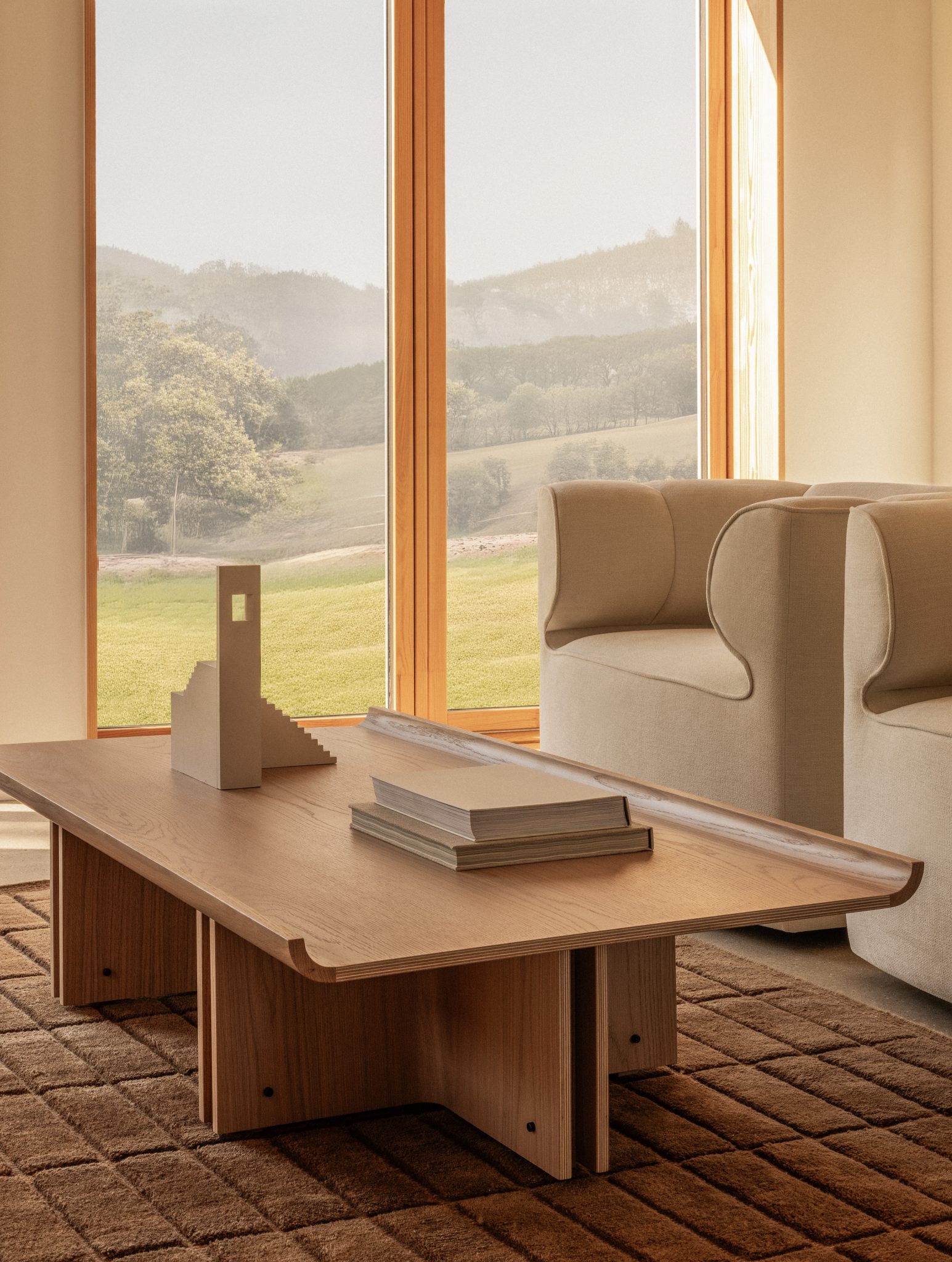
That structure became the starting point for Conrad, Laura’s new lounge table for Audo Copenhagen.
“With my background as an industrial designer, I’m often driven by a constructional way of thinking,” she says. In Conrad’s case, that material was form-pressed veneer, a technique she first learned in a dedicated course back in school and never let go of. She tells me she tested it once already on an early dining table, and came away fascinated by what the process allows a designer to get away with.
The process starts with thin sheets of wood veneer, glued and stacked in layers. That stack is placed inside a mold shaped like the final curve, then clamped under heat and pressure until the glue cures and the layers set permanently into that form. What comes out the other side has almost nothing in common with the individual sheets that went in.
“The material appears thin, but as soon as you bend it, you will find the strength to construct something that’s very strong and can hold a lot of weight,” she says.
Audo Copenhagen’s design director Joachim Kornbek Engell-Hansen, who worked alongside Laura on the piece, says that same instinct is what made her the right person for the job. Laura’s ties to Audo Copenhagen go back further than Conrad, to an internship at Norm Architects she took on while still a student. During that stretch, she helped develop a run of bespoke tables and lighting, including a lamp still in Audo Copenhagen’s lineup today. The habit she picked up there (thinking about a product and its surrounding room at once, rather than in isolation) has stuck with her since.
“We were interested in creating a table that felt refined and sculptural, but that also had a sense of character and honesty in the way it was made,” he says. “That balance became an important part of the design and ultimately shaped many of the details we see in the final piece.”
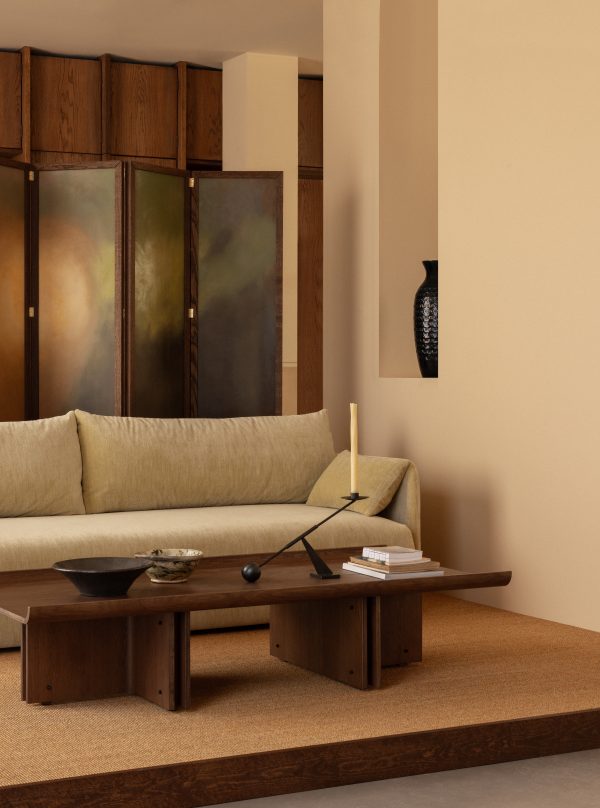
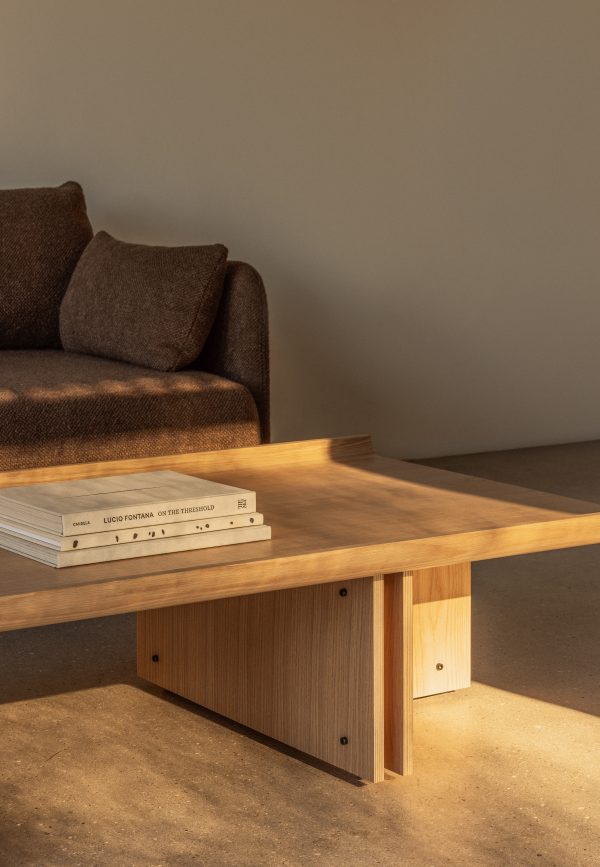
Nowhere does that honesty show up more plainly than in the hardware. While most furniture goes out of its way to hide the screws holding it together, Conrad puts them on display. The exposed screws are framed as a kind of structural candor, proof that the piece isn’t hiding how it holds itself together. But they’re also a design signature: the detail that makes Conrad recognizable across a showroom floor, the way a stitched seam or an exposed weld does for other brands.
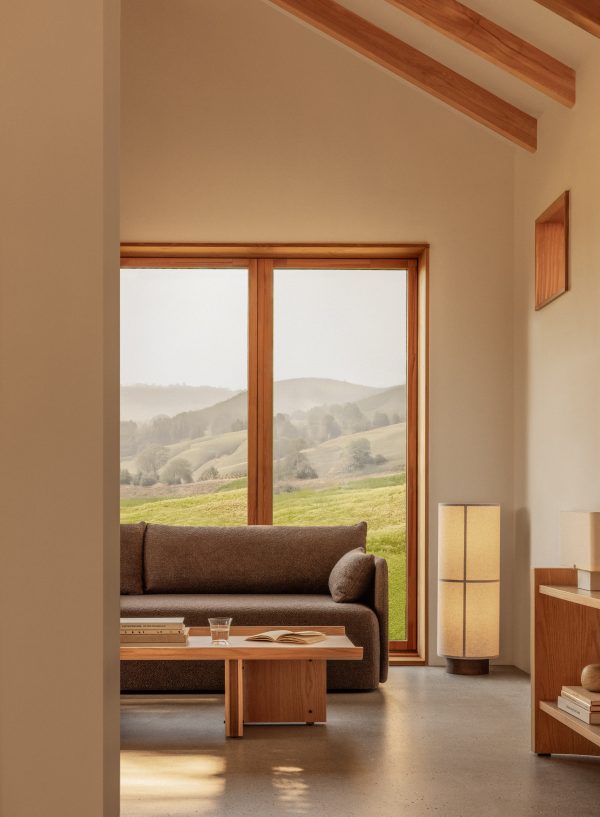
“Conrad is really a piece that’s really focusing on the people surrounding it,” she says. “It’s this low-height table that’s inspired by Japanese simplicity, you’ll sit close to the floor, you’ll gather around it, and this soft, elegant curve invites you closer to the product.”
That tension echoes through the way Laura talks about the piece more broadly. She resists pinning Conrad to a single use or context, describing it less as an object than as a family. Lengthen the legs and it becomes a stool, a dining table, or something else entirely. It’s a practical, sensible way to talk about a modular design, and it sits uniquely next to a design story built on something as specific as Japanese temple roofs.