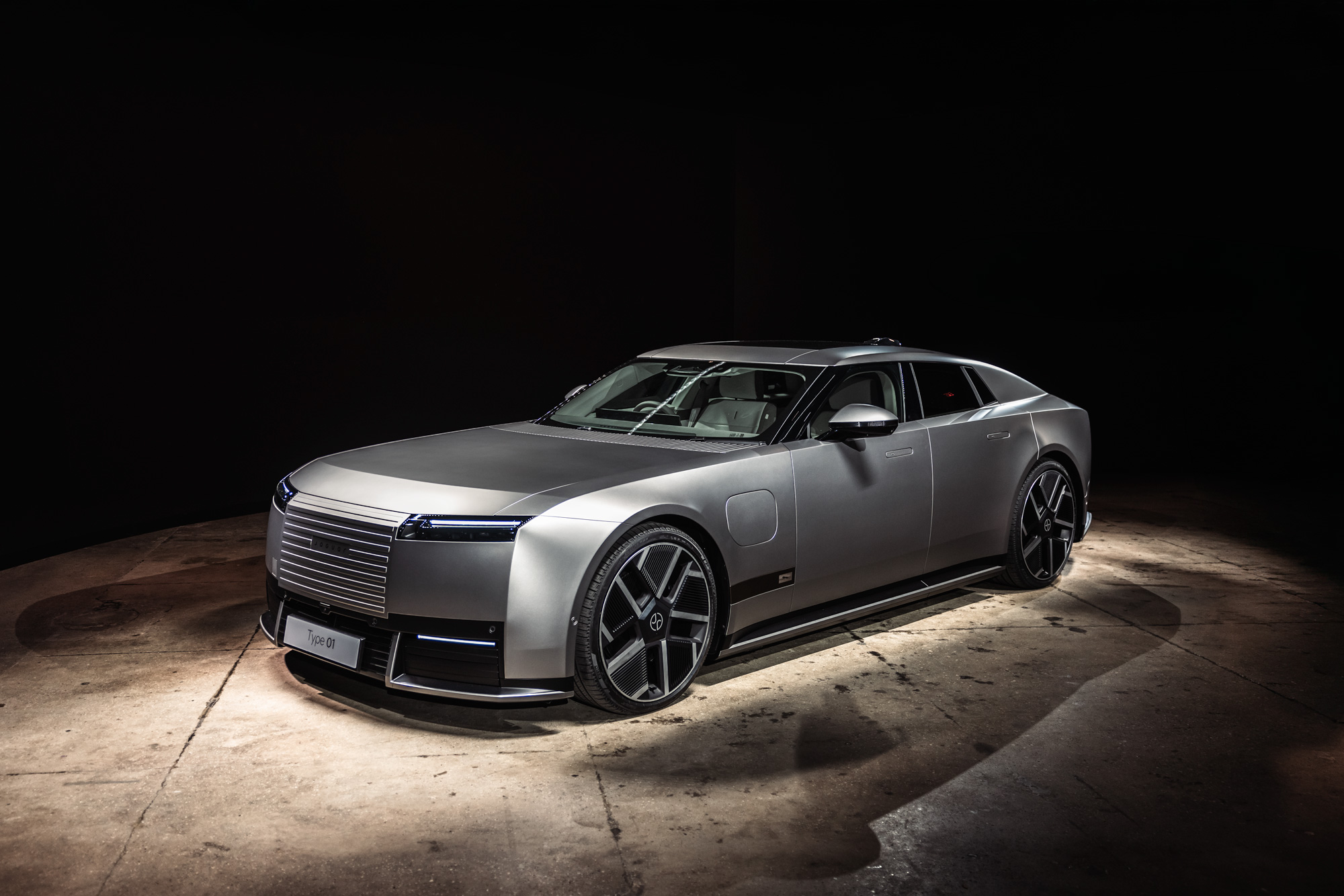
When the silk came off the Type 01 at STORIED in West Chelsea on Tuesday, it looked like nothing else. Its designers set out to make a statement, and they made it at full scale: 17 feet long and 55 inches tall, on 23-inch wheels. In person, the Type 01 is massive and bold in a way photographs don’t carry. In a category where plenty of electric sedans could trade badges without anyone noticing, that is the whole game.
In late November 2020, Alexey Andreev tells me, three design teams inside JLR got the same assignment: reimagine Jaguar on a blank sheet of paper, in three or four months. He remembers how it was put to them. “They said, ‘you will never get this chance again in your life.'” Most designers spend their careers on briefs that reward the logical and the safe. This one amounted to anything goes, and an expected car would have wasted it.
Alexey, who joined JLR as an intern in 2018 and became Jaguar’s lead exterior designer in 2024, was on the Range Rover team. Mary Crisp, now Jaguar’s chief materiality designer, was on the materiality team that worked with all three. In April 2021 the teams presented 18 models, and the Range Rover team’s won. From then on, Alexey says, “the whole company, not just the designers,” agreed on that vision. What you see today, he says, is “pretty much exactly what we started off with.” The production car has gained mirrors and a license plate, but the proportion is “exactly as we set it out.”
Alexey walked a group of us around the car and opened with the idea the team held to throughout the project. “Jaguar must be unique,” he says. “It cannot be like anything else.” Then he asked us to put a question to ourselves: “Have you ever seen a car like this before?”
The rules underneath are old ones. Long hood, fast windshield, low cabin, fastback, with the same backward lean as the Jaguars before it. That is the trick of the car. The most radical-looking Jaguar in decades stands on the oldest Jaguar proportions.
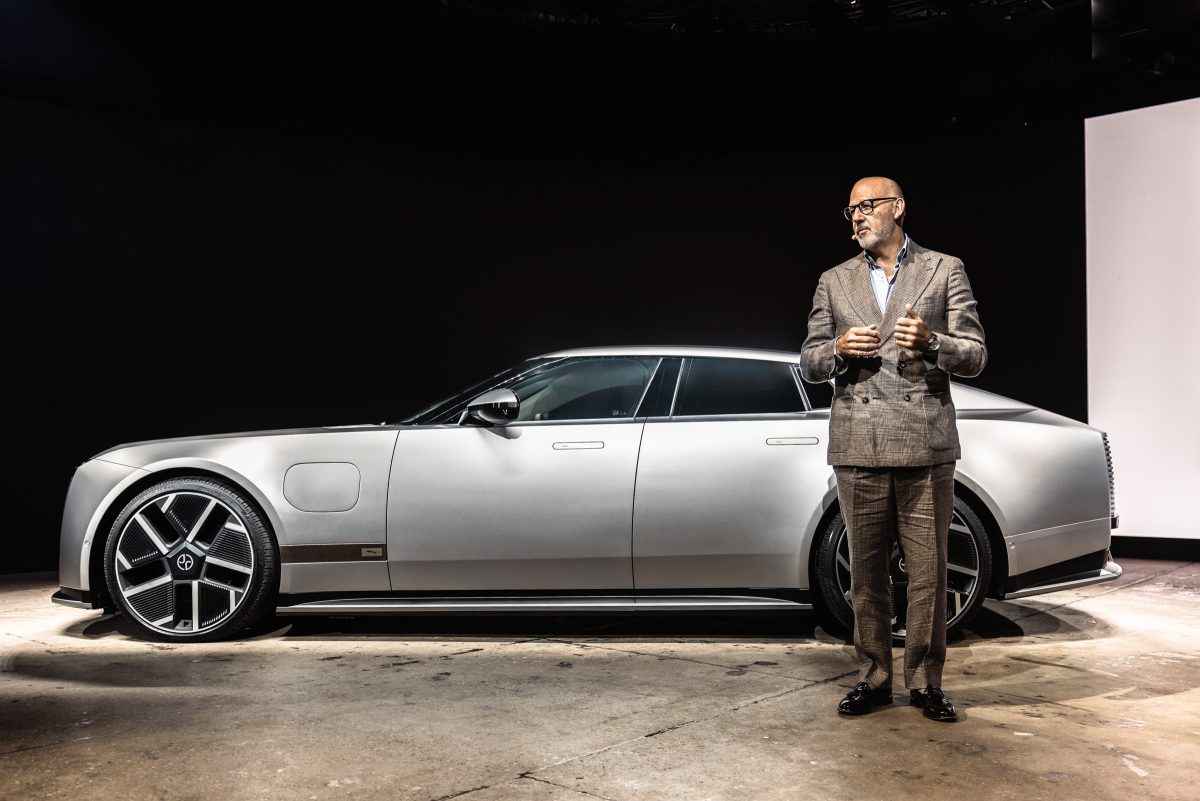
Carlee Hardaker, Jaguar’s communications and marketing director, says most cars start with engineering constraints. This one started with a single line on a blank sheet that became the actual silhouette of the car. Rawdon Glover, Jaguar’s managing director, says the team “spent the next four years refusing to compromise,” on the purity of the design, on how it drives, and on range. The line had to stay.
I asked Alexey who drew the line. “It doesn’t work like that,” he says. “It’s a team activity.” No one person, in his view, can design a car. The line came out of the full-size clay model that won in April 2021, shaped by an exterior team of five or six designers working 12-hour days. One week you’re flat, he says, and a colleague’s sketches in a review fire you back up. By the end, Rawdon says, hundreds of designers and engineers had “given absolutely everything.”
Keeping that line meant building a new platform. Electric cars usually seat people high, Carlee says, which raises the roofline and shortens the hood. Jaguar looked at existing architectures, found none that worked, and built its own. “It would be easier just to raise that roofline,” she says. The roof stayed at 55 inches.
Tom Bury, Jaguar’s product marketing director, has worked on the program since the start. He says 32 battery cells were moved to the front of the car, ahead of the cabin, into what Jaguar calls the luxury gap, the stretch between the front wheel and the door. “We use that incredible luxury gap to package the cells,” he says. On the E-type, the long hood covered the engine. On the Type 01, the same stretch holds batteries, which is a far better use of it than a plastic frunk.
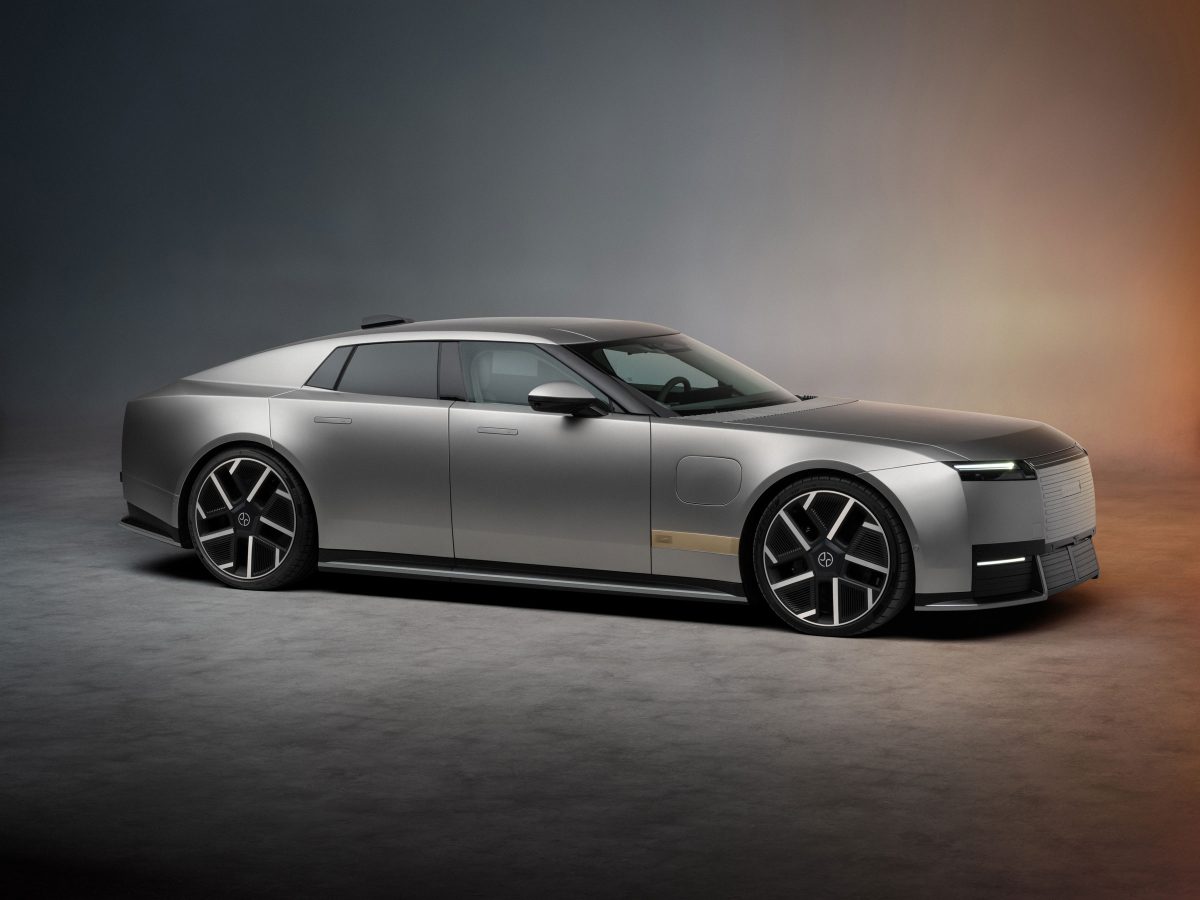
There is no conventional grille. “It’s an electric car,” Alexey says. “We don’t need a big grille in the center.” Four lines of light run across the nose instead. Most cars put their signature in a shape inside each lamp, he tells me, and that shape disappears at a distance. His test is a Type 01 seen far down the road, too far off to show any detail. The four lines alone should identify it. “If you’re sketching that on a piece of paper, one, two, three, four. That’s it.” The headlamps are 84 millimeters tall, the slimmest Jaguar has fitted, set high and pushed to the corners to make the car look wider.
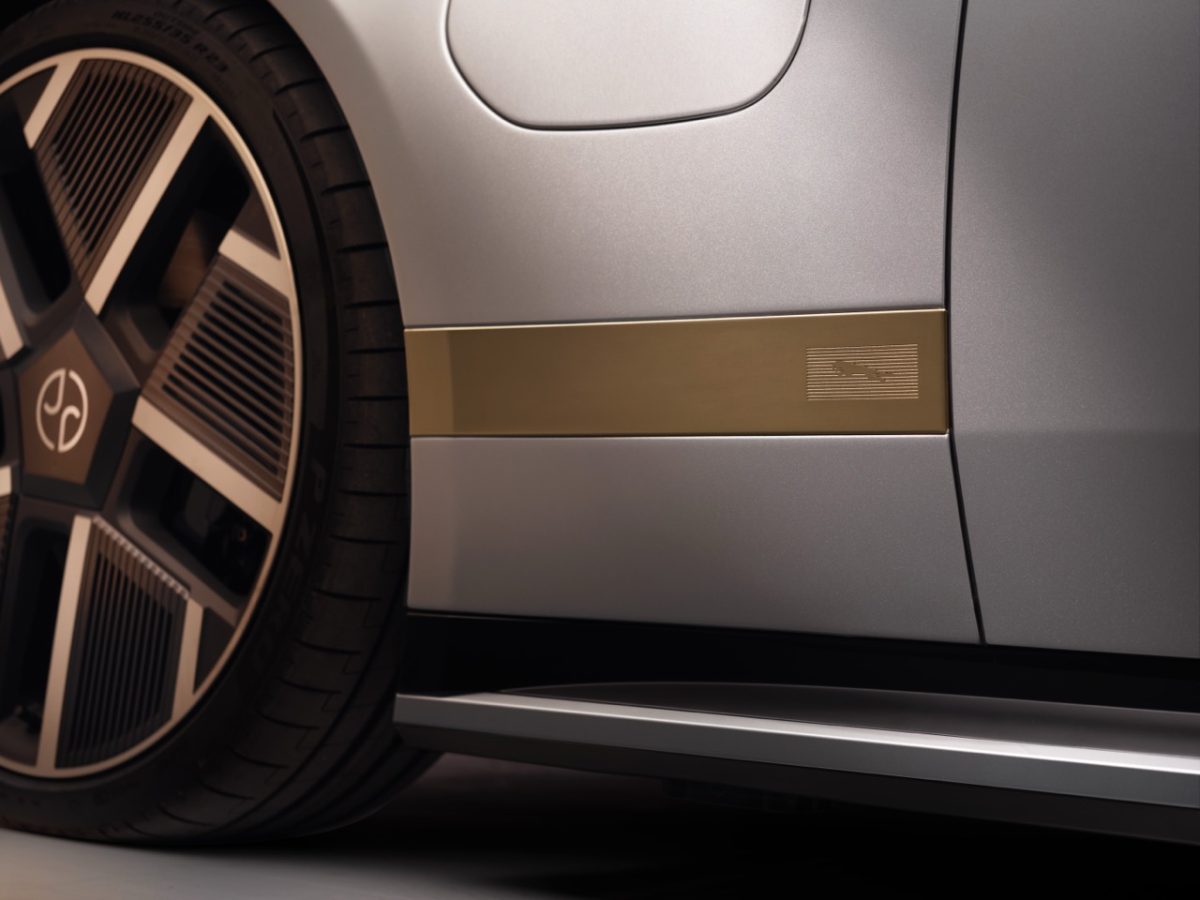
Along the side, the glass and door handles sit flush, and the frameless doors close against the body with no visible seal. “If you see a detail on the Type 01,” Alexey says, “it’s there because it serves a specific visual purpose.” The one he points to is the fender ingot, a brass-colored finisher in the luxury gap and the only place on the exterior where the leaper, the jumping cat, appears, laser-etched. Mary compares it to a hallmark on a piece of art. Below the shoulder, the bodyside carries enough shape to feel under your hand, down to a subtle break that only shows in certain light.
The team’s favorite surface, Alexey says, is probably the rear quarter, where the roofline comes down to meet the shoulder. He calls it “an unexpected moment,” designed to look “almost like a flick of a pen,” crisp where it starts and fading out. Tom says everyone fell for it in clay “because of the way it works with the light.” Then the engineering software flagged it as impossible: one aluminum pressing across five planes with acute angles, where Jaguar says industry practice stops at three. “But we couldn’t accept that,” Tom says. The team brought one person out of retirement, he says, “to iterate and create this panel and prove the computer wrong.” It took 22 weeks, against the usual two to four, “but only if you split the panel, lost the lines, and lost the Jaguar magic.” Jaguar calls it the Impossible Panel, and it is the best thing on the car.
Mary picks up at the panel. The car beside her is Visionary Silver Satin, which she says was the first paint Jaguar developed in-house, at the start of its reinvention around 2021. She calls it a complex silver. Where surfaces meet, as they do on the panel, the color moves from cool to warm, an effect inspired by chiaroscuro, the painter’s technique of light and shadow. Walk around the car and the panel keeps changing on you.
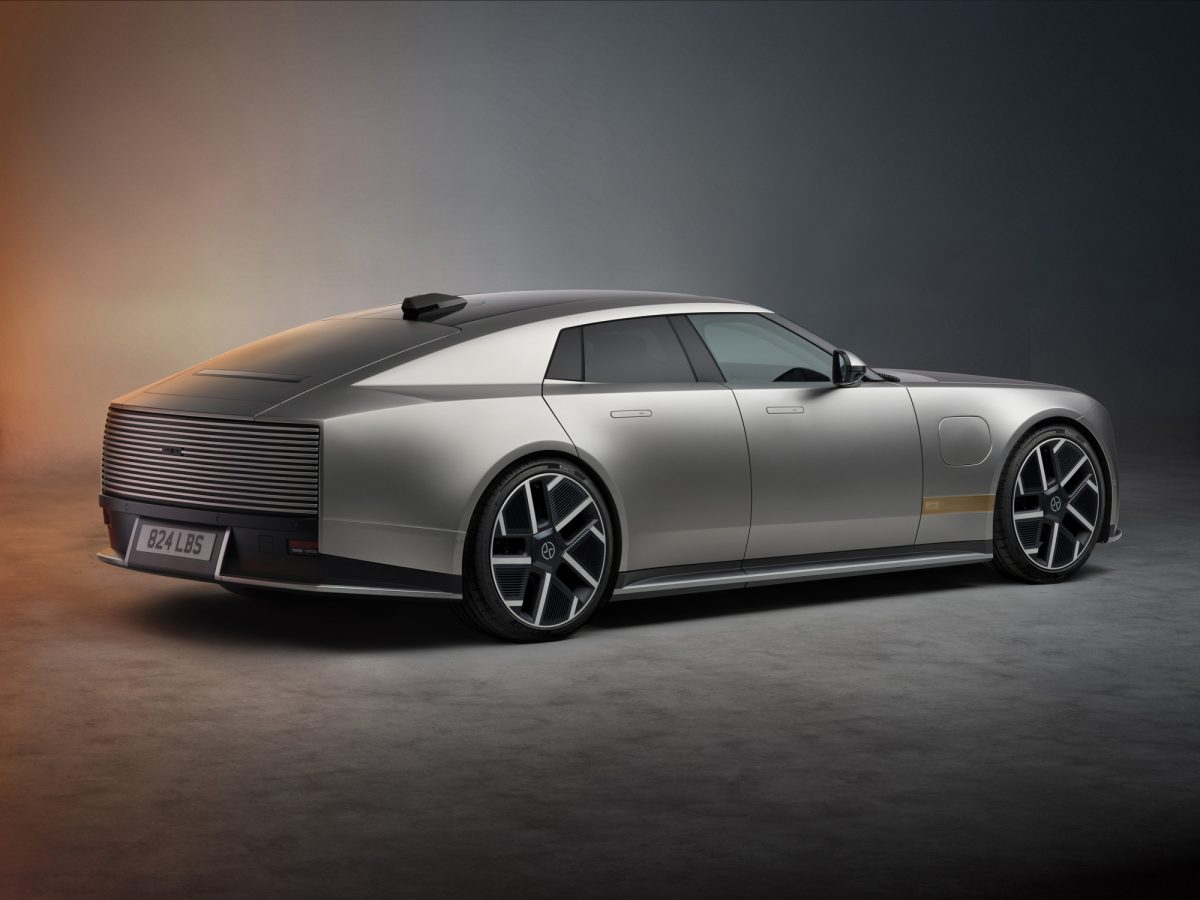
At the back, Alexey bets that anyone who closes their eyes can already picture the tail, a horizontal strikethrough with the taillights hidden inside it until they light. There is no rear window. Mary’s answer inside is a ClearSight screen at the base of the windshield, fed by a roof camera and set level with the door mirrors, in place of a rearview mirror. It sits in a full-width soundbar, which let Jaguar take the speakers out of the front doors and leave the door panels clean.
The driver sits low behind a slim dashboard, and a spine runs the length of the cabin, dividing it into four individual seats. Mary trained in textiles at Nottingham Trent and the Royal College of Art, and it shows in the seats, which she says “are designed to more closely resemble beautiful pieces of furniture.” A bonding process drops the vertical seams most car seats carry, and a wool-blend Kvadrat textile wraps around them. Mary wanted the cabin to feel like “a sense of home,” she tells me, with smooth surfaces set against ones with real texture and character. Her team took its references from fashion, art, and craft, and she says this was the first project where they actively partnered with artists. The cabin reads closer to a well-made room than to a cockpit.
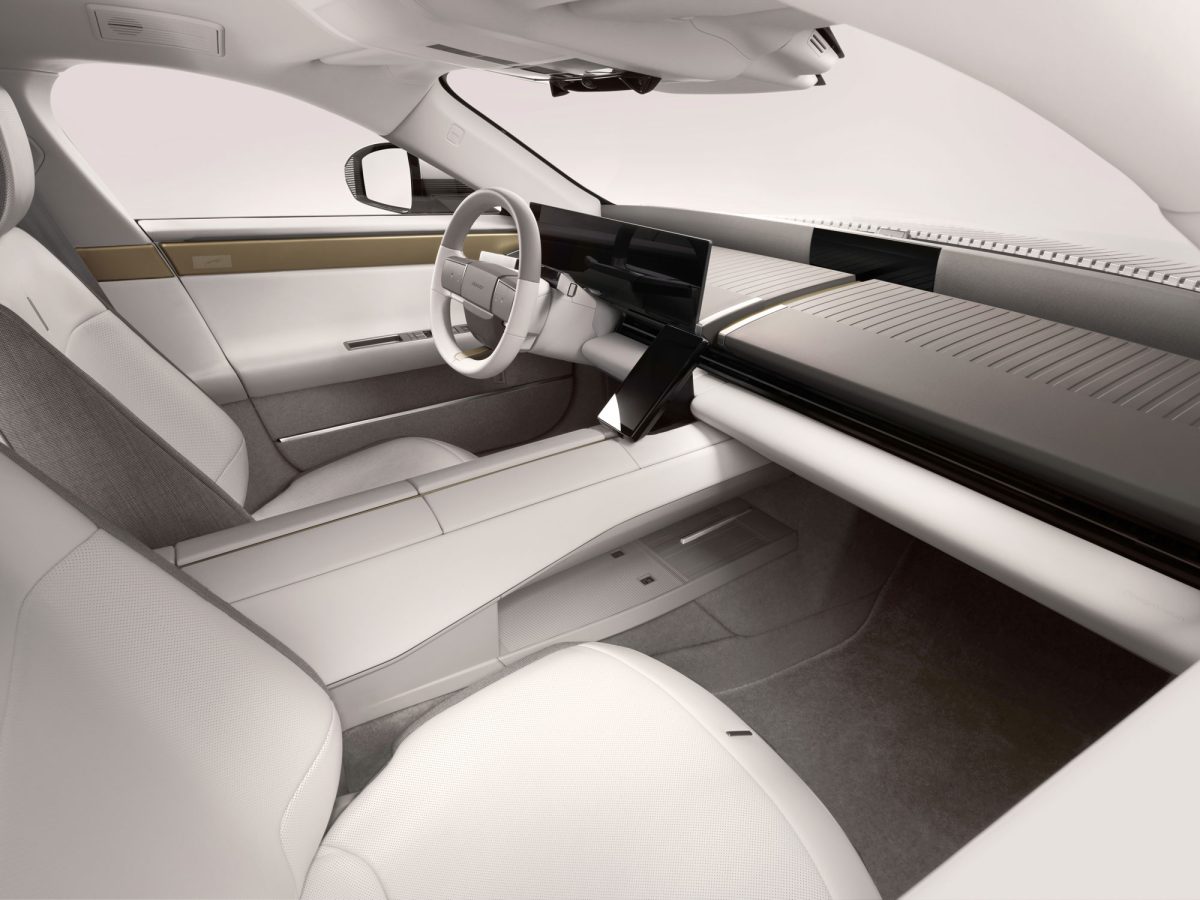
The Type 00 concept used real brass for a 3.2-meter spine and hand-finished ingots carrying the leaper. Brass is heavy and dense, Mary says, and her team spent four years finding a version production could use. It became anodized aluminum with a fine embossed texture in a brass color, along the spine, the tops of the doors, and the steering wheel. It won’t patina, and Mary doesn’t pretend otherwise. Materials that age the way brass and leather do are “something we haven’t quite achieved in Type 01,” she says. “There’s still lacquers on the material.” She calls it “an absolute aspiration,” and bespoke commissions may be where it happens first. I would take that answer over a brochure line any day.
There is no stone in the car either. The concept used travertine, and the production car takes only its colors from it. Stone veneers may come later through bespoke, once the team works out the weight. On the lightest interior, the backs of the headrests carry the JR monogram from the wheels, redrawn in-house by one of the designers with a strikethrough running through it and stitched by an embroidery technician who works in the studio. The goal, Mary says, was for it to look like an artist’s brushstroke. It is only loosely legible, which is the point.
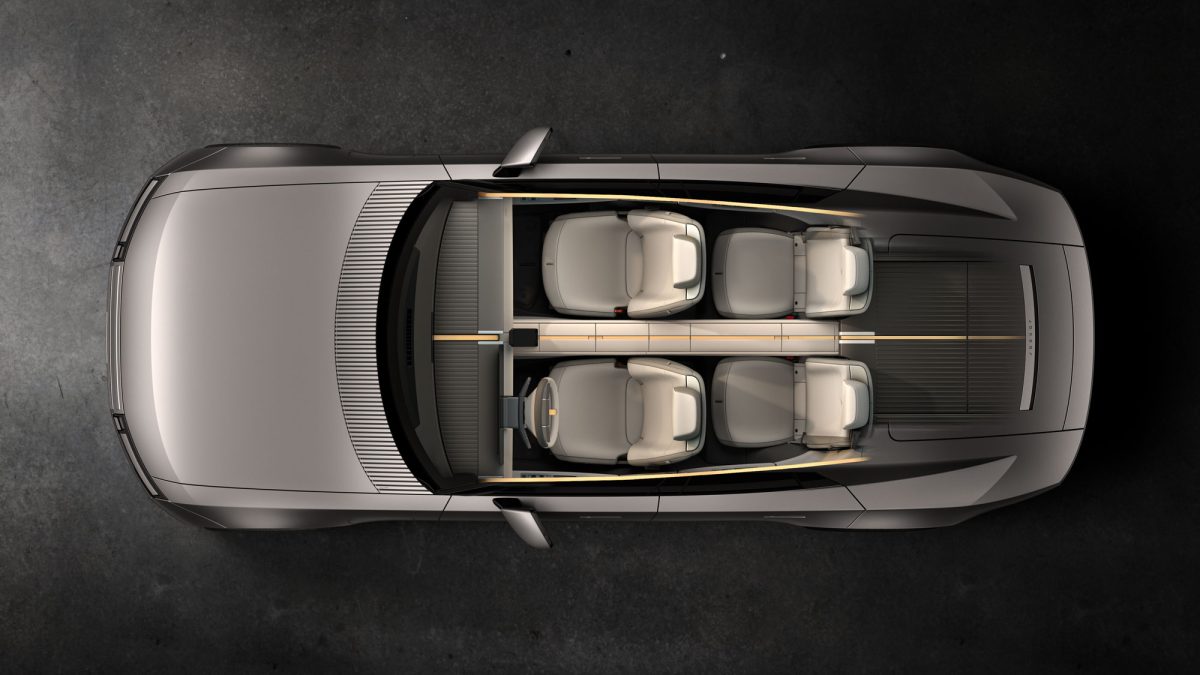
Jaguar’s engineers began development by driving old Jaguars, the E-type, XJS, and XJ among them. The designers, Alexey says, referenced no single car, only “the spirit of those classic Jaguars as a whole.” When the E-type first came out, he points out, “no one had seen a car like that before.” The last thing the team wanted was for the silk to come off and remind anyone too much of one particular Jaguar. The inheritance shows in the proportions more than the details. What Jaguar has made is a grand tourer with more than 1,000 horsepower and an experimental streak. Orders open in early 2027, with prices projected to start at $130,500.
Asked what the internet will go after first, Alexey talks about the street instead. “I’m waiting for when someone sees the car drive past them on the motorway or on the street in person,” he says. Mary expects the usual critics, but, she says, “they’re not going to be the people that have seen it.” There is no way to see it in person and not want to drive it. I came for the design story and left wanting the keys.