At 20, Frederik Molenschot had only seen Breda, the city in the south of the Netherlands he comes from, and Belgium on holidays. Then a Siemens design program sent him to Shanghai and the cities around it for six weeks. A flyover there meant 10 highways instead of two, and the average cab ride felt like a roller coaster. He was amazed. He mapped the interchanges on long walks, and three years later he cast the map in bronze.
That maquette became City Light, the cast bronze light sculptures Frederik has made with Carpenters Workshop Gallery since. Frederik studied public space at Design Academy Eindhoven and calls himself a landscape sculptor. Atlas 2000, his first solo show, opened at the gallery’s Paris space in 2023.
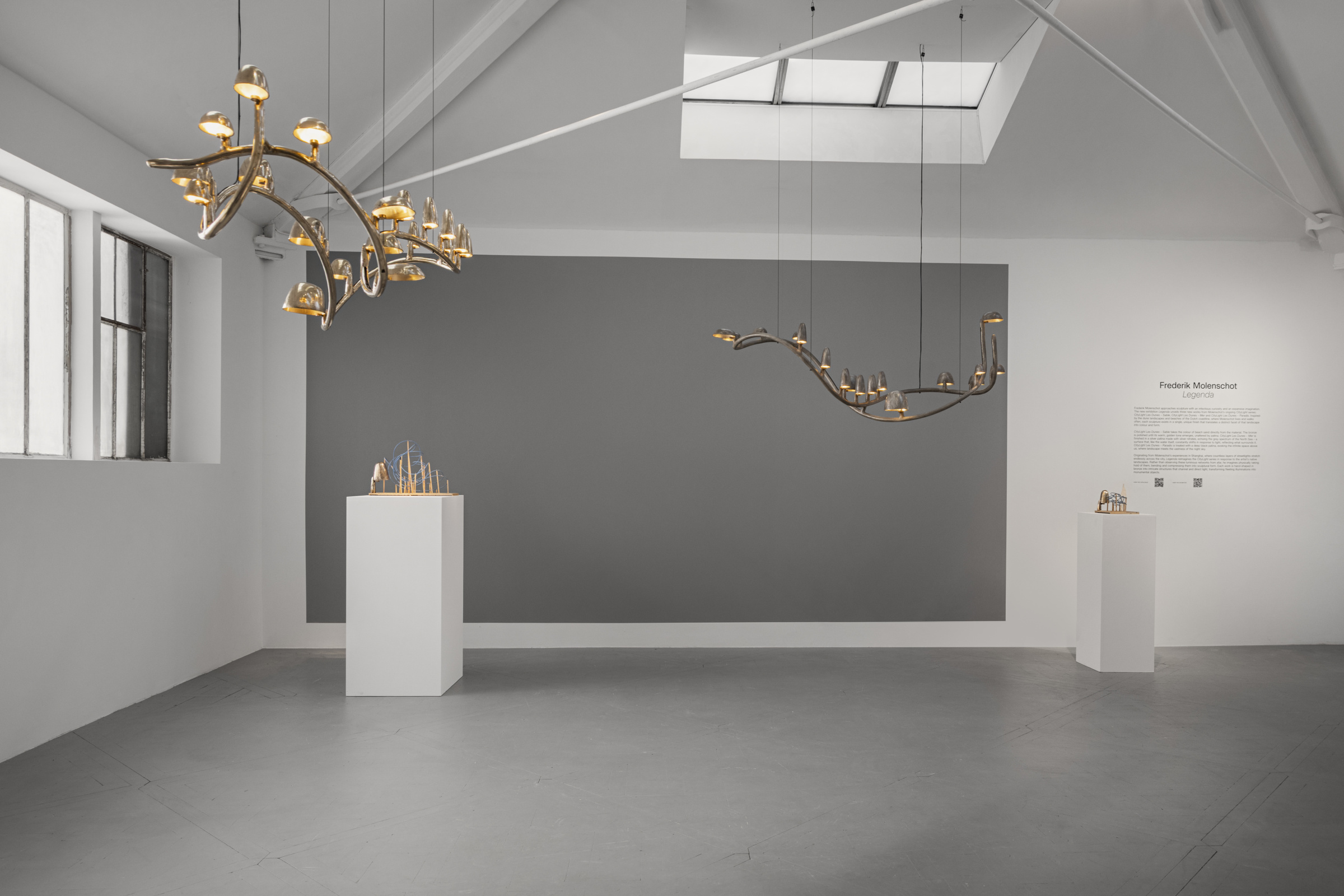
I met him there, in the Marais, on the day his new exhibit Legenda opened. The show adds three works to the City Light series: CL Sable, CL Mer, and CL Paradis. They are drawn from the dunes and beaches of the Dutch coast where he lives and walks.
Once we managed to find a quiet corner of the gallery, we talked about what Shanghai taught him, how a maquette gets made, why he designs for architects on spec, and what raising five-year-old twins has done to his calendar.
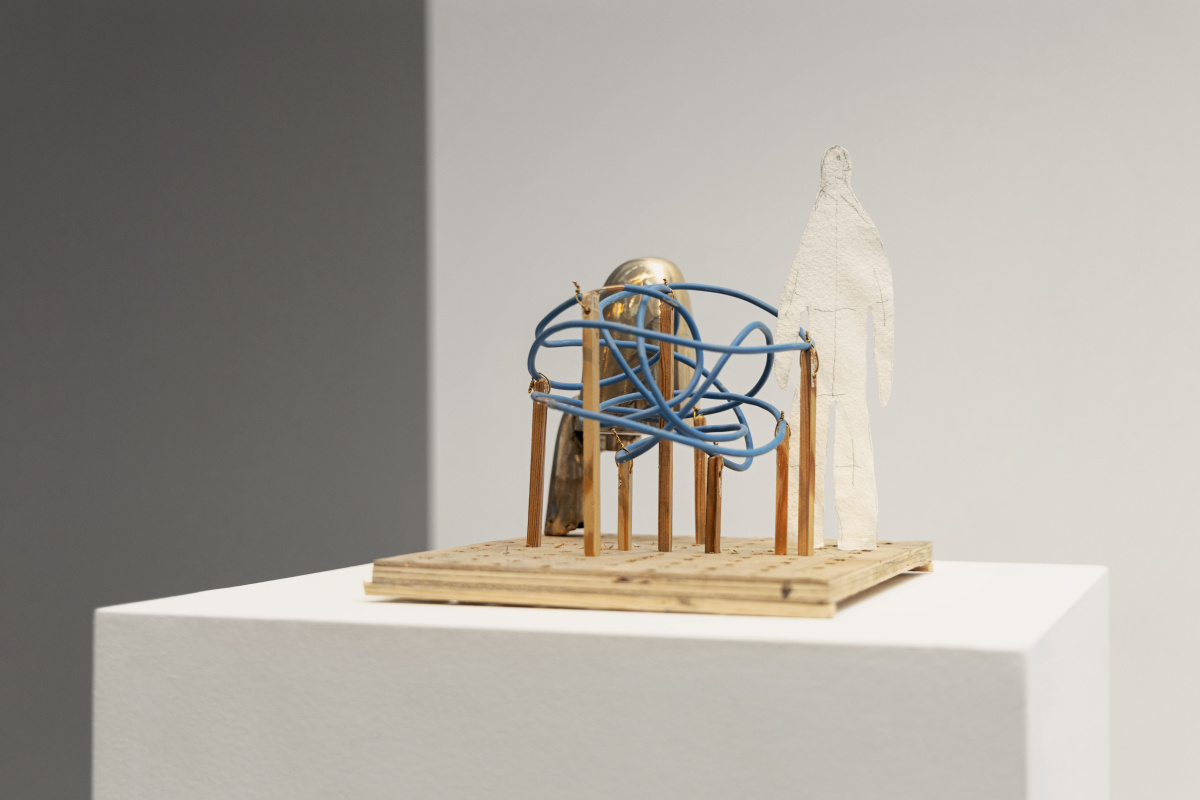
Blue wire carries the line composition from Frederik’s drawings into three dimensions, and a small cut-out figure sets the scale.
Chris Force: How did you get into the Polaroid camera?
Frederik Molenschot: There was an exchange program with Siemens Mobile in Munich. There I met a guy who became my tutor during the whole period. In his home there was a big collection of Polaroid cameras. He influenced me to start using the Polaroid. Back then I used these peel-offs, a very crappy plastic old thing. But with those peel-off Polaroids you could take several pictures on the same film. So you could overlay two buildings or two faces.
Is that exchange program also how you got connected to Shanghai?
Yes. The program in Munich was my internship, basically, from Design Academy Eindhoven, where I was studying public space research. I’m actually a public space researcher. I’m not a typical designer in that sense. Siemens hired me to do a program on finding out a connection between architecture and mobile phones. For a long time they were also a player within the mobile phone market, and they had this design lab program, which felt a bit like MTV’s “The Real World.”
Siemens invited like 10 people from random countries: China, Israel, the US, and put them all in one big group. It was a super cool time. It was a life-changing moment in my life to be invited to this group.
Then we were sent to Shanghai to do a program there, so we did around six weeks of traveling to Shanghai and all the surrounding cities. We did a student program, we did lectures. As a public space researcher from the academy I was always taught to make registrations of cities.
What I learned in those five years was really how to change my mindset. I learned to think in the abstract. I don’t just see a bottle, for example. I see if it’s recyclable, if it can contain water, air, if it’s touched by six people, or what brand it is. You can extract a lot of data from random objects.
It’s the same with public space research. We did cemetery research in Europe, day and night. We did interviews with people living around the cemeteries. In these five years of school it was always about finding a narrative within the public space, how people behave with each other and how they connect to the public space at differnt moments. From this you collect data, and from there on you can even extract a shape, or objects, or maquettes, or a book, or a photo shoot.
When we went to Shanghai, I did what I was taught in school to do. On these long strolls in Shanghai I created a map of certain connection points of highways. I was 20 years old. I come from Breda, a super small city in the south of Holland. My holidays were only into Belgium, so I didn’t see shit of the world, and then all of a sudden I was dropped in Shanghai. Crazy. It was like seeing a flyover, two highways, but there you had like 10 on top of each other. And if you take a cab, it’s like a roller coaster. Three years later I made a maquette of it in bronze. It was never intended to be a large sculpture. It was a maquette of this research of Shanghai city.
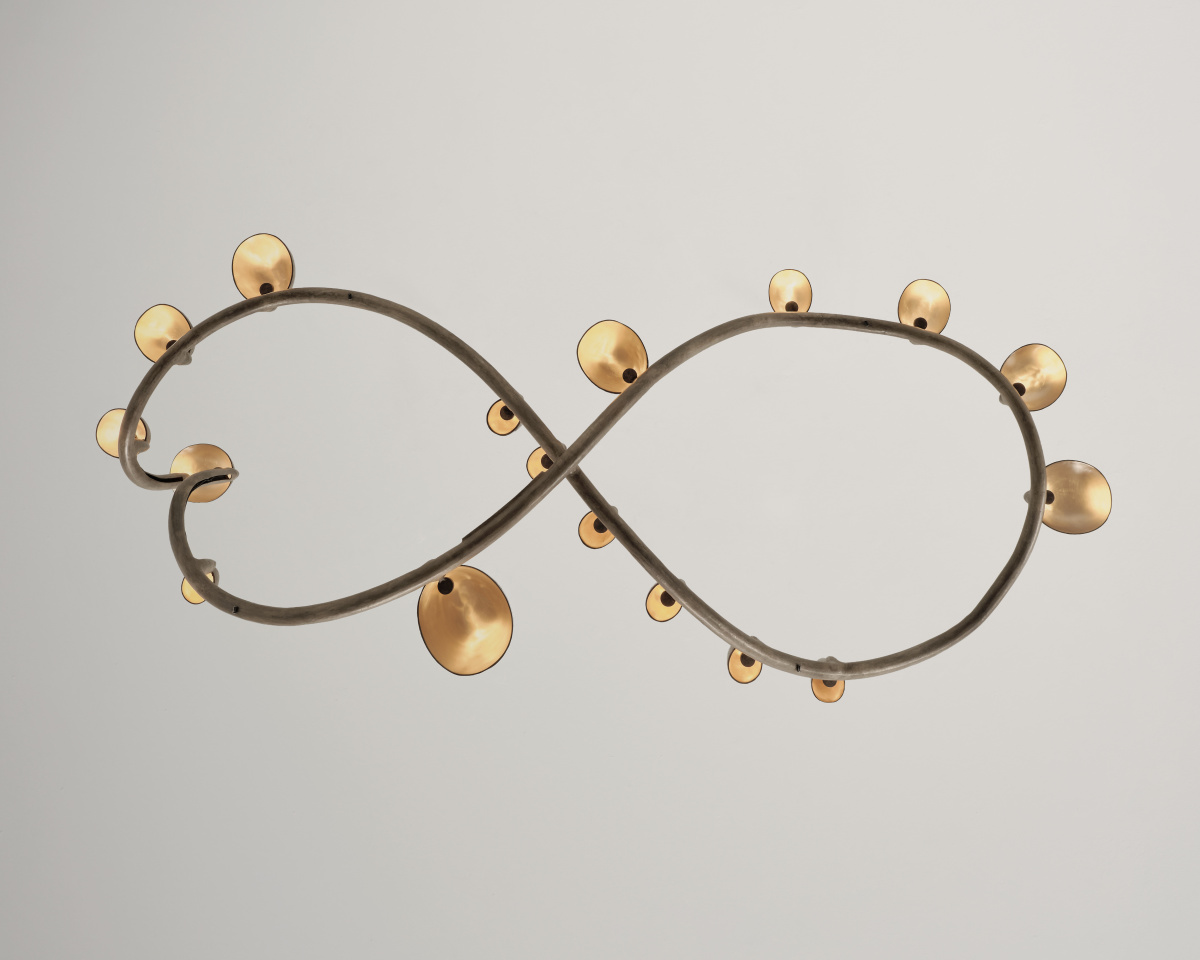
A single bronze loop through gold-lined cups that are Frederik’s abstraction of the city light pole. No two cups along the loop are the same size, and the piece is cast in sections at the foundry, reassembled, and wired for light back in his studio.
Were you making maquettes in school? Was that part of the training?
Yeah. One I made was of the train station in Eindhoven, where the school was based. I marked the whole train station in square meters, rectangles, and I did research on the movement of that specific pavement when a train passes by. So you get all this data from all these squares. So my maquettes were not really like an architect’s. It was different.
Years after, I met Carpenters and they saw a light sculpture in the Shanghai maquette, and from there on we started to create this form language.
So Carpenters had the idea of turning it into a hanging light? How did those two dots get connected?
It evolved. I presented this piece in Milan in, I think, ’09. From there on we started to talk, and then we made a first big installation in this gallery. Afterward we started to do editions, and it started growing.
Were you still working in public space research?
I still do it today. For instance, we just did a big statue in Miyakojima, in Japan, which is about bridge structures. It derives from other research.
In 2023 we did a show here called Atlas 2000, because it was the year 2000 that I started at the academy. The whole show was about showing every progress, every design. Everything I do, I try to relate it to us. The moment you can sit in something, or have something in your own space at home, you start having a relationship with it. So I think creating design has a stronger affinity with us as humans than if it’s only a sculpture. You either like it or you don’t like it. But the moment you can use it, you start a whole different relation with the object. That’s what I think is interesting between the border of design and when something becomes art. This whole discussion is, of course, interesting. People like to frame everyone.
You cannot express your creative time into money. It’s impossible.
Do you think you would have ended up here if you hadn’t gone to design school?
That’s a good question. Growing up, I had no clue about the world. Even in high school I was dreaming, and they kicked me out five times. Then I went to the art academy where I really, really felt good. I felt it was the right habitat for me. But still, I had no urge to commercialize myself. It’s a whole different life to make art, or to use your camera to just make a picture. It’s a recreative moment. But if you start doing this as research, or when it becomes a material for you to make an object, it gets a whole different layer. And then if you need to go into production, it’s another step.
How many people do you have working in your studio?
At the moment there are six people. I have people who do the maquettes. We get a lot of requests from architects. A lot of them email us, and with some of them we go into the design process. I get the drawings, I start to set out the compositions of lines on the drawings, and from there we go to the maquettes. Then we send these maquettes to clients, and they say yes or no.
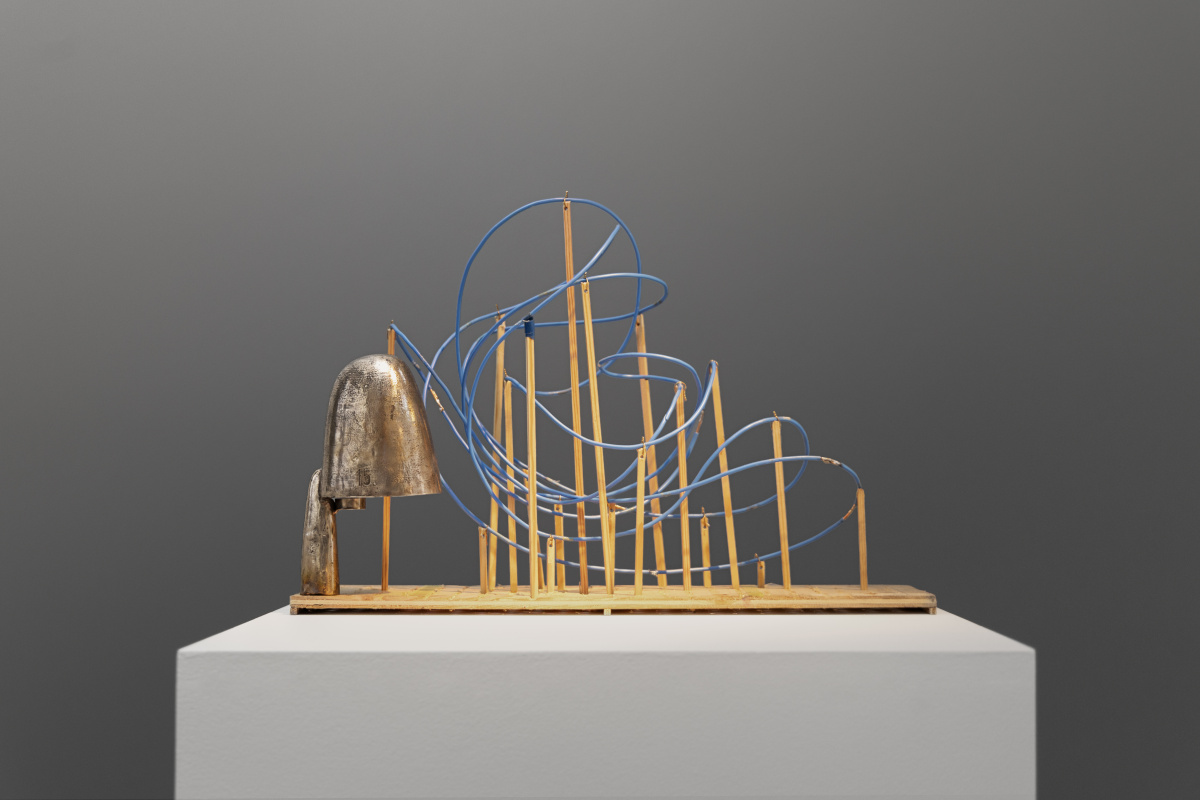
Blue wire swoops over wooden posts the way Shanghai’s flyovers stacked highways in the air, with two bronze bells standing in for the lights. To cast a composition like this, the studio rebuilds it full size as a wooden skeleton, bends aluminum tubes by hand along the lines, and wraps them in wax for the foundry.
If an architect calls and wants a sculpture for a lobby, you make all these intricate ideas and drawings for them, and then they might just say “no thanks”?
Yep.
That’s wild. It’s so much work and you just never know.
Yeah, but I started like this also because it’s a way of surviving in the beginning. You cannot translate your creative time into money. It’s impossible. But if I produce something, I can say, “OK, it’s been so many hours and this much material.” But beforehand you never know exactly how much time things take. So to avoid a block, just to keep the conversation going, I’d rather do the design and meet someone in real life and connect. It’s not only about the pieces, it’s also about the trust. You need to educate people on what they’re buying from you. It takes a bit of education to really get them into your world. And by giving something to them, you also get something back. For me it’s a way to start a relationship. I don’t mind to design 100 things or 1,000 things. At the end of the year I just need to eat and pay my people, and if I can do that, it’s fine.
What takes up most of your days now?
Kids at the moment. They are five. I have twins, a boy and a girl.
I think having kids also changes my work. You make different decisions on where you put time in. If you don’t have kids, you just fly around way more. As a creative I always like to have a deadline. Like your deadline for your magazine. If you work toward the date, this shit needs to be good. So when you have kids it becomes a deadline every day, right? Because you only have two or three hours where you get to concentrate.
Legenda is on view at Carpenters Workshop Gallery, 54 rue de la Verrerie, Paris, through March 15, 2027.
carpentersworkshopgallery.com, studiomolen.nl