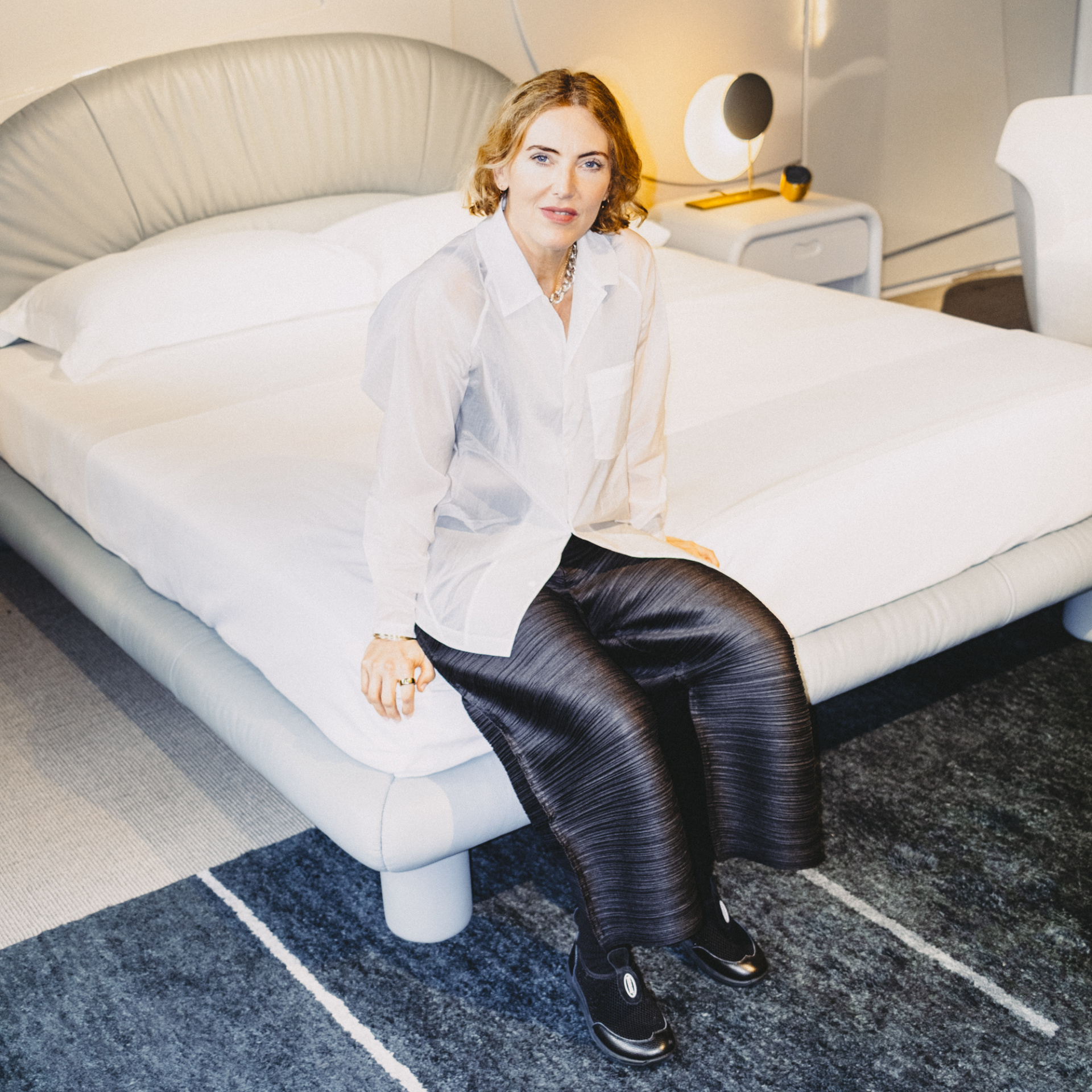
Faye Toogood is in the Poltrona Frau showroom during Salone, and she has already lost the argument she most wanted to win this week. Her new bed debut, the very first time she’s seeing it completed in person, should be in the middle of the room. Not against a wall. “If I had been allowed to do the space, this would be right in the middle. No one can see it,” she says. “I asked them this morning, and they’ve called a few people, and maybe that might happen tomorrow. This is a piece of furniture and they’ve upholstered the whole thing with beautiful leather.” The back is rounded and cushioned like the back of a sofa. The legs are cylindrical aluminum, upholstered in Pelle Frau Nest Impact Less leather in the Cemento colorway. She calls it LieLow. “I wanted that feeling like you’re floating on water or a cloud.” Despite its more traditional staging, and that it is 10am, the urge to climb into it was strong.
Poltrona Frau is the kind of brand whose name an American buyer might assume is German (maybe it means “chair wife?”). It was founded in Turin in 1912 by a Sardinian named Renzo Frau, moved to Tolentino in the Marche region in the early 1960s, and has spent the last century quietly producing some of the most exquisitely crafted leather furniture in the world. Their factory in Tolentino contains an in-house museum, designed by Michele De Lucchi for the centenary in 2012. The archive is not marketing décor, it is a working library.
Like a lot of Italian publishers, Poltrona Frau’s historical core has been built on Italian craftsmanship: Renzo Frau himself, Gio Ponti’s Dezza, Pierluigi Cerri’s Compasso d’Oro–winning Titano. The contemporary catalog has grown more international over time. Jean-Marie Massaud’s Archibald armchair has been a staple since 2009, and the current roster also includes GamFratesi, Sebastien Herkner, and Neri&Hu. Most of those collaborations have stayed within the brand’s classical, restrained register. What has been quietly happening over the last few years is more interesting: a pattern of pairings that step outside it entirely. Last year they launched a project with Six N. Five, the digital studio with no traditional furniture pedigree, and they extended that collection this year. None of this has fully landed yet in the United States, where the brand still presents with a traditional frilly logo, a name that doesn’t quite signal where it sits, and almost none of the cultural placement that could telegraph its modern, timeless aesthetic to a buyer at, say, The Future Perfect. So choosing Faye Toogood for a serious furniture collaboration was, in my opinion, rather brilliant.
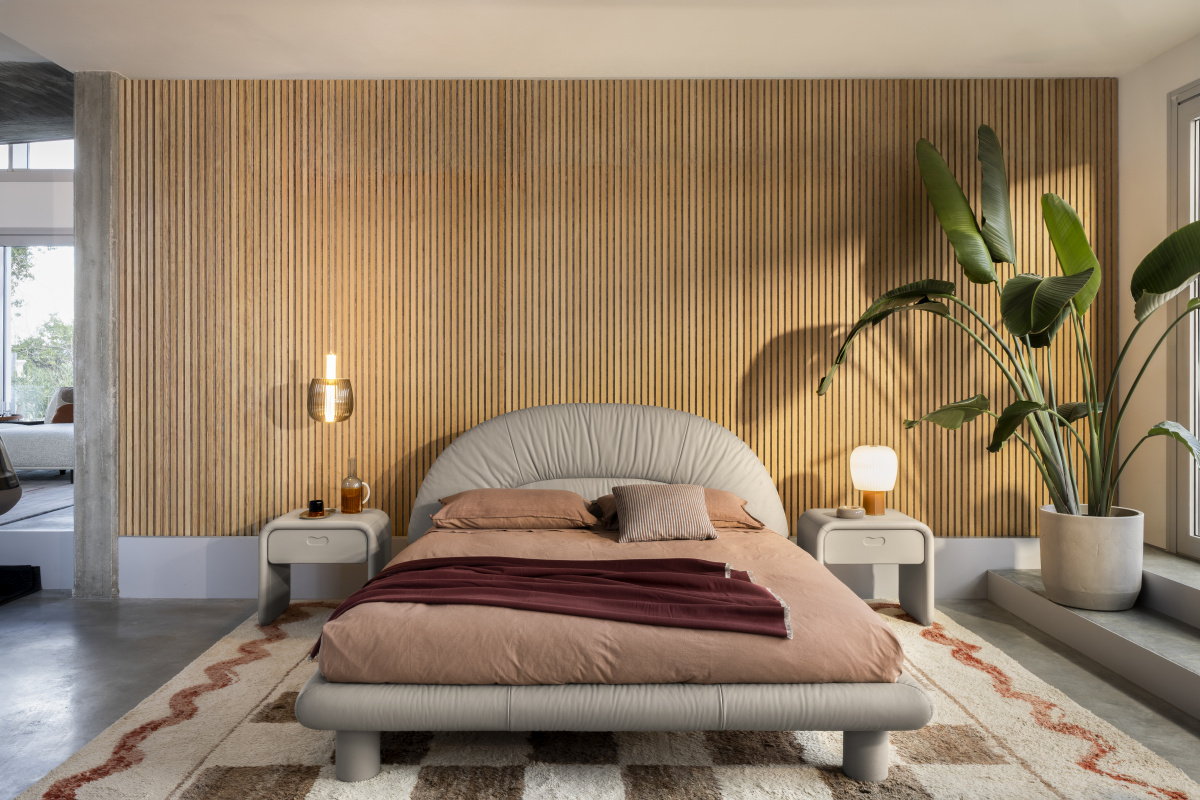
The LieLow bed for Poltrona Frau. The leather is not stretched with geometric precision but left free to crease and gather, a deliberate choice that translates softness into material form. Image courtesy Poltrona Frau
She is one of the most legible designers in furniture right now, partly because of how loudly her bold, playful shapes read across a room, and partly because of the sheer momentum of her ongoing collaboration with Tacchini. The Butter sofa she launched with Tacchini last year, she tells me, is already their second-best-selling sofa. That is from one year of work. Tacchini, she explains, “is essentially like working in a family. They challenge me and they push me to give them more, and vice versa.” Poltrona Frau is the opposite kind of working relationship. “They have set dimensions, set engineering, set proportions,” she says. “It’s that challenge of, I know that you normally have everything at this seat height, but can we try this seat height?” The Squash chair they launched together two years ago took roughly that long for the company’s salespeople and customers to absorb. “It is taking time for the people that sell, for their customers, everyone to get their head around this new geometry.”
The last time I sat across from Faye, she was being celebrated as Maison&Objet’s Designer of the Year at the British Embassy in Paris. Her acceptance speech, in retrospect, was telling. She talked about the future of design, about working with emerging designers, about youth and children and play. At the time I read it as gracious. Sitting with her now, a little over a year later in Milan, it lands differently. Earlier this year she announced she was closing her fashion line, the brand she had run with her sister across roughly 25 collections.
“I was not happy,” she says, with the directness of someone who has already made the decision and now mostly feels relieved to have done it. “I am a super-multitask type person, fully functioning ADHD, essentially. I love working on lots of things, but the danger is that I just became the person running a business. I stopped being an artist.” She has gone from 40 people on staff down to 7. “My revenue now is really a third of what it was. But I want to be happy.” She is 50. “I felt like I’ve given quite a lot of energy, now I need to put it in the right places.”
This is the version of Faye standing next to the LieLow bed. The version that closed a successful fashion line because it had become “a monster and a beast” and she was “starting to see things that I didn’t recognize and didn’t like.” The version talking about jewelry, lighting, a playground project, and figurative sculpture as the next things she wants to make. “Without play we lose innovation,” she says. “If we really unpack it, that’s actually right at the base level of any design, art, creativity, anything. The ability to play.”
That mood was all over the bed.
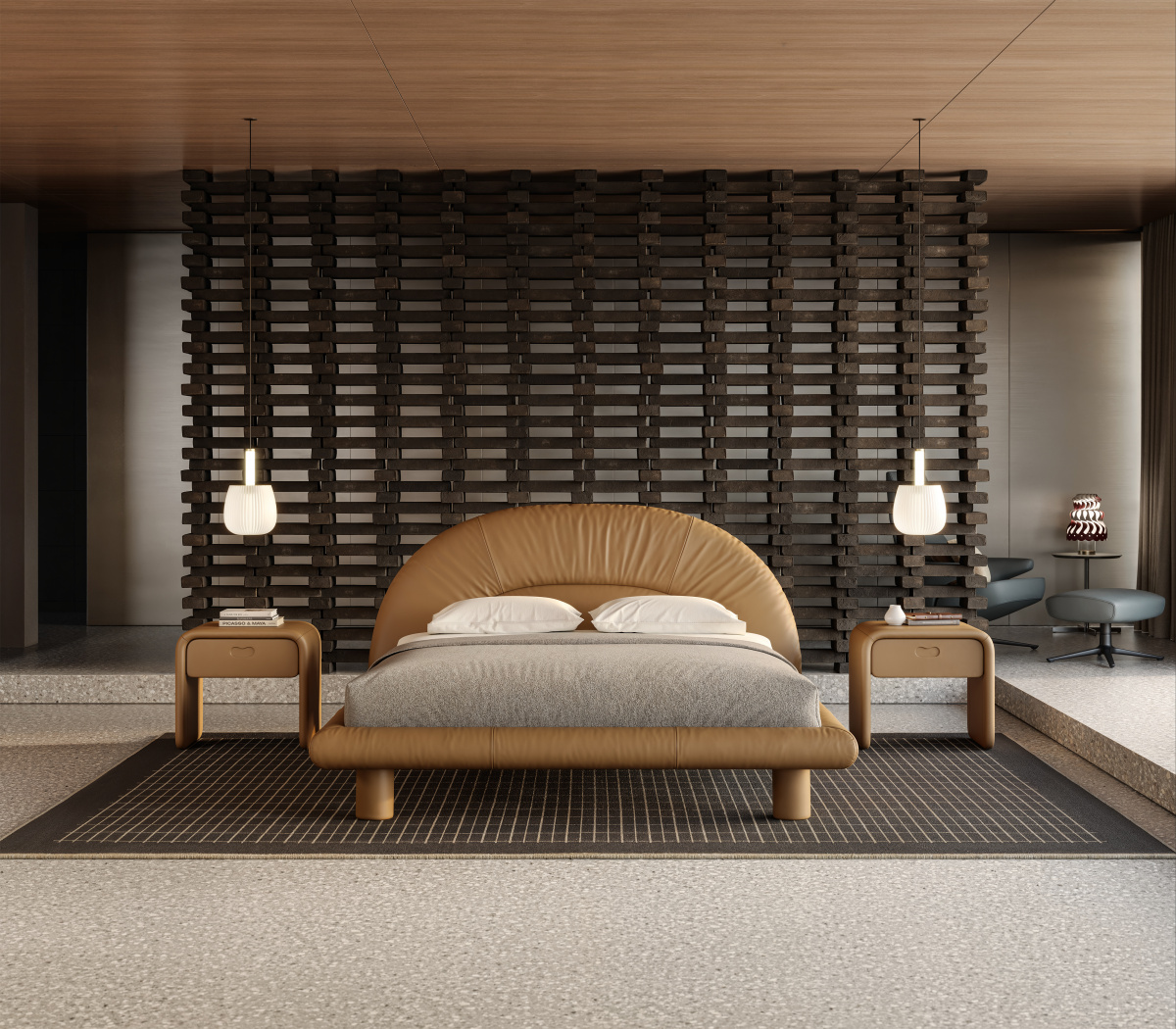
The LieLow bed and nightstands by Faye Toogood for Poltrona Frau. The bed’s curves echo Renzo Frau’s own Vanity Fair armchair, and the wide headboard nods to Tito Agnoli’s Rondò, both pulled from the brand’s archive in Tolentino. Image courtesy Poltrona Frau
She started, she tells me, in the Poltrona Frau archive, the museum at the factory in Tolentino. “It’s unbelievable. I loved all of their early graphics, all of their original logos and catalogs. They had a lot of energy. They were really out there. That 60s and 70s time, the classic heyday of Italian design.” That was the unlock. “I grew up with Poltrona Frau when I was at World of Interiors. I sort of knew that side of it, but actually re-establishing the attitude and the gesture, there was something there that made me go, okay, if we can go in this direction, then I feel like we can work together.” She presented Poltrona Frau with three chairs. They picked one. That one became Squash. The brand’s own materials note that the LieLow bed echoes the curves of Frau’s own Vanity Fair armchair, and that the wide headboard nods to the Rondò bed by Tito Agnoli. Both of those references come out of the archive she went into.
The bed is what comes next. Poltrona Frau, Faye tells me, sells three major things: chairs, sofas, beds. “They are the bread and butter.” The trajectory most external designers might expect would be chair, then sofa, then bed. Poltrona Frau skipped the sofa. They asked her to extend the Squash language into the heaviest, most architectural piece in the home, and a series of nightstands to go with it. She delivered three prototypes in order to land the proportions of the bed. “If you take the head up too high, then it’s overdominating. I wanted something that felt like a piece of furniture more than a base with a headboard.” The whole back is upholstered in leather like the back of a sofa, which is why she keeps insisting it should sit in the middle of a room with the sheets flung loose. “Like someone has just got out of bed,” she says. “That’s actually really beautiful, right?” The nightstands come in two versions, a push-pull drawer or an open shelf, and their tops echo the curve of the headboard. They are upholstered to match the bed. The leather Poltrona Frau is calling Heritage Impact Less, a new wax-finished, vegetable-dye-looking hide she had told me earlier she was hoping they would also put on the Squash chair, is one of three options for LieLow. It is on the bed in front of us.
When a brand asks a designer back for the chair, then the bed, then the nightstands, and lets her dictate proportion against the company’s own golden triangle, that is not a collaboration. That is a brand acknowledging where its future is. The American market may take another minute to understand what Poltrona Frau is. The LieLow bed will help.