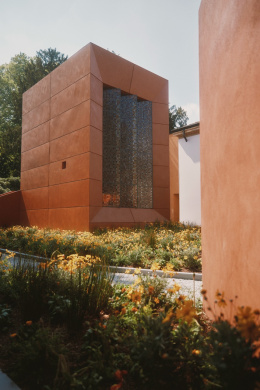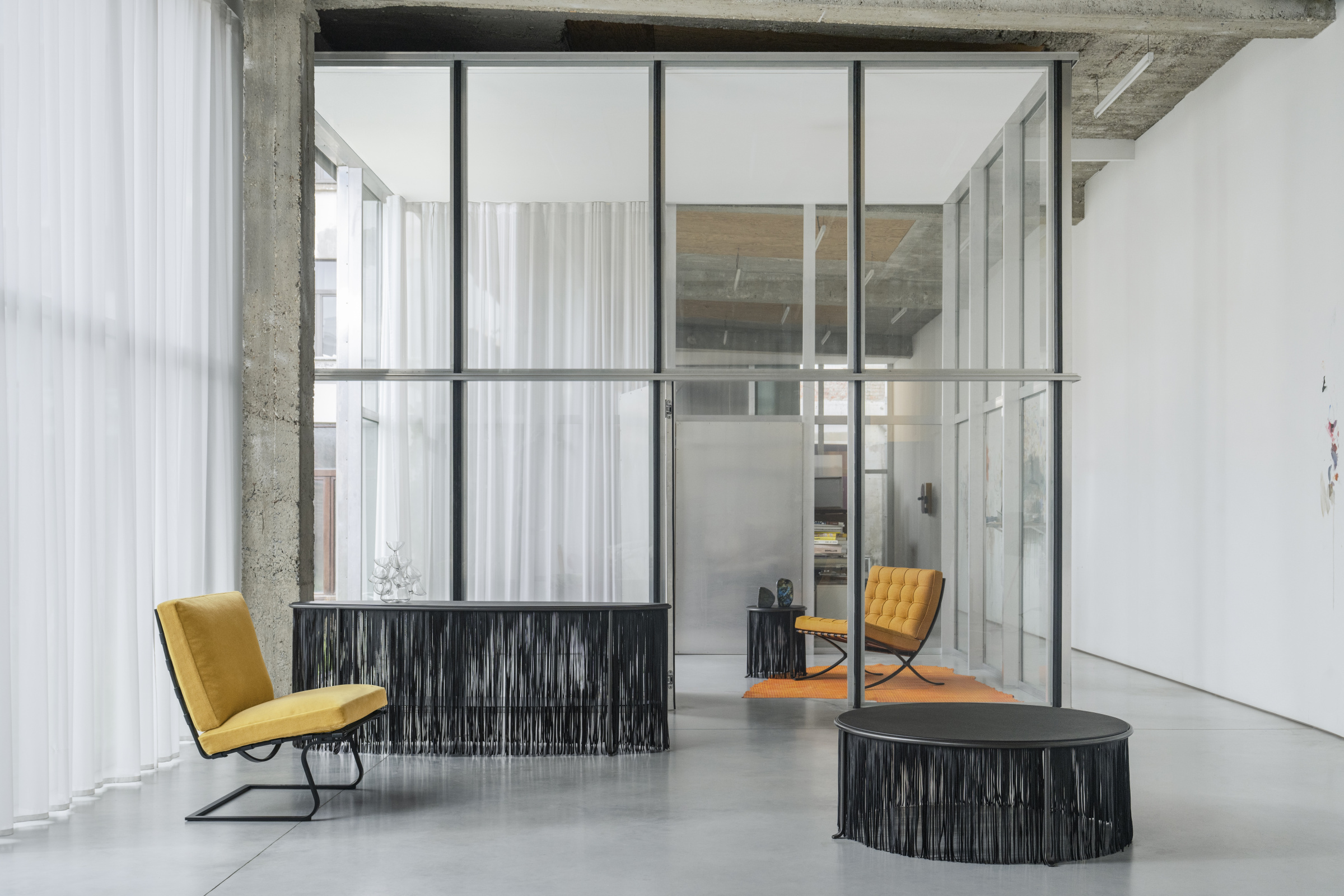
OFFICE, the Belgian practice led by Kersten Geers and David Van Severen, has built the Knoll pavilion at Salone del Mobile for the fourth year running, again out of repurposed and recyclable parts. Its steel frames capture the mid-century modern aesthetic the brand is renowned for, while giving visitors a consistent worry that they may or may not be about to walk through a window at any moment.
Inside it on opening day, Dozie Kanu walks the floor with a medium format film camera around his neck (he’s comfortable enough with the layout that, unlike me, he doesn’t subtly put his hand through each threshold first to ensure there’s no glass). His tables are the focal point of the presentation–a console, a coffee table, and a side table. Steel rods finished in either bronze or manganese metallic paint with taut leather tops.
The thing you notice first, before anything else, is the fringe. Long tassels hang off the edges and move every time someone walks past, flickering open and shut, giving fleeting peeks of the rod beneath, the floor, the next object over. They turn what is structurally a calm object into something performative.
“It’s not decoration,” Dozie says. “It’s a formal expression of exploration and desire.”
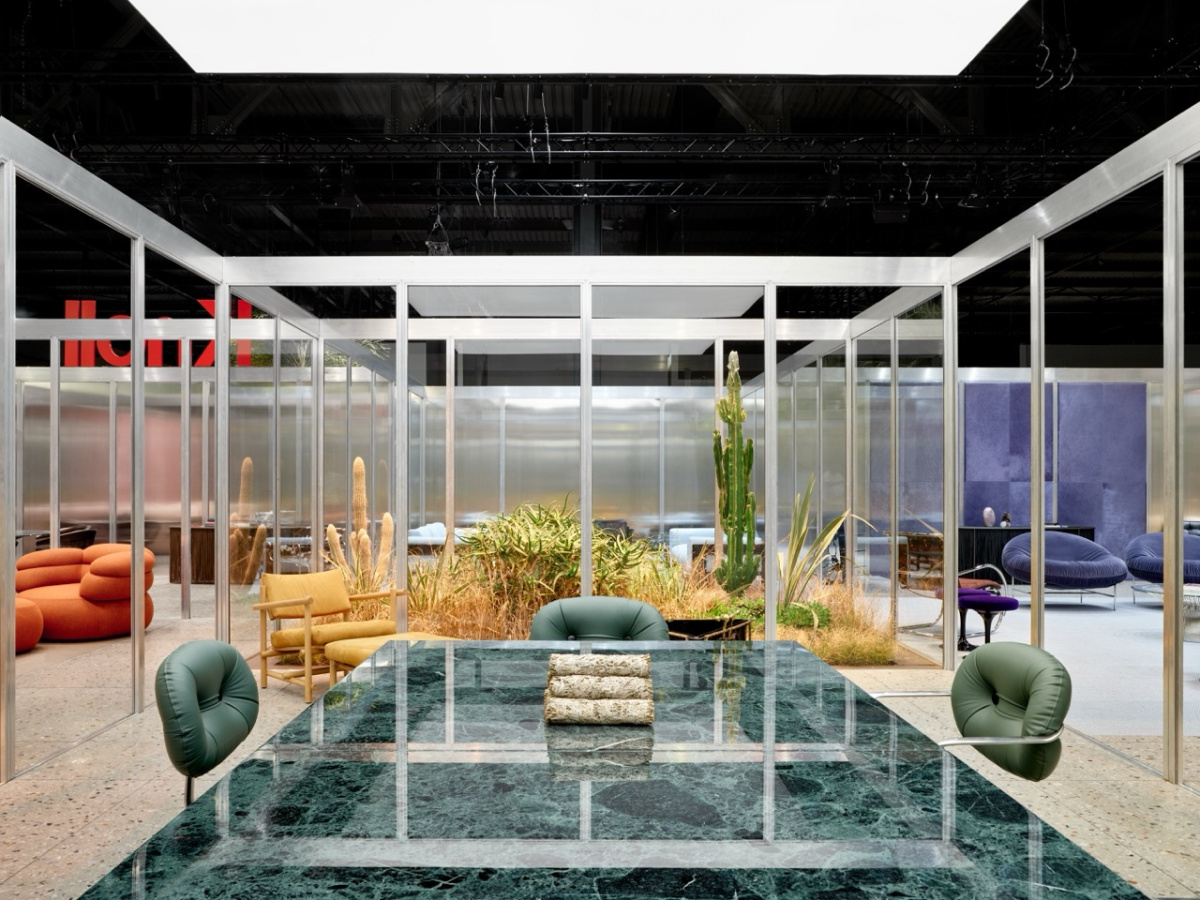
The Knoll pavilion at Salone del Mobile 2026, designed by OFFICE. Photo courtesy of Knoll
This is his first commercial collection. He has spent the better part of a decade deliberately positioning himself outside the exact world that is now hosting him.
Dozie was born in Houston in 1993 to Nigerian immigrant parents who wanted him to be a doctor or a lawyer. He went to the School of Visual Arts in New York instead, on a stubborn streak, to study production design for film. He thought he was going to do sets for Hollywood. After his parents stopped subsidizing him at 20, he landed a job in an interior design studio in Chelsea with the designer Carol Egan, walking into gallery shows on his lunch breaks. Then he started building chairs.
In 2017 he made a piece called Bench on 84’s. Concrete slab on industrial pipe, suspended above two chrome car rims pulled directly from Houston’s slab culture. It went into the Lever House show organized by Salon 94 and Maccarone, where it sat next to Gaetano Pesce and Vito Acconci. The New York Times called him a furniture designer and Dozie has been trying to shake that label ever since. Jonathan Olivares saw the bench, fell hard, and the two became friends.
In December 2018, Dozie visited Lagos for the first time. He was 25. The trip rerouted everything. He had been making work about Houston and African-American material culture, but he had not yet been to the place his parents kept telling him was home. By 2019 he had his first museum solo, Function, at Studio Museum in Harlem. He won the Hublot Design Prize. He moved to the countryside outside Lisbon, found an abandoned warehouse, and converted it into a live-work studio in Santarém. He kept making sculpture and refused to be called a designer.
Then Jonathan Olivares, who joined Knoll as SVP of Design in 2022 and is now creative director, picked up the phone.
-
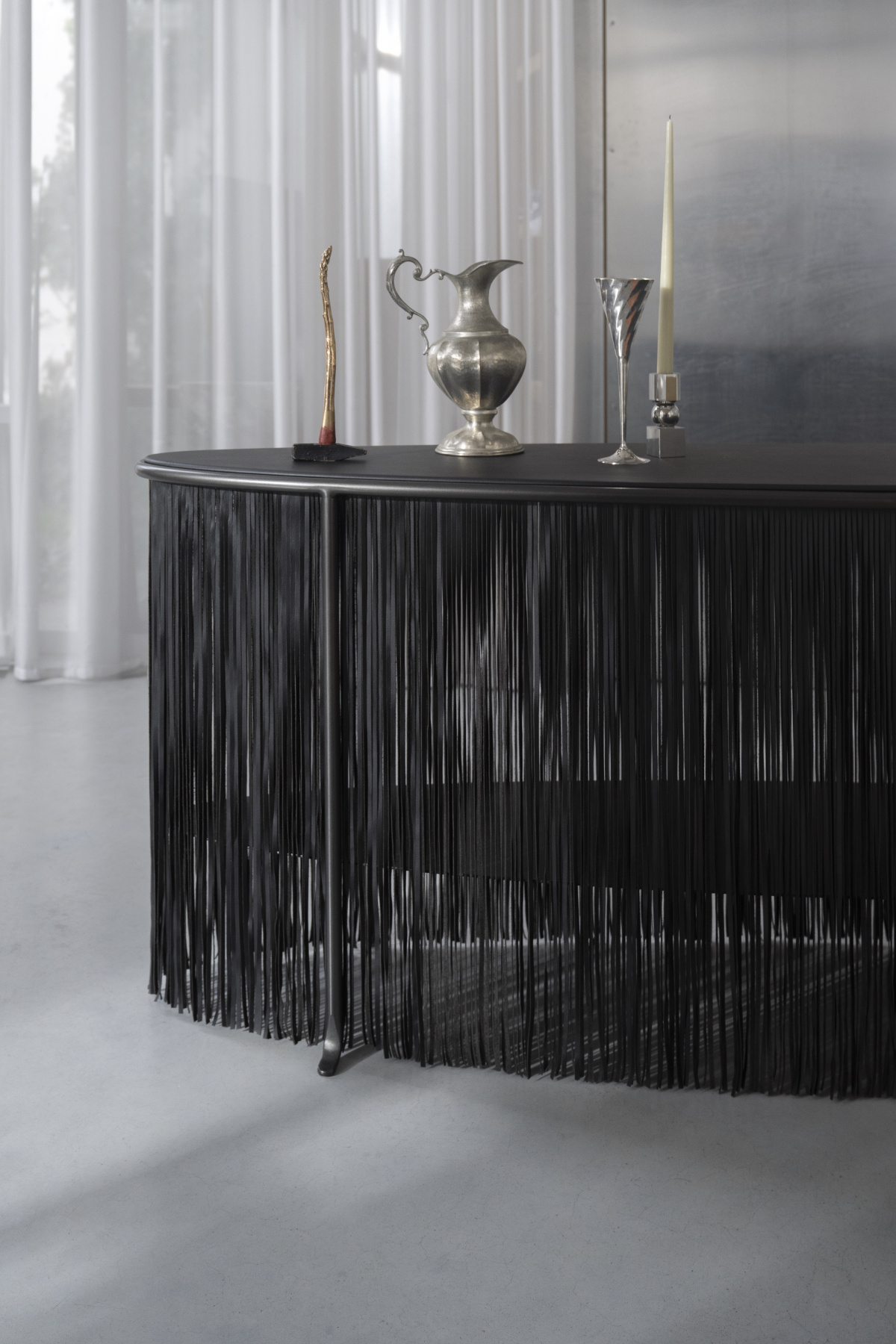
- The console in manganese metallic, showing the leather top and fringe at scale. Knoll’s tubular steel system replaced Kanu’s original choice of rebar, a substitution that brought the price point down without softening the silhouette.
-
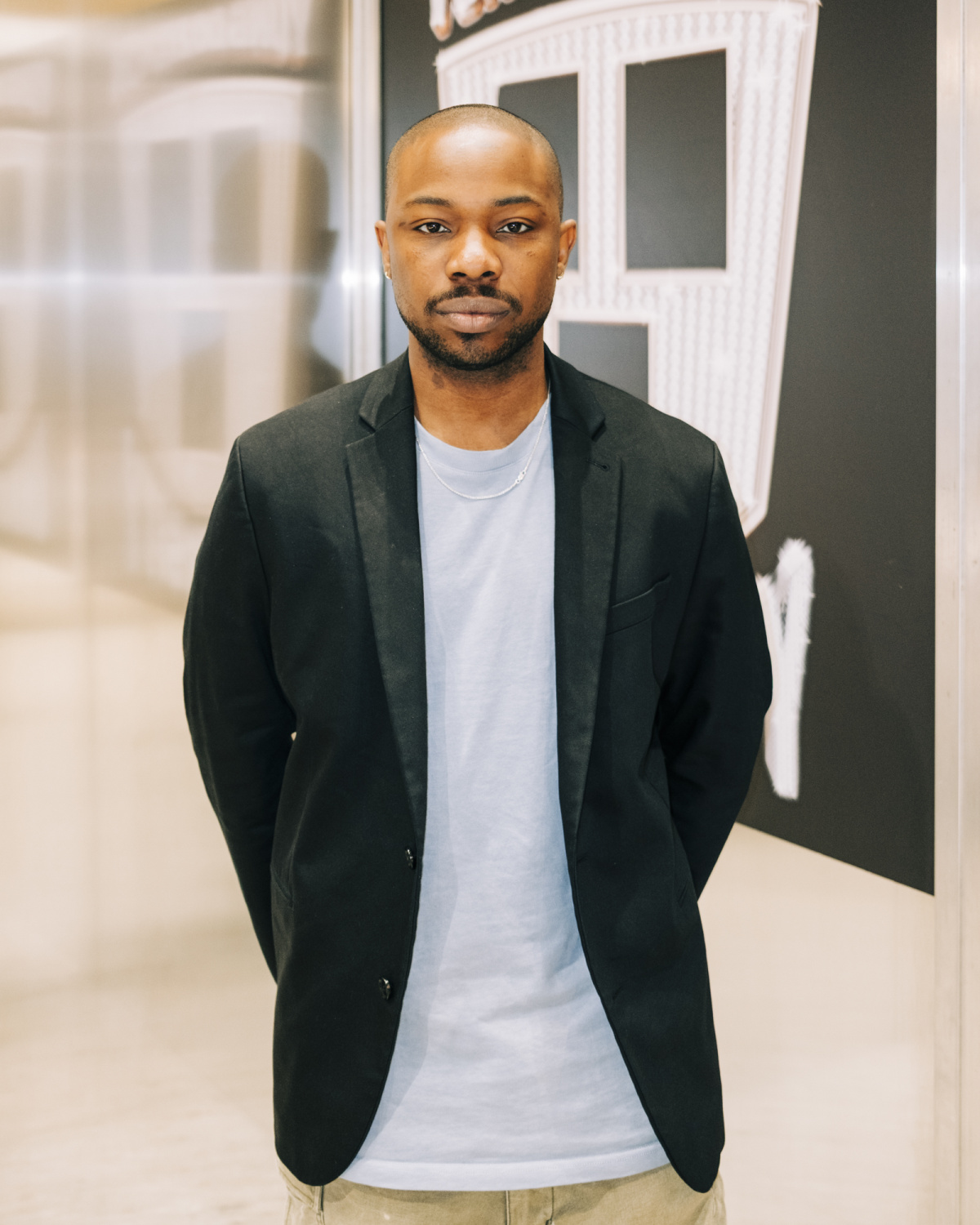
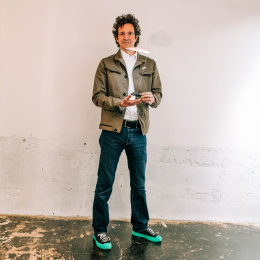
- Dozie Kanu at the Knoll Pavillion, Salone del Mobile 2026. Photo by Chris Force
“I met Jonathan Olivares in 2017. I trust that guy,” Dozie says. “He’s one of the guys that snuck into this corporate landscape. And when he asked me to do a collection, I trusted him.”
The collaboration almost didn’t happen. “I was ready to decline this collaboration, I thought I was selling out.” He pauses. “But you can’t ignore the importance of what Knoll has built, what they’ve done. I took a hard stance to be an artist. I live on the countryside of Lisbon, Portugal. I’m kind of isolated. I want to make the objects that I want to make.” He decided, with Jonathan’s help, this would be a project worth diving into.
Originally, Dozie wanted to build the tables out of rebar. Rebar is loaded for him. It alludes to structural breakage, to construction sites, to the unfinished. But, Knoll has its own deeply refined tubular steel system, developed over decades. Rebar would have run an extra $500 to $1,000 per piece. Jonathan walked him through the math.
“I wanted to fight that so much,” Dozie says. “But then I had to be like, ‘What’s gonna bring the price point down so that these things can go?’ I think the table still turned out beautiful anyways.”
Jonathan is coaching Dozie through every step of how to enter this world without surrendering to it. “He said, ‘You don’t have to say yes to every interview,'” Dozie tells me. “In the beginning, what he wanted to make clear was, let’s focus on the commercial success of this so you get to have more freedom on the next one.” Now Dozie is figuring out profit margins for the first time. He is deciding which fights are worth fighting. He is learning in real time how an artist operates inside a 1938 American furniture institution without his work going stiff.
-
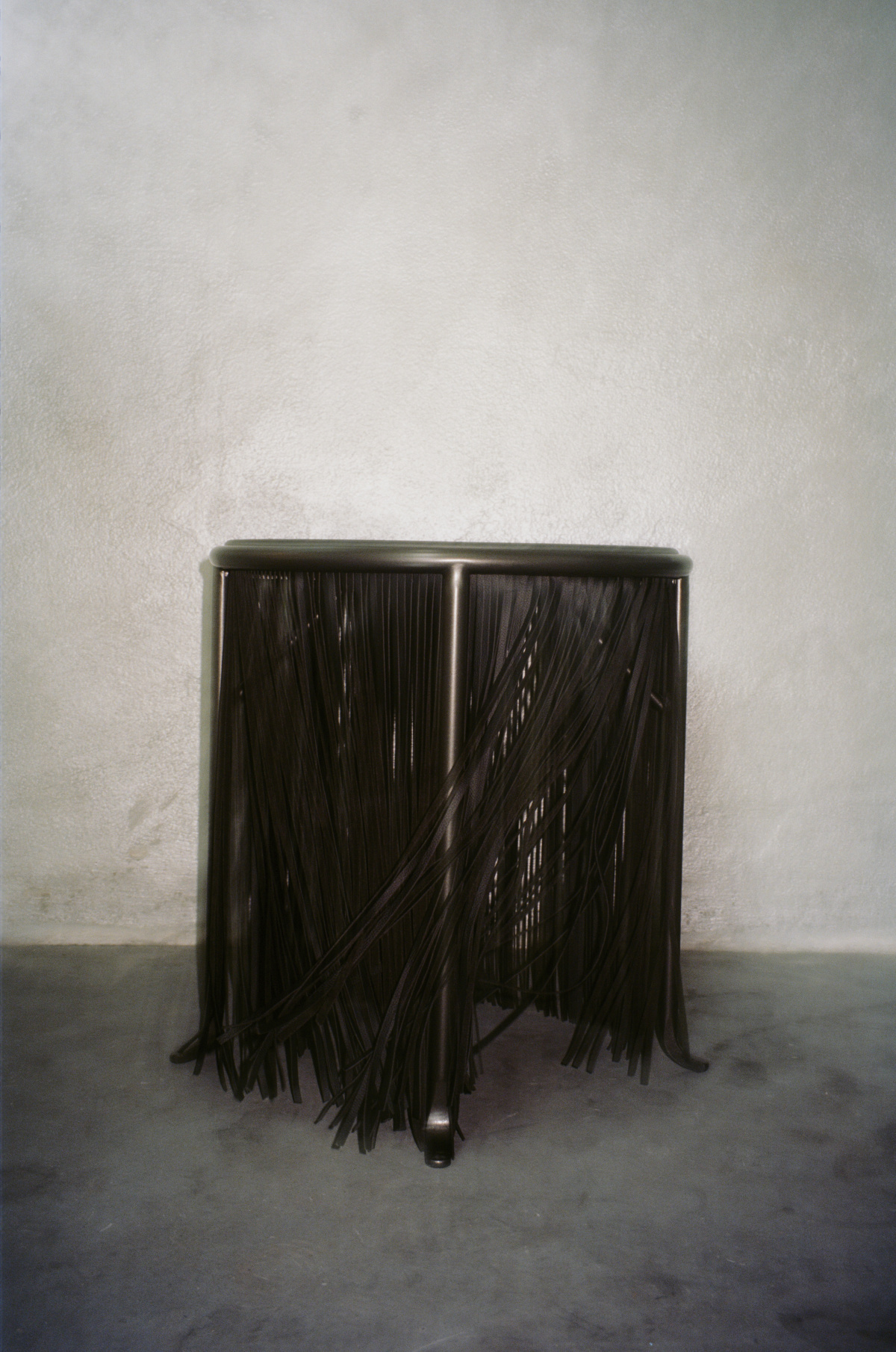
- Dozie Kanu Side Table for Knoll. Photo by Liz Johnson Artur
-
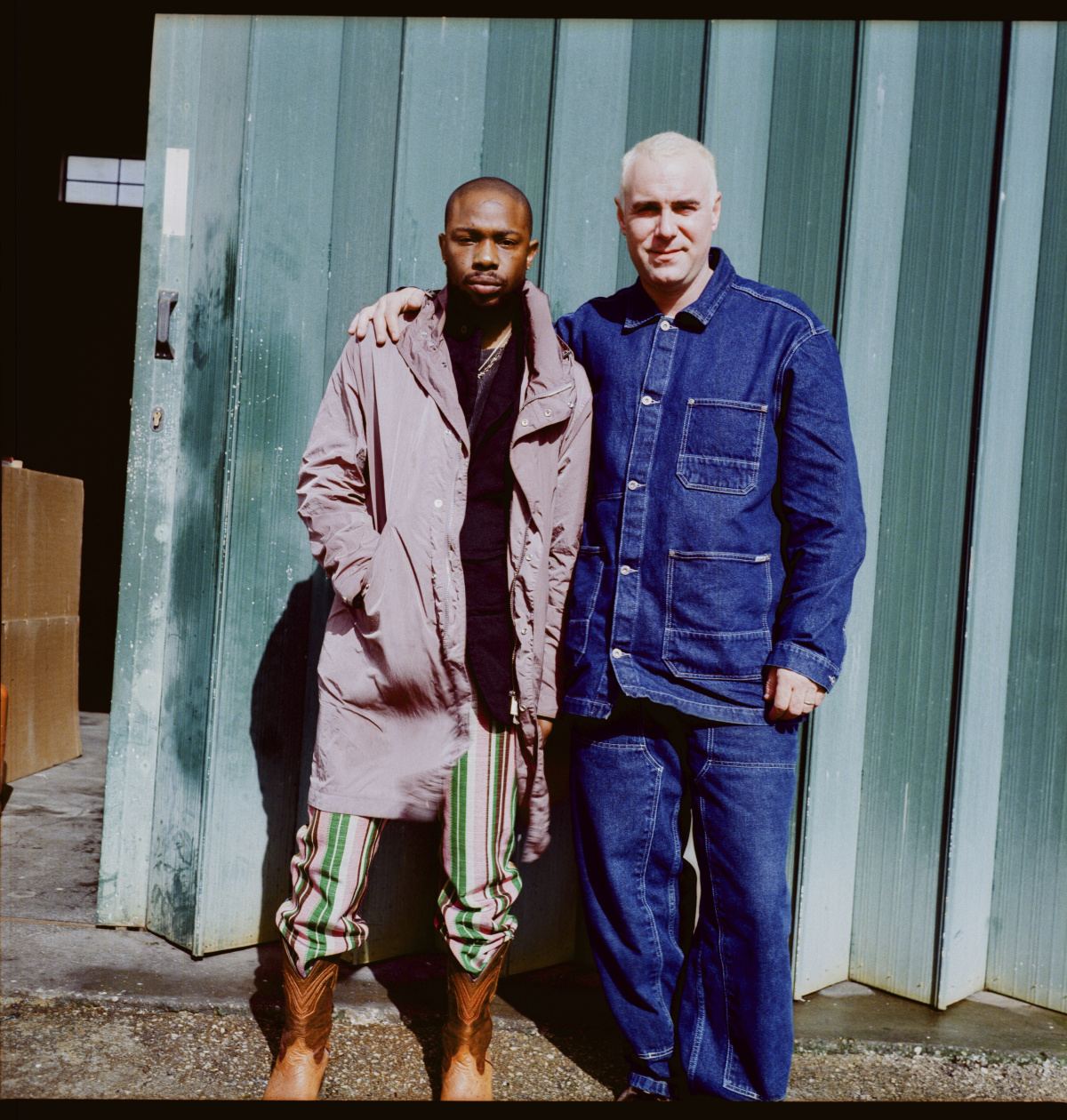
- Dozie Kanu and Jonathan Olivares. Photo by Liz Johnson Artur
This is the program Jonathan has been building since he took the role. Last year he brought in Jonathan Muecke, this year he extends the Biboni line by Johnston Marklee, and his big bet for Salone 2026 is Dozie. Knoll’s opening pitch in the Olivares era has consistently been artists, not branded designers. Dozie is the most pointed expression of that idea so far.
The decisions Knoll didn’t fight him on are the ones that carry his geography. The taut leather top references an African drum he collected. The fringe tassels do double duty: they pull from Texas cowboy culture and from African masquerade dancers, the hay skirts that sway on the body during ceremony.
“I felt it was necessary to allude to my heritage,” he says. “My parents are Nigerian immigrants that moved to the states in their 30s. I’m African, but I was considered Black when I left my house, but there’s not Black culture at home. So there’s this feeling, ultimate feeling of displacement that I’ve always felt.” It is also why he could move to Portugal. “I never actually felt like I belonged anywhere.”
The movement of the tassels was the entire point. “I definitely wanted movement to be part of these pieces, because all of those pieces are very sterile and sort of like fixed,” he says, gesturing at the room. He has been making the opposite of static objects for his entire career. Even sitting still inside Knoll’s program, this had to move.
He plans to exhibit the tables in an art context, to see if the same audience reads them as sculpture. “I’m always challenging people’s perception of design as sculpture.” It is also why he does not really care that the Times called him a furniture designer in 2017. The misnaming is the material.
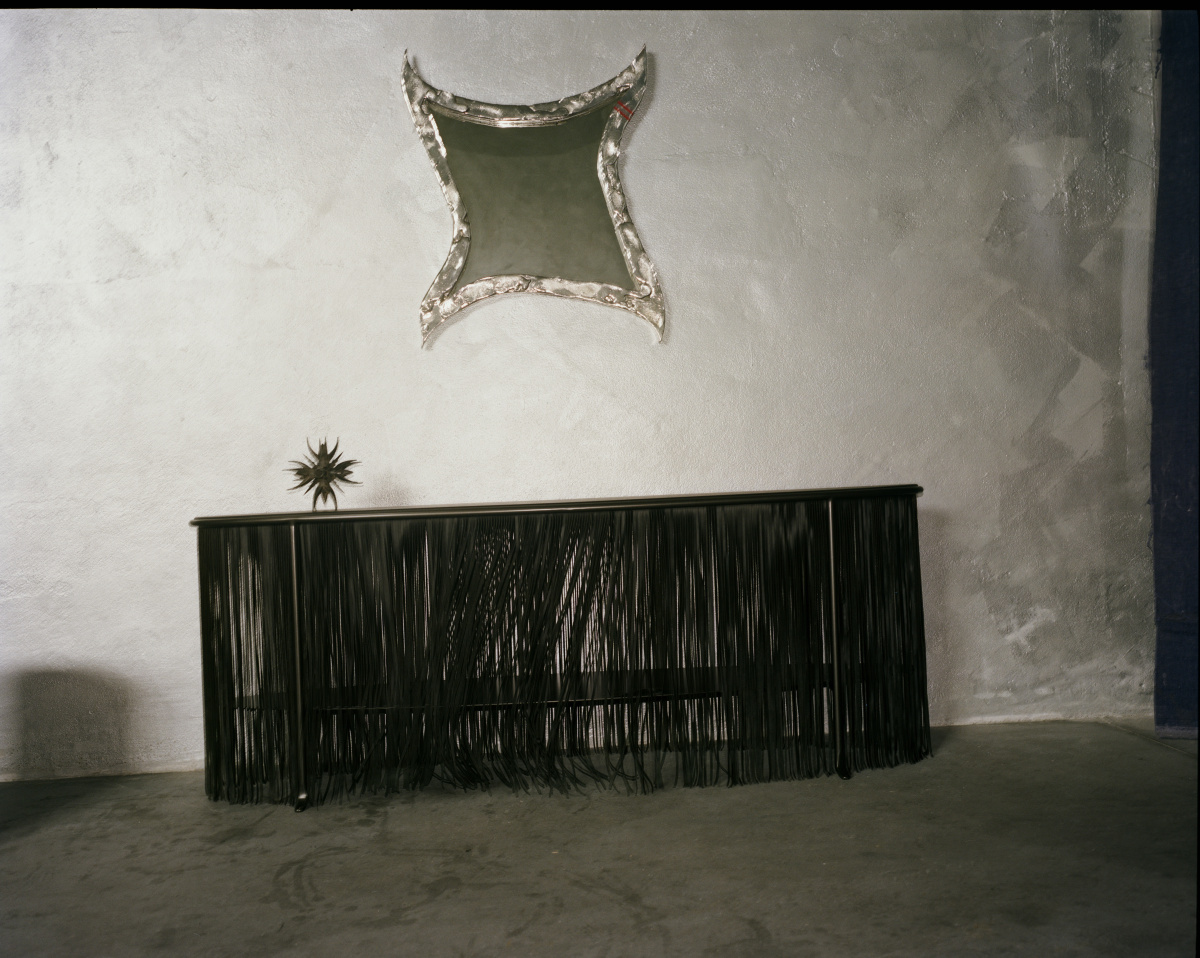
Dozie Kanu Console Table for Knoll. Photo by Liz Johnson Artur
Dozie is getting calls. He’s tired of the model the Travis Scott collaborations established. “I don’t want to see another Jordan one low with a backwards swoosh. We’ve seen it.” He says he will not become “a brand whore.”
He brings up Grace Wales Bonner, recently appointed creative director of Hermès menswear, with reverence. “You talk about Jordan-era Nike. I think that’s where we’re getting her,” he says. He admires how she puts the work first and lets the politics live underneath. “It works first. The work is super good.” He says the same of the Knoll commission. “I’m using the history of Knoll as a conceptual tool. But it’s underneath the work.”
This is, I think, the actual proposition of the collection. The tables are not a manifesto. They are a beautiful piece of furniture that happens to carry, as undertow, a Nigerian-American sculptor’s lifetime of negotiation with material culture. You do not need any of the context to want one in your house. The context is doing the work whether you read it or not.
The bigger ambition is architecture. Dozie keeps coming back to it.
“Within material culture, it’s hard for blackness to reach its full self because there’s always that capital aspect,” he says. “Within athletics, within dancing, within oratory, that doesn’t require capital to get exceptional at it. So I’m looking towards the future. I want to exist fully in material, like architecture. What does a building of mine look like where I was not compromising at all?”
We continue to chat the politics of design, and Dozie is comfortable speaking to major, systematic issues. “Racism and capitalism are intertwined at the hip. I don’t see capitalism going away anytime soon. I think a way to combat it is making blackness exist as fully as possible within this moment. And that’s going to take a lot of capital.”
It is the opposite of what most artists in his position would say at a press event. It is also, structurally, the reason this collection exists at all. Dozie is gambling that doing it inside Knoll, with Jonathan as his interpreter, gets him closer to the building.
When we wrap, Dozie says he wants to go back to Lisbon and just decompress. “I can’t really process it right now.” He is right that the work needs time. We discuss how sculpture moves slower than music. People have to keep seeing it before it lands. Around the pavilion, people stop at his tables, watch the tassels move, lean in to look at the leather.
“People like Jonathan will give me the keys to the Porsche,” Dozie says. “Now, let me drive.”