Most people are careful about what they eat, what they put on their skin, and what cleaning products they use at home. Paint is a different story. It gets picked for color and finish, applied, and forgotten, despite the fact that it’s one of the most pervasive materials in any home. You sleep next to it, breathe near it, and rarely think twice about what’s actually in it. Maya Crowne and Price Latimer think that’s a problem worth solving.
Alkemis Paint is a mineral-based paint company, whose paint formulas are entirely made from crushed quartz and natural mineral pigments rather than the synthetic chemicals and petroleum derivatives that make up most conventional paint. The wellness case, the co-founders argue, is not a stretch.
“The EPA has ranked indoor air pollution among the top five environmental health threats, and interior paint is one of its most significant sources,” Price says. “Conventional acrylic latex paint is, at its core, liquid plastic, and it can off-gas VOCs and harmful chemicals for up to 10 years after application. That’s not a theoretical risk. That’s your bedroom, your child’s nursery, your office, or your yoga space.”
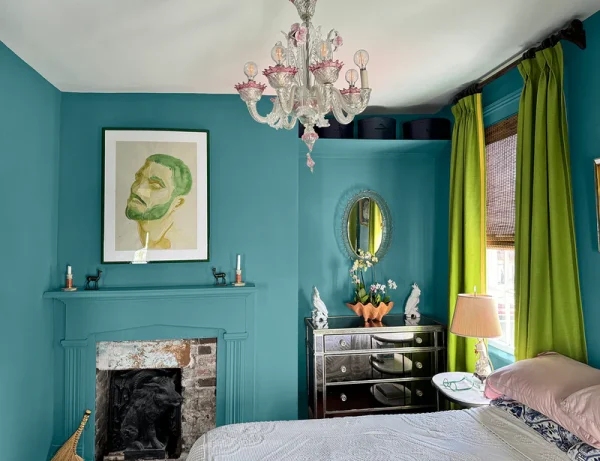
Alkemis Paint is a mineral-based, Cradle-to-Cradle Certified paint made from crushed quartz and natural mineral pigments rather than the synthetic chemicals and petroleum derivatives that make up most conventional paint. Above: Quetzal colorway
The brand was born out of personal necessity as much as entrepreneurial instinct. Maya Crowne is a strategist and creative with a background in art and design, and Price Latimer brings decades of experience in color theory, branding, and intentional living.
The two met at a wellness retreat in the mountains of New Mexico and found an immediate connection around art, biophilia, naturopathy, and color theory. When Maya found herself quarantined in her New York apartment in 2020, wondering what was actually in the paint she was about to put on her walls, she called Price. What they discovered together sent both of them down a research path that neither expected.
“We made the paint we wished existed, for ourselves as much as anyone else,” Price says.
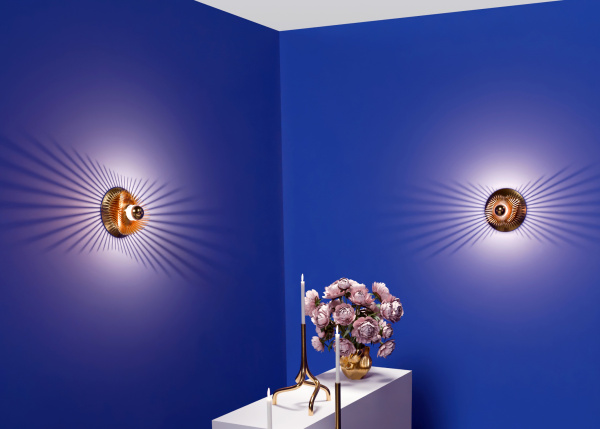
At this year’s Afternoon Light Design Fair in NYC, Alkemis collaborated with Brooklyn-based designer Ramona Albert (sconces above). Paint colorway: Lazurit
According to peer-reviewed research cited by Forbes, architectural paint is the single largest source of microplastics in the world’s oceans and waterways, producing 1.9 million tons annually, meaning more than tires, more than textiles, more than single-use plastics combined.
“Even as incredibly conscious consumers, we always just assumed that low and zero-VOC paint was the best option out there,” Maya says. “We never even knew to ask for and read a safety data sheet for paint.” The paint industry, she argues, has deliberately obscured this reality. “Paint has been successfully positioned for decades as a benign home improvement product, not a toxic petrochemical polymer coating. That opacity has been intentional.”
Alkemis spent three and a half years working with chemists, chemical engineers, and feasibility experts to build an alternative. The result is a paint whose binder and base layer are translucent quartz rather than the opaque milky white plastic binder used in conventional paints. That distinction changes not just what the paint does to the air in a room, but how color looks on a wall.

The mineral pigments used across Alkemis’s 119-color core collection are the same materials found in Roman frescoes, Renaissance paintings, and cave paintings at Lascaux and Blombos. Above: Hair of the Dog colorway
“Light passes through and interacts with the pigment in a way that’s different,” she says. “Colors shift and subtly transform throughout the day as the natural light changes.” The microcrystalline surface produces what Alkemis calls a velvet matte finish with an exceptionally high light reflective value, a quality that designers say is nearly impossible to capture in photographs and only fully understood when standing in the room.
The mineral pigments used across Alkemis’ 119-color core collection are the same materials found in Roman frescoes, Renaissance paintings, and cave paintings at Lascaux and Blombos. They have survived millennia, and the paint itself is formulated to last more than 20 years, which reduces repainting costs and the environmental impact that comes with them. For architects and contractors who might raise an eyebrow at language about chakras and mineral energy, the specs make the case on their own terms: vapor permeable, inherently mold and algae resistant, no off-gassing, and one gallon absorbs as much CO₂ as nine trees in a single day.
“We’re not asking anyone to choose between performance and biophilia,” Maya says. “Alkemis delivers both.”

Price Latimer and Maya Crowne
The current customer base spans health-conscious homeowners, interior designers and architects, hospitality developers, healthcare facilities, and progressive commercial spaces. In five years, the co-founders want Alkemis to be the default answer to the question of what paint to use, not just for wellness-oriented consumers but for everyone.
“We want the question ‘what’s in your paint?’ to feel as instinctive as ‘what’s in your food?’” Price says. The global wellness market is valued at over $6.8 trillion as of 2026 and forecast to approach $10 trillion by 2029. The co-founders are betting that paint is next.
“Consciousness is not a trend,” Price says. “It’s a trajectory.”