It was my first time in Venice, and I didn’t know what to expect from the 61st edition of the Biennale. For months, the art world Olympics had been marked by tragedy and controversy. The insurmountable loss of Koyo Kouoh, curator for the international exhibition In Minor Keys cast a large shadow over the event, but the Biennale’s reputation was further clouded by other abrupt actions. The jury resigned because it refused to consider awarding a prize to countries being investigated for war crimes (mainly Israel and Russia), a decision that may have been partly inspired by South Africa’s choice to self-censure their Pavilion that would have mourned the lives of Palestinians. The canceled exhibition, a solo presentation by Gabrielle Goliath called Elegy, did make it to Venice as an off-site presentation at a church, but only in the eleventh hour.
On top of those pieces of news, as an American, I was also intrigued by the mess happening in our pavilion, which presented animalistic and inoffensive works by Alma Allen. His pavilion must have been a scramble, as it followed an exhibition proposal that crumbled and sculptor Barbara Chase-Riboud bowing out. Ultimately the kerfuffle resulted in a ho-hum array of biomorphic sculptures, some gilded in a Trump-approved gold glaze, that was devoid of any message. While Alma’s artwork is pleasant—I think the spaghetti sheep is cute—when compared to the other pavilions, who addressed heavy issues like climate change, the migrant crisis, and genocide, America’s uncharacteristically subdued voice was embarrassing.
While I spent 48 hours in Venice sweating through a historic heatwave, I took notice of the countries who actually did want to leave an impression. As I present my top picks below, I want to provide a disclaimer that I barely scratched the surface of what the Biennale had to offer. There were more than 90 shows outside Arsenale and Giardini, so I still wrestled with FOMO; but that just means that I’ll have to return for a longer exploration in 2028, even if the 62nd edition fails to generate as much buzz.
IN MINOR KEYS (International Exhibition)
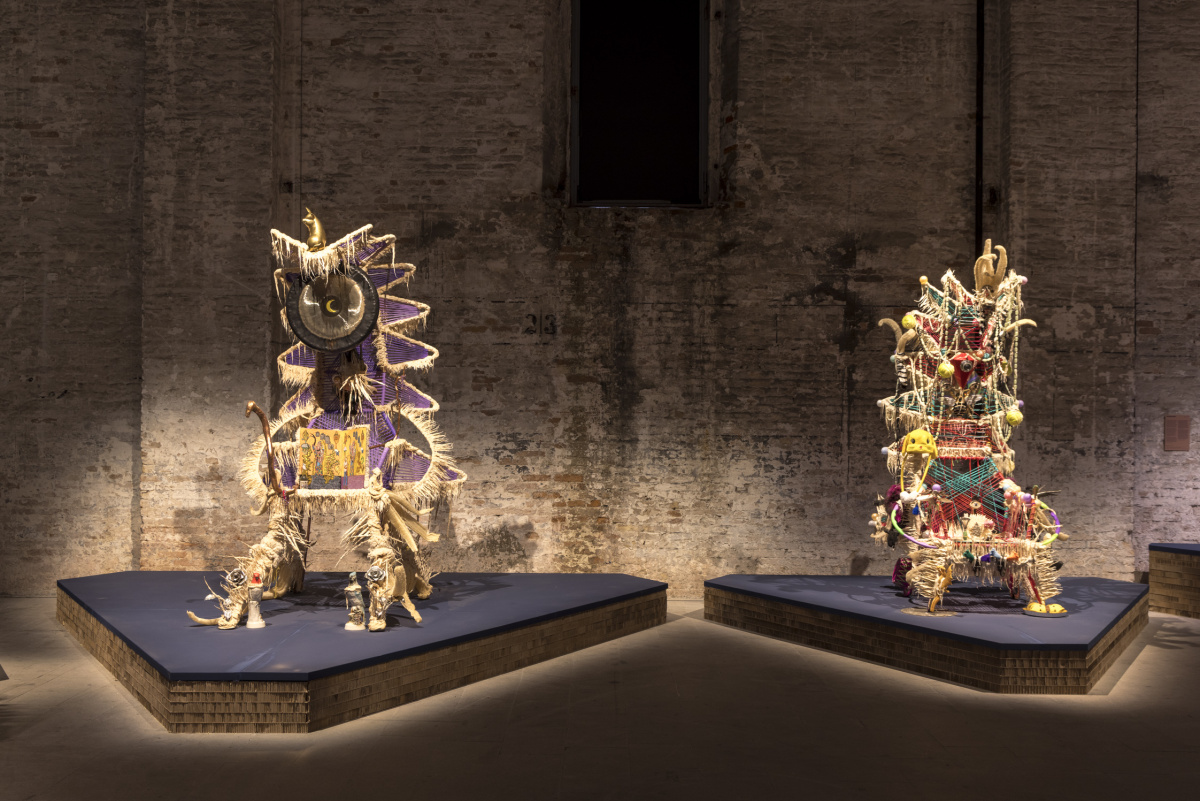
Servais Family Collection, Brussels ICE Age Disease Thrower #2 (2025) and ICE Age Disease Thrower #3, by Guadalupe Maravilla.Mixed media.
Koyo’s exhibition is truly the star of this year’s Biennale. In Minor Keys was completed by Koyo’s curatorial team—Gabe Beckhurst Feijoo, Marie Hélène Pereira, Rasha Salti, Siddhartha Mitter and Rory Tsapayi—who did their best to follow her plans.
In the exhibition text completed before her passing, Koyo wrote that minor keys are “the songs of those producing beauty in spite of tragedy, the tunes of the fugitives recovering from the ruins, the harmonies of those repairing wounds and worlds.” This allows for themes of rebellion and resilience to take center stage, and often, the works are monumental. One work that particularly struck me was Thania Petersen’s Cosmological Offerings for a Drowning World, a handmade tapestry that stretches beyond 16 feet. It shows a rich narrative of how Sufi music traveled throughout the world via beaded fish, embroidered Muslim saints, and appliquéd jaguars.
Though In Minor Keys spread across both the Arsenale and the Giardini, I found the works to be more impactful in the former. Koyo’s layout is dizzying and disorienting, which emulates the cacophony that could build when minor keys reach a crescendo. I thought of how many works amplified hyper-local stories, like Joana Hadjithomas and Khalil Joreige’s A State: BH3 which recontextualizes a core sample and archaeological studies from a drilling core sourced from an enormous garbage dump in Tripoli. I saw this potential best exemplified in Guadalupe Maravilla’s hand-thatched Disease Throwers, amalgamations of thrones and shrines that were composed of dried grass, crochet, and found objects. Each was topped with a bunny hat with long, dangly pompoms, which resembled the bright blue cap 5-year-old Liam Conejo Ramos wore when he was photographed being detained by ICE agents in Minnesota. With an ear tuned towards the minor keys, the world can hear oppression.
Austria’s Take on the Waterworld Stunt Show
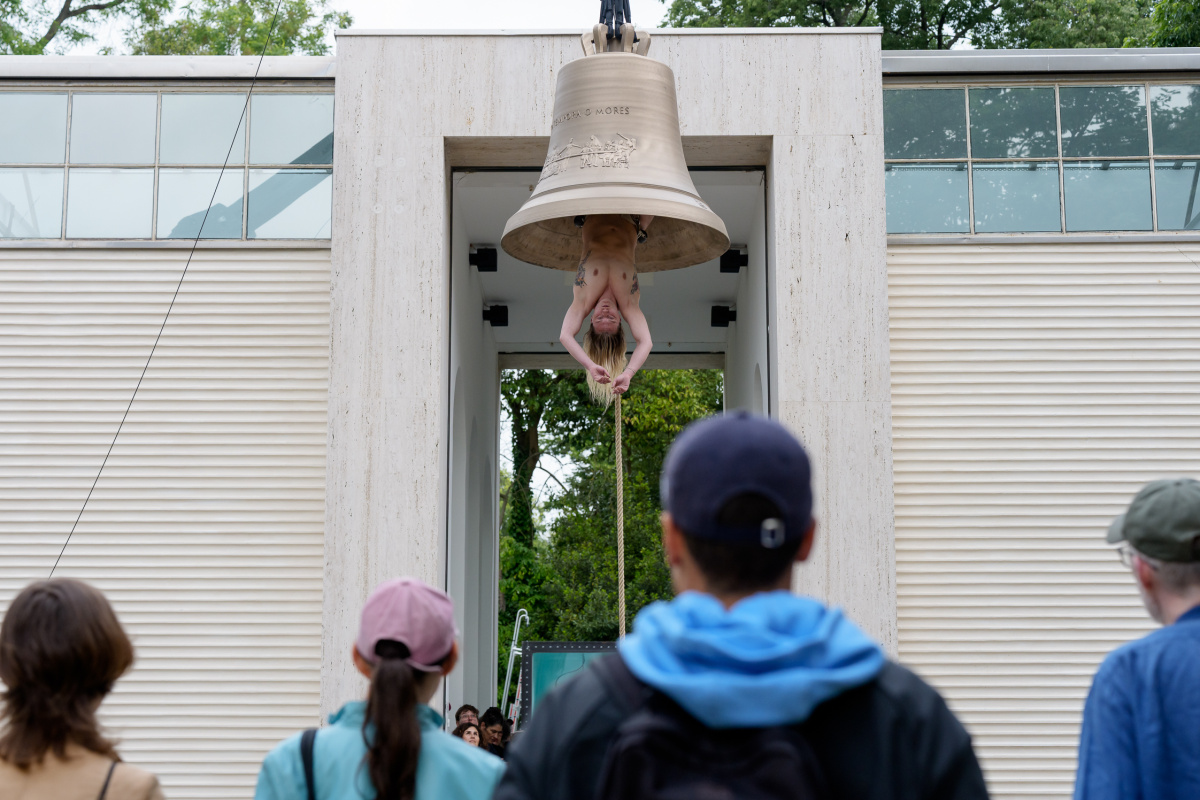
Pavilion of Austria. Seaworld Venice by Florentina Holzinger. Photo by Andrea Avezzù
Florentina Holzinger’s SEAWORLD VENICE was the buzziest pavilion, and the one I was most excited to see. I’m happy to say that the choreographer’s depiction of dystopian Venice, swallowed by sea level rise and tainted by human piss, was not overhyped.
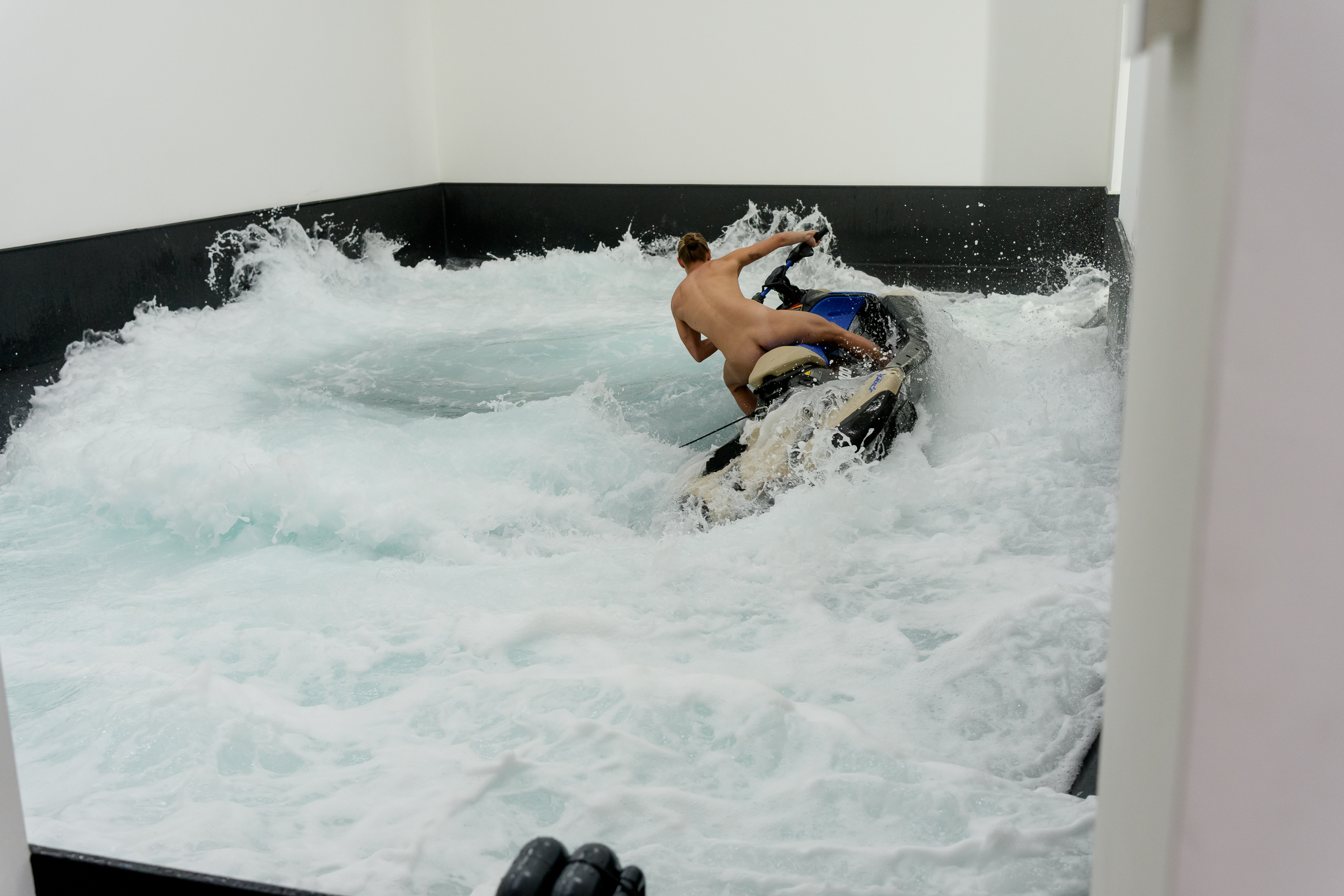
This artistic take on the Universal Studios Waterworld stunt show included a woman doing doughnuts on a jetski and two others scaling a rotating compass, equipped in harnesses and workboots like Sisyphean linemen. Their message, to me, was that the world is going to hell, yet we’re just sputtering in place, doing nothing to save it. At the top of every hour, a woman hauled herself up a rope and into a giant bell, taking the place of the clapper. Her torso knocked against its side, a human body triggering our death toll.
To further underscore humanity’s role in bringing about climate change, a circular system transferred urine from two porta potties into the waters the performers inhabited. While I visited the pavilion, no one volunteered to add their bodily fluid to the exhibition, but our most mundane, unsustainable actions aren’t often done in the open.
Poland Sings Interpretations of Whale Songs
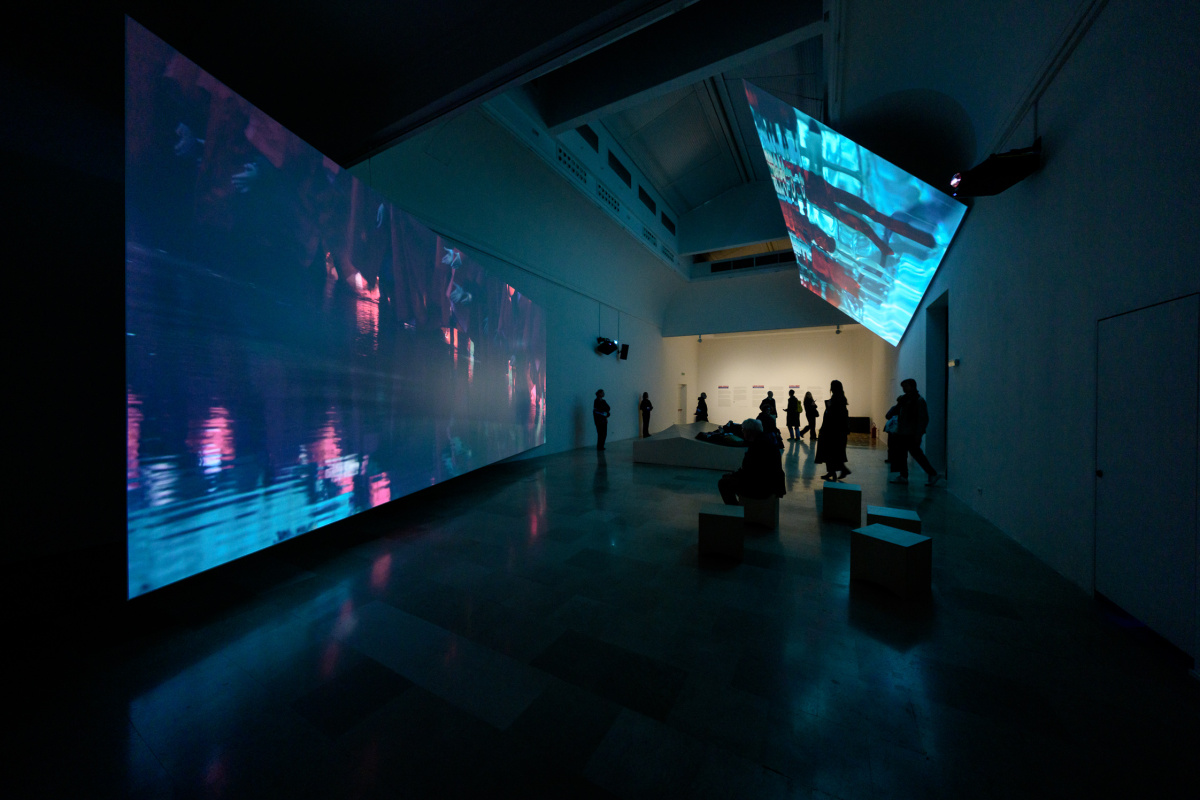
Pavilion of Poland. Liquid Tongues by Bogna Burska and Daniel Kotowski. Photo by Andrea Avezzù
I haven’t seen much love for the Polish Pavilion, but it was really taken by the two-channel video Liquid Tongues by artists Bogna Burska and Daniel Kotowski. The aquatic operetta featured the Choir in Motion, a chorus of Deaf and hearing community members, who sang and signed interpretations of whale songs while dancing in an Olympic-sized swimming pool. It served as a foil to Florentina’s Mad Max apocalyptic vision on our flooded future. Bogna and Daniel envision humans will adapt to new ecosystems through unity, communication, and cross-species pollination.
I may have also been seduced by the Polish Pavilion’s layout. Bogna and Daniel placed their screens in two different locations. One was presented more traditionally against a wall, with benches for people to sit. The other was mounted to the ceiling, and visitors watched the chorus invoke the spirit of the whale rider while laying down on a large wooden platform, like they were backfloating into this impending timeline.
Argentina Builds a Salty Labyrinth
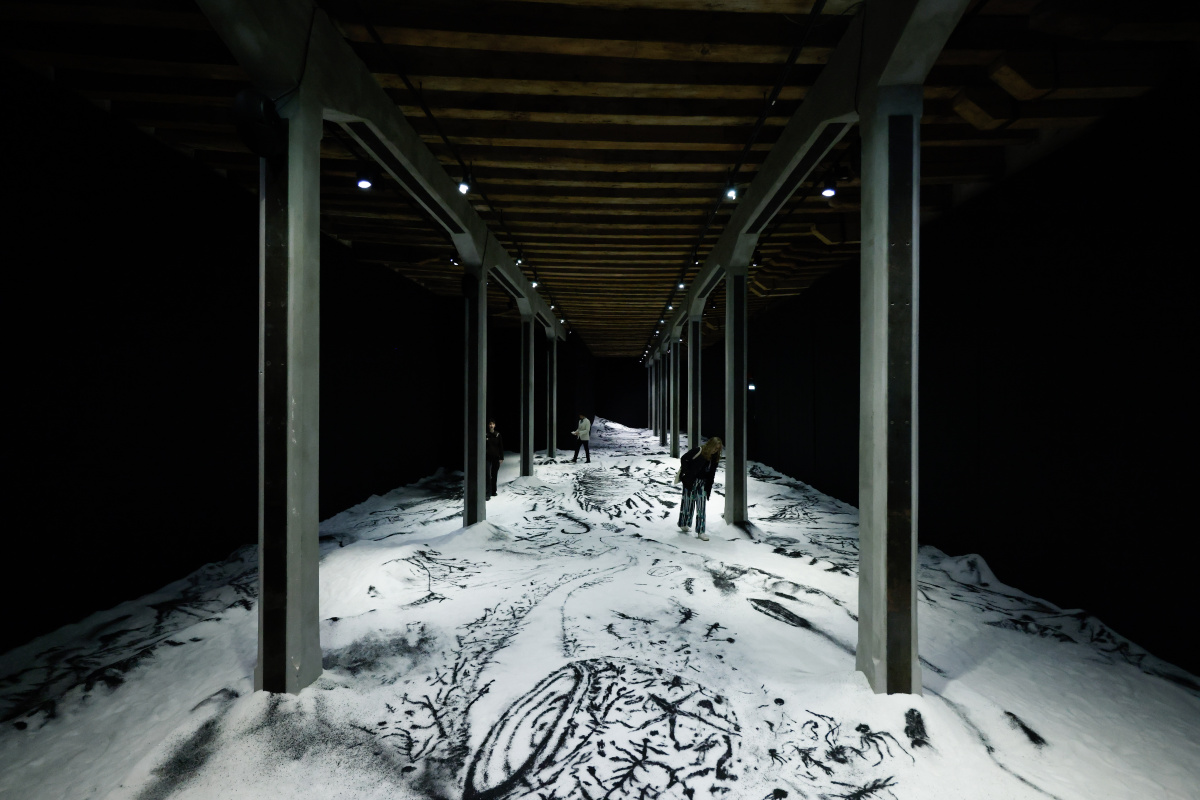
Pavilion of Argentina. Monitor Yin Yang by Matías Duville. Photo by Jacopo Salvi
Depending on how you entered the building, Argentina’s presentation in the Arsenale, Monitor Yin Yang by Matías Duville, was the first or last of a trio of earthworks. I accidentally entered through the back, so Argentina’s presentation followed a salty labyrinth dotted with pre-Colombian ceramic vessels by RojoNegro (Actos invisibles para sostener el universo, Mexico) and an enormous clay floor mosaic made by Dana Awartani (May your tears never dry, you who weep over stones, Saudi Arabia). All three guided visitors via dirt pathways, allowing them to linger upon images of palms, birds, and bones.
Matías’ take on the concept was the most successful to me, as it was the most immersive. As I snaked around salt mounds that were topped with charcoal petroglyphs, the granular terrain stretched my calves as if I were trekking through mountains. I was also most drawn to Matías’ forms, which mixed houses and tires in with the thunderbirds and feathers, which brought a contemporary edge that the other two installations lacked. Matías was considering how mythology shifts in the digital age, and how salt entwines with ancient remedy and modern machinery.
Uzbekistan Portrays the Ramifications of Soviet Farming
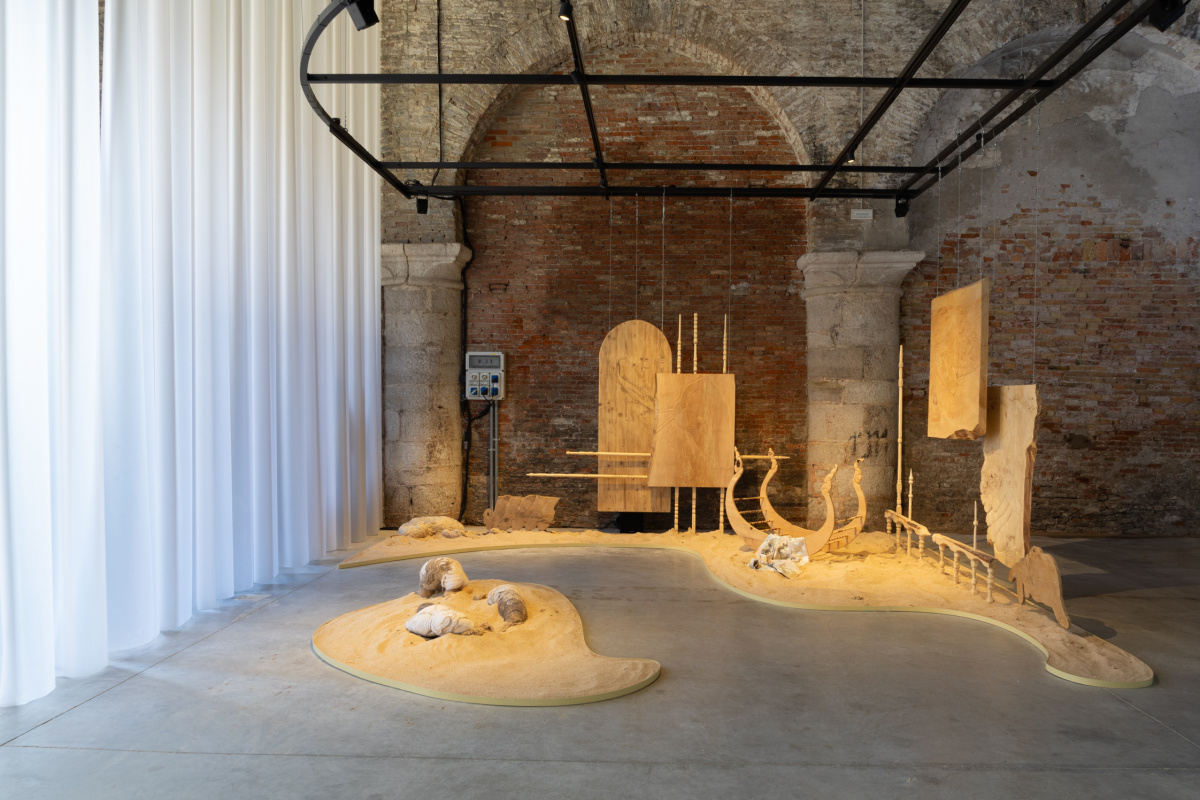
Pavilion of the Republic of Uzbekistan. The Aural Sea by Zi Kakhramonova. Photo by Luca Zambelli Bais
Salt did not just appear in Argentina and Mexico’s exhibit. The element occurred repeatedly throughout the Biennale because the substance accumulates in drought-plagued environments. For decades, Uzbekistan has watched the Aral Sea wither away due to irrigation methods, leaving behind a salty desert with toxic dust. Zi Kakhramonova’s Archive of Lost Forms (2026) embedded ceramic fish into mounds of salt. The creatures’ skeletons are a common sight along the gritty terrain and can be mistaken for fossils despite their recent decay.
In addition to portraying the ramifications of Soviet farming, the pavilion’s artists wrote modern myths to explain how the sea shrunk. Zulfiya Spowart’s Beshik (The Cradle) staged like a shipwreck, felt like the retelling of a Greek myth. But what I thought was a boat was actually a traditional baby cradle that was used throughout Central Asia. The vessel was embedded in sand, surrounded by wood panels depicting hands and feet, and scored by a soundscape. It made me envision a new story of a hero born within the dry seabed. As the world changes, artists will be at the forefront of storytelling. They will twist symbols of industrialization, like mines and irrigation systems, into serpents and sirens, warning the next epoch of dangers to come.
The Bahamas Highlights Junkanoo Artists
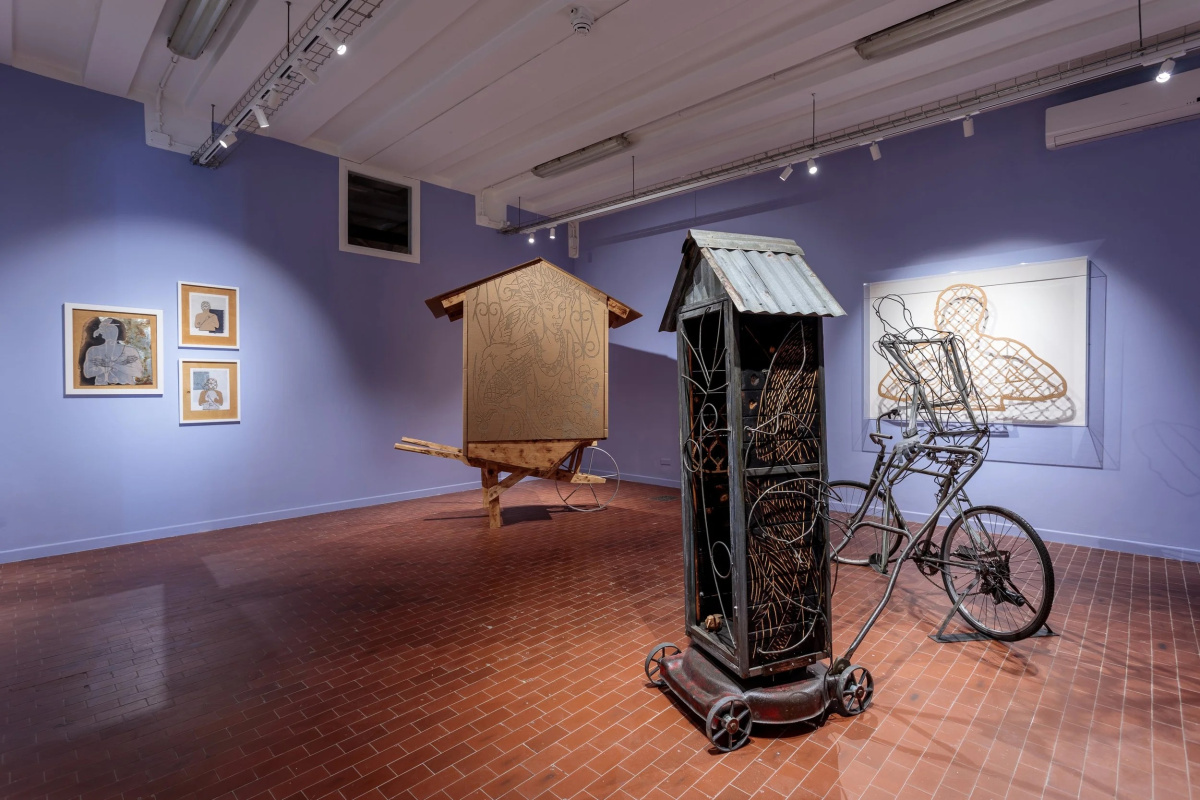
The Bahamas Pavilion, In Another Man’s Yard John Beadle, Lavar Munroe, and the Spirit of (Posthumous). Collaboration works pictured by Lavar Munroe and John Beadle. Photo by Francesco Allegretto
Of the off-sites I did manage to see, I was most impressed with the Bahamas’s pavilion at the San Trovaso Art Space, nestled within the Dorsoduro neighborhood. In Another Man’s Yard presented an unlikely posthumous collaboration between Lavar Munroe and a prominent Bahamian artist, John Beadle.
John was supposed to show at the Biennale in 2015, but was never able to do so due to lack of funding. In Another Man’s Yard finally brought John’s sculptures to Venice, which showcased an artform known as Junkanoo that is distinct to the country. Junkanoo artists mold discarded cardboard, wood, and found objects into intricate sculptures. John’s Mobile Housing Unit shows how the materials can be pierced and perforated to create figurative drawings that merge personal identity with motifs from the urban landscape, like wrought iron fences .
Junkanoo, however, isn’t just an artistic medium. It’s also integral to funeral celebrations, where locals lead processions to honor the dead, donned in Junakroo masks and regalia. Lavar Munroe’s colorful mixed media paintings depicted his community honoring Beadle. A large, 11 panel work, No Matter How Dreary and Gray, We People of Flesh and Blood Would Rather Live Here, Than in Another Man’s Yard, hugged the walls of an entire gallery, becoming a procession in itself. Throughout this piece, people pushed shacks that resemble Mobile Housing Unit. Lavar also created a site-specific installation of parading masked figures, However Long the Night, the Dawn Will Break, out of objects found in John’s studio, like wood, newsprint, and feathers. With this collaboration Lavar became Beadle’s protége, bonding them despite the gap between life and death.