I’m told the floatplane I’m about to board is called a de Havilland Beaver. I’m told this like it might mean something to me, but the last time I gave any thought to a plane that lands on water was as an eight-year-old watching a cartoon bear fly one on Disney’s “TaleSpin.”
But here I am, in something that looks like a cross between an old lawn mower and a transistor radio, lifting off the water in Vancouver Harbor. For the next 40 minutes there is nothing below us but the Salish Sea and forest running down to the tide line. This is how you reach the Sunshine Coast, since no road connects it to the rest of British Columbia. You come by ferry or you come by floatplane, and it’s the kind of geography that makes the case for an “adventure” version of anything. Adventure plane? Yes. Adventure shoes? Yes. Adventure truck? Also yes. When we taxi to the dock of our remote resort, a perfect line of INEOS Grenadiers is waiting above the ramp. In this context they read less like luxury SUVs and more like something menacing, the setup for a chase scene in a Bourne movie. I’m intrigued.
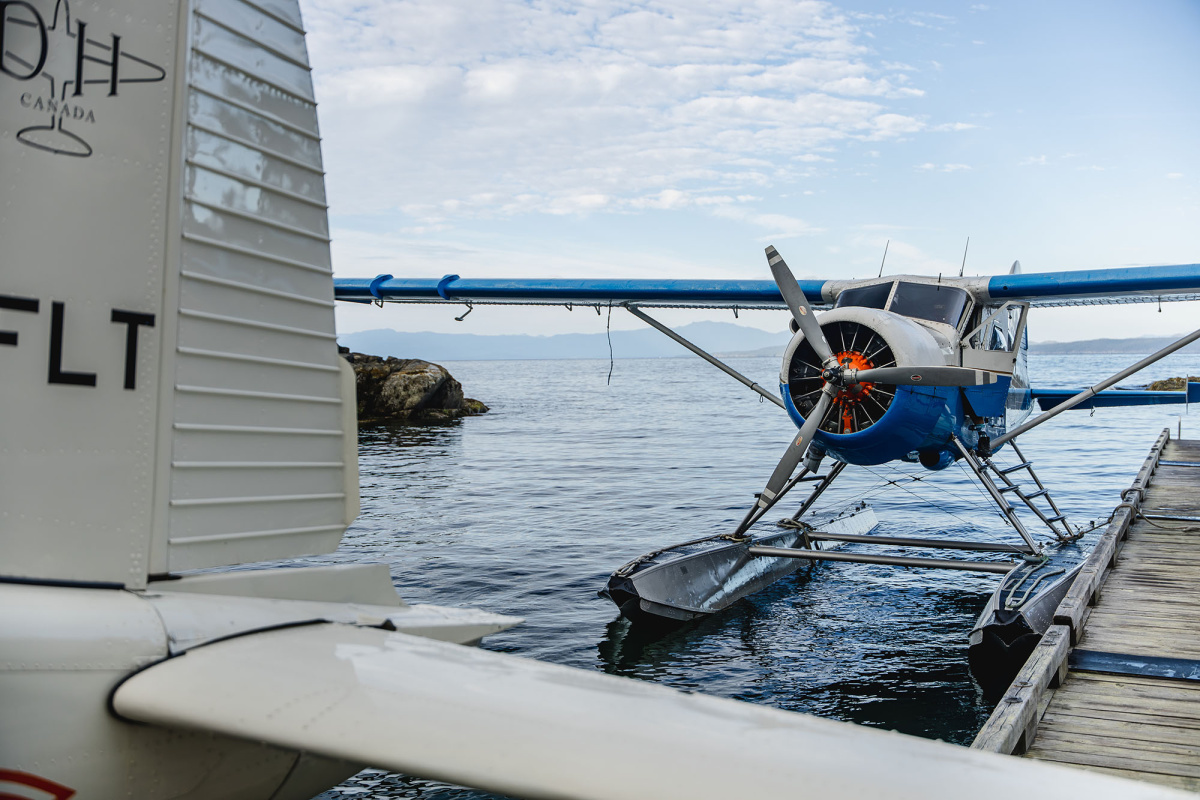
The resort INEOS chose sits on a stretch of coast with no road to it. You arrive by ferry or you arrive like this, by seaplane. Photo courtesy of INEOS
I know almost nothing about the Grenadier beyond the outline: it began as the pet project of a successful businessman who runs a chemical company. Chemical companies do not, as a rule, build trucks, so I’m curious what I’m about to be handed.
The chemical company is INEOS, one of the largest in the world by its own count, 26,000 people across 194 sites in 29 countries, and privately held. There is no private equity in the room, no analyst calls. It owns part of Manchester United and runs the club’s football operations, holds a third of the Mercedes Formula One team, and owns a Tour de France team outright. The man at the top is Sir Jim Ratcliffe, founder and chairman, and nobody here calls him anything but Sir Jim.
The founding story gets told at dinner the first night by Gregor Hembrough, who previously ran Polestar’s US business, spent years at Volvo before that, and is now executive vice president for the Americas at INEOS Automotive. Gregor knows cars, and he tells it as a car story before a business one. In 2016 Land Rover ended production of the original Defender, closing a lineage that ran back to 1948. Sir Jim did not want a successor. He wanted the truck itself, and he approached Land Rover about buying the tooling so the old Defender could simply stay in production. Land Rover said no, a word I’m assuming Sir Jim is not accustomed to. Fine, then. He would make his own. In 2017 he went to a pub called the Grenadier in Belgravia, near the INEOS offices, and with friends sketched out what the truck should look like on the back of a 5 pound note. The truck kept the pub’s name.

“The idea for Grenadier was brought together in a pub, sketched on a five-pound note, and that’s where it all came from,” says Sam Kuflik, INEOS press and special vehicles manager. The sketch became a brief for Toby Ecuyer, the yacht designer Sir Jim hired to draw the truck, who had never designed a car. Photo courtesy of INEOS
Then Sir Jim went shopping, around the world, for the best plant and the best parts money could buy. He landed on the former Smart factory in Hambach, France, bought from Mercedes-Benz, to build it. The parts list is a story Sam Kuflik will tell me in exquisite detail the next morning during our walkaround.
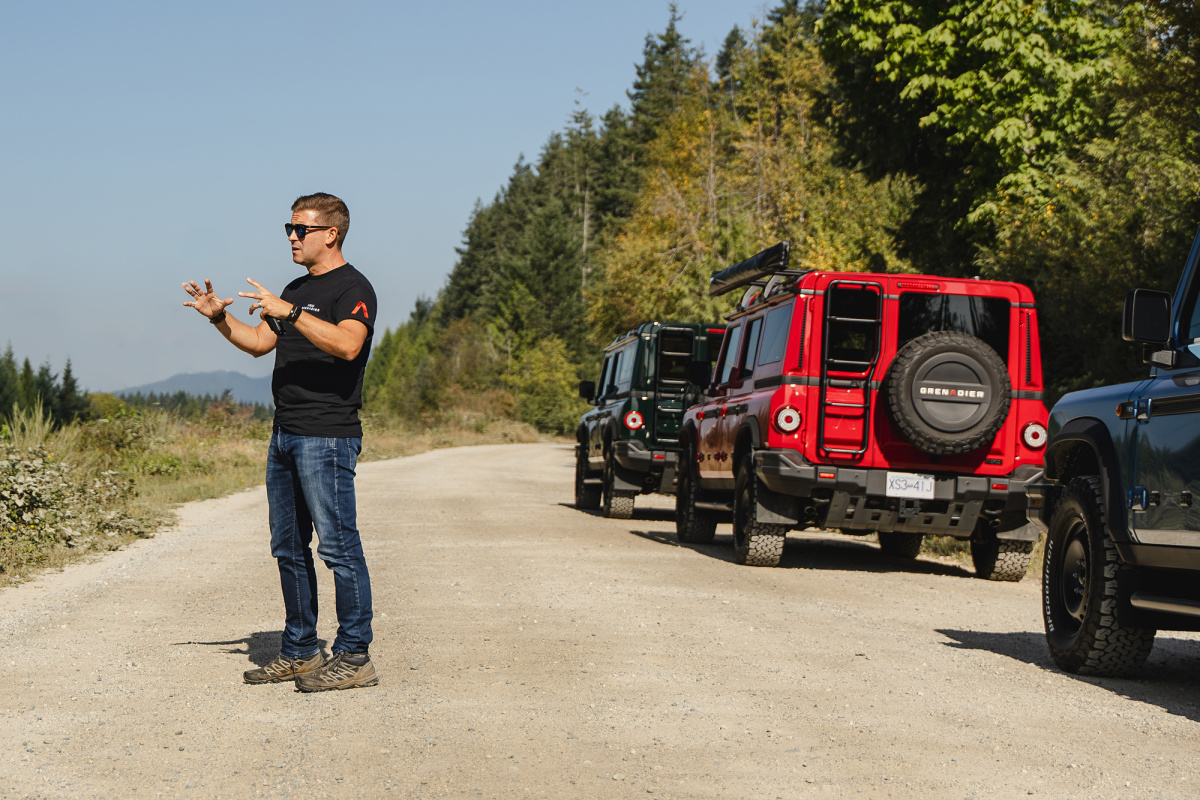
Sam Kuflik runs the briefing on a gravel road with the trucks lined up behind him. He came to INEOS from years at McLaren, and he talks about the Grenadier the way a race engineer talks about a car, in suppliers and part numbers. Everything you need to fix in the field is reachable without a dealer: no glued panels, no proprietary fasteners. Photo courtesy of INEOS
That “I’ll just build my own” instinct shows up all over the Grenadier. Designers gravitate toward objects that state their purpose without the need for notes. A Porsche 911. A Braun radio from the Dieter Rams years. The form tells you the job, and the Grenadier belongs to that family. Exposed hinges, a flat glasshouse, switchgear sized for gloves. Nothing on it is decorative and nothing on it apologizes. It looks like the kind of machine that comes with a manual, not a lookbook. Function first, vibes second, a set of priorities increasingly rare in the automotive world.
The truck, however, is not without personality or humor. The paint chart reads like a private joke. Scottish White is named for the pale legs of Sir Jim’s Scottish friends. Donny Grey is the sky over Doncaster, where his co-founder Andy Currie grew up. Eldoret Blue is the Kenyan town that produced Eliud Kipchoge, whose sub-two-hour marathon INEOS paid for. There’s a second, quieter horn, a red button on the wheel INEOS calls the Toot Button, a tip of the hat to its cycling team.
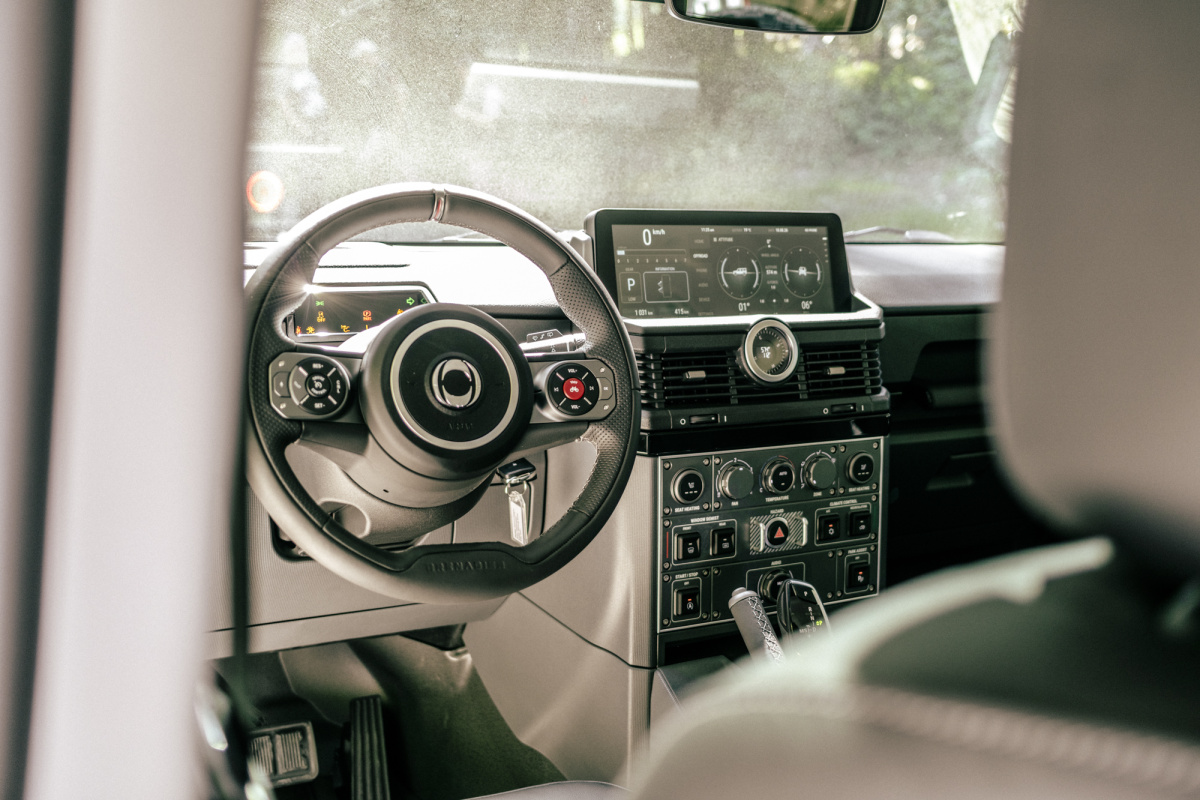
The red button at three o’clock on the wheel is the Toot Button, a quieter second horn for cyclists and walkers. Everything here is meant to be operated with gloves on. Photo by Chris Force
But the jokes stop at the hardware. Sam is clearly in his element as he begins the walkaround. His title is press and special vehicles manager, which undersells what he carries around in his head. He came to INEOS after years at McLaren, and he opens with the development philosophy. “It was basically to go to the toy shop and buy all the best bits you can possibly get hold of,” he says.
The engine is a 3.0-liter turbocharged BMW straight-six, retuned away from Munich’s priorities. “We dropped the power a little bit and brought the torque right up,” he says. “The torque curve on this is literally the same shape as the car. House brick.” The spec sheet agrees: 332 pound-feet, a flat plateau from 1,750 to 4,000 RPM. The gearbox is an eight-speed ZF automatic. The transfer case is an INEOS design built by Tremec. The axles come from Carraro, an Italian firm better known for agricultural machinery. “They’re usually green,” Sam says. “They’re used by John Deere, so we are the lightweight racing version.” Magna handled the engineering development. “Basically the G-Wagon 2018 edition. They finished doing that and then moved on to this. I think they’ve done a pretty damn good job.”
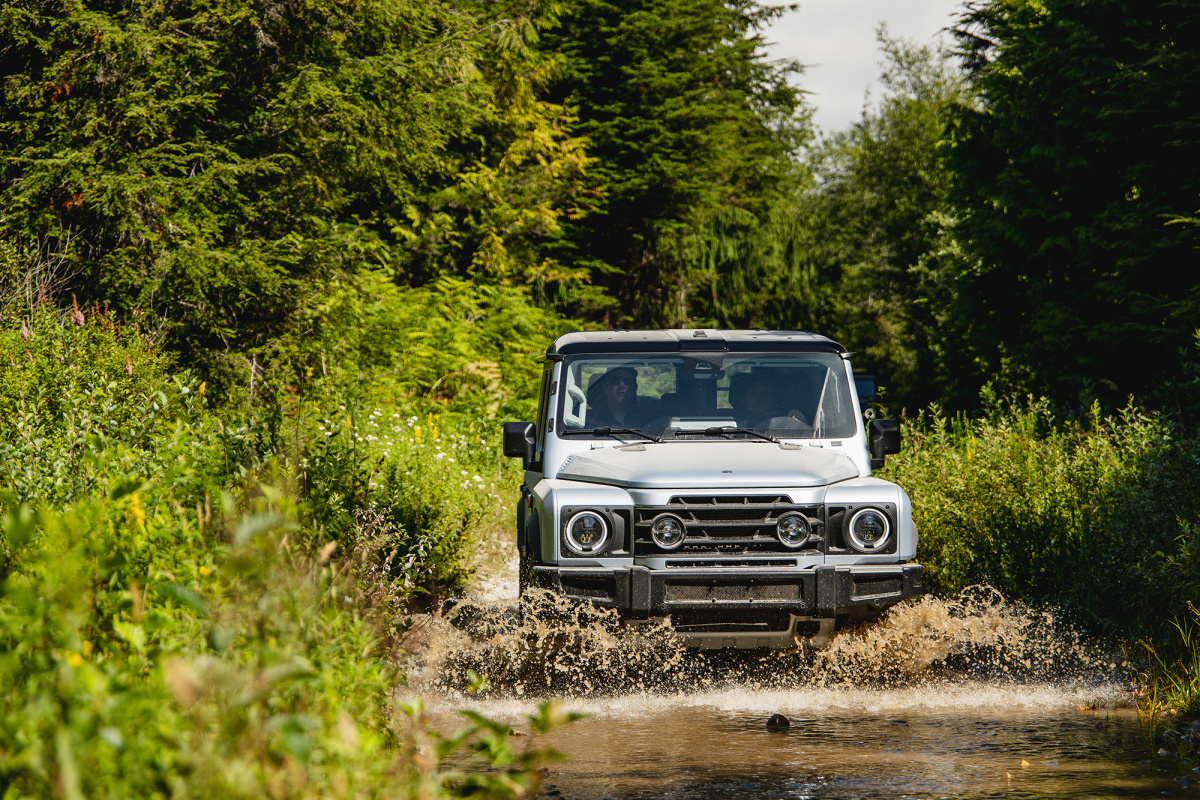
Chris Force drives a Grenadier across a small river. Low range has its own lever on the console. You lift a collar under the knob, move it, and feel it drop into place. Most trucks have turned this into a dial. Photo courtesy of INEOS
Sam mentions the number 37 several times. That is the count of electronic control units (ECUs) in a fully optioned Grenadier. “Most of our competitors, with all their off-road modes and all their electric sunroofs, are somewhere in the region of 100, 140 ECUs,” he says. Every module means pins and wires that corrode, and every one is a way to get stranded three days from a service bay. “Much more simplified means much more reliable when you’re out in the country.”
The logic runs through the whole truck. The body is galvanized steel, but the chassis is e-coated rather than galvanized, a decision made with a welder in mind. “If you need to make a repair in the field, welding galvanized metal is not ideal for the person with the welding torch.” The fumes are toxic. The seats adjust by hand. “Mechanical seats can’t go wrong.” The windows have no one-touch function, because the pinch sensor is one more part that can die. “If your sensor fails, the window won’t go up. Which means wet.”
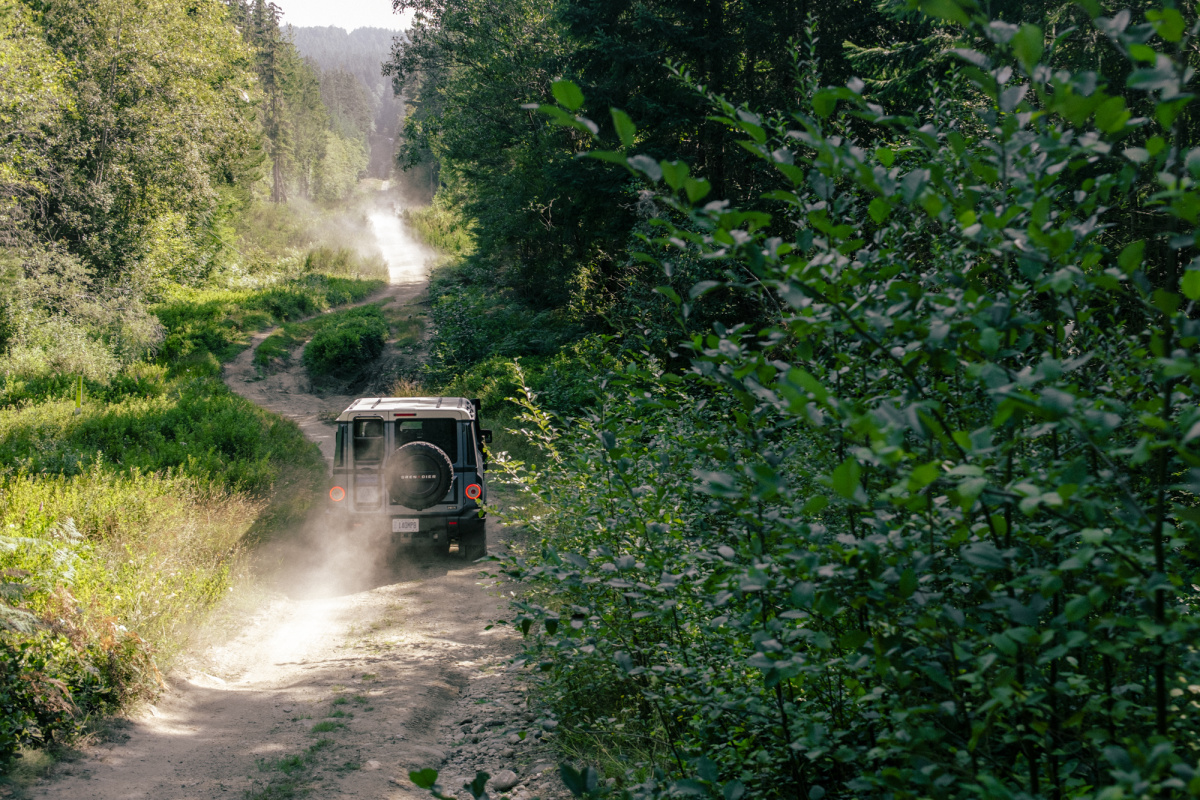
The truck’s body is galvanized steel, but the chassis is e-coated rather than galvanized, a decision made with a welder in mind. Photo courtesy of INEOS
There are no street maps in the dash; road navigation is your phone’s job, and the only built-in guidance is Pathfinder, a waypoint system that reads GPX files rather than restaurant listings. “We don’t put maps in the car because they’re out of date by the time we’ve programmed them in.” There are no 360-degree cameras either. “You’ve got a window, you’ve got a neck, and you’ve got the ability to shove your head out of the window,” Sam says. “A lot of people get used to the 360 cameras, and then suddenly you forget to use things like mirrors. And eyes.” The rubber floors lift out over five drain plugs so the entire cabin can be hosed clean, an upgrade on the ancestor. When the old Defender got that full of water, Sam says, “you used to have to go and find a 12-bore or a DeWalt and fire a hole in the floor. This one, you just pull the plug out, drive it around for a few minutes, the water drains out, plug’s back in. All done.” He closes the briefing with a recommendation about not getting eaten by bears and cougars, and we drive off into the forests of British Columbia.
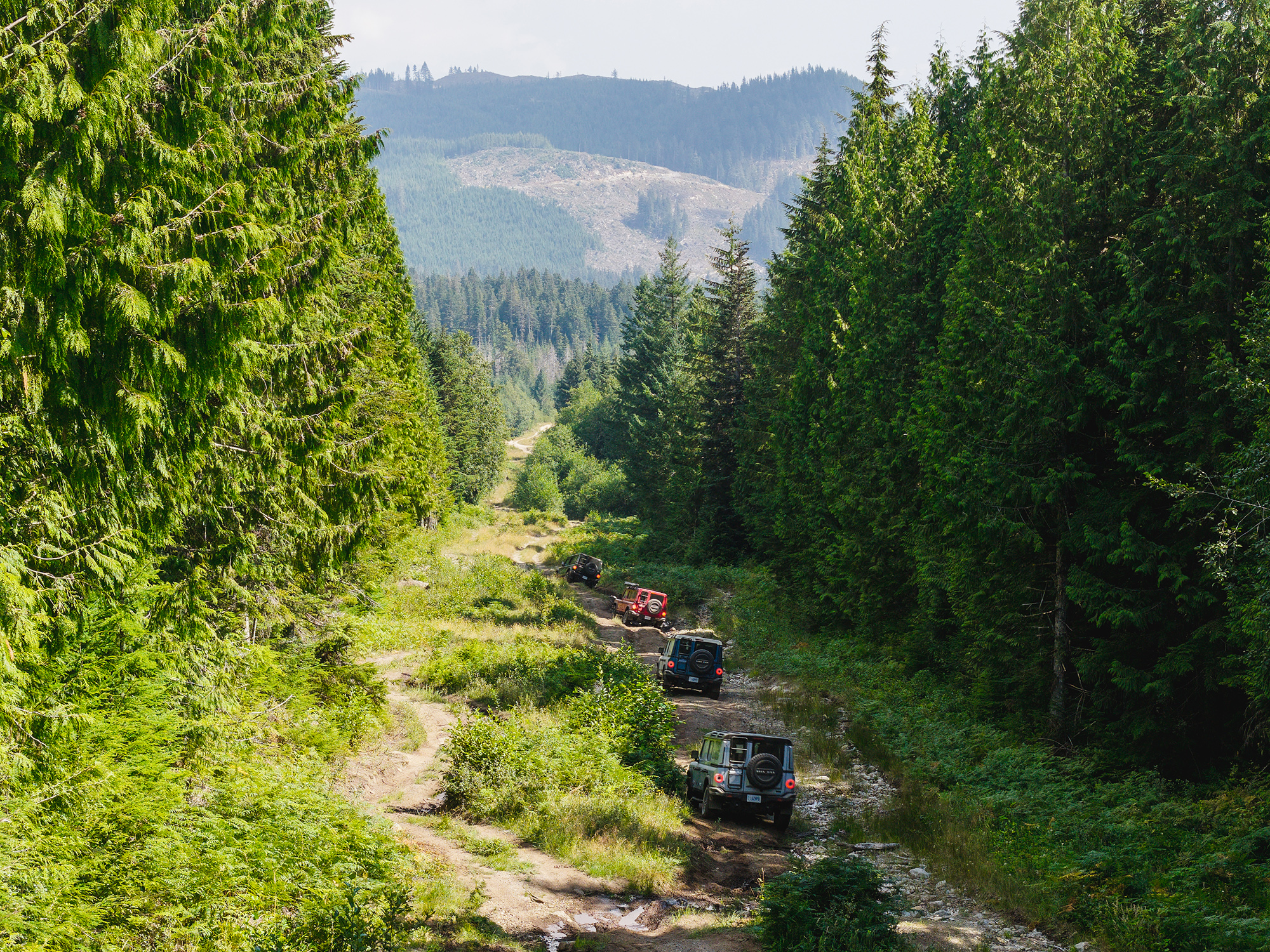
Sam has us shift into low range the moment the pavement ends. “Reduced speed, increased control, better safety, slightly less squeaking from me.” The fire trail is washboarded and studded with potholes, and the steering is the first thing I feel. The Grenadier uses a recirculating ball setup with slack built into the center on purpose, so a rock strike moves the wheel instead of snapping thumbs. Thumbs inside the rim, hands loose, I let the truck track over washboard that would rattle a unibody crossover apart. The slab sides mean I always know where the corners are; placing it on a tight trail takes eyes and a mirror, nothing else. When the steering wheel is turned to full lock, there are two stops, a hydraulic cushion first and a mechanical stop behind it, so the system never grinds metal on metal.
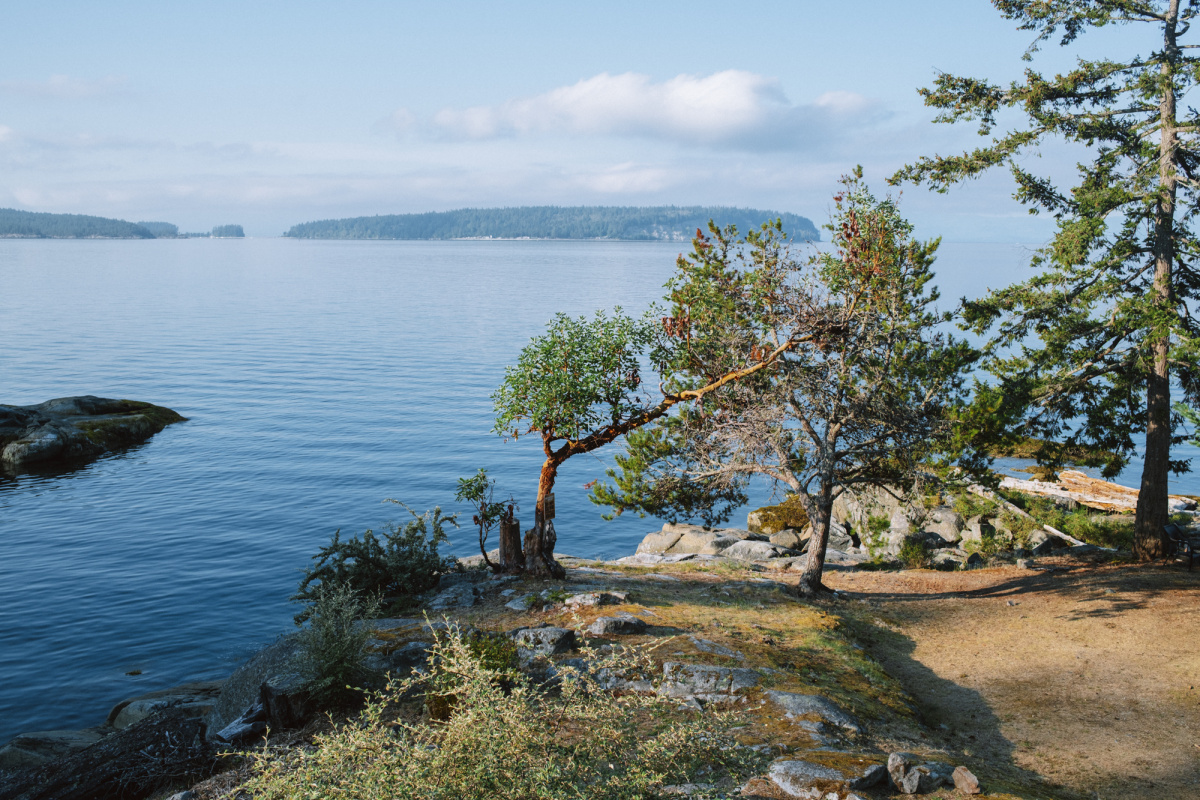
The Salish Sea, which runs from Puget Sound up past Vancouver Island across more than 6,500 miles of shoreline and 400-odd islands. Stand here for a minute and you understand why someone would build a truck like this. Photo by Chris Force
The logging roads climb into the country the floatplane hinted at, forest in every direction and nothing paved for a long way, and eventually they give up on being roads and turn into rock. This is where the differentials come in. I have almost no experience with any of this. It turns out not to matter. Sam talks me through the locks and the drive modes, most of them on an overhead panel that looks lifted from a cockpit, and within a few minutes I’m pointing the truck at things I’d think twice about on foot. It gobbles them. Ledges, ruts, loose rock, climbs where the only instruction is to keep the wheel straight and let the truck sort it out, and the Grenadier chews through every one of them at the same unbothered pace. I keep waiting for the moment it asks something of me. It doesn’t.
The pavement, when it comes back, is where the taxes show up. For 2026 INEOS fitted a variable-ratio steering box, tighter and firmer around center, and cut the turning circle by about five percent by extending the steering stops. The difference is between correcting constantly and correcting occasionally. It still refuses to self-center. Coming out of the first junction the wheel stays where I left it, and I wind the lock off myself, exactly as promised. “What you put into the turning, you need to take back out again,” Sam says. On the highway stretch the truck asks for more attention than it did off-road.
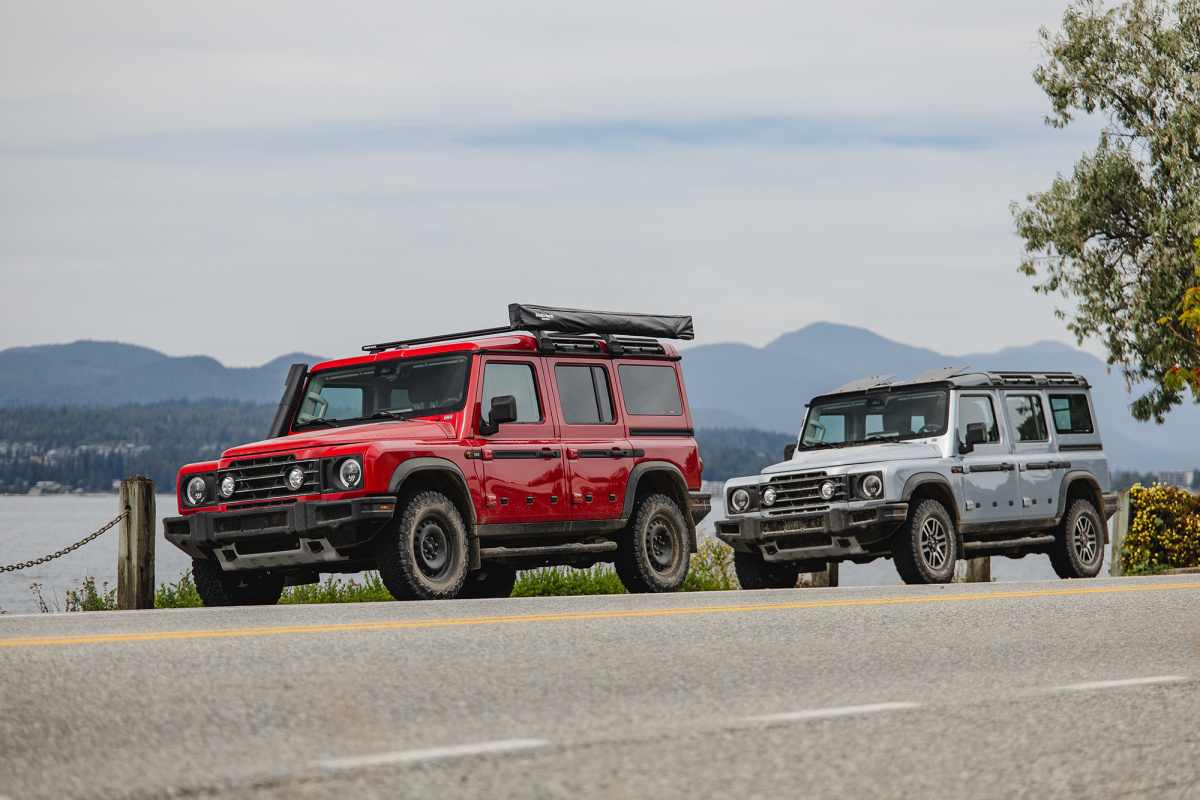
The Fieldmaster and the Trialmaster on the coast road. Both trim names come from Belstaff waxed cotton jackets, a brand Sir Jim also owns. Photo courtesy of INEOS
Scott Brady is at dinner that night. Scott publishes Overland Journal and Expedition Portal and was the first overlander to cross all seven continents by 4WD; his polar résumé includes two vehicle crossings of Antarctica and the first long-axis crossing of Greenland. That seven-continents record was set in the same Toyota Land Cruiser, driven on every continent over two years and completed in 2014. His current truck is a Grenadier Quartermaster, the pickup. He ran an early-production Fieldmaster more than 25,000 kilometers across Africa, Cape Town to Djibouti, without a single vehicle failure. The Fieldmaster, like the Trialmaster, is named for a Belstaff waxed cotton jacket (Sir Jim owns Belstaff as well). There is no better cosign than a person taking a machine to its limit and finding the limit holds.
Over dinner I ask Gregor what comes next. He is careful with it. INEOS will consider other models if they can be designed properly, he tells me, maybe a variant with a structure conceived around its cargo rather than a box grafted onto the back, maybe something smaller and more street-oriented, a truck that would meet the G-Wagen where the G-Wagen now lives. But for now the job is the Grenadier, done as well as it can be done. That focus has moved more than 36,000 trucks worldwide, with the United States its largest market. Companies with shareholders diversify. This one gets to concentrate.
The Beaver that flies me back to Vancouver went into production in 1947. De Havilland built 1,657 of them through 1967, and a good number are still working, many on floats along this coast, because nothing newer does the job better. The Grenadier is built on the same philosophy. Simple outlasts smart.