The afternoon I walk into La Gaîté Lyrique, a group of students is drawing the objects. Nobody stops them. Nobody stops anyone from sitting on a bench or handling a lamp either, which is the point. “Paris Design Week is often about creating an exhibition to show and to create distance. ‘Don’t touch,'” Christopher Dessus tells me. “I prefer to create a moment like this instead.”
Christopher is the architect behind Paf atelier and the publisher of Pli, the magazine he started when he was 24. This is his third September in a row taking over a Paris institution with a show named after a pop song. “Pour que tu m’aimes encore,” the Céline Dion song, ran at the Pavillon de l’Arsenal in 2024. Design Disco Club, which I wrote about from Lafayette Anticipations last year, took its cue from “Disco Inferno” and put about 40 designers around a chrome X with a light beam that swept the room once a minute.
This year, Tout est Chaos borrows the opening line of Mylène Farmer’s “Désenchantée,” the most played song on French radio in 1991. “Mylène Farmer is just a reference for pop culture,” he says. “It’s a pretext for me to find the narrative of the exhibition.” The narrative, as he puts it, is not another Paris Design Week opening. “It’s about the future of design. It’s about the possibility of design, and why it’s possible to create today within this chaos.”
-

- Christopher Dessus in front of Casta Diva. Christopher trained at the École nationale supérieure d’architecture de Versailles, teaches, and in 2024 launched JTM, an annual magazine that looks at creativity through emotion. Photo courtesy of Pli Office
-

- Atelier Fomenta’s Casta Diva is a theater in rubber and metal, with a curtain, a stage, a spotlight and podiums. Atelier Fomenta built it to be walked through and touched. Photo by Florent Michel/11h45
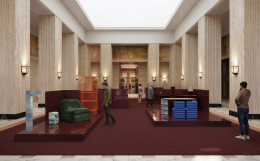
It starts at the door. “The triangle, this form is the basis of stability,” Christopher says, and the scenography plays that stability against the chaos of the title from there. The walls are the metal framing used to put up partitions in apartments, which Paf atelier can unbolt and use again. “All is reusable, with no waste.” Bureau Bruit, who scored Design Disco Club, is back among the production partners. The ground floor, he says, is a résumé of the whole selection, materials and narrative in one room. Upstairs the same system runs long, and a tower carries the thread between the two floors.
-

- Bright hearts appear throughout the show as part of Paf atelier’s scenography, marking the route and softening all that steel. The studs keep their factory printing, so the set never hides where it came from. Photo by Florent Michel/11h45
-

- The same framing climbs into a tower that rises toward the Gaîté’s upper level. At its base, a patterned rug hangs from one frame and a green shelving unit stands in for a wall. Photo by Florent Michel/11h45
The scale is new. Christopher invited 11 studios, among them matali crasset, Samy Rio, Odd Matter, Maria Jeglinska-Adamczewska, and Cluzel / Pluchon, then opened a call to designers with less than five years of experience. 64 made the cut, 75 names in all, and the Gaîté gave him the building. “It’s a carte blanche for me.” Ask how a project that size gets produced for a five-day run and the answer is partnerships and his own time and money. “For all the designers, it’s free,” he says. “I raise a lot of partnerships, and I invest a lot of money.” The rest of his year goes to retail scenography and institutional work in Paris and Milan.
-

- Pli Office’s film, also titled Tout est Chaos, wraps the walls of the Gaîté’s immersive 360 Room. Jason Borruso directed it. Photo by Florent Michel/11h45
-

- Between title cards, Jason Borruso’s film moves through an eye, a face and a ring of shapes that circles the room. The 360 Room gives visitors a pause from the objects on both floors. Photo by Florent Michel/11h45
What he does with the freedom is seat the established next to the untested. Samy Rio‘s terracotta table lamps are the studio’s first self-produced series, made by a Burgundy roof-tile manufacturer. Camille Viallet and Théo Leclercq’s Canelé lamp, a cotton shade pinched into a steel frame, is their first piece for HAY. Cluzel/Pluchon turned their Théorème Éditions pendant system into an installation, and Patrick de Glo de Besses set a group of chairs inside a large triangle marked out on the floor. Grégory Lacoua’s InOut coat rack is a ready-made of cast-off industrial parts, and his Slice bench was developed for the laminate maker Polyrey. Odd Matter’s piece can be a seat or a bed.
-

- Samy Rio’s terracotta lamps run from pale yellow to deep brown, some glazed and some left raw. Each of Samy Rio’s shades is open at the top, where the light comes through. Photo by Florent Michel/11h45
-

- Looking down one spine, an orange clamp lamp, glass vessels and a woven lounge chair stack into a single view, with no partition between one designer and the next. Photo by Florent Michel/11h45
I have seen some of this work in other emerging-design group shows, where it can read as craft. Here it reads as thinking. The staging does an unusual amount of the lifting, and the open-call designers sit beside established designers like matali crasset without a step down between them. Christopher noticed the same thing. “The young people have a really good quality of project,” he says. “It’s not just about having money. It’s about having the intelligence of the project.”
-

- Glass vessels stack funnels, cups and gourd shapes in orange, pink, chartreuse and pale blue on a corrugated steel shelf. Photo by Florent Michel/11h45
-

- A ladder-back chair covered in tufted yarn, its rungs striped in rust and cream, stands alone in a frame against a black wall. Photo by Florent Michel/11h45
-

- A small chair patterned in a black and natural-wood checkerboard rolls on casters across a sheet of corrugated decking hung between two frames. Photo by Florent Michel/11h45
-

- Ribbed orange vessels, one upright with flowers and one on its side, share a shelf with a folded gold box. Photo by Florent Michel/11h45
-

- Through the frames, a steel cabinet fading from blue to silver and a white ceramic piece overlap, with a red pendant glowing behind them. With so little wall to stop the eye, work by different designers overlaps from almost anywhere in the room. Photo by Florent Michel/11h45
-

- Tout est Chaos flew its flag over the Théâtre de la Gaîté, which opened on rue Papin in 1862 to designs by Jacques-Ignace Hittorff and Alphonse Cusin. The City of Paris reopened the building as La Gaîté Lyrique, a center for digital arts and music, in 2010, and admission to Christopher’s show was free. Photo by Florent Michel/11h45
After five days the walls came down, as designed. The framing goes to the next one.
Tout est Chaos ran September 10-13, 2026 at La Gaîté Lyrique, 3 bis rue Papin, Paris, as part of Paris Design Week.