Samantha Gallacher tells me not to look yet, then flips her phone camera around and walks me into the front room of a gallery I’ve never seen in person. The first thing in the frame is Andreea Avram Rusu standing next to a light fixture that climbs the wall, crosses the ceiling, and arcs back down. It’s one of Andreea’s Continuum pieces, a single illuminated line wrapping the entry like a drawing made in glass.
Untold Editions is the name of what they’re doing here. It’s a permanent gallery, not a pop-up, and it’s structured around a premise that the people who make the work also run the shop.
Samantha is the founder of Art+Loom, the Miami-based rug studio that has spent the last 13 years arguing that hand-knotted rugs belong in the same conversation as collectible furniture and lighting. Andreea, born in Romania and trained as an architect, runs Avram Rusu Studio out of Brooklyn, where she makes lighting at installation scale, sometimes using glass techniques too unpredictable for production runs.
They’ve been collaborating for years. The story Samantha tells me is that she “basically cold-called” Andreea out of nowhere to put her lighting in the Miami showroom, and from there they ended up developing a line of rugs whose silhouettes are pulled directly from the lighting. Earlier this year, they were both exhibiting at Collectible in New York when another exhibitor mentioned an empty space downtown. Samantha left the fair for an hour, walked through it, came back, and called Andreea. They decided to open together that day.
-
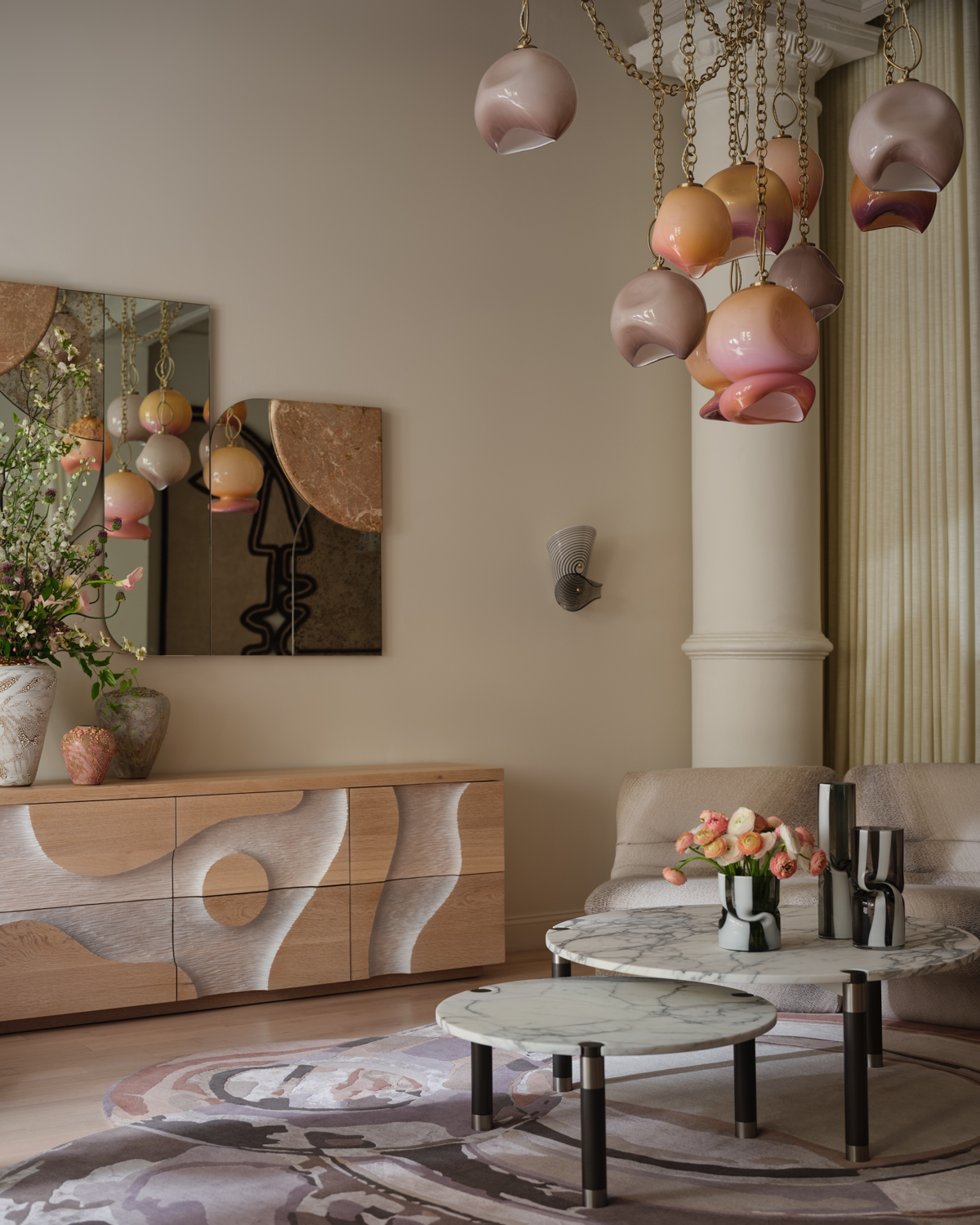
- Andreea Avram Rusu’s Marea collection chandelier, blown in heat-reactive glass that ranges from apricot through deep rose. The carved walnut credenza beneath it is by the North Carolina furniture maker Casey Johnson, and the round mirror at left is from the gallery’s collaboration with Parts & Assembly in Los Angeles.
-
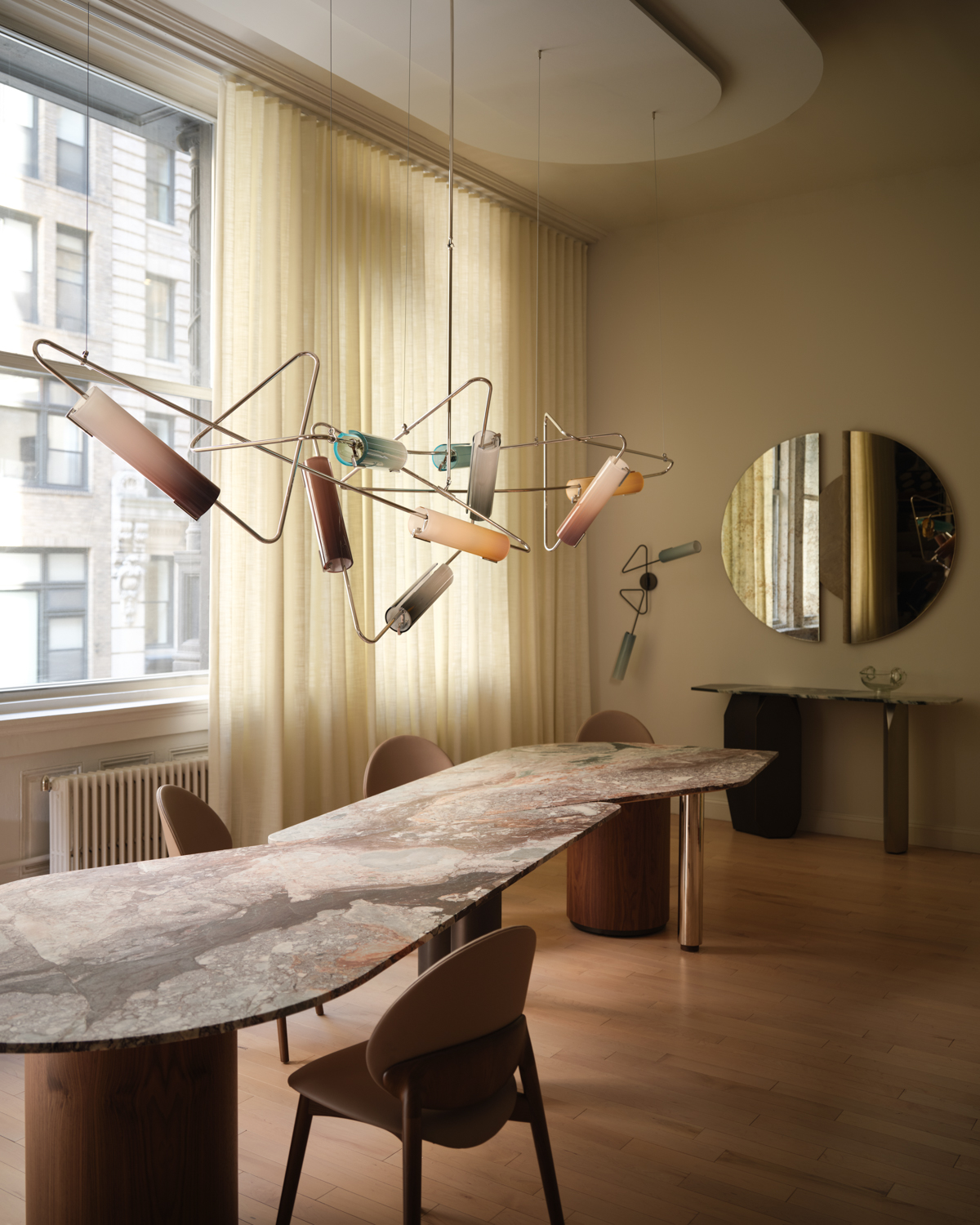
- A view across the dining room: Andreea Avram Rusu’s one-of-a-kind closed-loop Continuum chandelier, suspended over the custom dining table she designed for Untold Editions.
The model they’ve landed on is something they kept describing to me as “by makers, for makers.” Most of what’s on view at any given moment will be Samantha’s rugs and Andreea’s lighting and furniture, including pieces designed specifically for the gallery. Around those works, they’re rotating in friends, every six to eight months, whose work they want to show. No heavy commissions. No exclusive contracts. Casey Johnson, the North Carolina furniture maker whose carved wood console sits under one of the mirrors, signed on quickly because, as Samantha relays it, he was “tired of the old gallery model and had been burned by galleries.”
I just got back from Milan, where the most resonant work I saw at Salone was almost universally staged in apartments, not in trade booths. The Future Perfect-style show house has done something to how this industry presents itself. I asked Samantha if she sees the same shift.
“I love the show house concept versus the showroom concept,” she said. “It feels more personal, and it’s actually easier to sell more expensive pieces when you see what a spectacular impact it would have on an interior.”
Andreea pushed it further. “If you have a place where people want to spend time, maybe they don’t need what you’re showing that moment, but maybe they’ll always want to be back.”
-
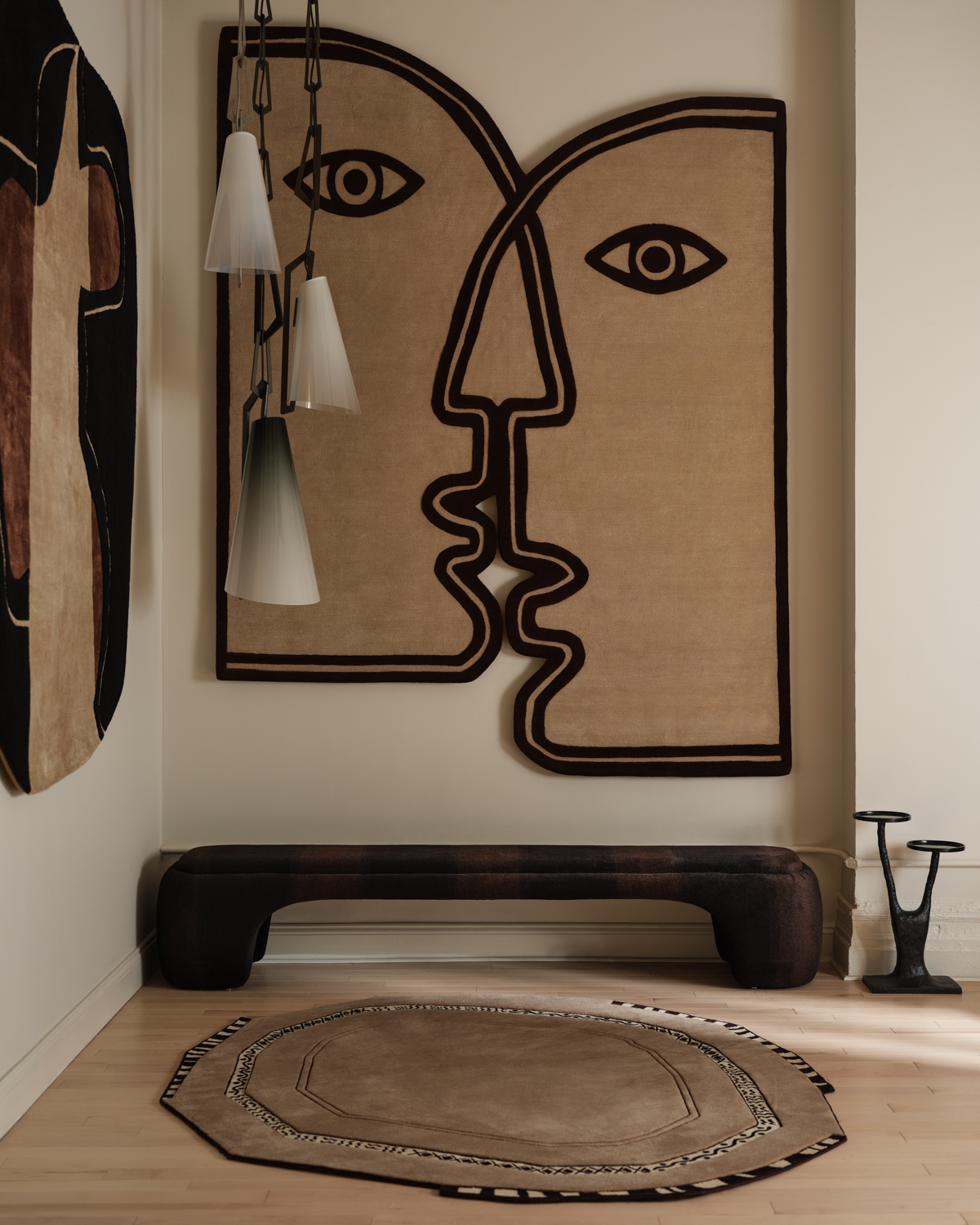
- A wall-hung rug from Samantha Gallacher’s collaboration with the Israeli artist Shira Barzilay, translated from one of the artist’s paintings into hand-knotted wool. The bench beneath the rug is by Aguirre, reupholstered in Sandra Jordan’s striated brown alpaca.
-
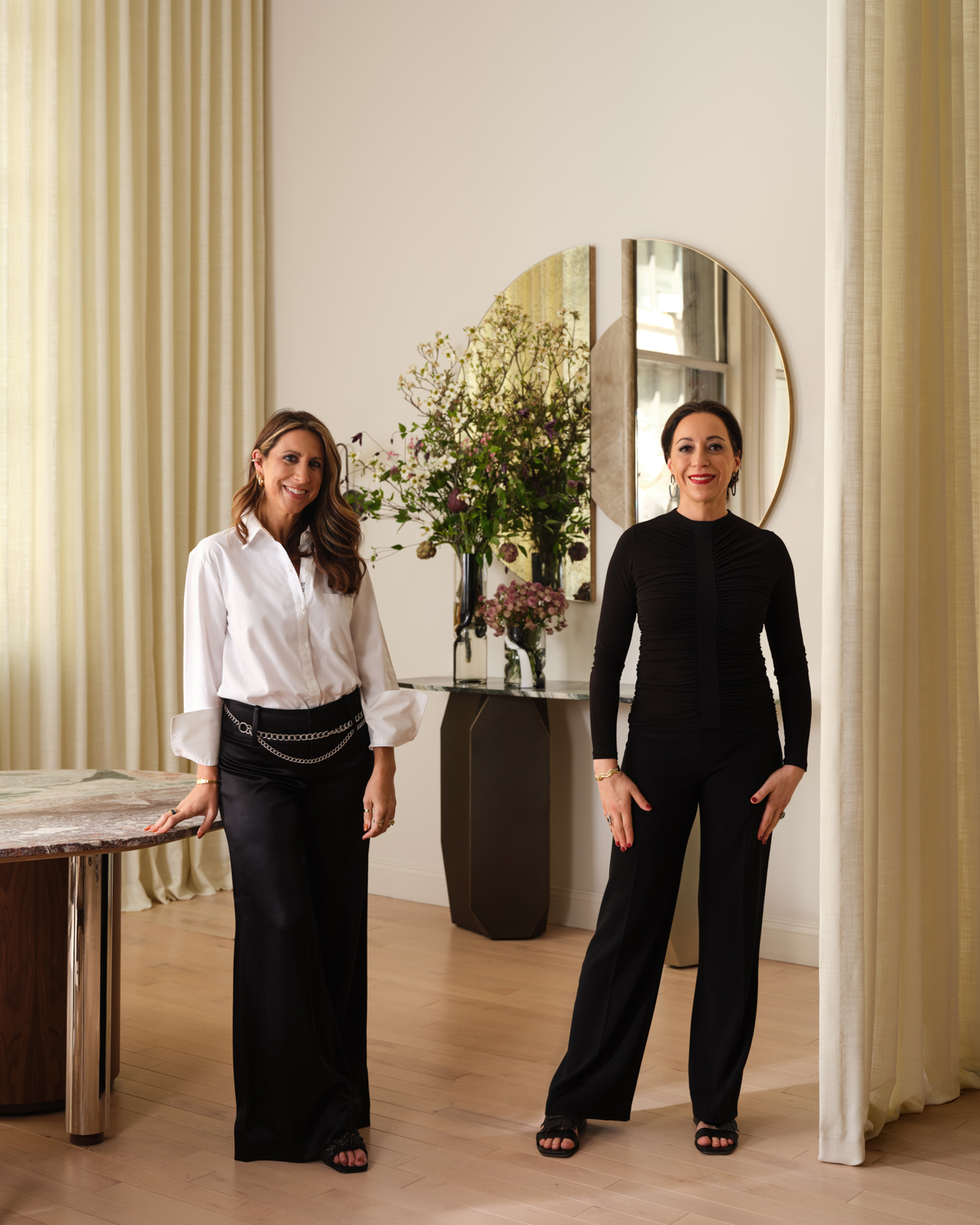
- The founders of Untold Editions: Samantha Gallacher (left), of Art+Loom, and Andreea Avram Rusu (right), of Avram Rusu Studio. Samantha and Andreea have been collaborating for years on rugs whose silhouettes are pulled from Andreea’s lighting.
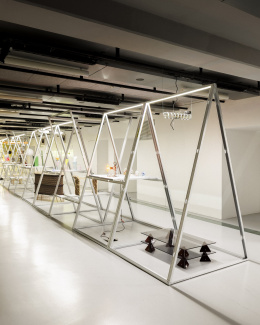
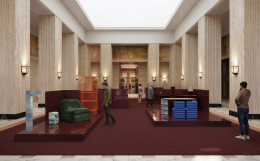
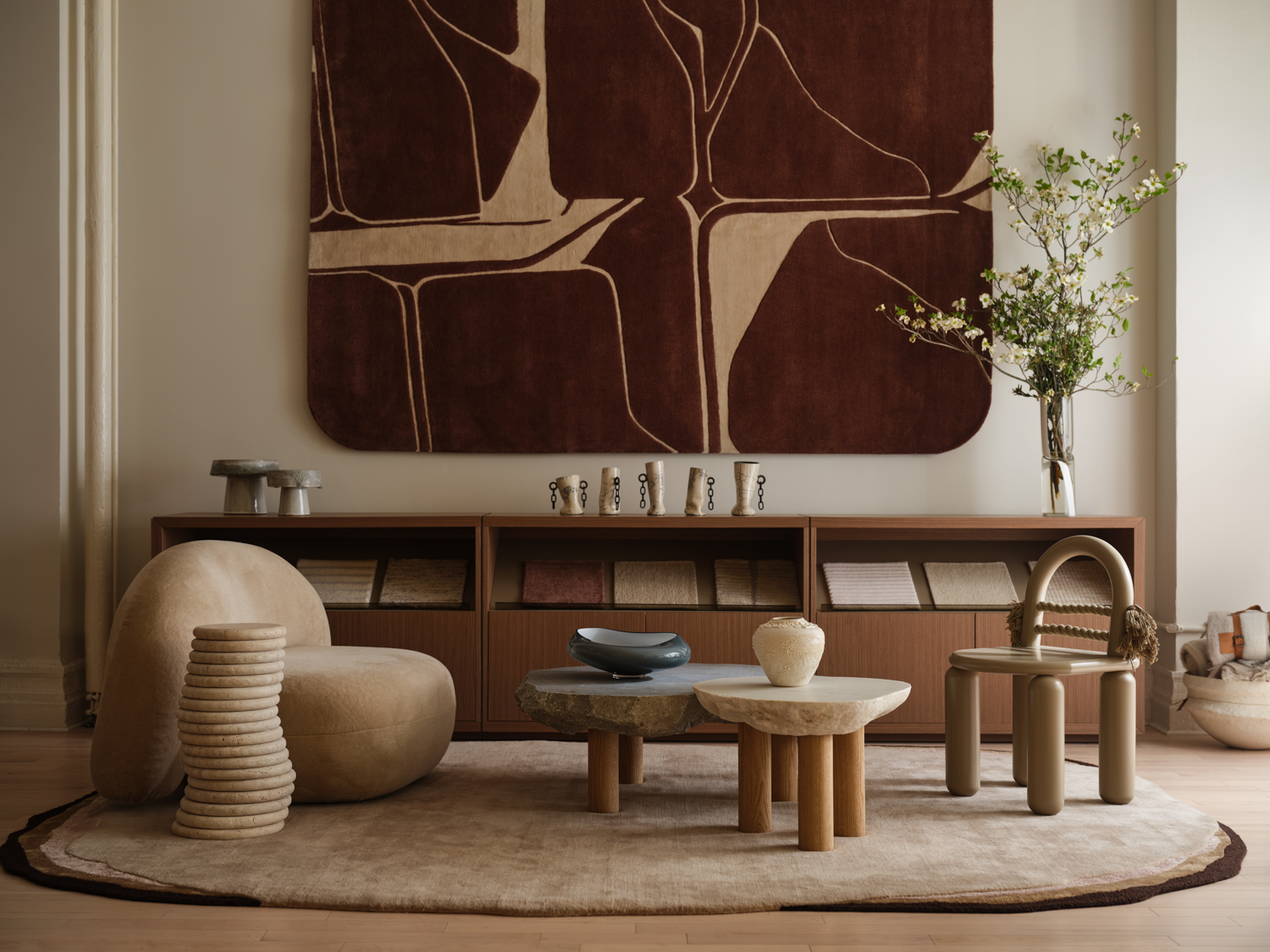
The gallery itself is staged like an apartment. Vignettes, not booths. A vintage sofa reupholstered on the diagonal in Sandra Jordan’s striated alpaca, with mohair pillows whose covers play the salvage edge as a feature. Andreea’s Nova nesting tables in front of it, modular, brass legs, marble tops. Glass and ceramic pieces tucked into custom millwork that extends the entry hallway. A lacquered chair by the young Italian designer Virginia Arlotto, rope-detailed at the seams, finished in a high-gloss color that matches the rope itself. A stacked travertine piece by Manifeste Edition, a French marble designer who fabricates in Turkey.
The piece I would love most in my own home is the stunning dining table at the center of the space. Andreea designed it for Untold. It’s two sections meeting on a diagonal, supported by three legs each, every leg in a different finish: solid walnut, polished nickel, oil-rubbed bronze. The slab on top is the kind of stone you don’t easily forget. Deep burgundy with raisin and peach moving through it, and a thread of teal Andreea pointed out at one edge. Above it hangs a one-of-a-kind closed-loop Continuum chandelier, the first time she’s done one of her Continuum pieces as a closed circle at this scale.
I asked them both how they think about collectible design as a category, particularly around pricing. Last year at Design Miami I’d been talking with the fair’s CEO, Jen Roberts, about whether collectible design might eventually follow the contemporary art market into speculative territory, with futures and resale appreciation. She didn’t think it would. The objects, she argued, are still functional, and that functional ceiling caps the price.
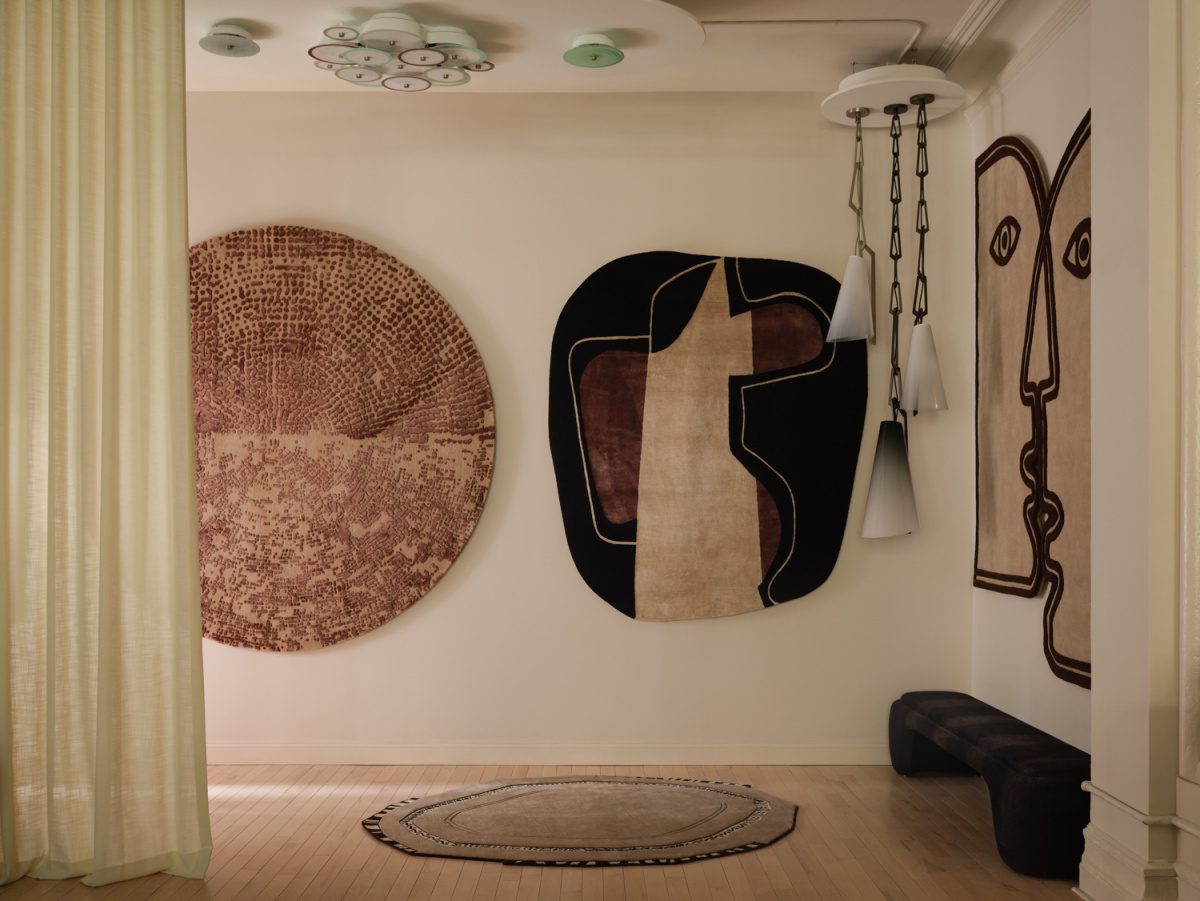
A view of the gallery’s entry wall, where Samantha has hung three of her hand-knotted rugs as art. Overhead, Andreea’s Nymphaia ceiling fixture clusters hand-blown glass discs in pale green and cream, a composition inspired by water lilies.
Samantha mostly agrees, at least when it comes to rugs. “I have a hard time thinking that a rug, unless it’s hung on a wall, can really grow in value,” she told me. “We hand-knot them in Nepal and they’re meant to be heirlooms, but you’re still having your dogs and your kids on it.”
Andreea’s answer was more complicated. She thinks the question of whether a piece becomes “collectible” in the market sense has more to do with the maker’s career than with the object. “The amount of control I actually have over that is pretty minimal,” she said. “I can only decide what I want to do as a creative. I want to make installation-scale, spatially interactive pieces.”
That’s what Untold Editions is built around. Not a thesis about where the market is going, but a place that lets two designers continue making the work they were already going to make, and bring their friends in to do the same. The space they finished installing yesterday is the proof of concept, and walking it remotely is its own argument for what apartment-style staging is doing to the gallery model.
Untold Editions opens May 7, 2026, at 20 West 20th Street, Suite 203, in Manhattan.