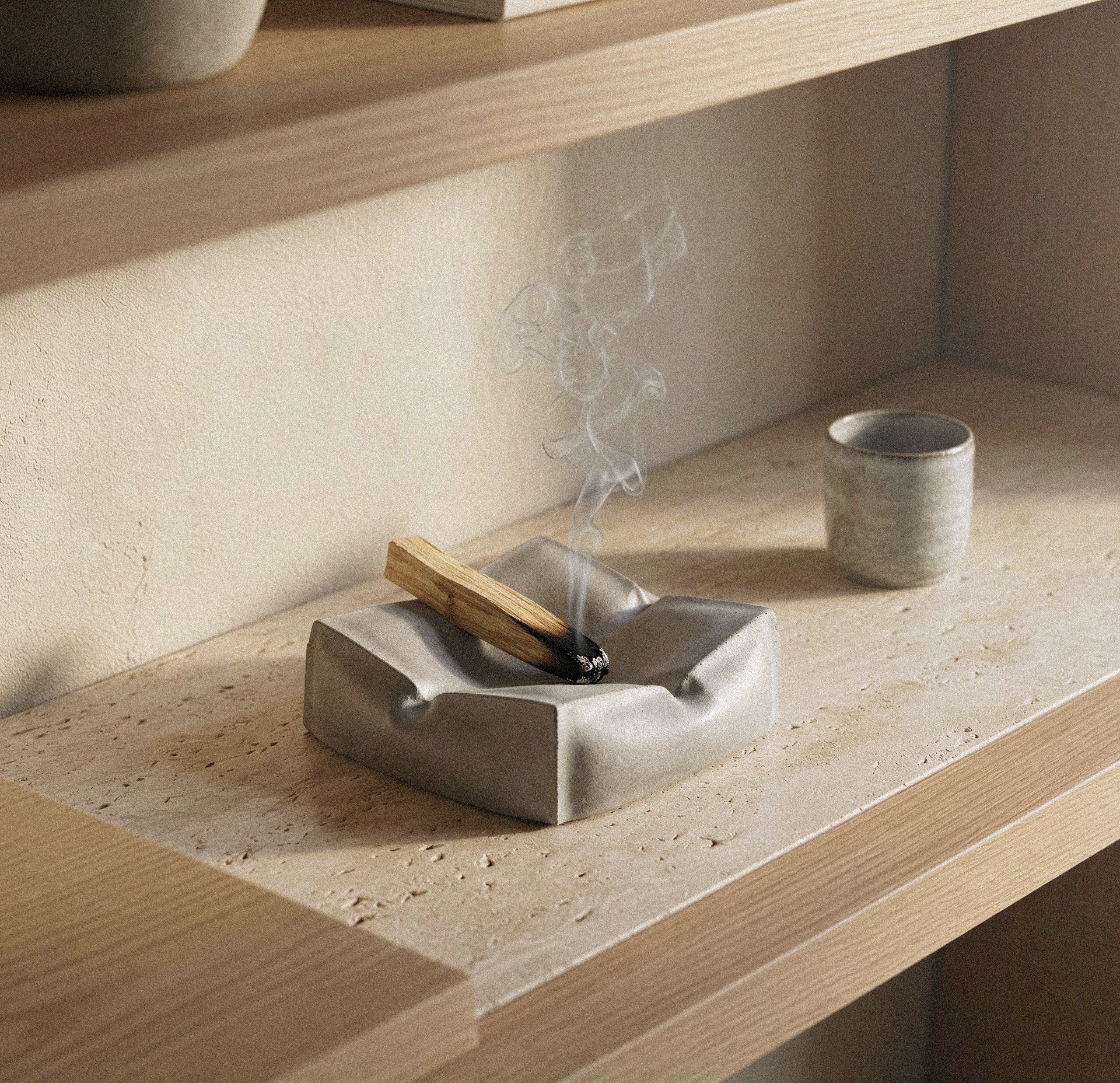
The Pillow Tray looks exactly like what it’s called: a pillow, slightly bent at the edges that seems like it should be soft to the touch. Pick it up and the illusion holds for about half a second before the weight gives it away—two pounds of solid concrete.
The tray is made in Berlin by a designer julius.works, who works at the intersection of digital tools and physical craft. He tells me the design for the Pillow Tray began on a screen, developed through a simulation-based process and refined across multiple prototyping rounds to get the proportions and surface tension just right. From there it was cast by hand in fine concrete, then sanded and finished manually.
“The starting point was the idea of translating a soft, almost textile-like gesture into a solid object,” says Julius. “A key aspect is how the piece retains a sense of lightness and movement despite being made from a dense material.”
The Pillow Tray belongs to a growing conversation in collectible design around what happens when digital tools are used not to achieve perfection, but to create forms that feel surprising. London-based duo Soft Baroque have been doing something similar for years, using digital processes to create objects that question conventional notions of the functional and aesthetic, blurring the line between art and design in ways that feel more like material critique than decoration.
Julius is working in that same spirit, using digital simulation to develop a form that would be nearly impossible to arrive at by hand.
“The tray sits at the intersection of digital design and contemporary object culture, somewhere between product design and collectible design,” Julius says. “It reflects a broader shift toward more fluid, organic geometries made possible through digital tools.”
The tray is available in two finishes, raw concrete and ultramarine, the latter with a deep blue pigment that gives it an entirely different character in a space. It works as an ashtray, a jewelry dish, or a place to rest a piece of Palo Santo.
A version of this article originally appeared in Sixtysix Issue 16.