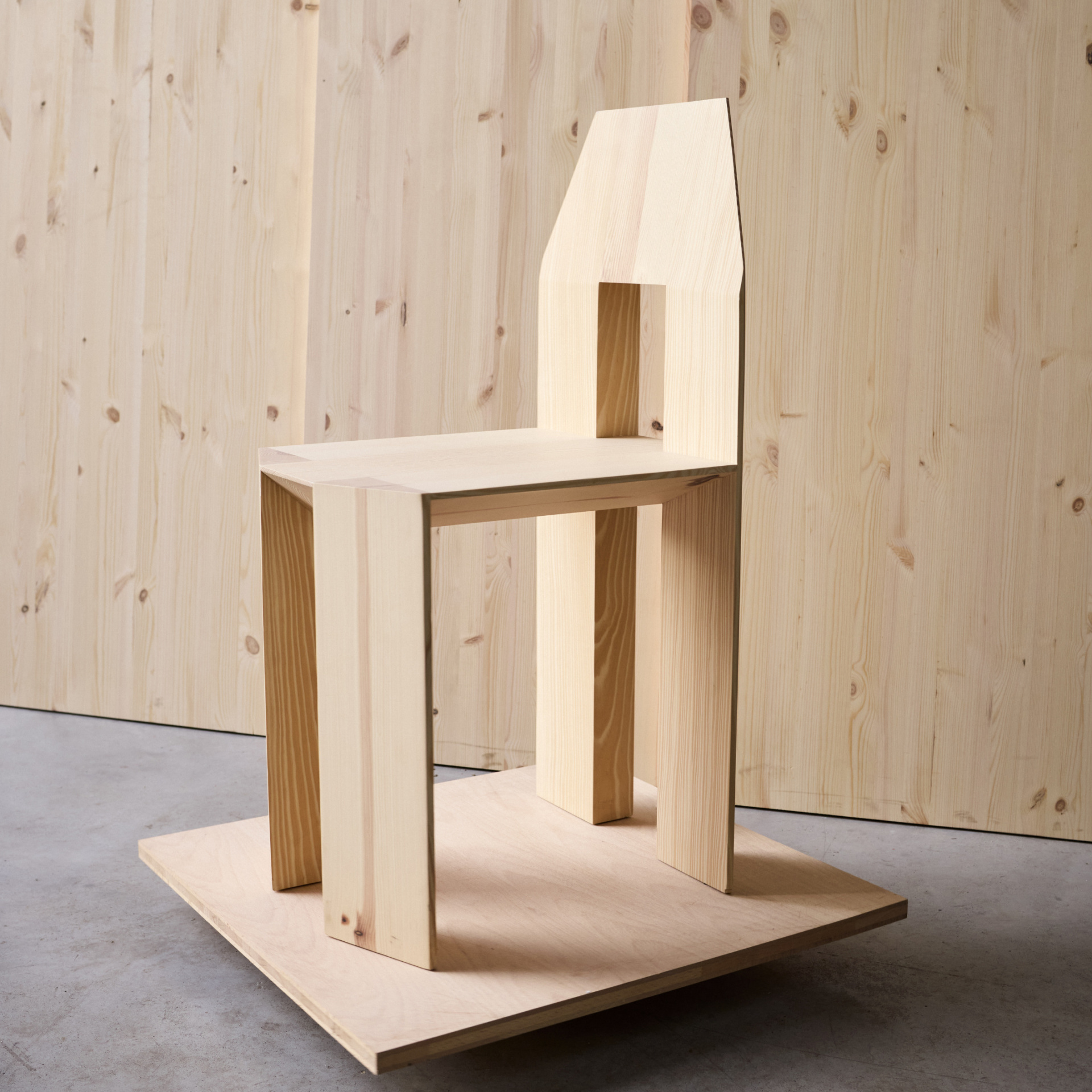
There is a certain kind of design problem that Max Lamb finds irresistible: take a standard industrial material, push it as far as it will go, and see what comes out the other side. The Min Chair, developed in collaboration with furniture brand Hem, is a particularly elegant answer to that question.
The chair is built from a single timber dimension, 75 by 125 millimeters, a standardized industrial plank that arrives from suppliers around the world, dried, seasoned, and trimmed before Max begins working with it. From that starting point, the entire chair is designed around the material rather than the other way around.
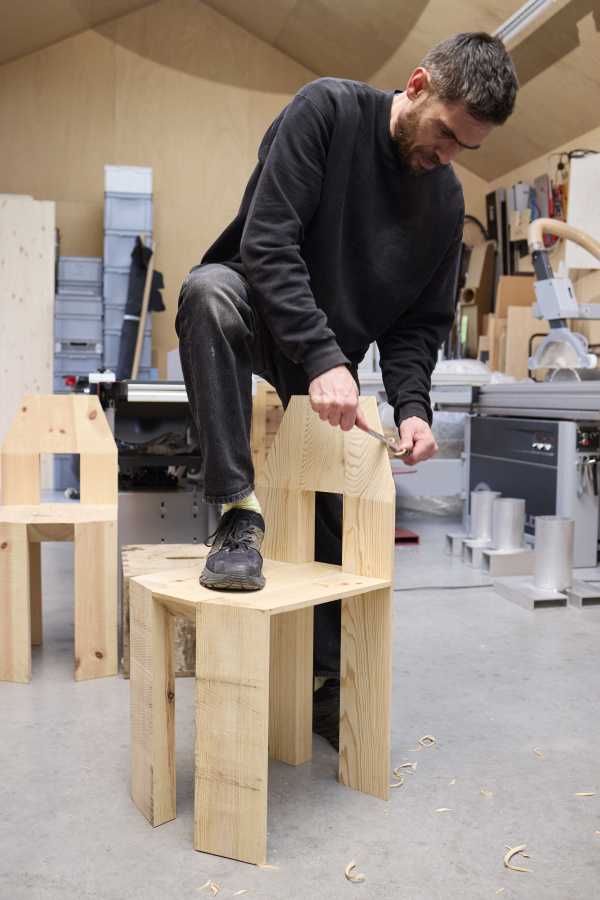
The chair is built from a single timber dimension, 75 by 125 millimeters, a standardized industrial plank that arrives from suppliers around the world, dried, seasoned, and trimmed before Max begins working with it.
“I start with a square or rectangular section of wood and cut it in half diagonally, resulting in essentially two triangles,” Max says. “Those triangles become the back or front legs, or the side rails of the chair. Effectively, you make one leg, but by slicing it diagonally, you get two.”
That single cut is the key to everything. By dividing the timber diagonally rather than squaring off each component, the chair uses almost half the material that a conventionally legged chair would require.
“What gives the chair its personality and character is not necessarily about using as little material as possible,” he says. “Rather it’s about making one piece of material go twice as far as it otherwise would if the legs were square.” The result is a chair that is lighter, more refined, and more economical to produce, without any of those qualities feeling like a compromise.
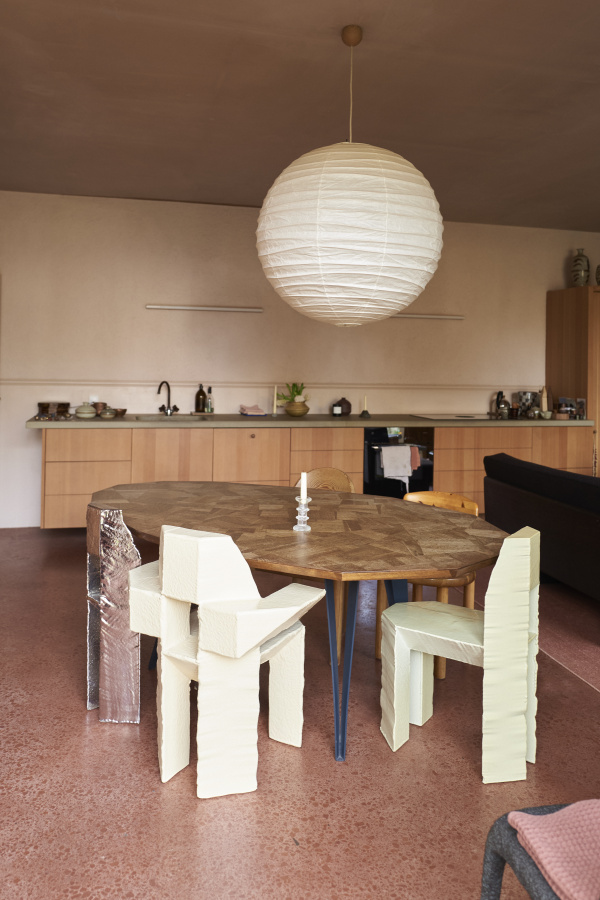
The Min Chair is the latest iteration of Max’s ongoing Economy Chair project, which began in 2020 with a small production run made entirely from polystyrene.
The Min Chair is the latest iteration of Max’s ongoing Economy Chair project, which began in 2020 with a small production run made entirely from polystyrene. The chairs in the original series were cut from three square blocks, each component sliced diagonally to create pairs of legs and side rails. From there, Max explored the same logic in lime wood, glulam, and other materials.
“Rather than creating a square piece of wood, I would modify the design to work with the standard dimensions of the raw material I was using,” he says. “That’s what I’ve done for the Min Chair as well.”
Moving into timber brought its own set of challenges. Where polystyrene is static and unaffected by its environment, wood is anything but.
“Wood is a law on its own,” he says. “It absorbs humidity and shrinks when dried out, and has a tendency to crack if it’s not treated carefully. When you cut through wood, you reveal tensions in the grain structure that are otherwise hidden.” To navigate those tensions in production, Max and Hem landed on joining two smaller pieces of timber to achieve the required section size rather than working from a single larger plank. Differences in grain structure between the two pieces balance one another out, producing a more stable and consistent material without changing the visual character of the chair.
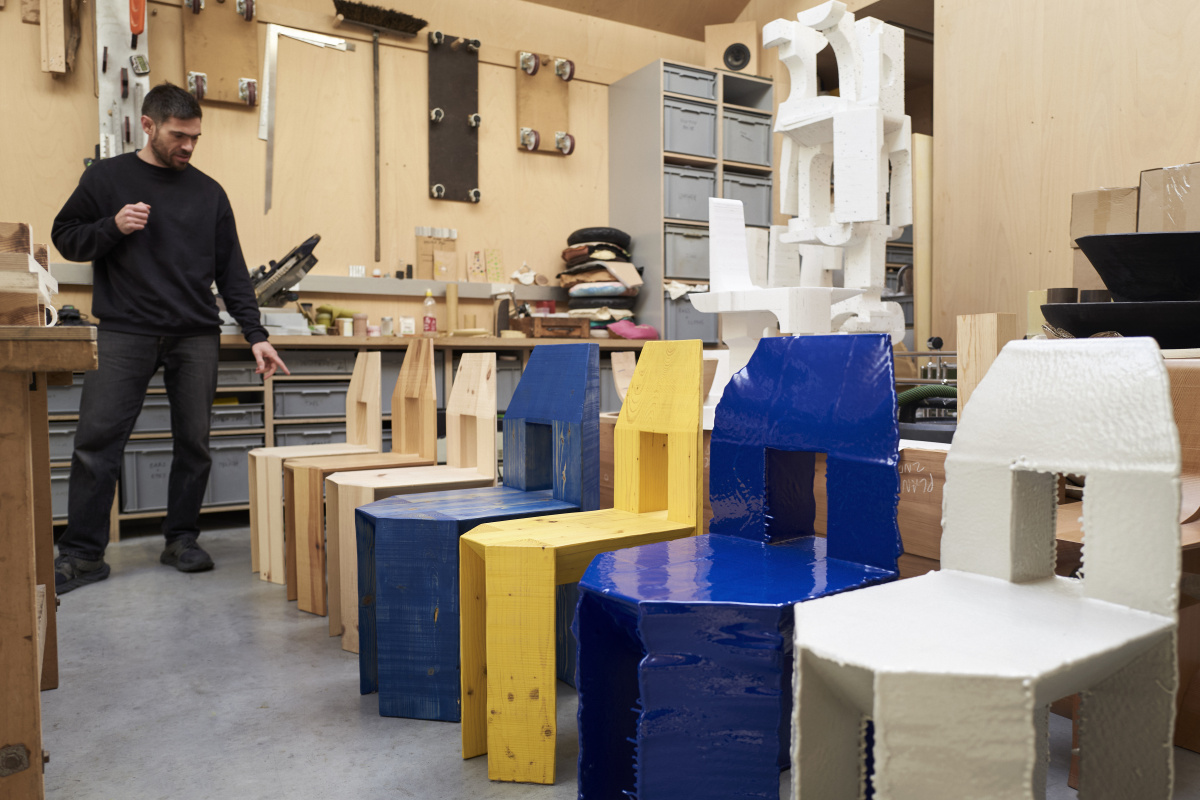
The chairs in Max’s original series were cut from three square blocks, each component sliced diagonally to create pairs of legs and side rails. From there, Max explored the same logic in lime wood, glulam, and other materials.
The production process also required decisions about finish. In the prototype versions, cut using a bandsaw with a very thin blade, Max left the blade marks visible on the surface, a trace of the making process embedded in the object. For the production version, that face is planed smooth after cutting.
“This removes a very small amount of surface imperfection, but results in a much cleaner, safer surface,” he says, “ultimately making the chair more commercially viable.” It’s a small concession, and one he navigated carefully to ensure the chair’s essential character remained intact.
That tension between studio spontaneity and industrial consistency is something Max thinks about often. In his workshop, decisions happen in real time, responsive to what the material is doing in front of him. At production scale, that freedom narrows a bit.
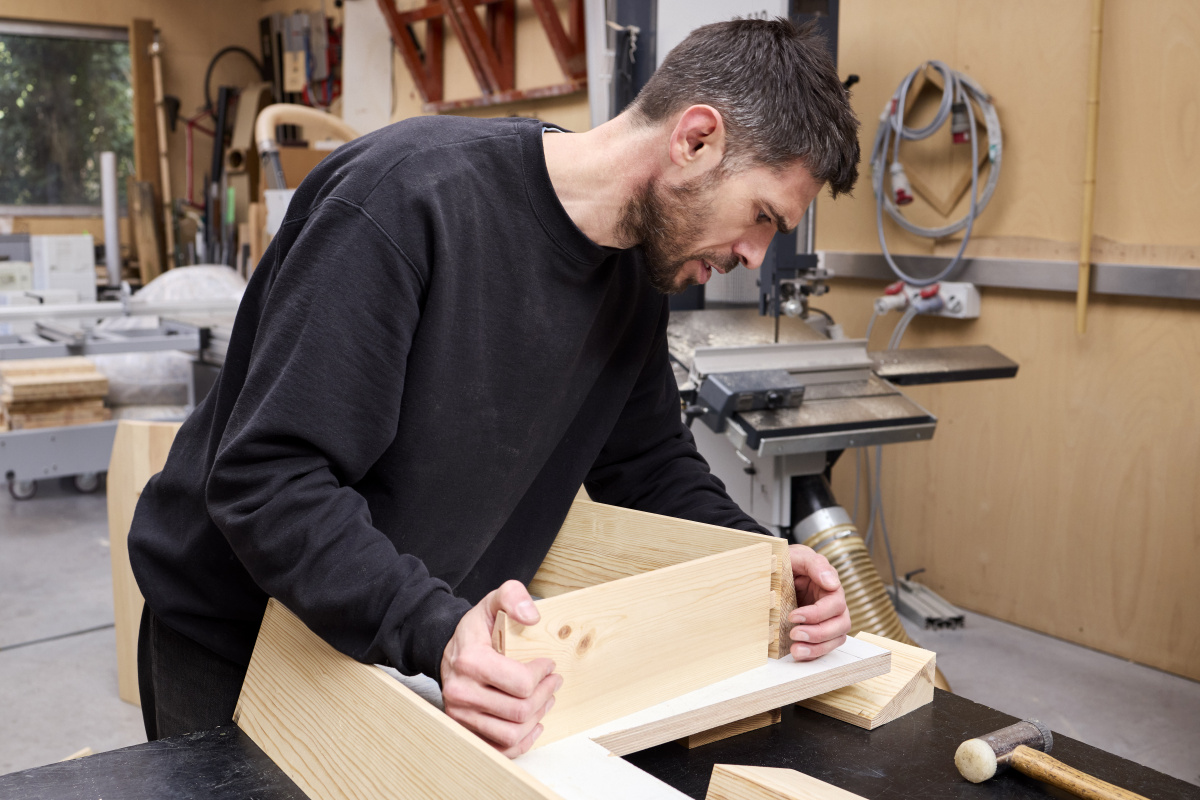
“All of the development and prototyping happens within my workshop,” Max says. “I want to make sure that the design is responsive to material, the properties of the material, and the production process.”
“In an industrial setting, there’s a need for a much more streamlined approach,” he says. “The technical development of that piece is more paramount to achieve those efficiencies and consistency so that every single product that comes off the production line has uniformity.” For Max, whose practice is rooted in making rather than drawing, that shift requires a different kind of discipline.
“All of the development and prototyping happens within my workshop,” he says. “I want to make sure that the design is responsive to material, the properties of the material, and the production process.”
The Min Chair is the clearest expression yet of what that process looks like when it works.
“The design is a consequence of the making process and my endeavor to achieve these efficiencies in production and material usage,” Max says. “The outcome is a chair that has personality, has an aesthetic, but that aesthetic and personality is a consequence of those endeavors to efficiency.”