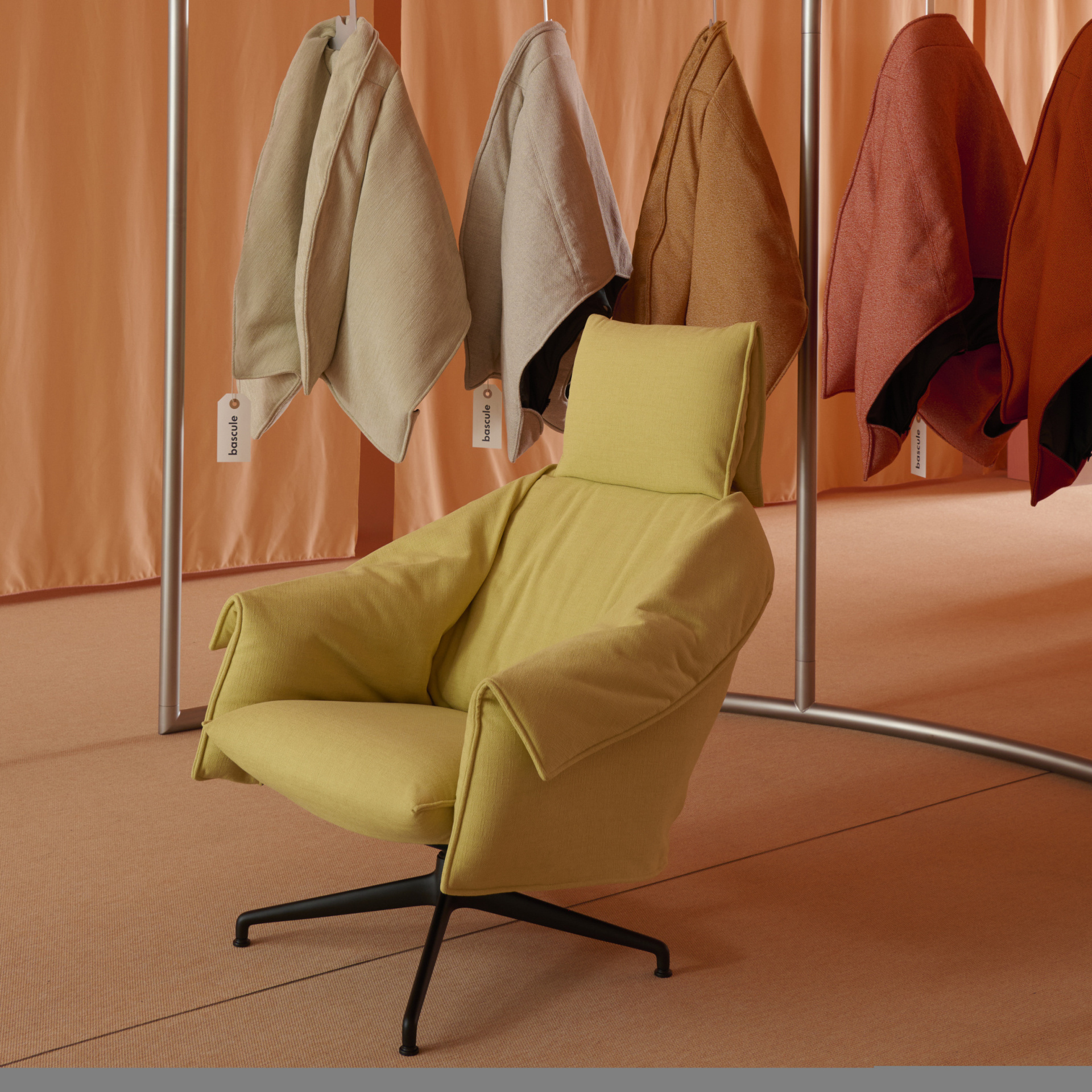
Lisa Ertel and Anne-Sophie Oberkrome of Berlin-based Studio Πstarted not with a shape, but with a feeling from childhood when they were designing their latest piece with Vitra: the weightless back-and-forth of a seesaw. The result is Bascule, a lounge chair built around the idea that the best seat might be the one that never forces you to sit still.
That feeling first stemmed from a new reclining mechanism Vitra’s engineers had developed, one Lisa and Anne-Sophie built the entire chair around rather than trying to fit it into an existing form.
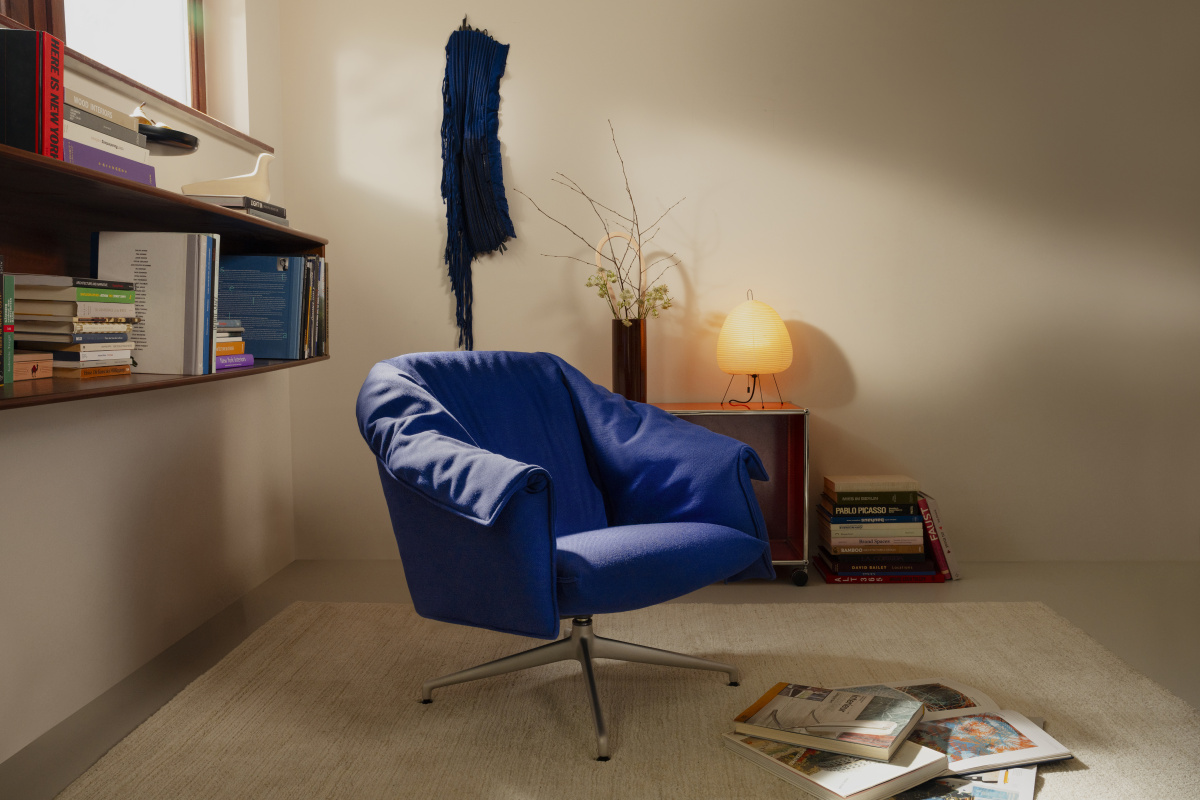
Bascule’s loose cover is designed to move like a piece of clothing, using tailoring techniques that let it shift and fold as the body changes position.
“The mechanism developed by Vitra offers a very fluid, almost weightless transition between upright sitting and deep reclining, which felt both intuitive and new to us,” Lisa says. “That sense of movement became a core design driver, we didn’t want to design around it, but rather let the entire chair emerge from it.” The name follows from the same idea–”Bascule” is French for seesaw.
That decision shows up most obviously in the chair’s upholstery. Where a lot of contemporary lounge chairs go for a tight, controlled surface, Bascule’s fabric hangs loose.
“We were drawn to a softer, more relaxed expression because it makes the chair feel approachable and familiar,” Anne-Sophie says. “The loose cover brings a sense of openness and ease. It communicates softness at first glance and invites you to settle in naturally, in your own way. Fashion was an important reference for us, especially in terms of how garments are designed for movement. We approached the cover like a piece of clothing, using tailoring techniques that allow it to adapt as the body shifts.”
The reference to clothing even extends past aesthetics into how the chair is actually built. Clothing gets taken on and off, cleaned, replaced, and Lisa and Anne-Sophie wanted Bascule’s textile elements to work the same way.
“This idea informed our ambition to create a lounge chair whose textile elements can be easily removed, maintained, or replaced, supporting both serviceability and a longer product life,” Lisa says, adding that Vitra’s range of fabrics and colors also lets each chair take on its own character.
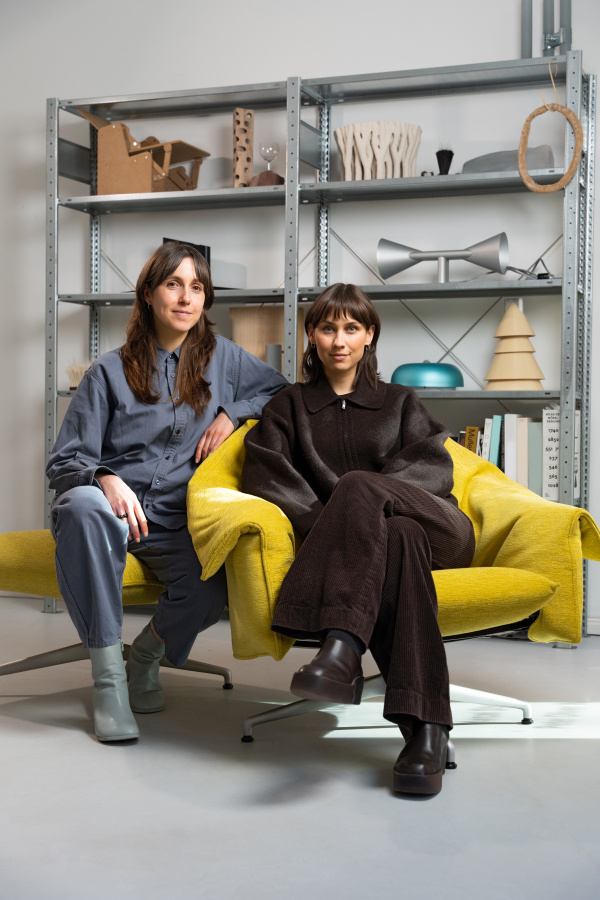
Studio Œ’s Lisa Ertel and Anne-Sophie Oberkrome designed Bascule around a new reclining mechanism developed by Vitra’s engineers.
Because the fabric moves with the body instead of staying fixed, the design process for Bascule meant watching a lot of textiles in motion.
“As the chair moves, the fabric continuously shifts, tightening in some areas, relaxing in others, forming folds that define its character,” Anne-Sophie says. Every textile behaved differently under that kind of movement, ranging from calm and structured to livelier and more textured. The studio treated that unpredictability as a feature rather than something to iron out.
That same instinct shaped how they thought about comfort itself.
“It’s the feeling that a chair understands and supports how you want to sit without asking you to adjust,” Lisa says. “We wanted you to sense the comfort before sitting down. It’s a kind of honesty, a chair that feels as relaxed as it looks.” Even small details carry that logic through, like the headrest on the high-back version, which nods to the everyday habit of folding a pillow behind your head.
“We liked the idea of translating these familiar everyday moments into the design.”
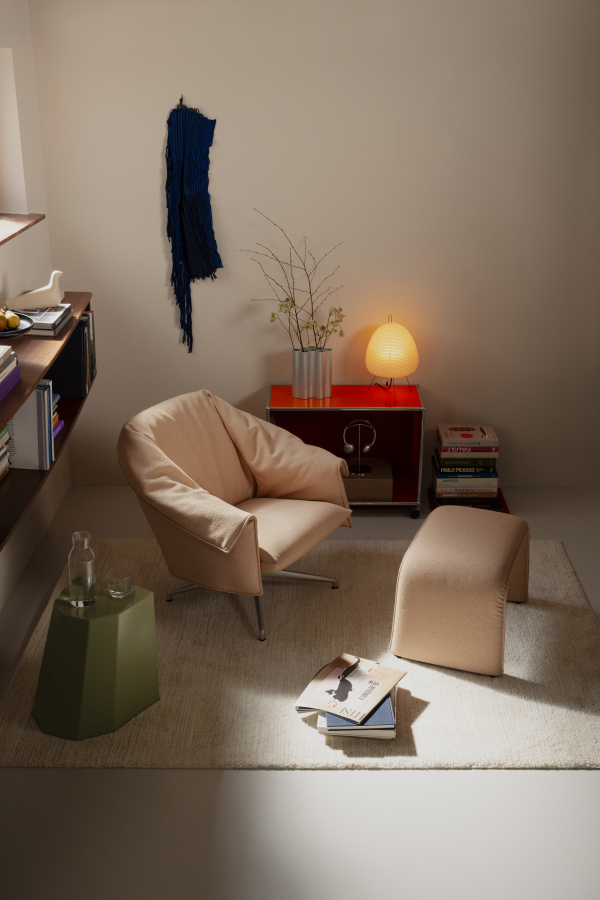
Bascule avoids adhesives throughout its construction, allowing every part of the chair to be removed, repaired or replaced.
Bascule also skips adhesives entirely, relying on separable materials instead, many with a high share of recycled content.
“We wanted to question conventional upholstery, especially glued constructions that make repair and recycling difficult,” Lisa says. Its cushions use recycled PET fibers and V-Foam, a recyclable foam Vitra developed with BASF. Removing the cover exposes the chair’s inner components for easy maintenance.
“This means that every part can be removed, repaired, or replaced,” says Anne-Sophie. “For us durability also means adaptability, the ability of a product to evolve with different contexts, needs, and lives.”
“We see Bascule as a proposal for a lounge chair that rethinks comfort through movement, adaptability, and transparency,” Lisa says. “Instead of offering one fixed idea of relaxation, it supports a broad range of positions, from upright sitting to a more reclined, almost daybed-like posture. It combines comfort with openness, durability with adaptability, and a soft, familiar expression with an honest and transparent construction.”