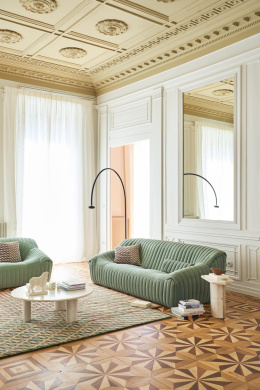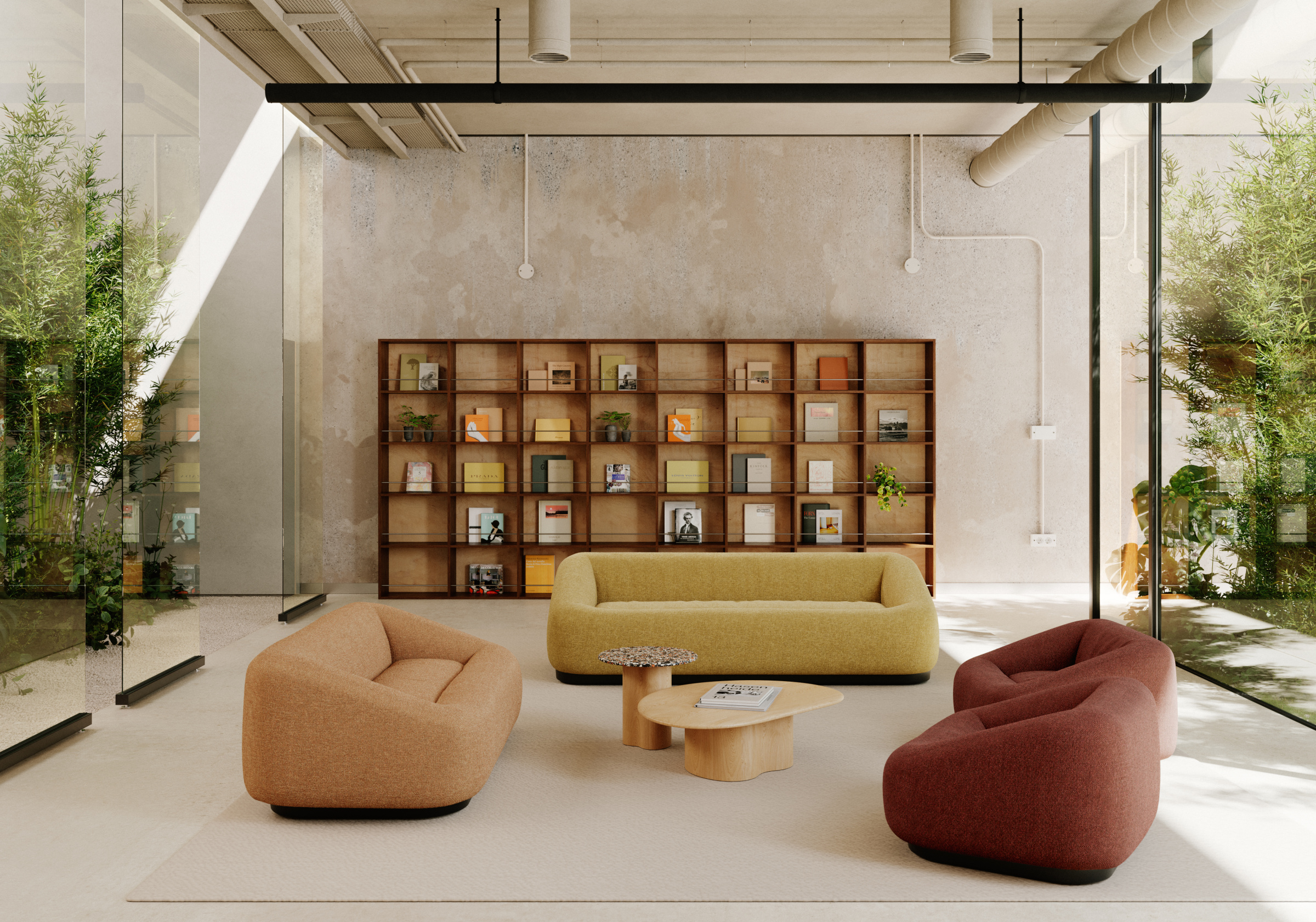
Jean-Marie Massaud has spent over three decades designing furniture defined by lightness. Aom, his new seating collection for Arper, is the clearest distillation of that philosophy. Debuting at Salone del Mobile 2026 and shown again at Chicago’s Design Days, Aom is built from just two components. Neither one is wood, foam, or metal in the way most upholstered seating still relies on.
“Aom embodies the essence of comfort, at home and in hospitality settings, both indoors and outdoors,” Jean-Marie says. “No design for design’s sake, but rather a holistic synthesis of lightness, expertise, longevity, and genuine sustainability.”
The two components in question are a structural base in expanded polypropylene, or EPP, and a cushion core made from Breathair, a recyclable polyester elastomer. There’s no polyurethane anywhere in the collection, no wooden frame, and more unusually, no glue or staples holding anything together. Instead the pieces interlock mechanically, held in place through friction joints and tensioned envelopes rather than adhesive. It’s a construction method few upholstered sofas attempt, largely because it’s harder to engineer and manufacture at scale.
“By eliminating glue and staples, its assembly requires tight manufacturing tolerances and advanced production capabilities, such as those available within Arper’s own facilities,” he says. Aom is produced in Europe within Arper’s own manufacturing network, specifically because that network could handle the precision the design demanded.
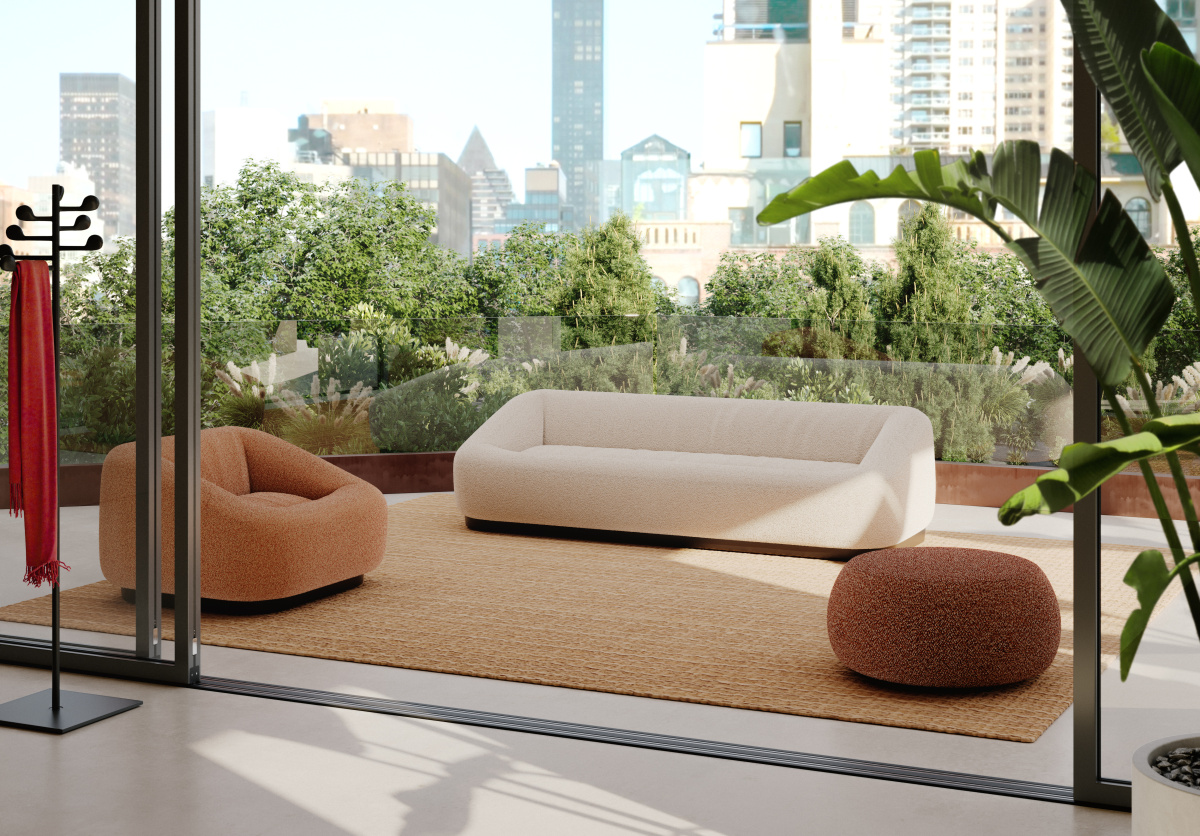
Aom is built from just two components. Neither one is wood, foam, or metal in the way most upholstered seating still relies on.
Getting there took time. Jean-Marie and his studio spent close to three years on research, prototyping, and stress testing, refusing what he calls the “standard shortcuts” of upholstered furniture.
“Every friction joint and tension envelope had to be engineered from scratch to meet contract-grade performance requirements,” he says. The payoff shows up in how the material behaves once it’s built. Breathair is an open-cell foam, which means water passes straight through it instead of pooling, letting Aom move between indoor and outdoor settings and dry quickly after rain, a detail that’s rare in a piece meant to also work as a living room sofa.
Even the manufacturing process was built around waste reduction. The EPP base and Breathair core are molded and machine cut using processes designed to make efficient use of material, while the slipcovers and tensioned envelopes are hand tailored, a deliberate mix of industrial precision and handwork.
“Aom combines soft-tech industrial precision with expert textile craftsmanship,” he says.
For Jean-Marie, all of this sits at a specific inflection point in furniture history, a break from the heavy frames, metal springs, and adhesives that have defined upholstered seating since the 19th century.
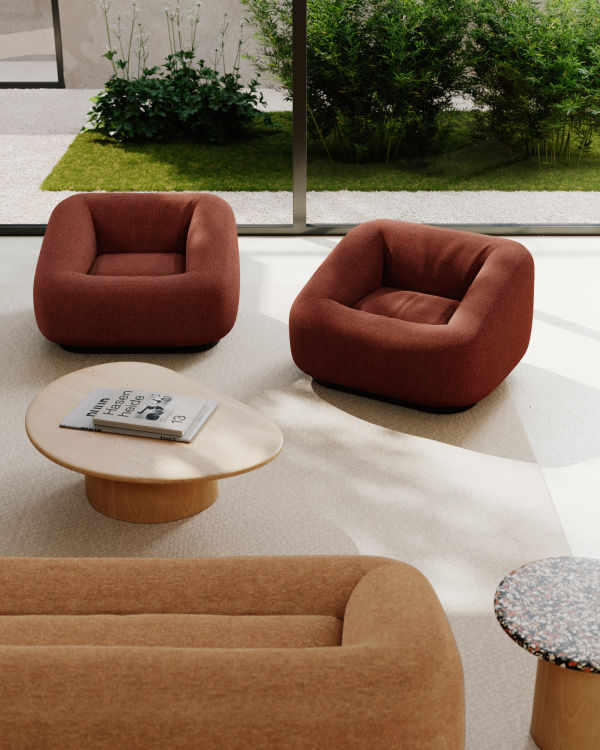
“We are witnessing a shift from status to well-being and from possession to flexibility,” says Jean-Marie. “People want furniture that moves with them, works indoors and outdoors, and is designed for long-term durability.”
“We are witnessing a shift from status to well-being and from possession to flexibility,” he says. “People want furniture that moves with them, works indoors and outdoors, and is designed for long-term durability.” That shift shaped Aom’s whole design brief, distilled into a single line Jean-Marie kept returning to throughout development. “We can do better with less,” he says. “Aom is a manifesto for virtuous radicalism.”
But he is careful to separate that ambition from anything that reads as performative.
“With Aom, we didn’t want to create a product that shouted, ‘I am sustainable,'” he says. “Instead we wanted to address two questions: How can we make radical sustainability invisible? How can we reconcile desire with responsibility?
“Aom acts as a lightweight, adaptable anchor,” he says. “Unbound by heavy frames, it can be moved effortlessly from a living room to a sunlit terrace or easily reconfigured in hospitality spaces, adapting seamlessly to changing needs.”