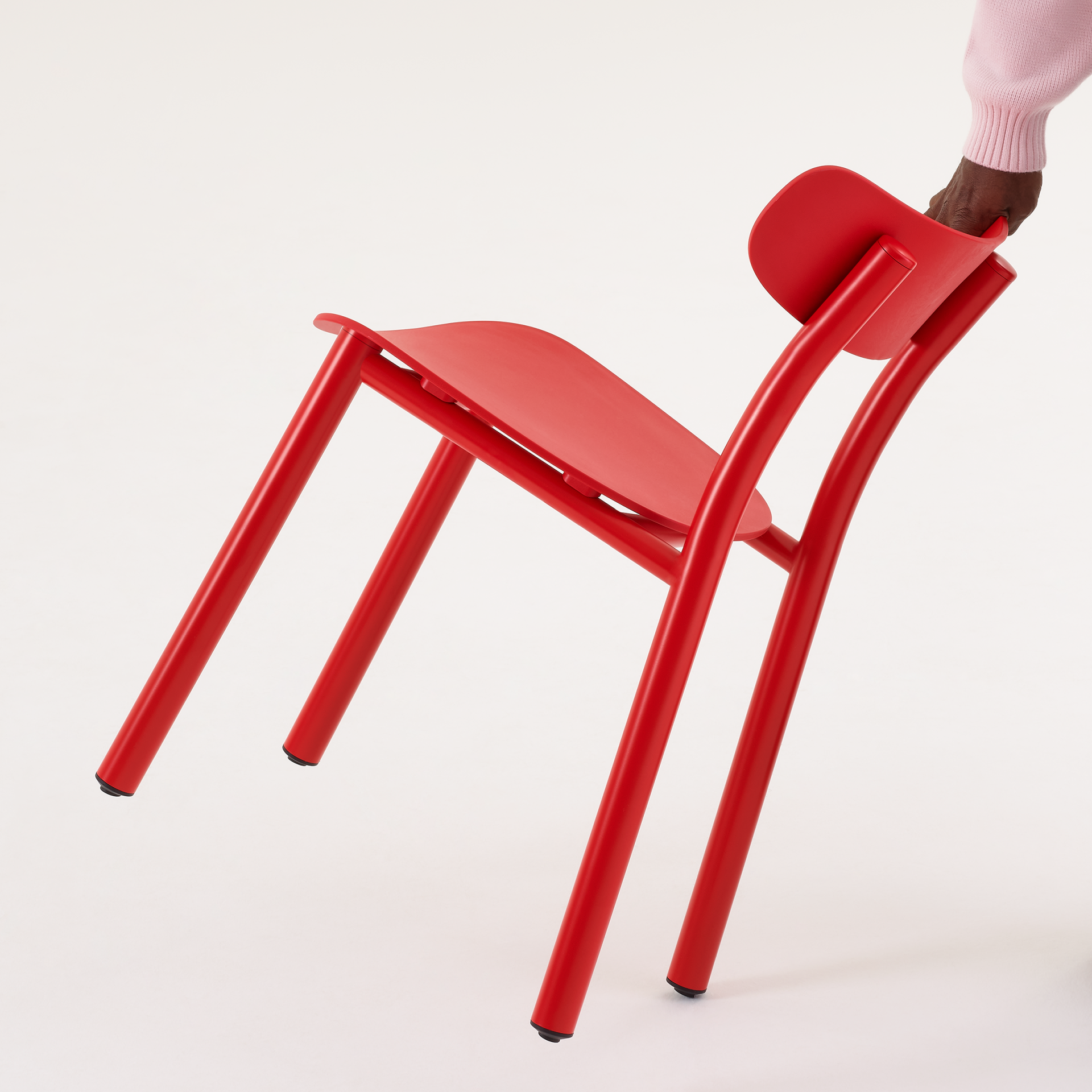
Keiji Takeuchi didn’t design Lotti for a client. He designed it in the corner of his own workshop, tinkering with it between other jobs for the better part of three years before anyone at British furniture company NaughtOne knew it existed.
Keiji is a Japanese designer based in Milan, known for moving fluidly between objects like coffee grinders, walking sticks, and café chairs that are always guided by the same instinct. As he puts it, design is fundamentally about care. Lotti, now officially launched as a collaboration with NaughtOne, carries that instinct into the café chair.
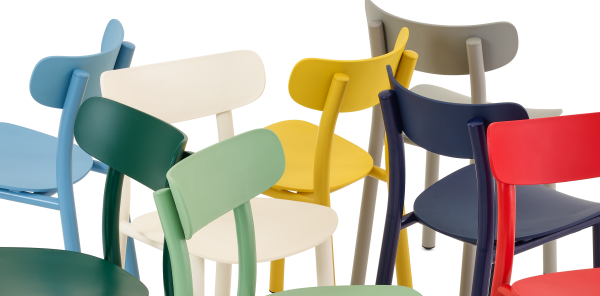
Available with either a plastic or plywood seat, Lotti moves easily between cafés, terraces, schools, and airports.
“I’m not familiar with many other café chairs like this that have a bold design and are built to last,” he says. “It’s meant to be used for decades with a clean, robust construction that aids in its longevity.”
The reference point behind Lotti goes back decades further than the workshop it was built in. The chair traces back to a Danish wooden chair from the 1960s, a design Keiji liked because it was simple and let the material do all the work, a spirit he borrowed to build a chair with no visible trace of engineering. He’s also cited Jean Prouvé’s Standard Chair as a touchstone, particularly in the versions of Lotti where the seat and backrest are wood.
“I have always been a fan of Jean Prouvé and his Standard Chair,” Keiji says. “I respect his honesty about the material and his intelligence in developing such an iconic form.”
That honesty about material shows up most clearly in how Lotti is built to be taken apart. There’s no glue anywhere in the chair, and no visible screws in the back a small detail Keiji points to as one of the chair’s most distinct features. Most café chairs eventually develop a rattle as their backrest screws work themselves loose over time, and once that starts, it tends to compound.
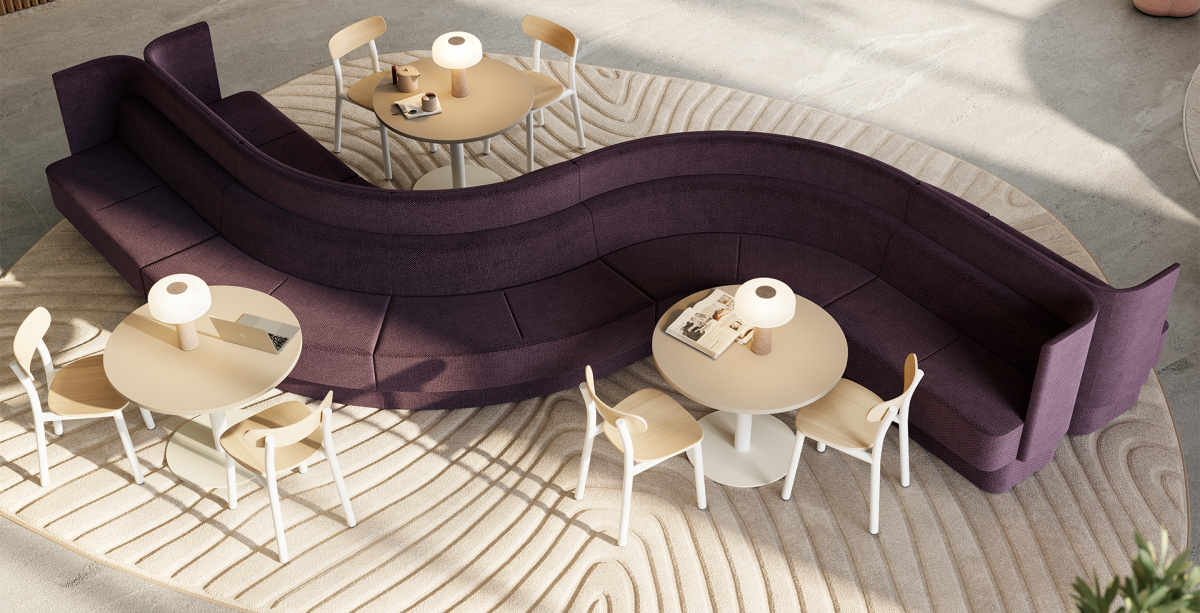
Lotti started as a workshop experiment and became a café chair engineered down to the millimeter for comfort, durability, and easy repair.
“We focused on this natural tendency, and we redesigned the assembly techniques from the ground up,” he says. “In the end we developed something very unique. It allows the backrest to fit tightly and securely without mechanical loosening, and if the backrest is damaged, we can replace it on site.” Every fixing in the chair is accessible without specialized tools, so a damaged backrest doesn’t mean replacing the whole chair.
Sustainability runs through the rest of the build the same way. The frame is steel, paired with either a plastic seat containing recycled content or a plywood seat finished in a water-based lacquer rather than a solvent-based one. NaughtOne says it used its own environmental scorecard to weigh material choices at every stage, treating sustainability as a practical outcome rather than a marketing bullet point.
Visually, Lotti plays with proportion more than it first lets on. The legs are noticeably oversized, the seat has a slight waterfall curve at the front edge to avoid pressure behind the knees, and the backrest appears to float above the frame rather than sit flush against it. NaughtOne says it spent hours refining the chair to make sure it would be comfortable for all kinds of people, pushing back on the assumption that café chairs and comfort don’t usually go together.
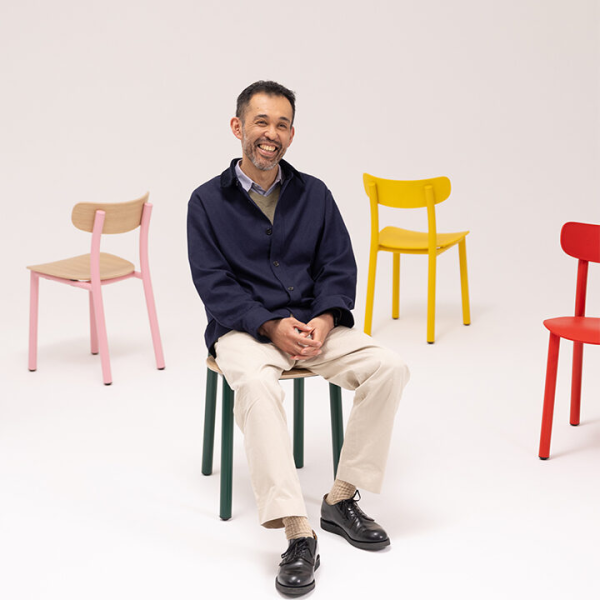
Designed by Keiji Takeuchi for NaughtOne, Lotti pairs oversized legs and a floating backrest with a quiet nod to Jean Prouvé, proof that a café chair can be both sculptural and built to last.
“I think the design itself is quite contemporary, yet timeless as well,” he says. “Since it has a metal structure with either a plastic or wooden seat and backrests, certain combinations make it look more classic than others. While the form is simple, the design plays with proportion in a way that is more unexpected, for example the legs of the chair.”
Keiji imagines the chair living outdoors as much as in. “I see the chair used in the sun. Cafés, terraces and balconies, I think this chair will give a nice vibe in atmospheres like these,” he says. “Of course, it can be used at home and at bistros, airports, public areas, and food courts as well. Many people are also associating it with schools.”