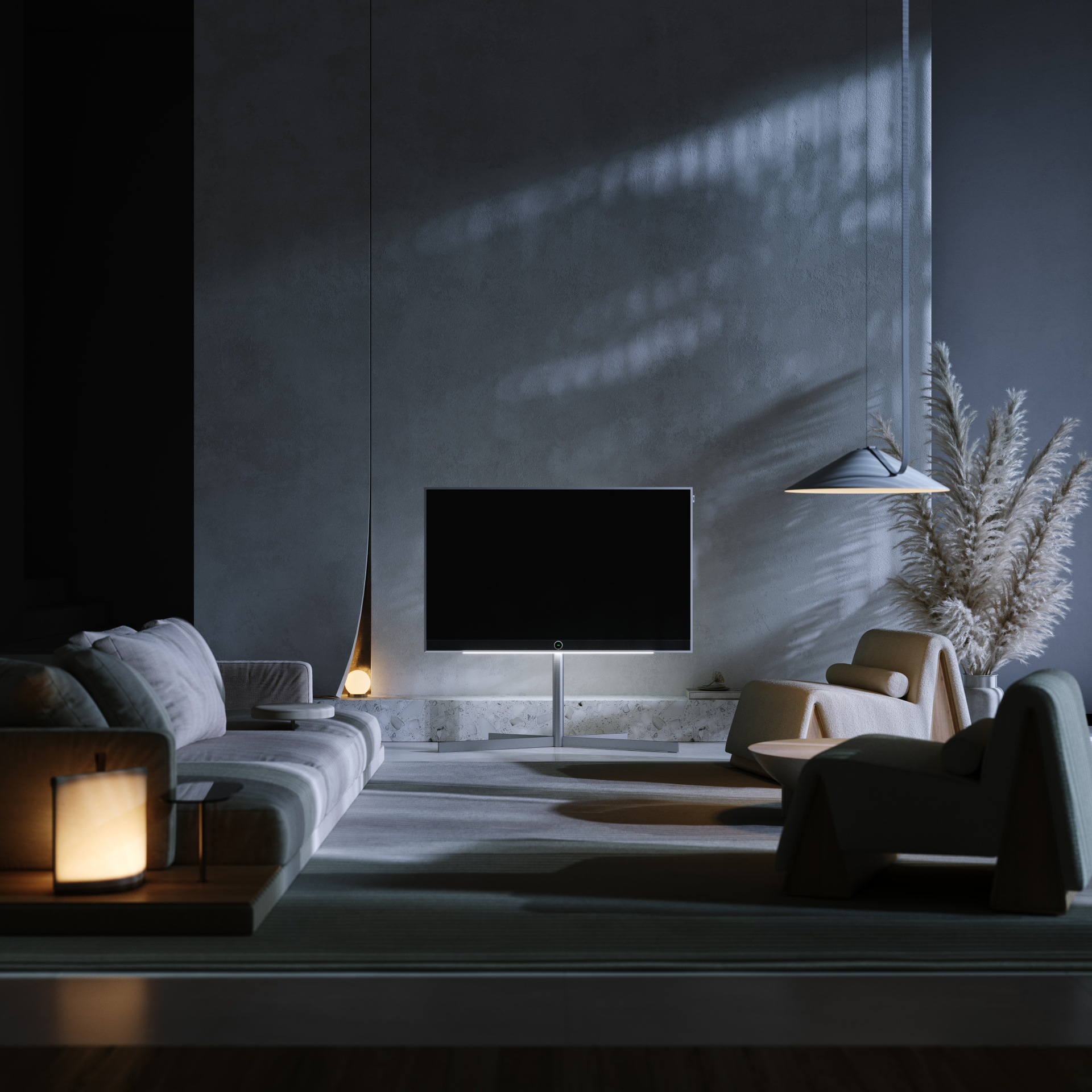
Most televisions are designed to disappear into the background. They become a black rectangle on the wall that people stop noticing the moment it’s switched off. Loewe Technology has spent more than a century arguing for something different. The stellar, the German brand’s flagship television, is built around the idea that a screen can function as a sculptural centerpiece in a room rather than an interruption of it.
“Loewe has long approached television not simply as consumer electronics, but as a considered design object for the modern home,” says Jeff Costello, GM of North America at Loewe Technology. “The brand’s vision centers on elevating everyday viewing into a more emotional and intentional experience, where technology enhances the atmosphere of a space rather than dominating it.”
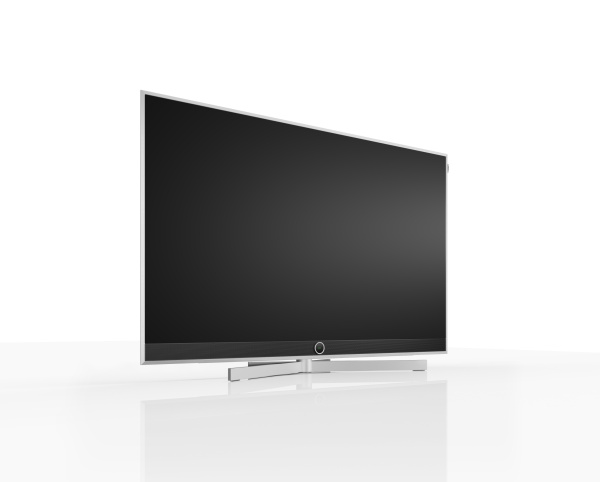
The stellar TV, Loewe’s flagship television, is built around the idea that a screen can function as a sculptural centerpiece in a room rather than an interruption of it.
Loewe was founded in Berlin in 1923 by brothers Siegmund and David Ludwig Loewe, initially as a radio manufacturer. Television development began there in 1929, and in 1931 the brand presented the world’s first fully electronic television to the public at the Berlin Radio Show. Between 1930 and 1935, Loewe held more television patents than any other company in the world.
A century later, that founding instinct that television could be a frontier of design as much as engineering, still defines the brand.
The stellar, Loewe’s flagship television, is built around the idea that a screen can function as a sculptural centerpiece in a room rather than an interruption of it. The design draws from Bauhaus principles and contemporary European minimalism. The stellar’s frame comes in diamond-cut brushed aluminum or matte black, the speaker grille in acoustic fabric or painted metal, and the rear cabinet in real concrete or aluminum. Each concrete panel has its own naturally unique surface texture, meaning no two units are identical.
“Every piece has its own distinct character,” Jeff says.
Production takes place entirely in Kronach, Germany, where Loewe has been based for over a century.
“Keeping production in Germany allows the company to maintain quality control, precision engineering standards, and close collaboration between its design studio, software engineering, prototyping, and manufacturing teams,” Jeff says. The brand is also the only European TV manufacturer producing its own OLED modules.
The manufacturing process reflects that same attention to detail. Precision-machined aluminum components and OLED panel integration are handled by specialized industrial processes, while finishing, calibration, and quality inspection involve significant manual work. Every unit goes through a 24-hour burn-in test across both screen and integrated speaker systems before leaving the factory, and all production batches go into a 48-hour quarantine for randomized quality inspection.
“It’s a meticulous approach rarely seen within the category,” he says.
Concealed within the stellar’s minimal silhouette is also a feature called magic.light, an integrated ambient lighting system that creates subtle atmospheric illumination around the television even when it isn’t in use. Hidden cable management keeps the wall clean. Art Mode means the screen earns its place in the room whether you’re watching something or not.
“The goal was to create a television that feels intentional within curated interiors rather than purely technological,” he says. “Unlike mass-market televisions, stellar is designed as both a high-performance entertainment product and an architectural design object.”