For the past five years, Yellow Studio has been responsible for the visual design of the Grammy Awards. Founded by production designer Julio Himede, the New York-based firm creates everything from the stage setup to the seating arrangements that have become a signature of the modern show.
Days before the 2026 Grammys, I caught up with Julio and creative director Damun Jawanrudi as they finalized this year’s design. Julio, who moved to New York from Australia in 2014 after starting his career in theater and television, explained how the café-style seating evolved from COVID restrictions into a format that lets Grammy host Trevor Noah move freely among celebrities during the broadcast.
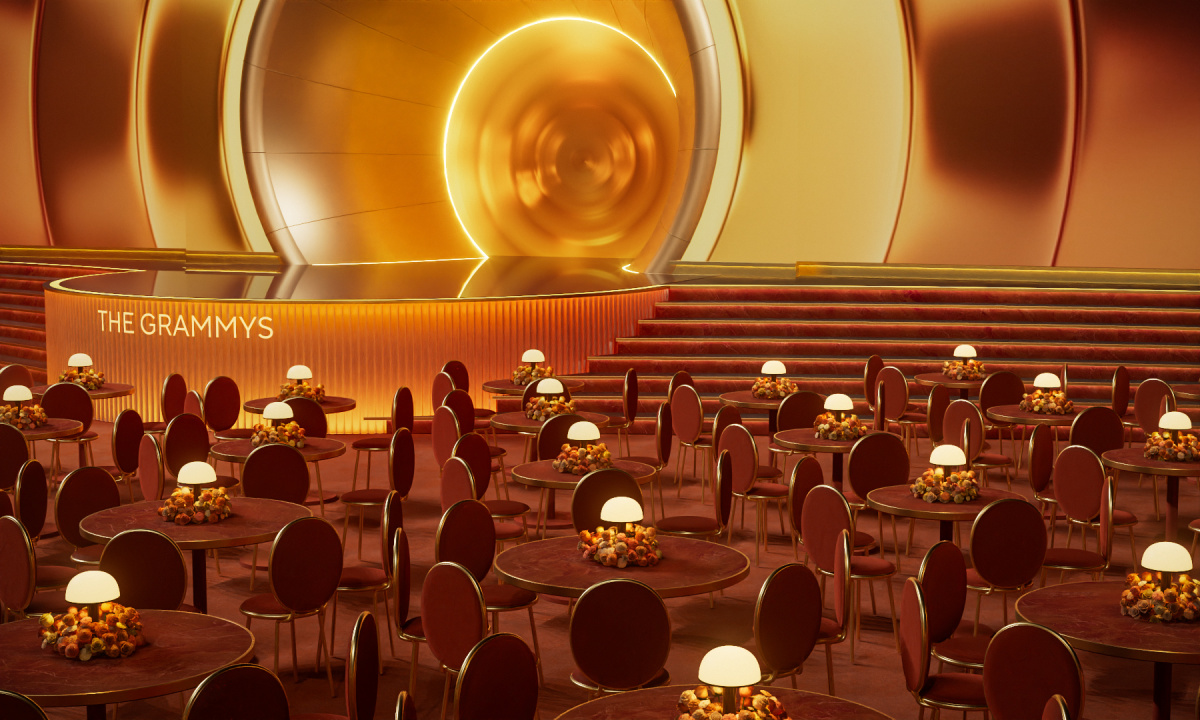
“This year’s café-style interior is something that’s been developing for the last few years, and I feel like this year it’s the best it can be. It came out of COVID since during COVID, you could only have two or three people per table, six feet apart.”
Let’s start with your path to Yellow Studio. You came up through theater, which feels very different from live television. What drew you to spatial set design, and how did that theater background shape how you approach something like the Grammys?
Julio Himede: I’m originally from El Salvador and migrated to Australia where my parents settled and I grew up. I went to theater school there and studied set design and costume. I very quickly became a set designer, starting in theater and doing some opera work, but then became more involved in television. Coincidentally I’ve always had work in television and music, doing music specials and working with artists from very early in my career in Australia.
I moved to New York from Sydney in 2014, which is when I opened Yellow Studio. There are seven of us at the studio between designers, creative directors, coordinators, and producers. Our focus is usually centered on music, television shows, award shows, and music specials. We just finished the Shakira World Tour last year, and we’re in the middle of producing some other music specials right now. We also do design activations for experiential brands. Really we work across design in different platforms, like festivals, fashion shows—things that are peripheral to music, fashion, and TV.
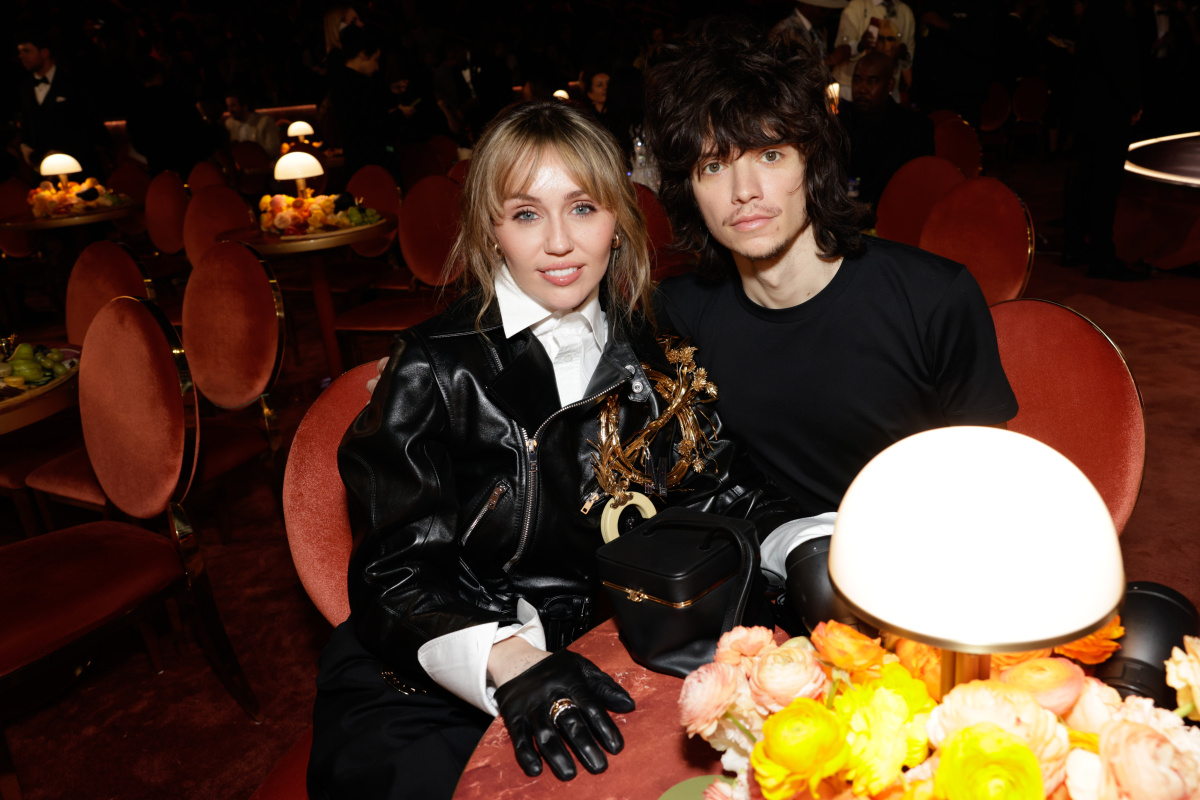
“The lights on the table in this interior we created, even though they’re decorative, have a very specific purpose, to light the faces of our artists.” Above: Miley Cyrus and Maxx Morando. Photo by Francis Specker, courtesy of CBS
The Grammys has been the cherry on top, in a way. I started working on award shows very early in my career, doing the VMAs and the Kids’ Choice Awards in Australia, and the equivalent of the Grammys in Australia or the Brits. When I came to America, I started working on the MTV Movie Awards. My studio did the MTV VMAs for a number of years here as well. So it’s been a steady road to the Grammys, which is an exciting place to be. We love music, we love performances and working with artists. Sometimes on the Grammys, not only do we design the set, but we also design some of the creative elements for artists as well.
This is your fifth year doing the Grammys, right? How did that relationship begin?
Julio: The Recording Academy had a change in the producing team, and Ben Winston from Fulwell started being the executive producer of the show, along with Raj Kapoor. We knew each other and they invited me and my team to give the Grammys a fresh new look. We collaborated together very closely with them and the Academy, and here we are five years later.
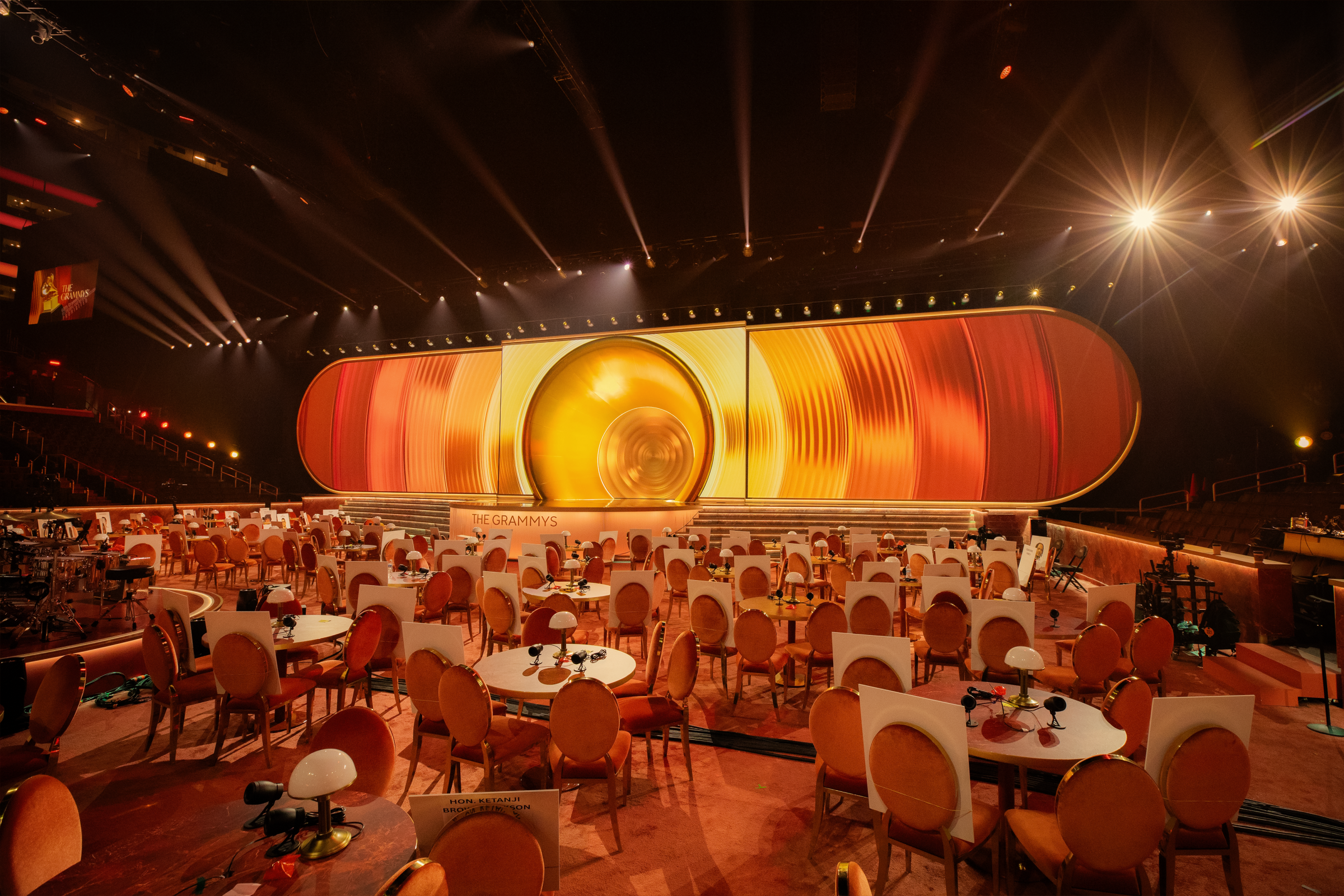
This year’s café-style interior is something that’s been developing for the last few years, and I feel like this year it’s the best it can be. It came out of COVID since during COVID, you could only have two or three people per table, six feet apart. We took advantage of that and evolved it to this wonderful lounge interior. I don’t really see this in any other type of award show where celebrities, artists, musicians, or anyone who’s performing is sitting in a very intimate café-style table.
It allows our host Trevor Noah to mingle around, socializing on camera live to air, interviewing people, making jokes, all in a very harmonious way. The second thing it does is allows the viewer at home to feel closer, to feel as if the action is right there, not only on the stage, but to be almost in this backstage, cool, more relaxed environment where anything can happen.
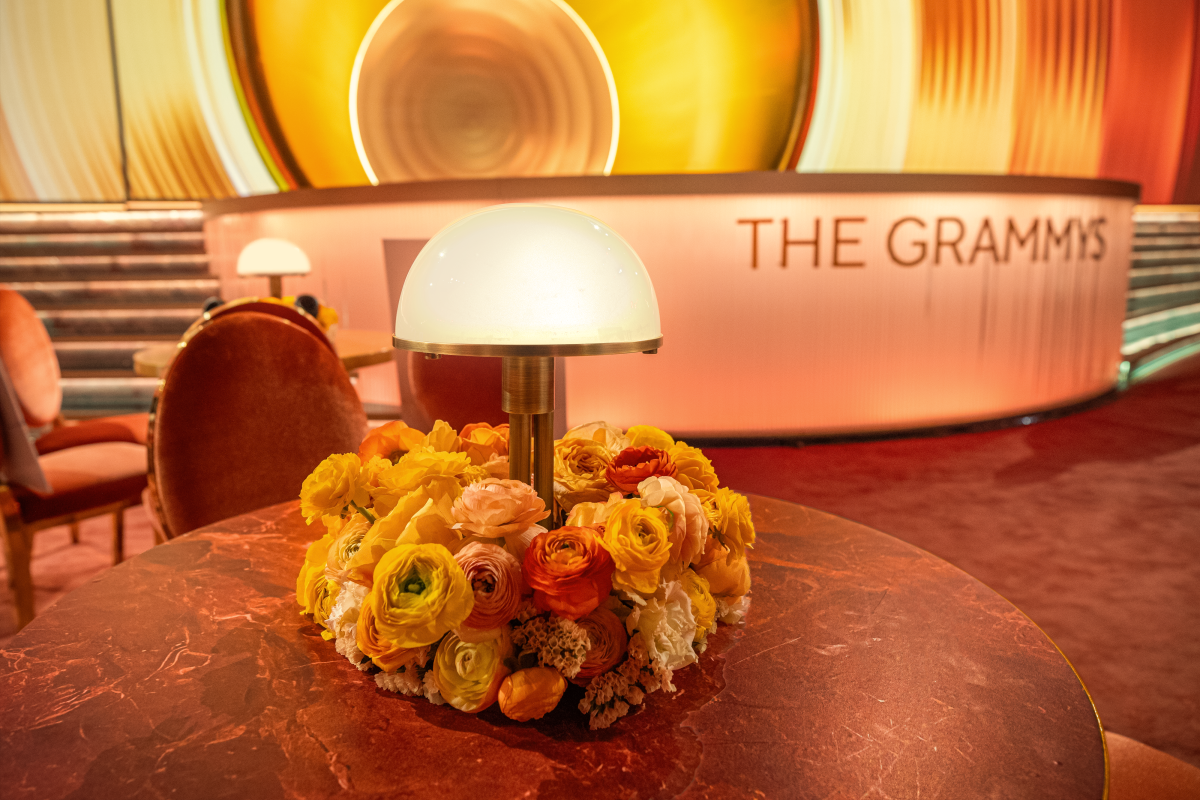
“This lounge setting has become a very beautiful, elegant, relevant interior that celebrates music. It also challenges us to design that area, from the tabletops to the seating to the flower arrangements and the lighting.” Photo by Kristina Bakrevski
Damun Jawanrudi: That has grown over the years too. Trevor Noah has used it extremely effectively. Last year Benson Boone started his performance sitting at one of those tables, then stood up and walked around while Heidi Klum and Nikki Glaser were ripping his outfit off. It was all happening in there. It’s a very camera-friendly area.
It also gives us a connection to our satellite stage, our smaller B stage in the same area. All that becomes an extended stage, which gives us a lot of different things to capture with the camera that really excites people at home.
Julio: In our world where everybody wants an immersive experience, it has become exactly that. The performance and the performer feel less presentational and more immersed with the audience. This lounge setting has become a very beautiful, elegant, relevant interior that celebrates music. It also challenges us to design that area, from the tabletops to the seating to the flower arrangements and the lighting. We continue our design language in that area.
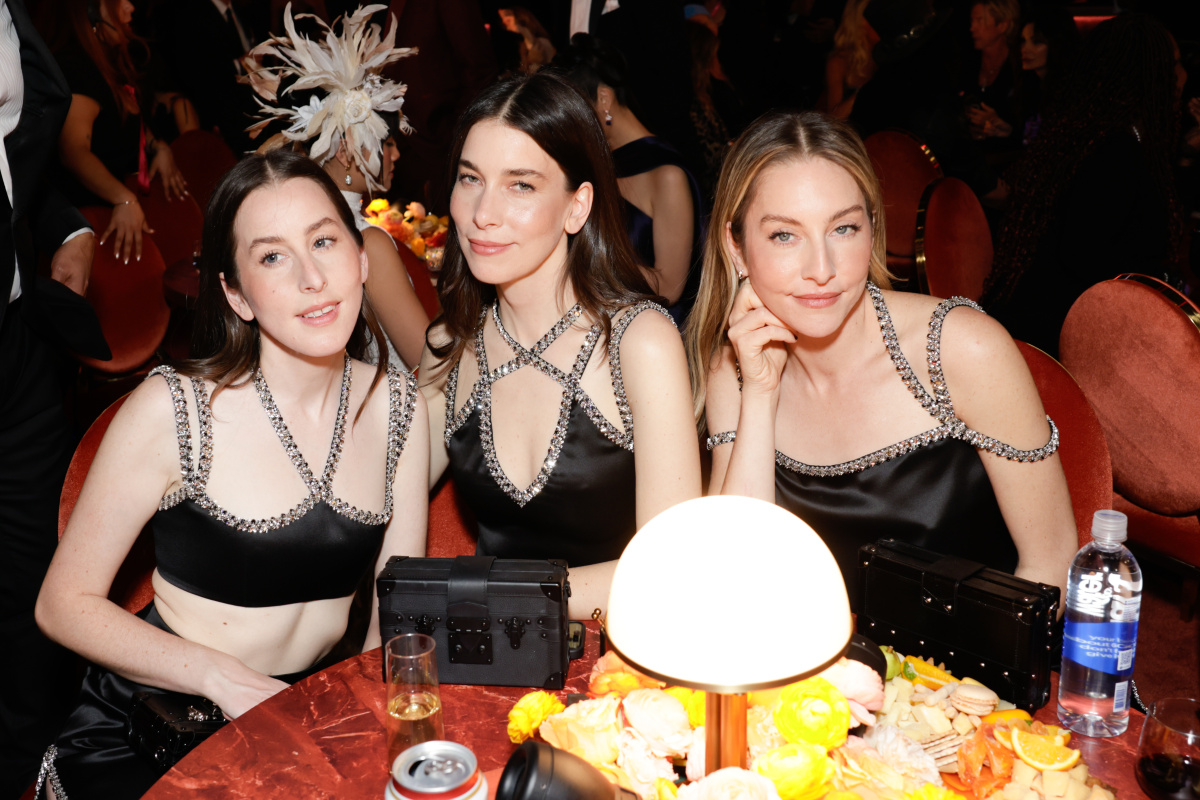
Haim at The 68th Annual Grammys. Photo by Francis Specker, courtesy of CBS
The terracotta palette this year feels warmer and more grounded than past years. Last year was that cool blue. How intentional is that shift year to year, and what drives those color decisions beyond just wanting something different?
Julio: Every consideration is explored in detail. We have the luxury of working on the process for about six months. We start working with our producers in late summer and go through all these different color variations. We look at what works best under lighting, next to skin tones. It’s very considered.
We also want to make sure the color palette feels clean and elegant, because with so many different musicians and producers all wearing different colors, it can get very busy. The choice of terracotta color is considered for that reason, to keep it clean. Last year we went with a very fresh blue, which was very light and airy. This year we wanted to contrast that and go with something earthy and rich, a little more grounded.
Damun: In combination with our visual language, which revolves around stained glass, it was a great combination. That rich, earthy terracotta tone and the beautiful stained glass that reflects the light, those two together really made sense and worked together beautifully.
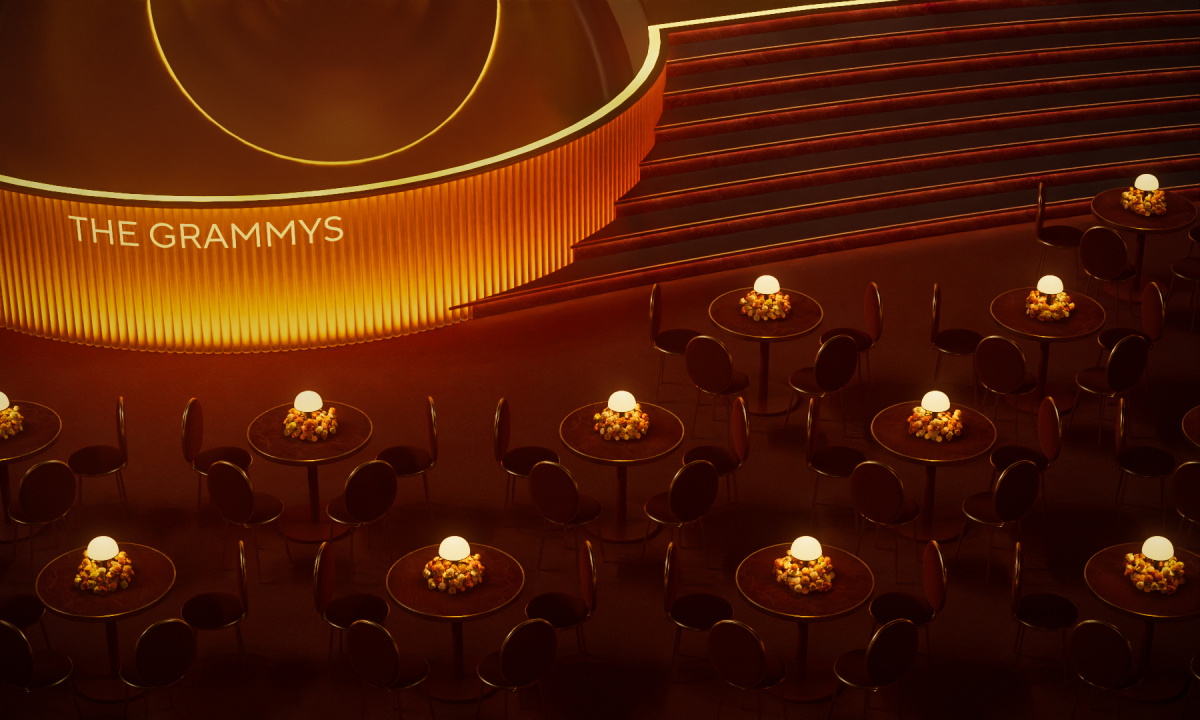
“Trevor Noah has used the cafe-style space extremely effectively. Last year Benson Boone started his performance sitting at one of those tables, then stood up and walked around while Heidi Klum and Nikki Glaser were ripping his outfit off.”
What about the main stage itself? What’s anchoring that space visually this year?
Julio: We focused a lot on the café interior aspect of our design. The other thing is that the center of our stage is this big golden sculpture, a beautiful three-dimensional version of a gramophone, but in a very abstract, much cleaner, modern way. We developed this identity a few years ago and it’s become such a great iconic identity for the Grammys over the years.
It’s gold, which acts really nicely when somebody’s winning their award. When someone like Miley Cyrus comes up and accepts an award, she’s crowned by this golden gramophone, this modern interpretation. I think it’s become a recognizable iconic feature for the Grammys. We’re very proud we developed that.
That gold of the gramophone gets repeated in gold accents and little trims around the interior, and the trims of the chairs and tables. So it all connects. The gold accents are a way to describe the Grammys, but it’s also not too Hollywood—though we are in LA, this is Hollywood, which is also a world of music. So it all combines and connects together nicely.
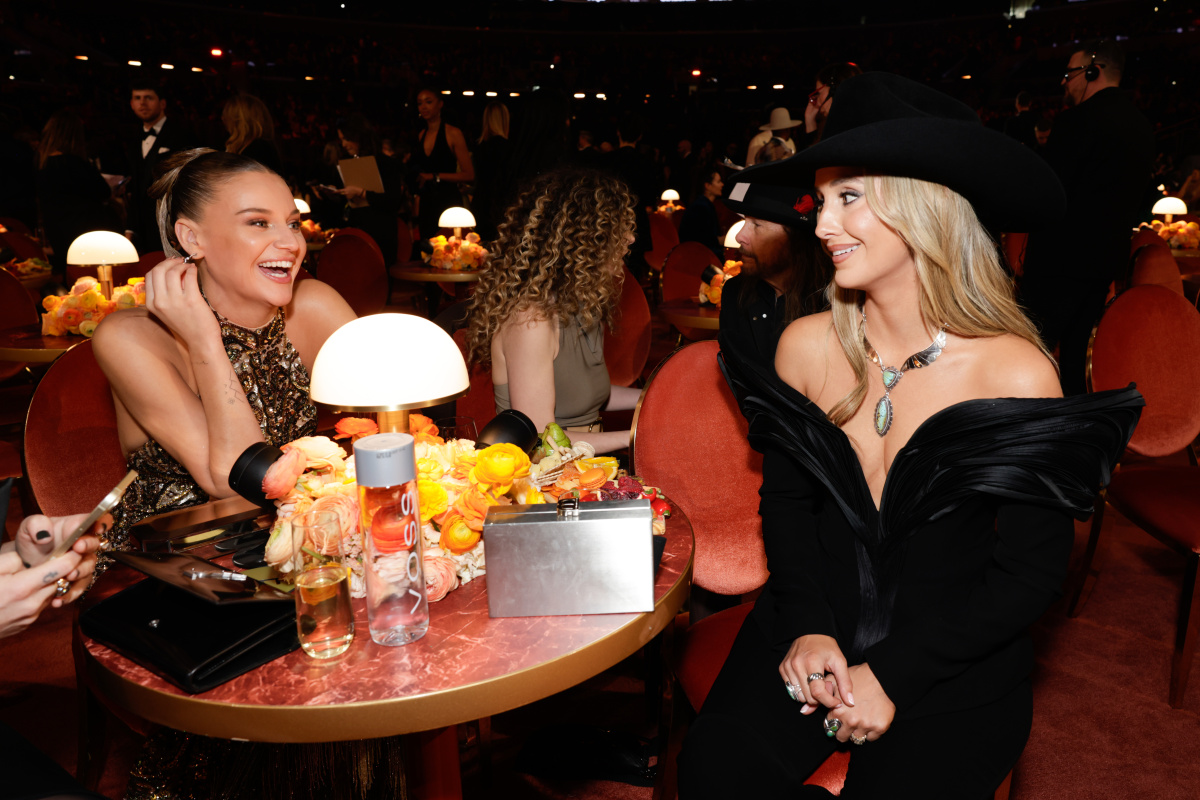
Kelsea Ballerini and Lainey Wilson. Photo by Francis Specker, courtesy of CBS
When you’re designing for a show like this, are you primarily thinking about how it reads on camera, or is there a balance between the in-room experience and the broadcast?
Julio: A lot of consideration goes into every material. We make every choice in relation to that. For example, the fabric we use for the chairs this year has to be a specific kind because if it’s velvet, it can brush one way or the other. If it brushes the wrong way, it looks messy on camera and looks whitish or yellowish. We have to test and try all of these things. It’s a big dialogue between our collaborators and us at Yellow Studio, down to the flowers.
We try to bring a bit of spring into the flowers because spring is around the corner here in California. Most people are going to watch this at home, so we want them to have the same quality of experience as the people in the room.
Damun: How we help bring the room to people at home is with broadcast elements that match our visual language on site. If we’re going with the stained glass visual language and the gold to terracotta gradient, we have broadcast elements that mimic that glass, little banners, the announcement of the next performer. You see that at home and you really feel that visual language. It ties everything together, the physical space and the digital realm.
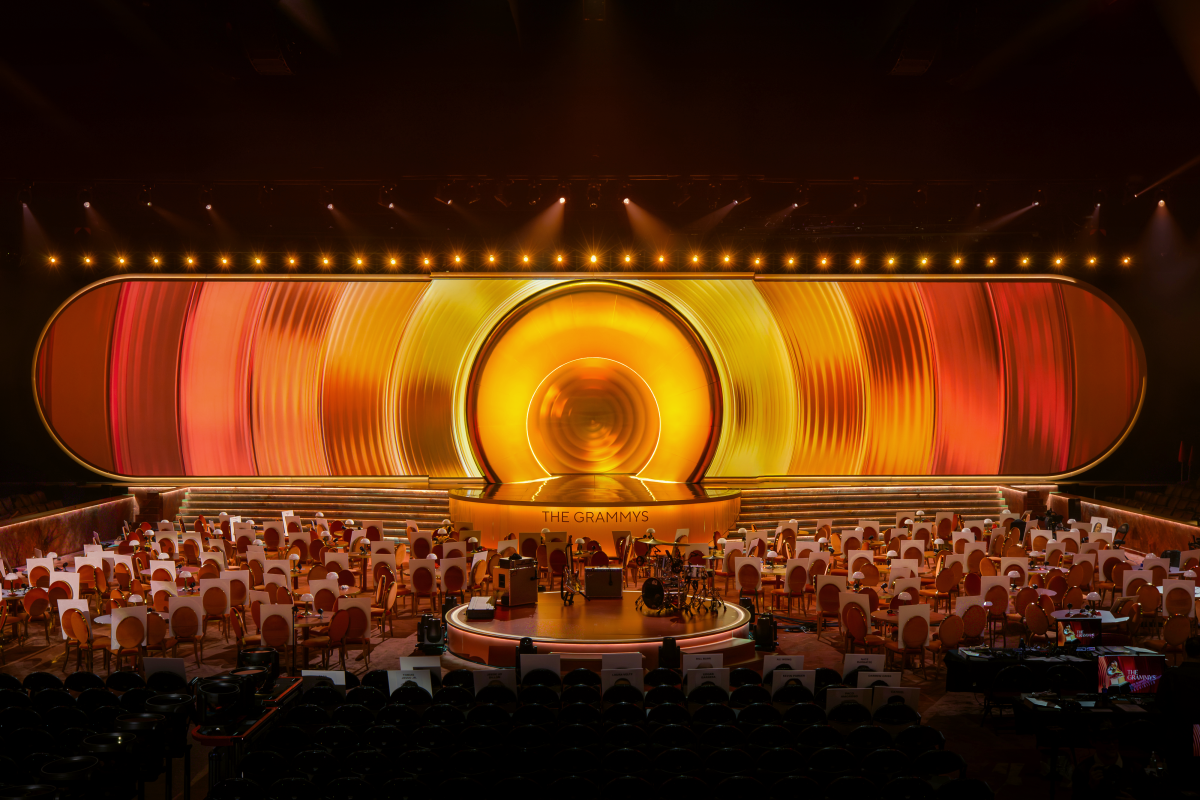
“Designing the Grammys is process where people don’t really know how much work is behind those visuals we create. It’s months and months of revisions and very detail-oriented work, making sure everything we see on the show works together as a coherent whole.” Photo by Kristina Bakrevski
You’re collaborating with studios like Hello Charlie, BASA, and Studio M on the visual elements. On a production this big, how do you keep everyone aligned?
Julio: To be honest it is a large production, but the core team is three or four or five of us between Yellow Studio and our producers. We bring Hello Charlie in very early in the process once we determine the color palette and the look and feel. Once we developed the glass idea and the terracotta idea, we brought them in to start collaborating and expand our vision, exploring different ways to do glass and transparency.
They’ve been collaborating with us on the Grammys for about three or four years, but we’ve known them for over ten years. They’re a great partner who helps us push our vision further and also deliver.
Damun: It’s a process in that at the end you see the final product, and people don’t really know how much work is behind those visuals we create. It’s months and months of revisions and very detail-oriented work, making sure everything we see on the show works together as a coherent whole.
Julio: We don’t want the opening visual to be different than the broadcast elements or the banners where the names of the artists are. Everything needs to be unique and make sense individually, but also as a collective so the show feels like one big story.
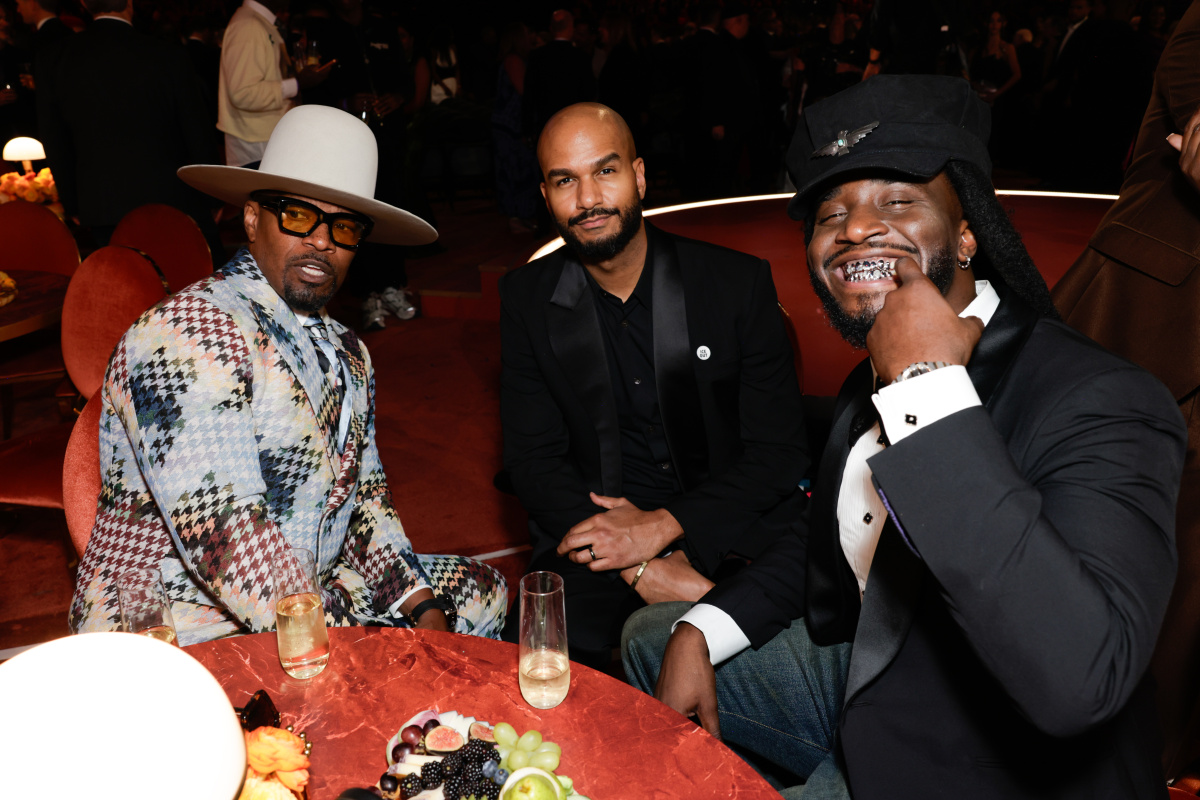
Jamie Foxx, X, and Shaboozey. Photo by Francis Specker, courtesy of CBS
We’re talking just days before the show. Are you still making adjustments, or is everything locked at this point? What does the final stretch look like?
Julio: It’s like a baby we’re about to bring into the world. There are always little touchups and details we keep polishing up until the very last minute. We just sat down this morning and went through every single look on the screen to make sure the colors and tones look right. We made some changes.
The job is not done until we go live on Sunday evening, but it’s super exciting. It’s always a thrill doing a live show, because no matter how much rehearsal you’ve done, when you go live, that’s it. There’s no other opportunity.
For someone who’s never been backstage at something like this, what’s a detail or constraint in your process that would surprise them? Something that looks simple on camera but is actually incredibly complicated?
Julio: We try to calculate every single design decision as much as we can. For example, in our café-style setting, every table is placed in a specific position and that takes weeks of planning. There’s not very much space, and there’s a table and speakers on every table surrounded by flowers. All the electrics have to go down inside the lamp underneath the carpet. When we come on site, if we say, “Let’s just move the table a couple of inches,” well, you can’t, because everything is so connected to lighting and sound.
The lights on the table in this interior we created, even though they’re decorative, have a very specific purpose, to light the faces of our artists. When you see Beyoncé or Taylor Swift or anyone sitting there, they look beautiful and lit because everything is calculated—the color on their skin, the colors from above. All those logistical things are very well planned, even though they look just decorative.
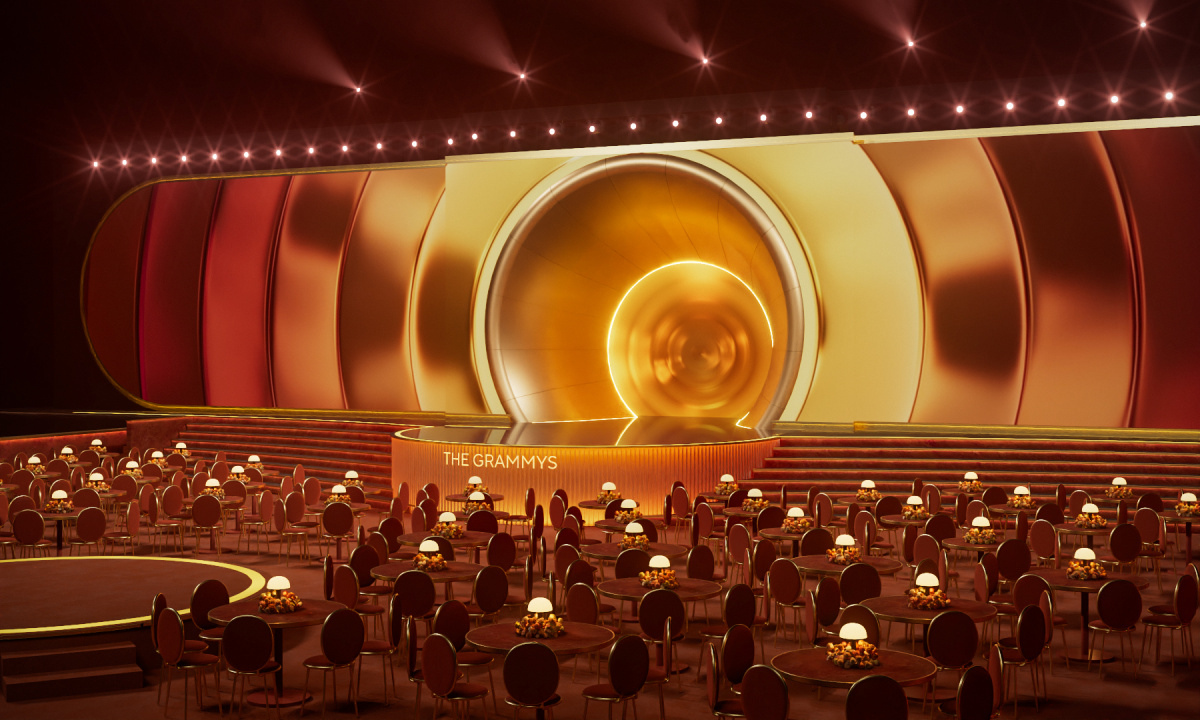
“The center of our stage is this big golden sculpture, a beautiful three-dimensional version of a gramophone, but in a very abstract, much cleaner, modern way. We developed this identity a few years ago and it’s become such a great iconic identity for the Grammys over the years.”
When the show goes to air we don’t really have control—anything can happen. For example, a couple of years ago we had this beautiful deep cherry red as our color palette, and then Adele turned up in this beautiful deep cherry red dress. She just so happened to blend with it perfectly. She was luminous. It was such a fun coincidence we couldn’t control or anticipate.
Damun: The ideal is that you as somebody who hasn’t worked here can enjoy the show and be impressed by everything. We want it to be an experience for you rather than you seeing cables or lights or distractions. Seeing what all this is about is kind of crazy once you see all the logistics behind it.
Beyond the Grammys, what’s next for Yellow Studio? Anything else you can talk about?
Julio: We started on the Shakira World Tour at this time last year, she’s still touring. Her American leg is over and she’s going to do different parts now. That was a very big project we were excited about. We have a bunch of different projects now, always in parallel. Some aren’t announced yet. We’re actually working with a very exciting Latin artist right now. That’s kind of the next thing on our agenda.
A lot of our work is connected to music, which is what we love. That’s what really keeps us excited and our work exciting. We also love the fact that our work is so international. One day we work somewhere in Asia, then in the Middle East, then in Europe. It’s nice to be able to see things in different perspectives and find different cultures in the design.