In the heart of Athens with sweeping views of the Acropolis sits an apartment steeped in seven decades of family history.
For Elena Alexopoulos and Jonathan Stene of the Paris-based studio Stene Alexopoulos, renovating Elena’s grandmother’s home presented a unique challenge: honoring the memories embedded in every room while infusing the space with new energy and contemporary design. Working with local craftspeople and drawing inspiration from ancient Greek architectural forms and archaeological fragments, the duo created a space that seamlessly weaves together 19th-century heirlooms, mid-century modern pieces, and custom-designed furniture.
Gianna Annunzio: This project seems incredibly personal. What was it like deciding to take on renovating a family member’s apartment?
Elena Alexopoulos: This was my grandmother’s apartment, built about 70 years ago in the heart of Athens. She passed away 10 years ago and the space had remained largely untouched since then, almost like a time capsule. The challenge we faced was quite specific: how do we preserve the family spirit and the old-fashioned aesthetic of the apartment where we grew up spending our summers, while at the same time giving it a more contemporary and modern approach? We didn’t want to erase the past, but we also didn’t want the apartment to feel frozen in time. It needed to breathe again, to have new life while still honoring her memory and everything this place represents to our family.
-
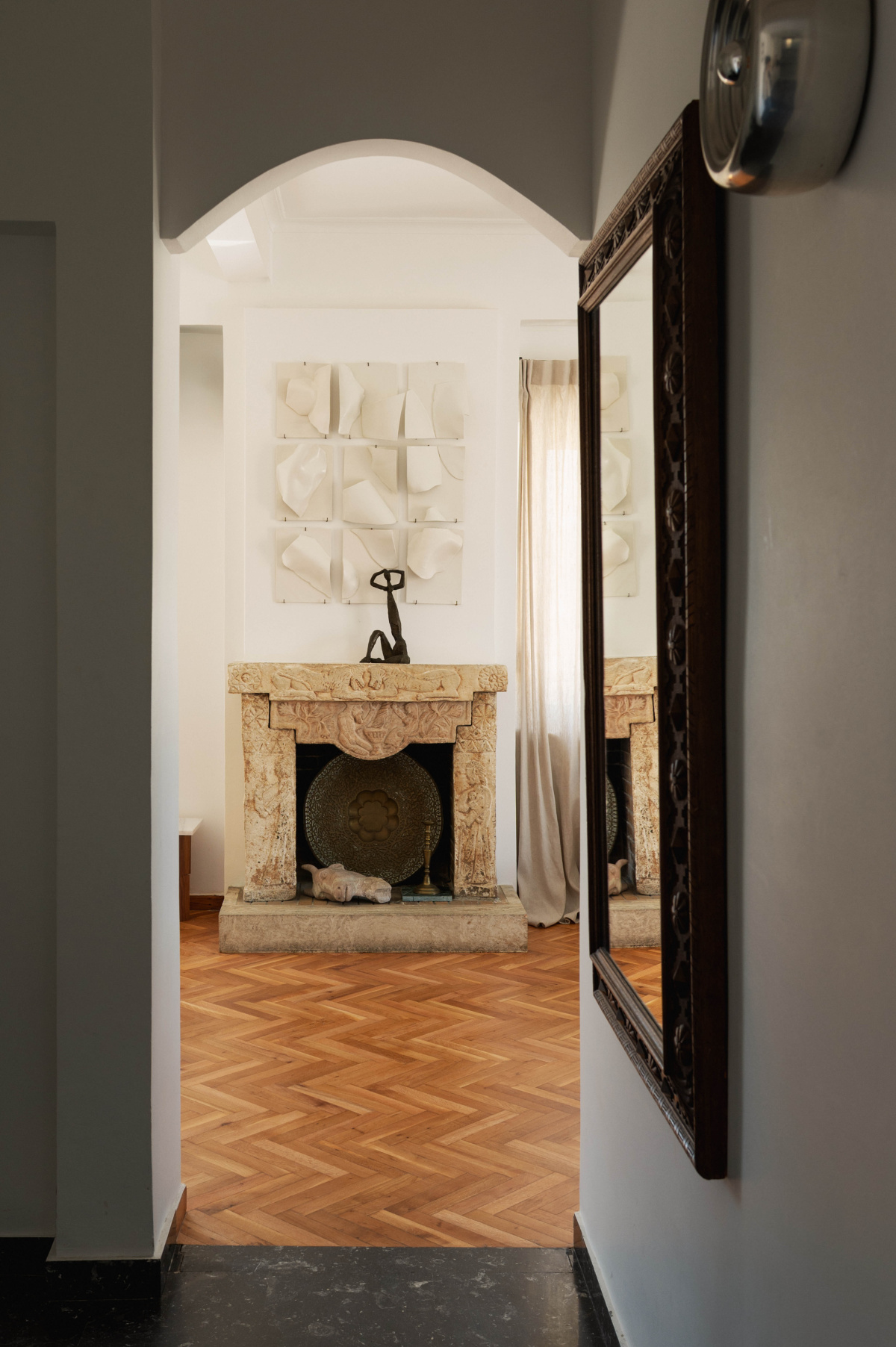
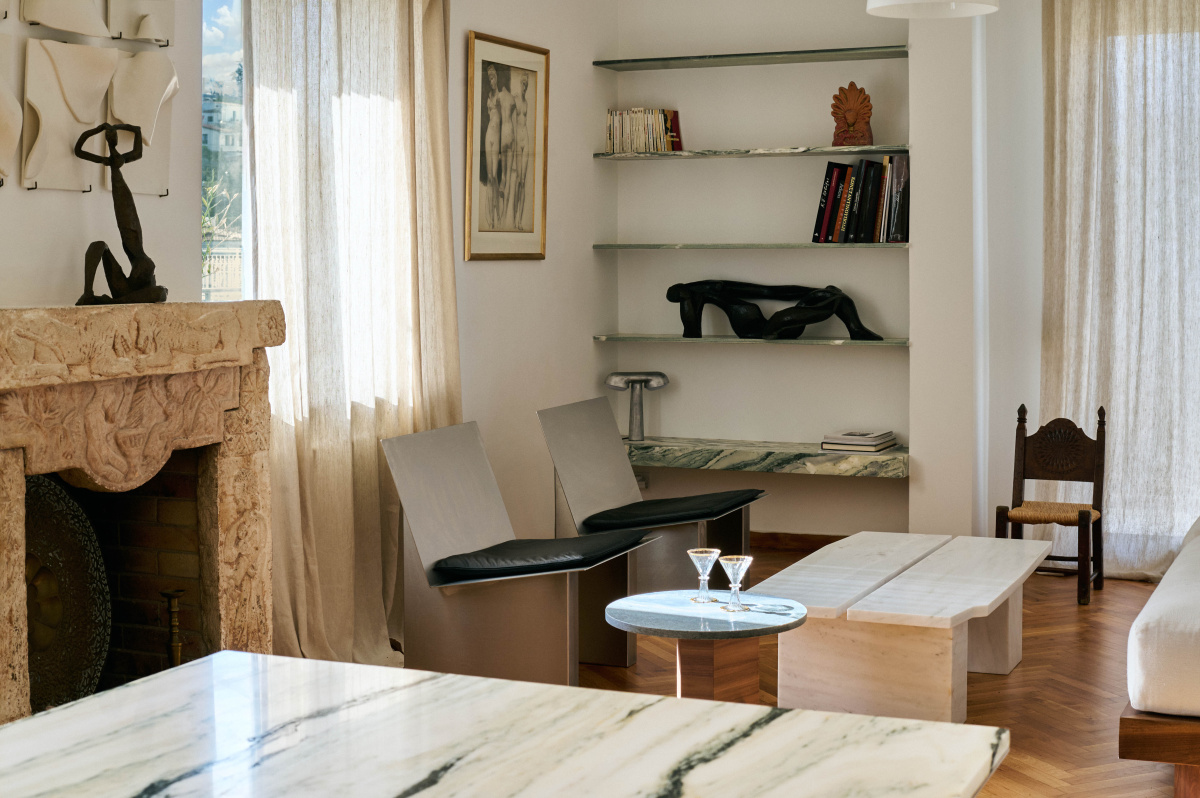
- The living room’s Persian and Greek-inspired fireplace was personally commissioned. Inside sits a pink bull’s head sculpture by Coulentianos, a famous modern Greek artist from the 1950s and longtime friend of the family.
-
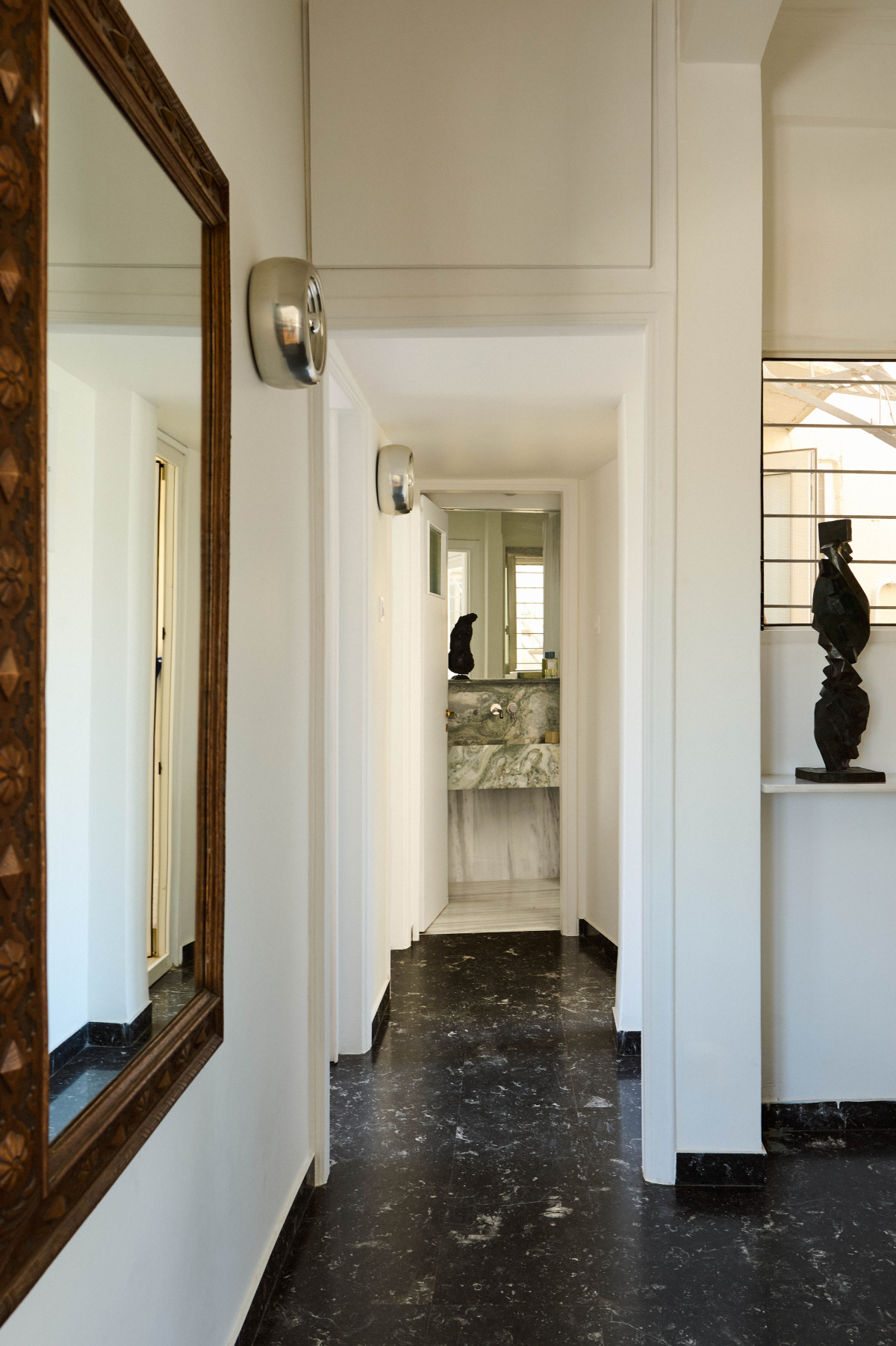
- Original marble flooring from the building’s 1950s construction leads through the hallway.
Gianna Annunzio: When you walk through those rooms now, what memories surface?
Elena Alexopoulos: This apartment is where all my most cherished childhood memories live. My brother and I spent every single vacation here—all our summer holidays were at our grandmother’s. It was the gathering place for our family where everyone would come together. The rooms themselves hold these memories. You walk into the living room and you remember sitting there as children, the kitchen where meals were prepared, the bedrooms where we slept. Most of our formative memories are rooted in this apartment, so it holds tremendous sentimental value for us. That emotional connection made the renovation both deeply meaningful and incredibly challenging, because every decision felt weighted with memory.
-
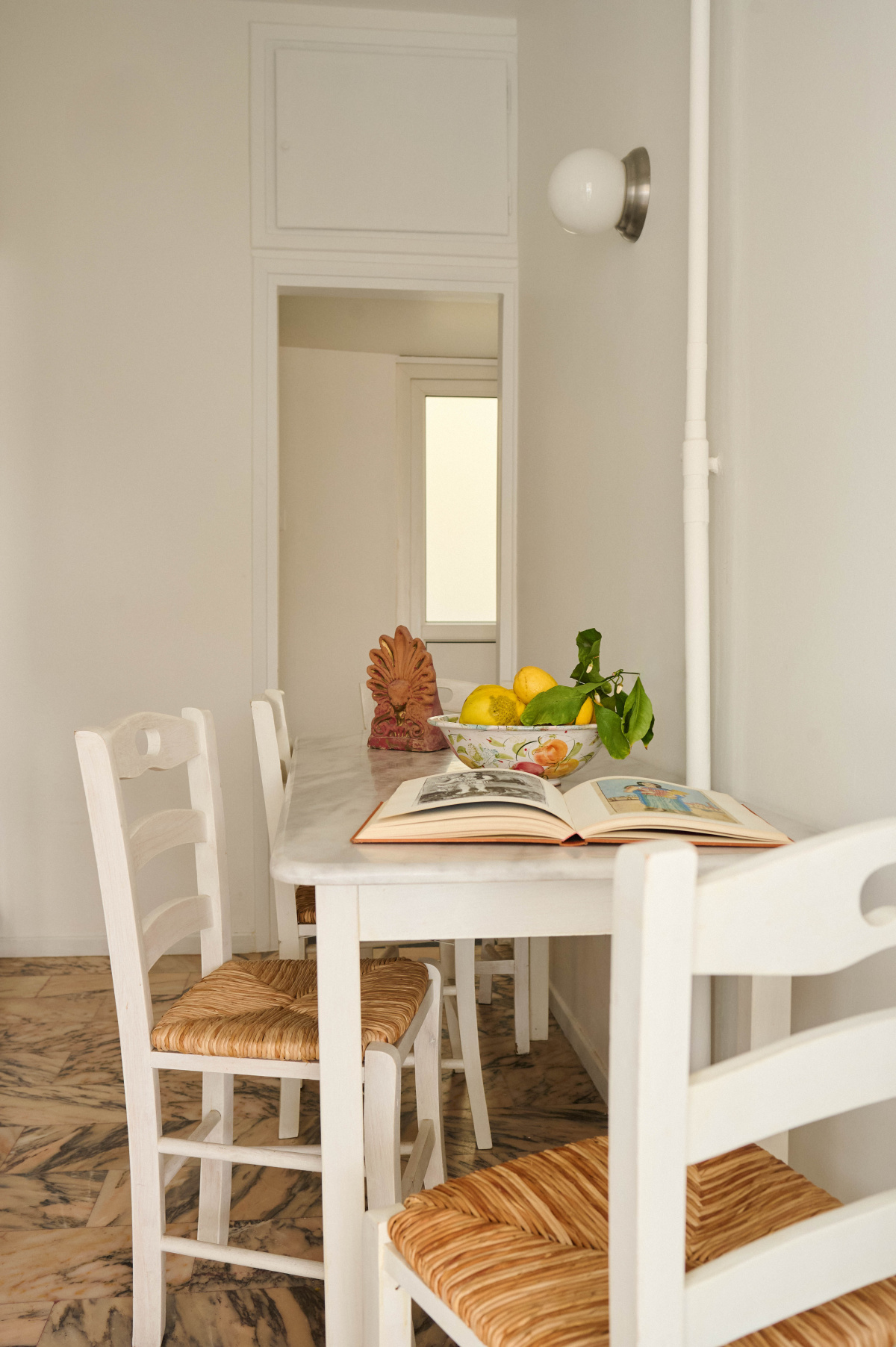
- The kitchen table and white chairs draw direct inspiration from traditional tavernas in the Cycladic islands.
-
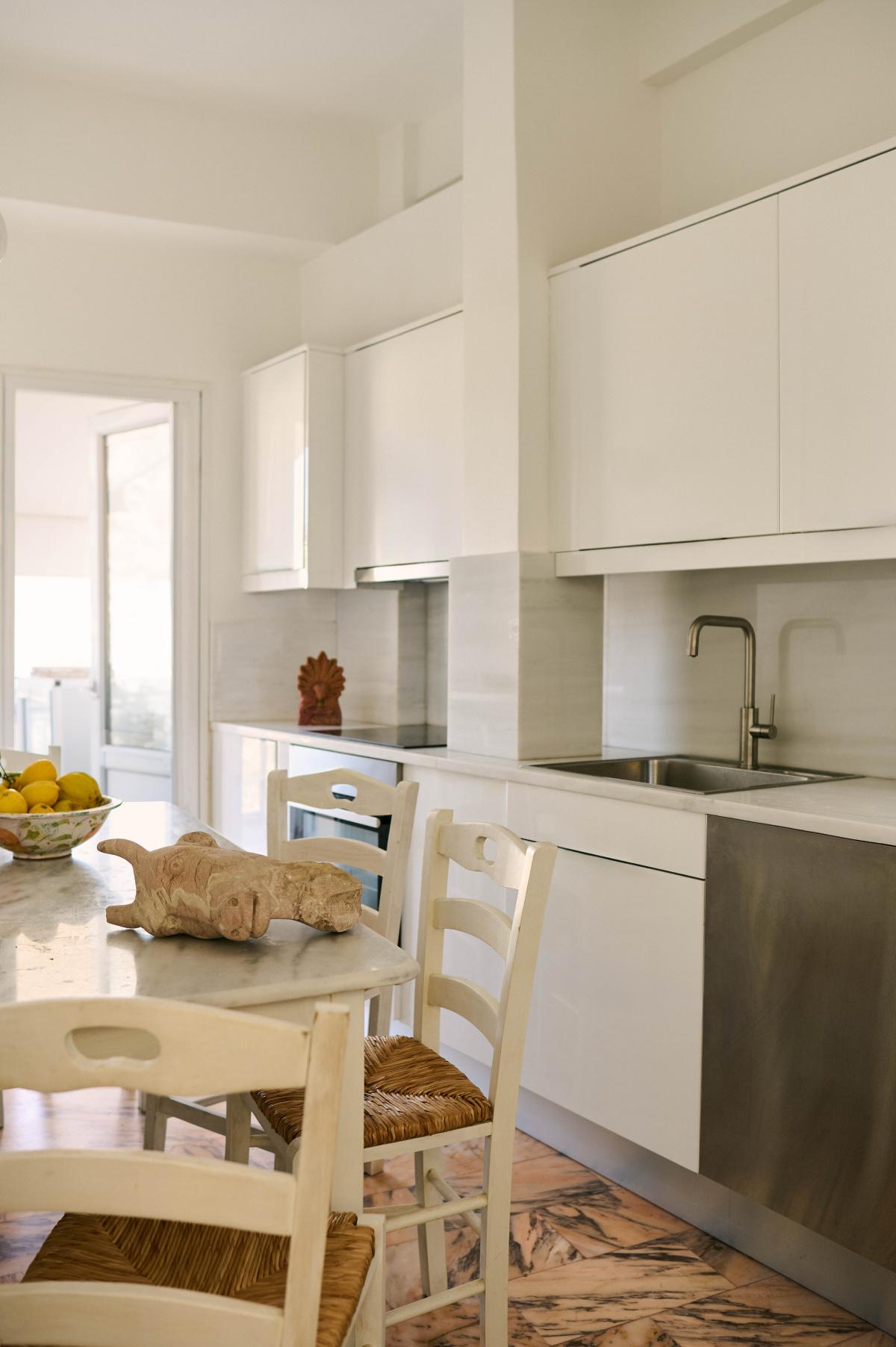
- Simple wood construction and casual seating define family-run Greek restaurants.
How did you navigate that tension between preservation and transformation? It sounds like you were trying to honor two different impulses at once.
Elena Alexopoulos: Our philosophy was rooted in respect for what existed. We made a very conscious decision to keep the organization of rooms exactly the same. We didn’t want to disrupt that spatial memory. All the 19th-century furniture that belonged to our grandmother also remains in place; we didn’t move anything. The original wood floors which exist almost everywhere in the apartment, and the marble floors in the kitchen and bathroom were all preserved. These elements are integral to the apartment’s history and character. But within that framework of preservation, we introduced contemporary elements—new art, custom-designed furniture, modern lighting—to create a dialogue between past and present. It was about layering rather than replacing.
Did you feel any hesitation when it came to renovating a space with such a long history and personal memories?
Elena Alexopoulos: Of course we felt hesitant. When you’re working with a space that holds so much personal history, there’s always that fear of somehow disrupting or disrespecting the memories. But we realized that it’s been ten years since our grandmother passed, and in that time we’ve continued to visit, to stay here, to create new memories in this apartment. The space needed to evolve with us. I think it’s actually been very good for my father and our family to make these changes, to refresh the furniture and introduce new elements. It honors those old memories while allowing the apartment to have new energy, to continue being a living, breathing space rather than a museum. The past and present can coexist.
-
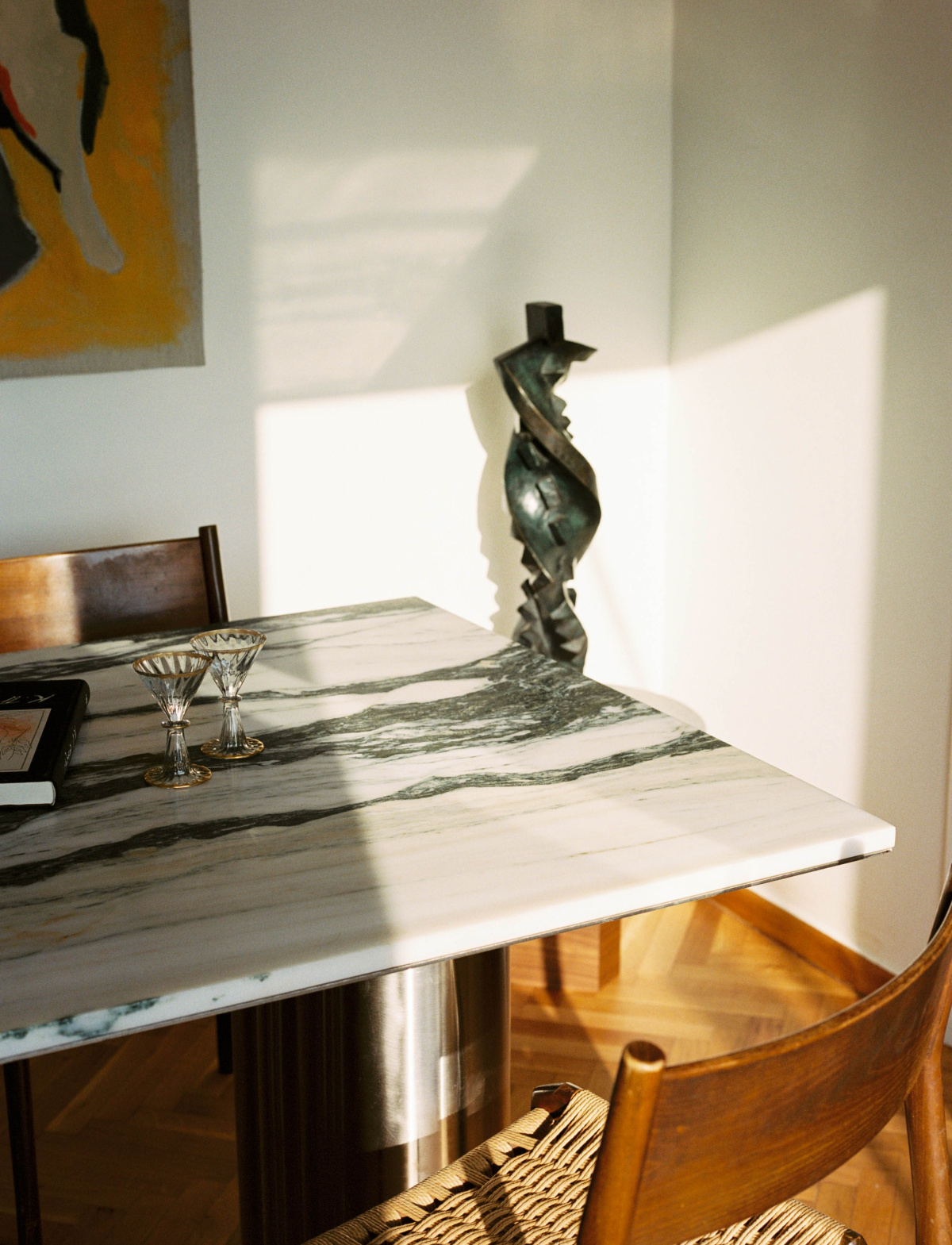
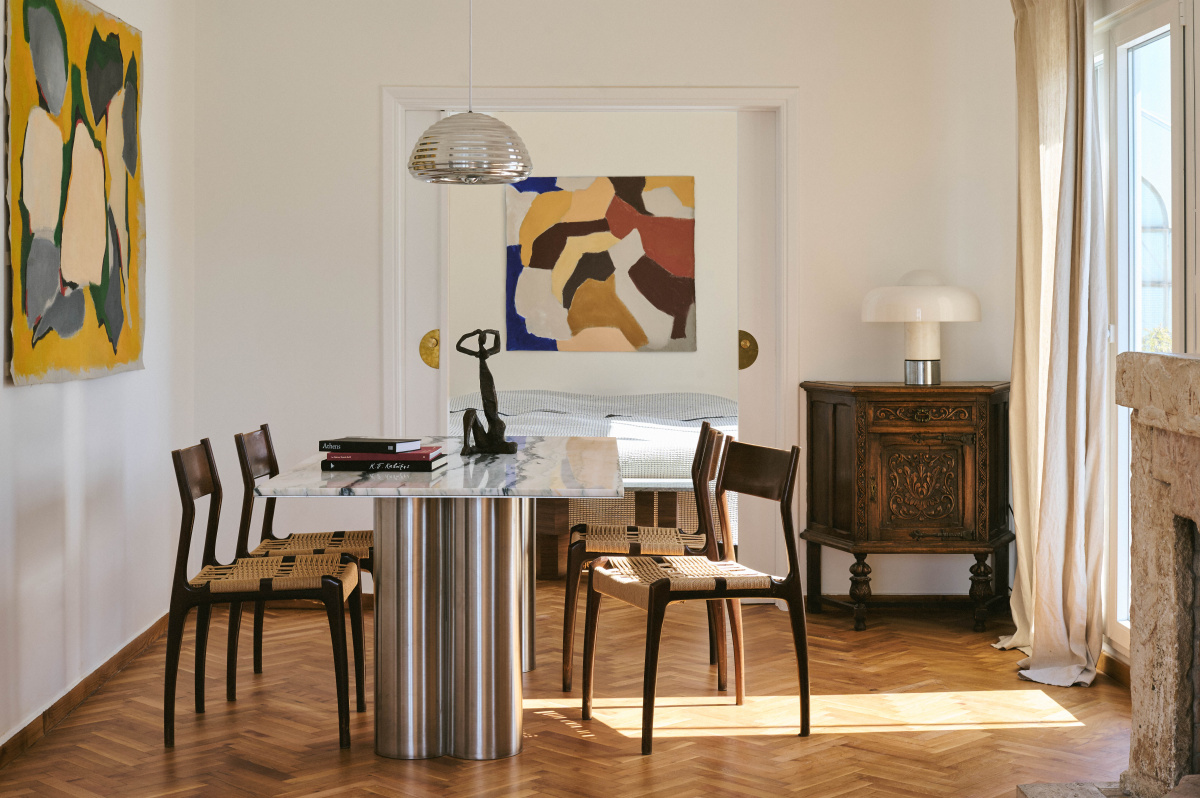
- Designed by Stene Alexopoulos and fabricated by a local metal craftsman who understands traditional metalworking techniques, the table creates a visual and conceptual connection between the interior and the ancient monument outside.
-
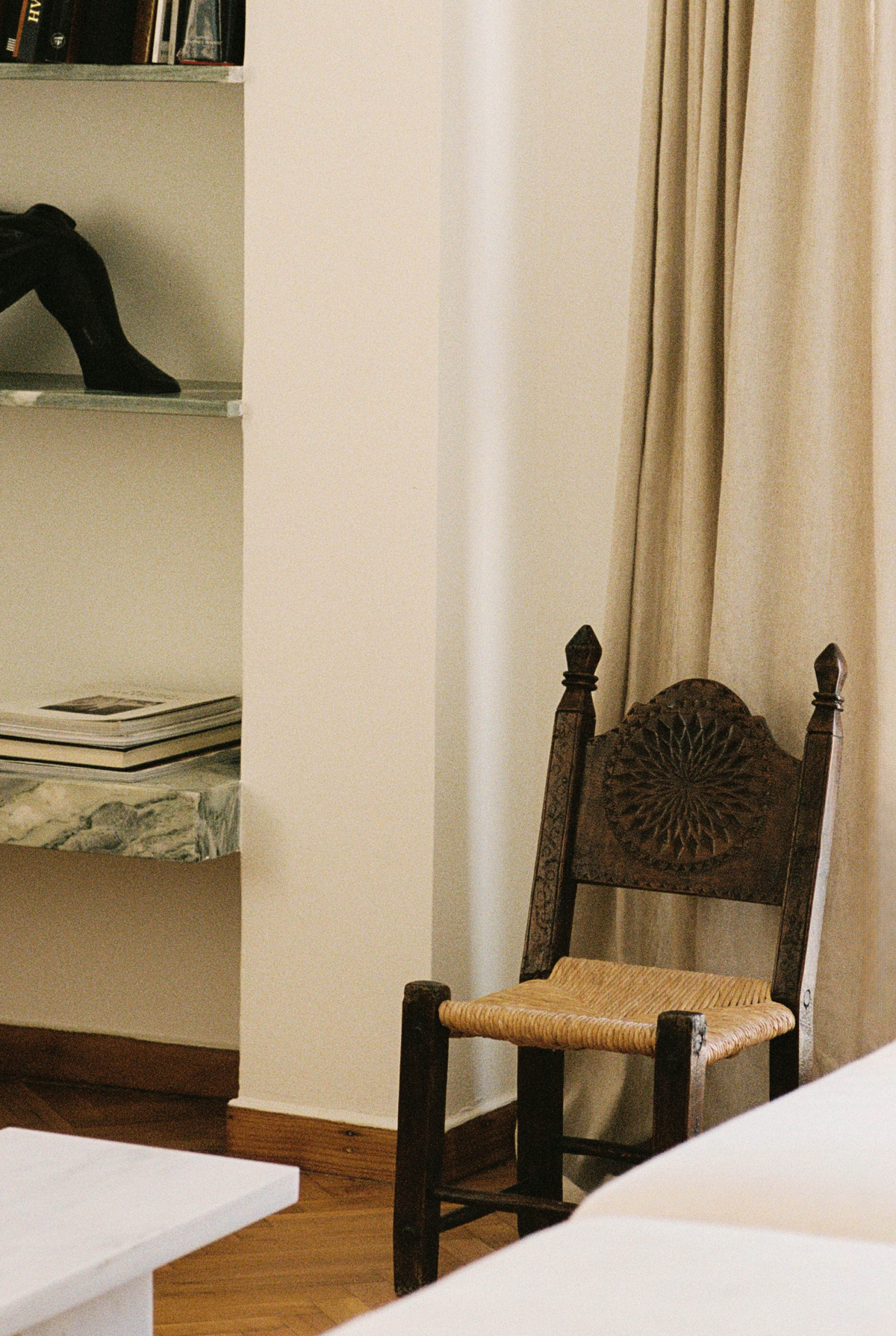
- A vintage chair sourced from the island of Skiathos adds Greek vernacular character and references the tradition of simple, functional furniture found in homes and tavernas across the islands.
You mentioned this wasn’t your first time renovating a family home. How did that earlier experience shape your approach here?
Jonathan Stene: Yes and that previous experience actually informed our approach here. This is our second major family renovation, and both have been deeply intimate and emotional projects. After Elena’s mother passed away four years ago, we worked on renovating her childhood apartment in the south of Paris, where she was raised. Our mother had always wanted to renovate that apartment, so after she passed we saw it as a tribute to her. That experience taught us so much about how to balance preservation with transformation in emotionally significant spaces. We learned that you can make changes and introduce contemporary elements without erasing what came before.
So who gets to experience this space now? Who’s making new memories there?
Jonathan Stene: It’s primarily a family space that we all share. We visit regularly whenever we’re in Athens, but Elena’s father uses it the most consistently. He’s retired now but he’s still very active—he teaches Beaux-Arts classes in Athens, so he spends considerable time in the city and stays in the apartment. But it’s really meant for all of us.
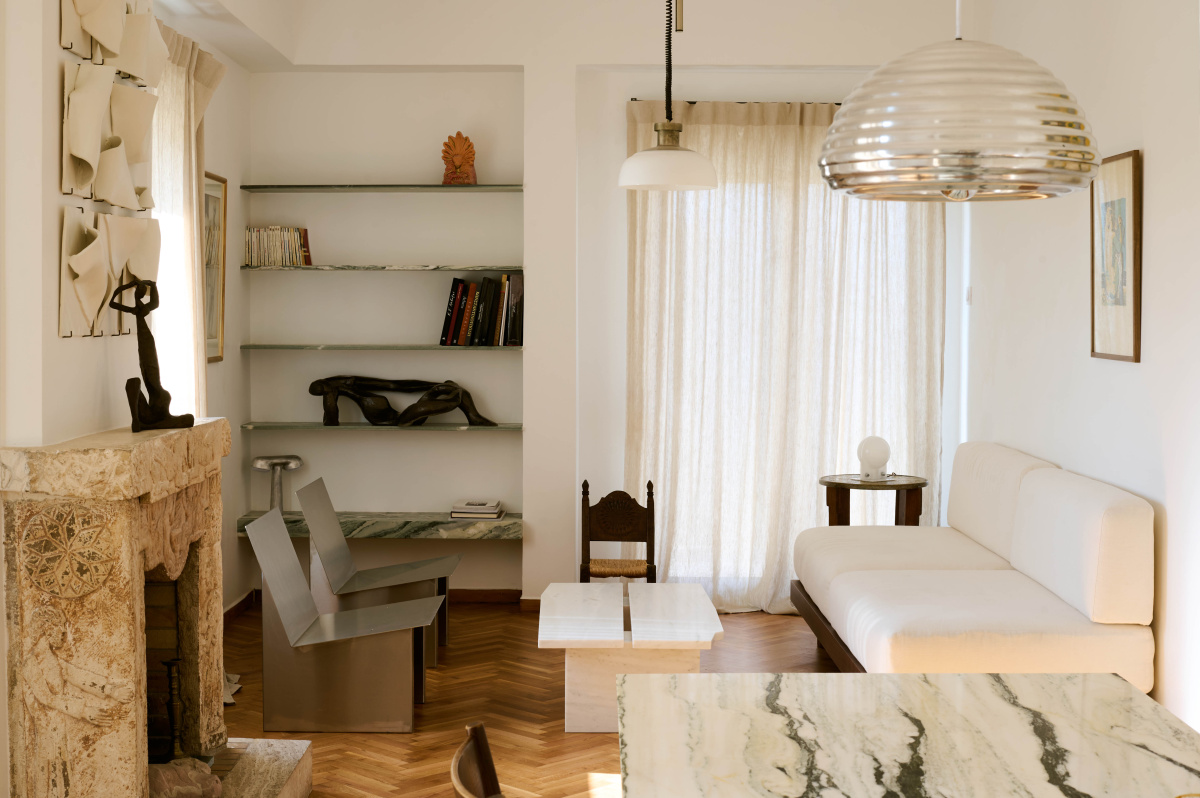
The custom white sofa was designed by Stene Alexopoulos and constructed by a local woodworker. A marble table—part of the designers’ evolving furniture collection developed directly from this project—anchors the seating arrangement with its contemporary interpretation of ancient forms. Behind the seating stands another sculpture by Coulentianos, the famous 1950s Greek artist
Tell me about the people who helped bring this vision to life. What was it like collaborating with local craftspeople on something so personal?
Jonathan Stene: Working with local artisans was essential to the success of this project. The marble worker was our primary collaborator, and choosing someone local was crucial because he sources local Greek marble—the kind that’s been used in Athens for generations. He has this incredible expertise with the material, knows how to handle it properly. Marble is so fragile and difficult to work with; it requires a true professional who understands its properties.
We also worked closely with a local woodworker to execute our furniture designs. We would draw the pieces, work out the proportions and details, and he would bring them to life. And we had a metal craftsman who created pieces like the living room table with its tubular legs, and the metal elements on the balcony.
-
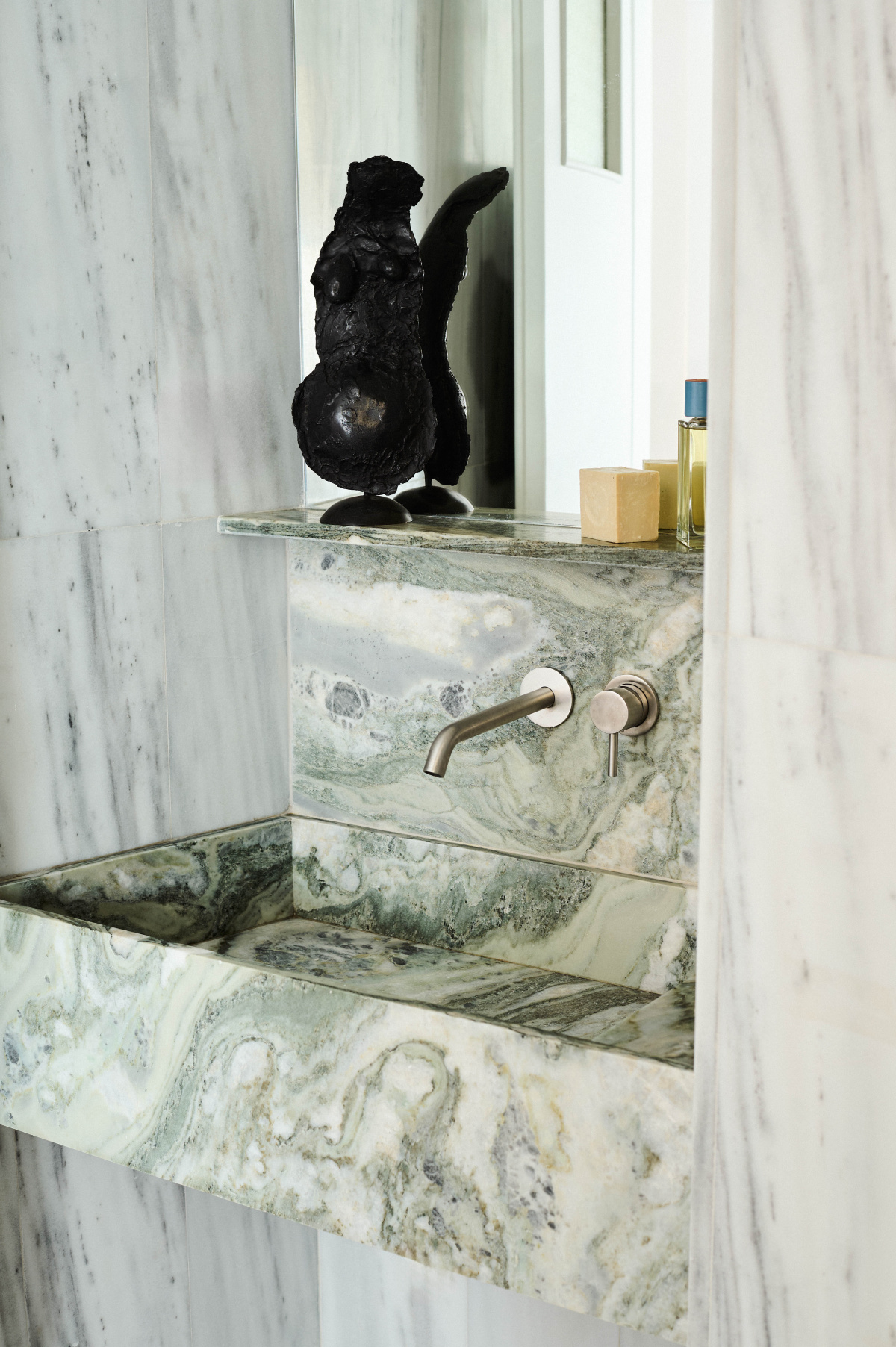
- The bathroom showcases a mix of Italian Cipollino marble with green veining.
There’s such a clear dialogue with Greek history in your design choices. How do you translate thousands of years of cultural heritage into something that feels contemporary?
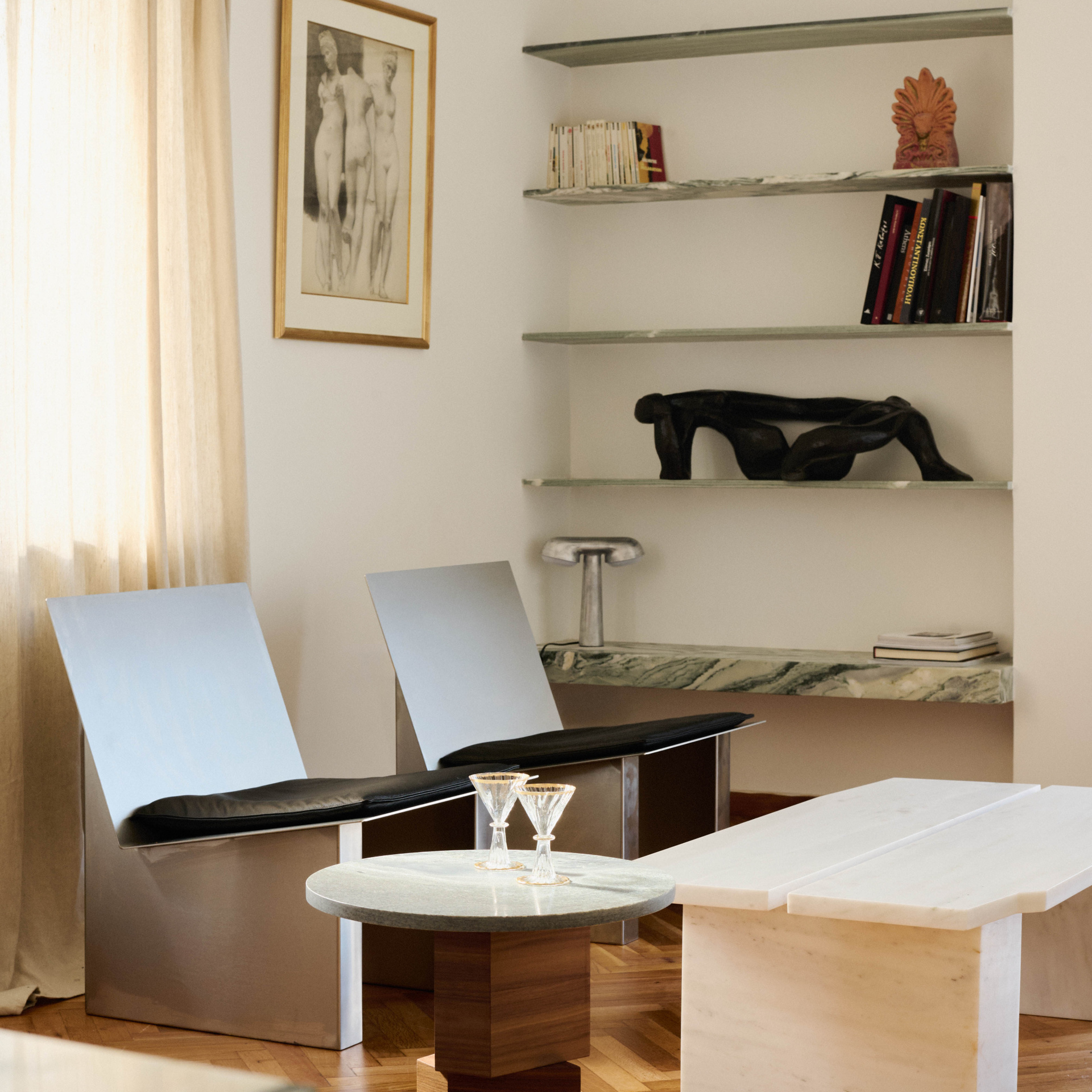
Elena Alexopoulos: We draw heavily from Greek architectural and artistic tradition, but our approach is to interpret it in contemporary ways rather than simply reproducing historical forms. For example, the living room table has these tubular metal legs that directly reference the columns of the Parthenon.
The small marble tables we designed represent archaeological fragments and ruins, recalling the Athenian marble quarries and the fragmentary nature of how we experience ancient art today. We’re pulling from thousands of years of Greek history and culture—archaic archaeological forms, Persian and Greek arts, the neoclassical architecture of Athens—but making it feel current and relevant to how we live today.
The kitchen table also has a particular aesthetic. What inspired that?
Elena Alexopoulos: That design was inspired by traditional restaurants in the Cycladic islands. The wood construction with simple white chairs is extremely typical of Greek tavernas, those casual family restaurants you find throughout the islands. There’s something so warm and inviting about that aesthetic. It’s very unpretentious and welcoming. We wanted to bring that quality into the kitchen to make it feel like a natural gathering place where people want to sit and spend time together.
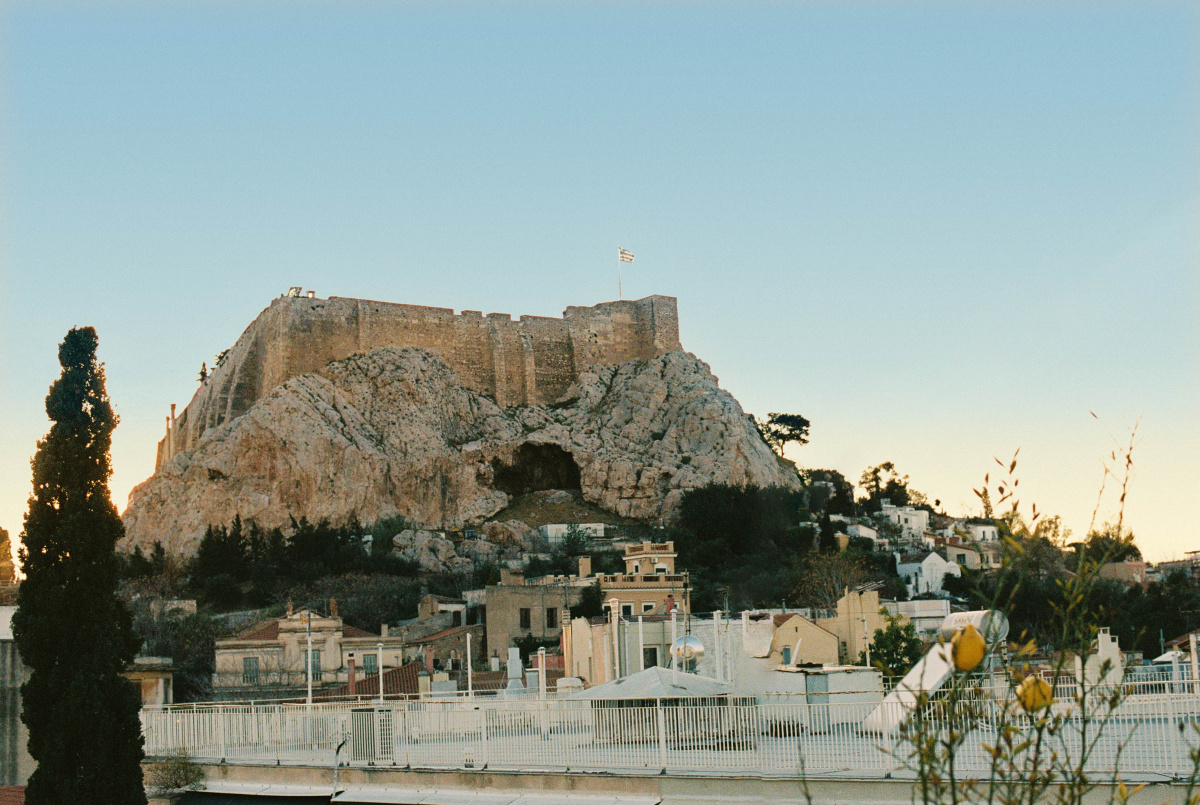
Floor-to-ceiling windows frame an uncommonly rare side view of the Acropolis mount rather than the typical direct Parthenon perspective that most Athenian apartments offer.
The view this apartment has of the Acropolis is also so beautiful.
Elena Alexopoulos: The views are truly spectacular, and what’s particularly special is that this perspective is quite rare in Athens. Most people don’t have access to this particular angle. The apartment is almost like a penthouse—it has these large windows in the living room and both bedrooms that create nearly a 180-degree panoramic view. Light and sun can enter all the rooms throughout the day, which was important to us.
From this specific angle, you don’t actually see the Parthenon directly. You see the mount of the Acropolis itself, the rocky hill, which is a very uncommon perspective. Most views in Athens show you the Parthenon head-on, in all its glory, but this side view is much more unusual. People who visit are always surprised by it.
Can you talk about the material choices, particularly the marble?
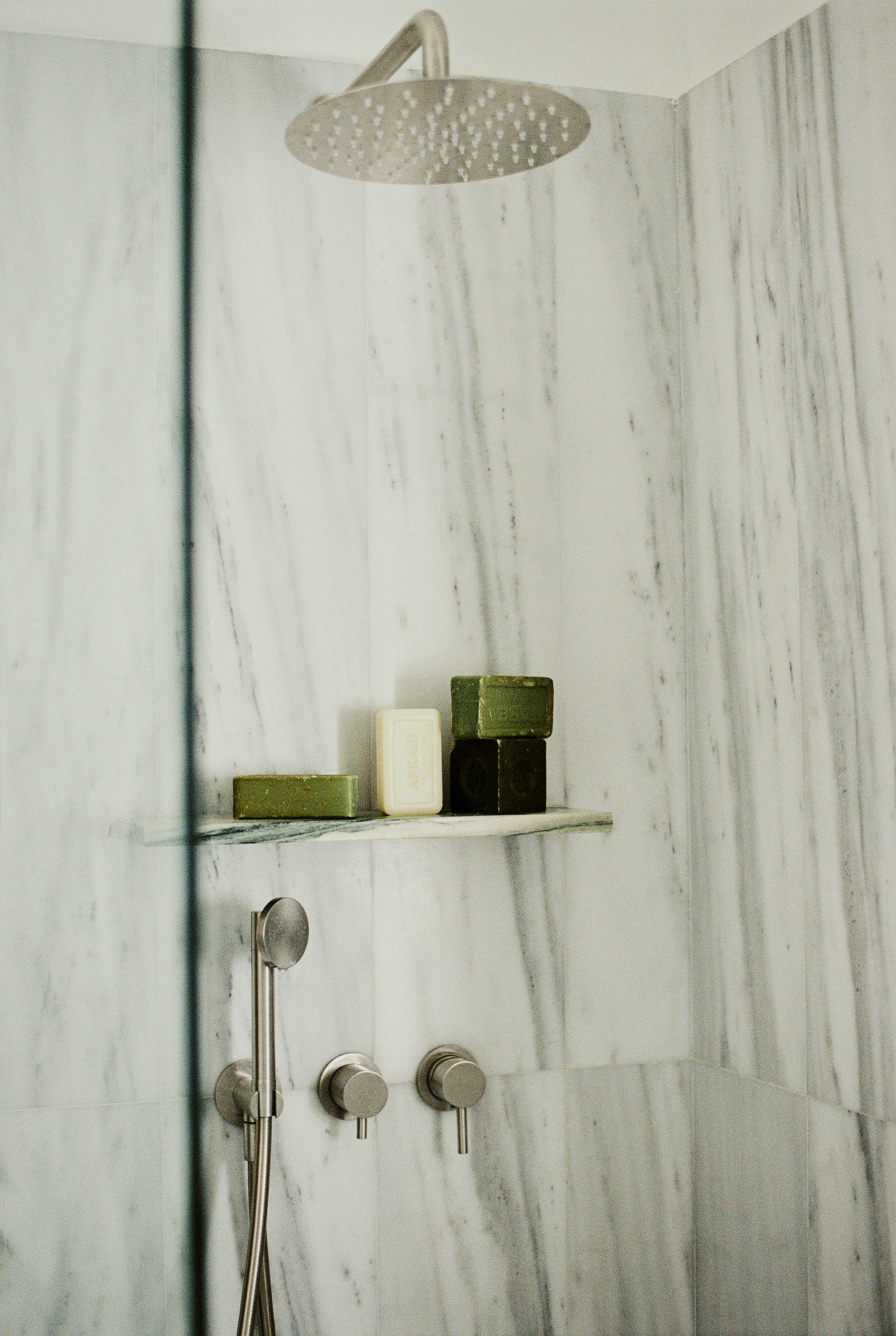
Elena Alexopoulos: The marble was one of our most important material decisions, and we created a very intentional contrast, particularly in the bathroom. We used Italian Cipollino marble, this beautiful stone with distinctive green veining for the sink and certain wall sections. It’s a sophisticated, precious material. But we paired it with a very simple white marble that’s commonly used throughout Greece.
This white marble has real historical significance in Athens. You see it in so many buildings, in the halls of apartment buildings, in public spaces. It’s very classical and humble. The original marble floors in the kitchen and bathroom were preserved completely, as were all the wood floors throughout the apartment.
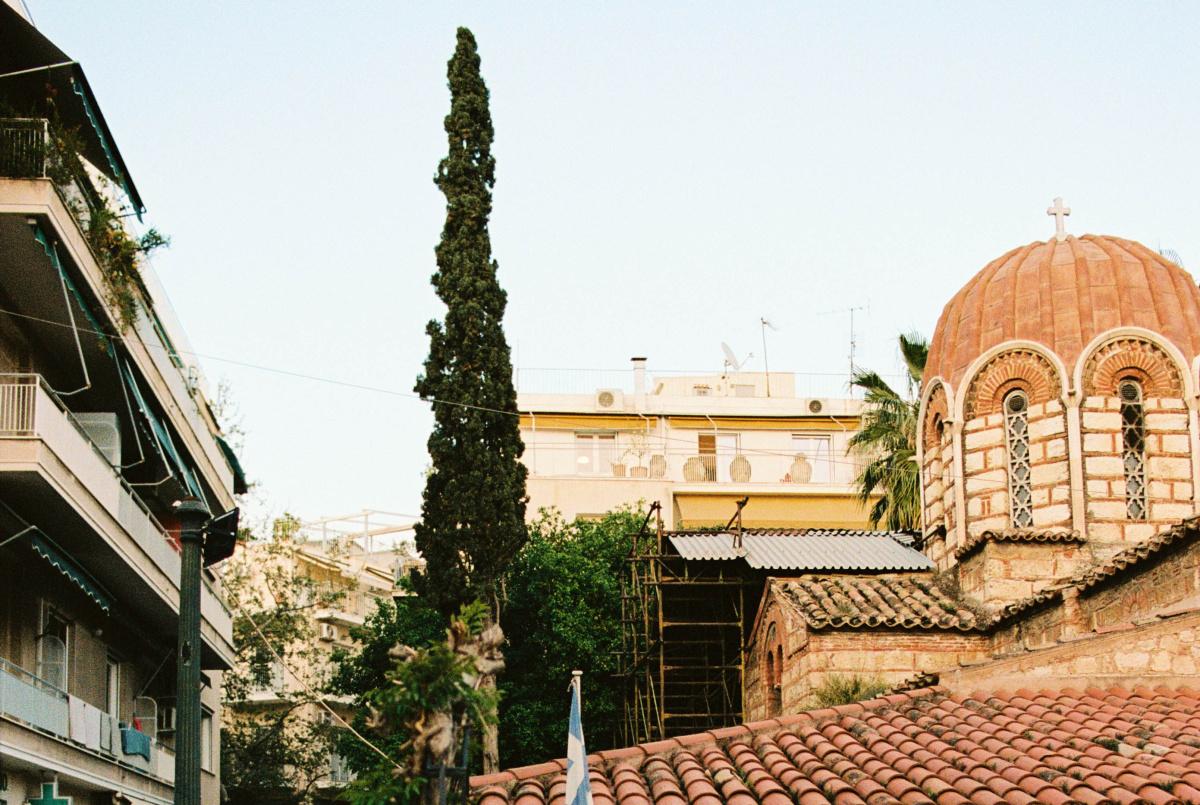
This unusual angle of the Acropolis surprises even local Athenians who visit, according to Elena, making this one of the apartment’s most distinctive architectural features.
How did you incorporate art and objects into the space?
Elena Alexopoulos: The art and objects create this layering of different periods and different parts of our family history. We have several paintings by our father, Andreas Alexopoulos, from his time studying at the Beaux-Arts in Paris when he was younger. These are very personal pieces that connect the space to our immediate family. There’s work by Fassianos, who is one of Greece’s most celebrated artists and now has a museum dedicated to his work. We incorporated sculptures by Coulentianos, a quite famous modern Greek artist from the 1950s who was a friend of the family, so there’s this personal connection there as well. We also have objects that our grandmother collected, like the fireplace she negotiated for decades ago, which is inspired by Persian and Greek arts, and sculptures from French artists from mid-century Paris.
We also brought in traditional architectural elements like an acroterium—those decorative sculptures you see on top of neoclassical buildings throughout Athens. It’s this red terracotta piece that references the urban landscape outside. And there’s an authentic 1800s painting of the Three Graces that’s been in the family.
-
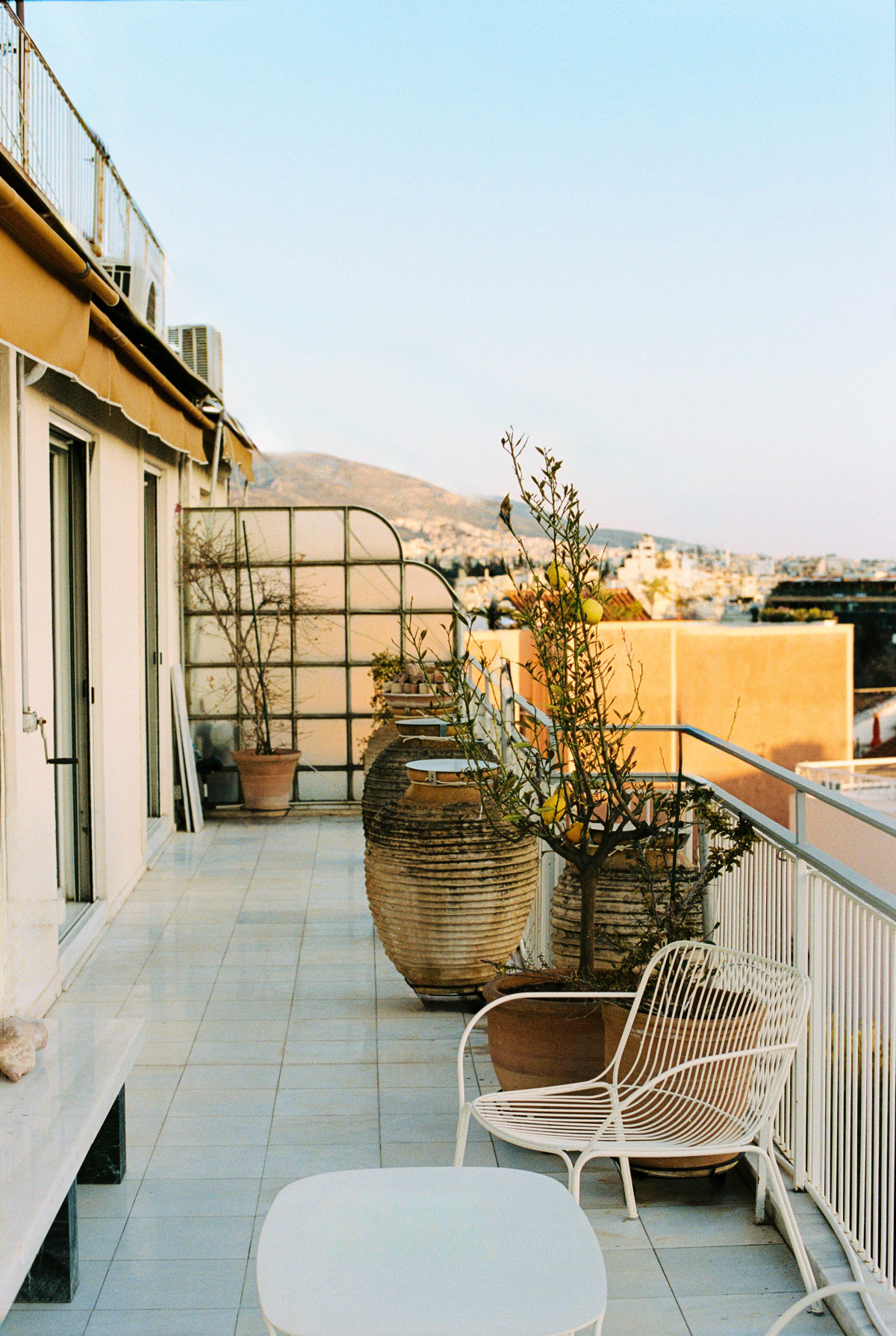
- The apartment’s penthouse-like design features identical large windows in the living room and both bedrooms.
-
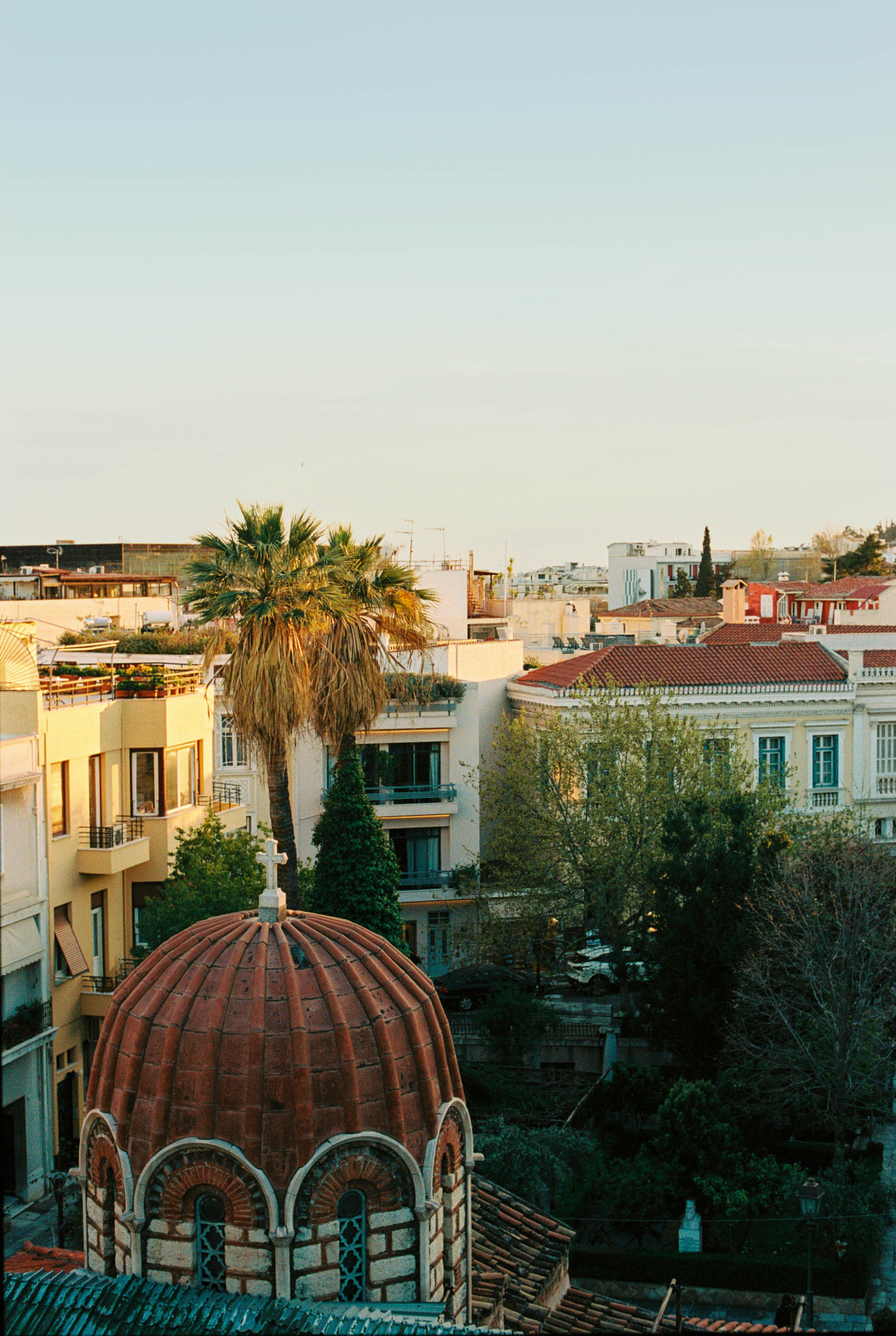
- These windows create nearly 180-degree panoramic views that flood all rooms with natural light throughout the day.
You also designed custom furniture for the space. What does it mean to you to work at that intimate scale, especially in a project so close to you?
Elena Alexopoulos: Designing custom furniture has become an increasingly important part of our practice. We drew all the furniture pieces ourselves and collaborated with local craftsmen to execute them. The white sofa in the living room, various tables with circular marble tops, a chair we sourced from Skiathos—each piece is considered in relation to the whole. We’re in the process of developing our own furniture collection that draws from all these Greek influences we’ve been discussing, but filtered through a contemporary sensibility.
Looking ahead, what’s next for you both?
Jonathan Stene: We have three main focuses right now that represent the breadth of our practice. First we’re in the process of constructing a villa in Tinos, which is one of the Cycladic islands. That’s an exciting project because it allows us to work with the landscape and the particular light and architecture of the islands.
We’re also continuing to work with private clients in Paris, primarily renovating old apartments. That’s really the core of our practice—taking these historic Parisian spaces and finding ways to make them function for contemporary life while respecting their history. And third, we’re expanding our furniture and object design collection, developing pieces that can exist independently but that also grow out of our larger design philosophy. So we’re working across multiple scales simultaneously and across different contexts, from Paris to the Greek islands. Each project informs the others.