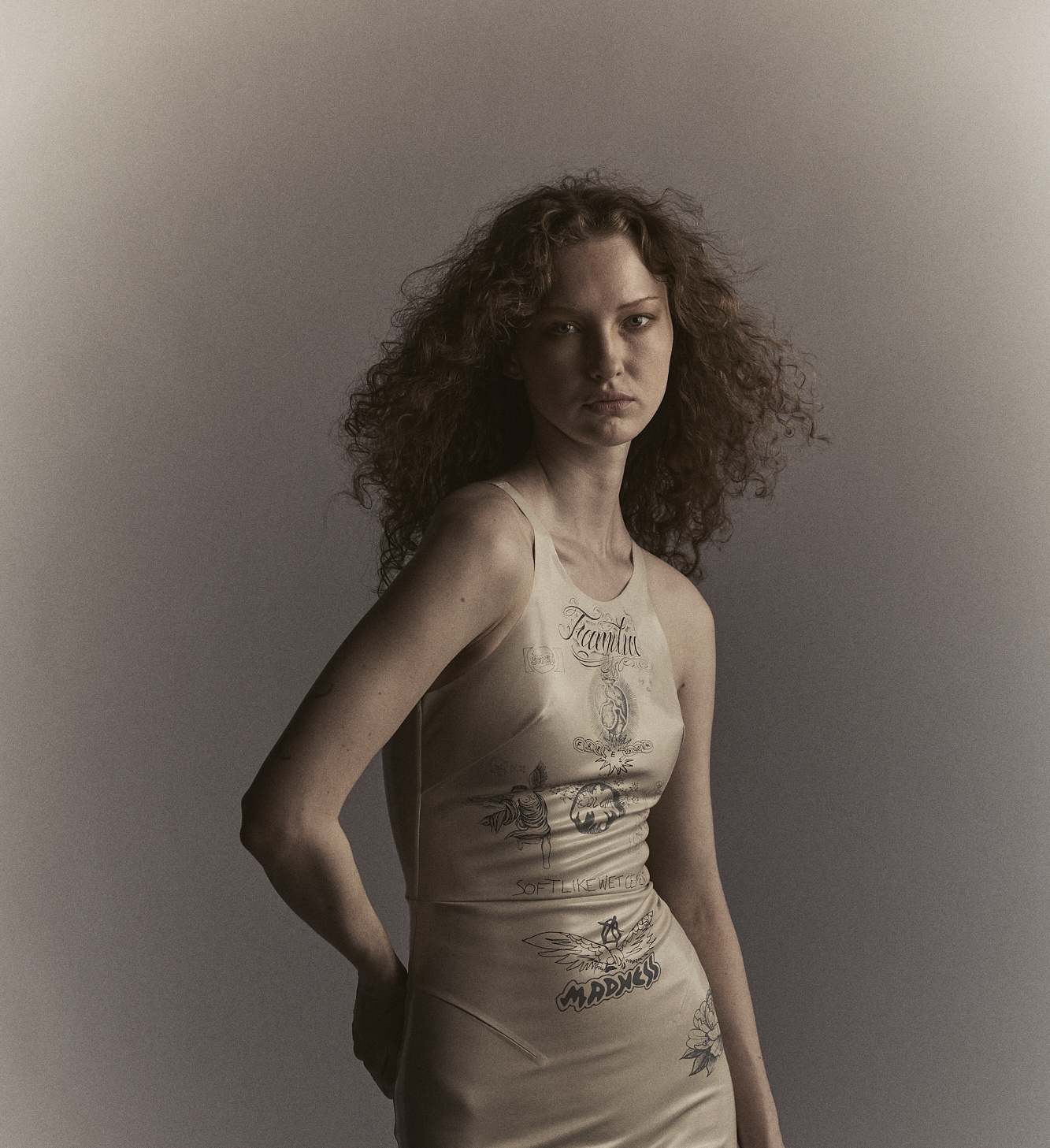
Leon McKay is the kind of maker who thinks in metal before he thinks in words. Ask him how a new piece begins and he’ll tell you he can see it folding before he’s touched it, where the joints will sit, and how the weight will distribute. The entire project is already resolved somewhere in his mind.
Leon is the founder of Saintleo, a design studio that began its life as a precision fabrication workshop in Auckland, New Zealand, and has since found a new home in New York’s Brooklyn Navy Yard. What started as a practice built around architectural commissions has followed Leon’s interests in music, art, and architecture toward special projects, collaborations, and limited-edition pieces that carry the mark of his hands in a way his earlier work couldn’t. The work is slower, more uncertain, and more alive than anything he has made before.
He is by his own account, “beginning again.”
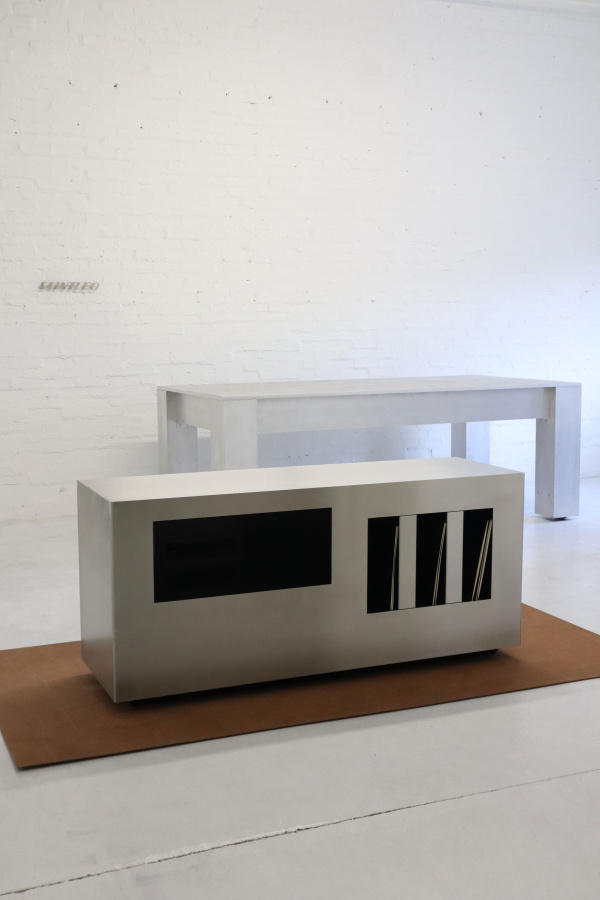
The Bunker Music Credenza, designed and commissioned for a private listening room in Los Angeles, purpose-built around a McIntosh integrated amplifier. Photo courtesy of Saintleo
“At one point I felt like I’d stopped learning,” he tells me while sitting in his studio. “Because I was doing things so repetitively, it was easy to feel like I ‘knew it all.’ Now that feeling of newness has come back, which is the best feeling I’ve had in a long time.”
Leon grew up watching his father weld commercially in New Zealand building trailers, fences, and everything else the trade demanded. When he eventually moved to Melbourne to pursue a metal fabrication apprenticeship years later, he landed at a studio that worked almost exclusively with architects on high-end fitouts. Two teachers shaped him in opposite directions at once: a master builder who drilled into him the proper grammar of the trade, and another who came from a background in sculpture.
He rounded out those Melbourne years with a short course in Japanese joinery, taken while working for a furniture maker on the side. It was a discipline built entirely around patience and precision where joints were engineered to interlock without nails or adhesives, according to Leon.
“Everything was a lot more slowed down in that practice,” he says. “It’s very delicate and careful. I feel like that helped with my tolerances.” On weekends he and his friends would visit Melbourne’s National Gallery of Victoria, where international exhibitions cycled through consistently. The music scene was also extraordinary. It was, he says, as close to the international art world as that part of the world could get.
Leon eventually returned to New Zealand and launched Saintleo in 2017, channeling everything he had learned into a workshop of his own. He tells me the name Saintleo came to him in the early days of the workshop, inspired by the Kanye West song Saint Pablo. It was a full operation from the start: CNC machines, laser cutters, a team of fabricators—the whole architecture of a serious commercial practice.
From there the reputation built steadily eventually reaching architectural firms, interior designers, and international fashion houses like Bulgari, Louis Vuitton, and Entire Studios. As the commissions kept coming, the operation grew into something that left little room for anything else. It was in the middle of all of it that a question had started to press on Leon: what did his own work even look like?
“I never want to make something just for the sake of making it,” he says. “It’s almost a deep thought or study of my own in design: what do I need, and what would I personally want in my home that I would live with?”
The first honest answer came from a mundane problem. His record player was sitting on the floor without a stand, so he designed something to hold it using mesh.
“I love music so I thought, ‘maybe I should start by designing a credenza for that,’” he says. “The materials I had worked with previously, I’d always have offcuts lying around. Maybe I’d used the mesh for a staircase or a handrail, something more like a home fitting. But playing around with it opened up this whole other world for me to start creating.”
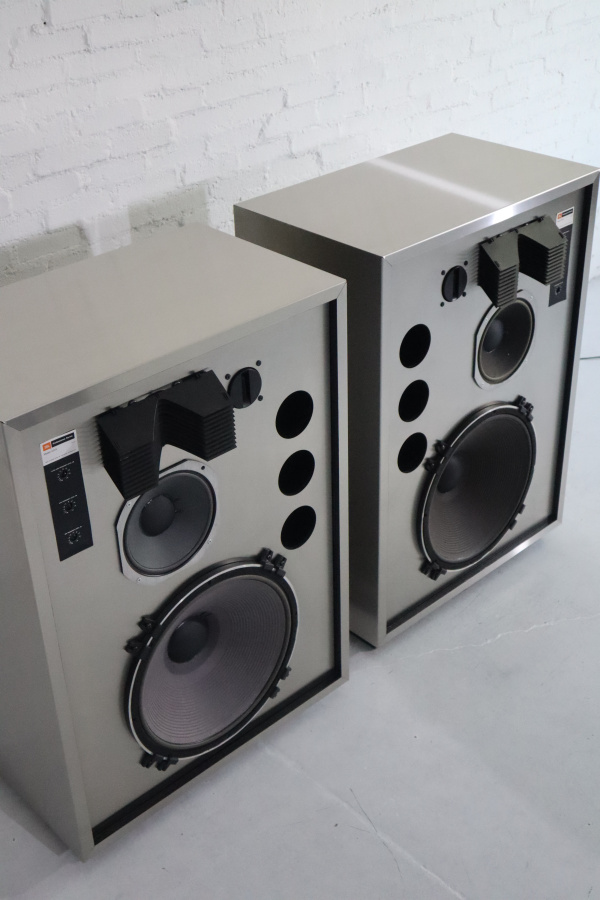
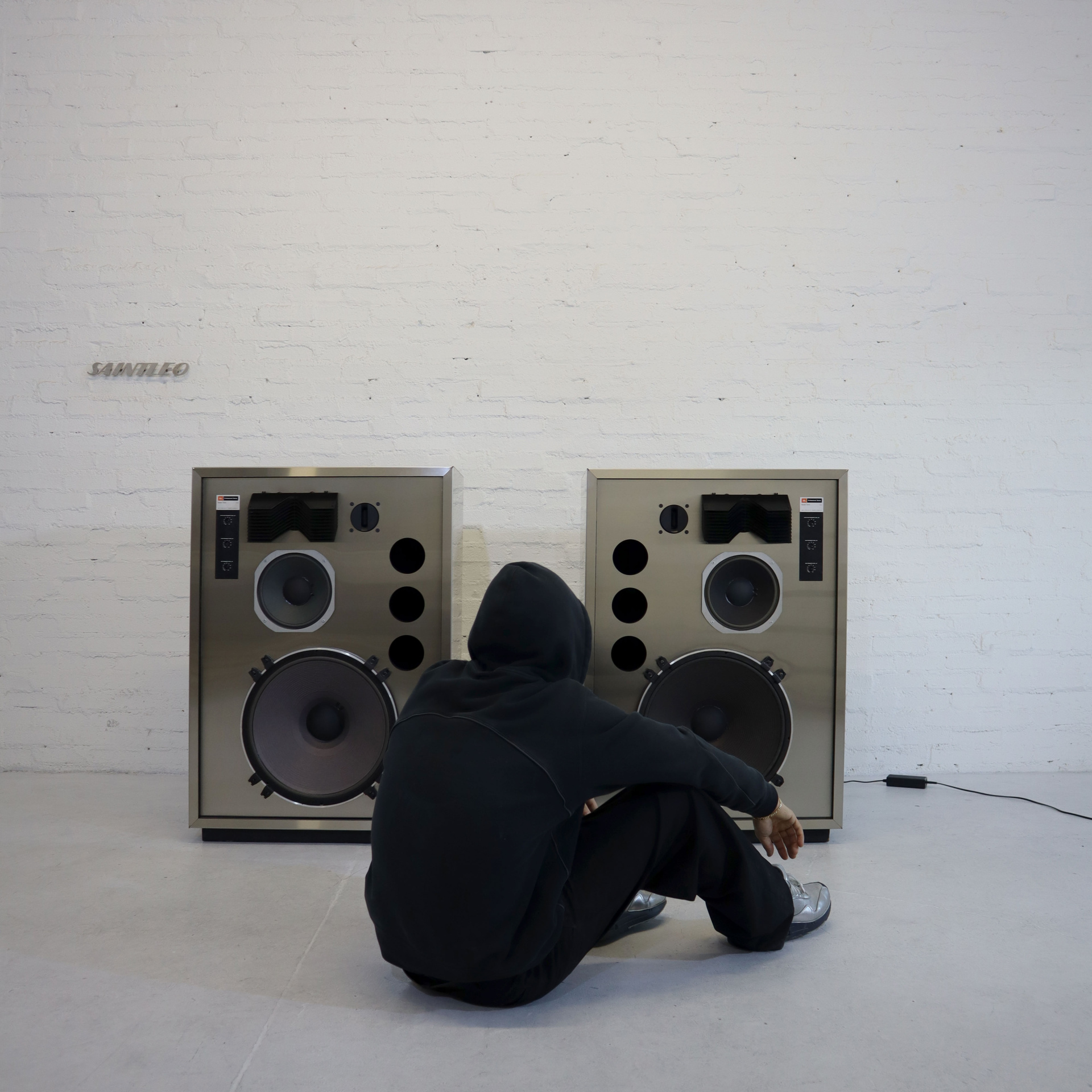
The JBL4345 studio monitors in semi-polished stainless steel for Atlantic Records.
Around the same time, he and his partner began making trips to New York, spending whole days moving from gallery to gallery, seeing paintings and sculptures he had only ever encountered online. He would fly home each time with the gap between his two lives a little wider.
“Everything I’d see online and in pictures, I was seeing in real life all of a sudden,” he says. “I was inspired by New York. It changed my perspective of creating and making. All of a sudden I didn’t want to only make things for architects and other designers.”
Each time he flew home, the pull of New York stayed with him. Eventually he followed his calling. He restructured the operation, handed the workshop to his business partner under a new name, and kept the Saintleo IP. Then came the part that was harder to plan for.
“Towards the end I was really creative,” he says. “But the scariest thing about moving was there was no studio set in stone, not even an apartment to live in. Everything was completely new. You could only really prepare up to the part where you get on the plane.”
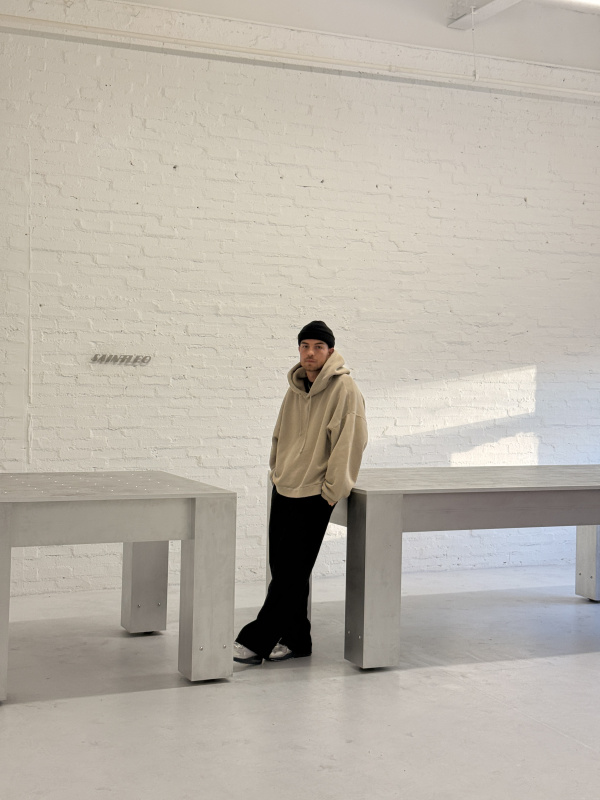
Portrait courtesy of Saintleo
Landing in New York, a chain of conversations eventually led him to the Brooklyn Navy Yard, a working manufacturing district tucked between Williamsburg and Dumbo where industry has been deliberately preserved inside the city. He found a studio in a building that houses a florist, a furniture prop house, and timber workers. After years of imagining what it might feel like to set up alone in a city he barely knew, the community of it came as a relief.
“That was the most intimidating thing,” he says. “I’m so happy to have found this place, and to have my own space but know that there are people around. My studio here is more human-made where I’m working with my hands and doing a lot of experimenting. There’s a lot of play and prototyping involved as well. If I have an idea for something, I have a space ready for executing that.”
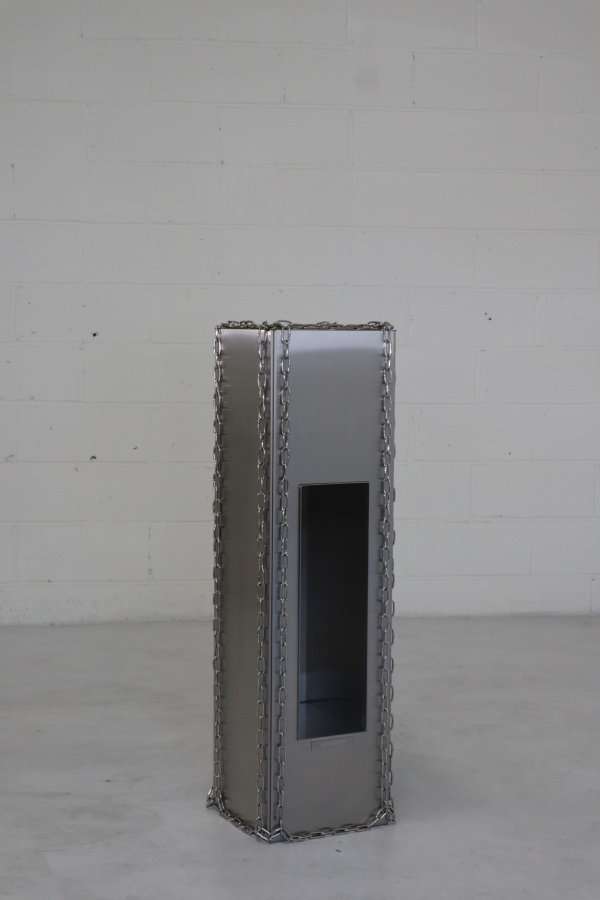
The material at the center of the Saintleo practice is stainless steel. Leon says he’s worked extensively with aluminium, mild steel, and brass, but stainless kept pulling him back. Partly it’s practical: aluminium is complicated to weld, throws contamination and smoke, tarnishes and oxidises over time. Stainless holds up outdoors without compromise and stays clean in a way that other metals don’t. But more than any of that, it rewards handwork.
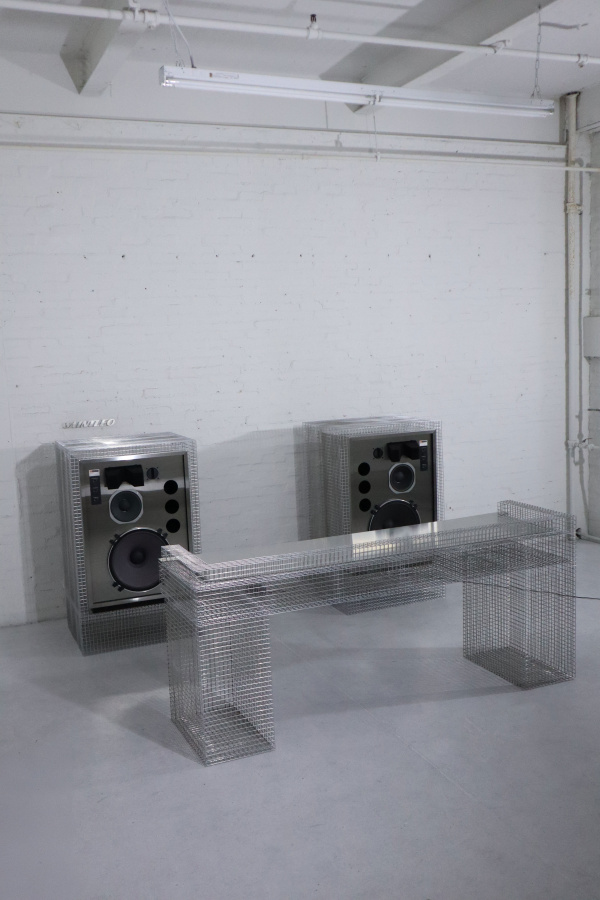
“I love music so I thought, ‘maybe I should start by designing a credenza for that,’” Leon says. “The materials I had worked with previously, I’d always have offcuts lying around. Maybe I’d used the mesh for a staircase or a handrail, something more like a home fitting. But playing around with it opened up this whole other world for me to start creating.”
“I try not to follow too much of what’s trending, and I can see why a lot of furniture blows up on the design scene,” he says. “The way it comes off a CNC almost clipped together, it doesn’t take very much labor. With the materials I’m working with now, I’m trying to do the opposite and work with my hands. I want to put a lot of love and energy into everything that I do.”
Music has also been threaded through the practice, though Leon has never been a musician himself. He’s spent his career listening, following artists, and trying to merge everything he loves into a single body of work rather than keeping the different parts of his life separate. He once built a pair of stainless steel-clad Altec A7 speakers from scratch with the exterior sheathed in stainless steel after deciding that importing them to New Zealand would be too difficult.
“It just came to me,” he says. “I had all these tools around me, I had the skills to be able to create it, and the plans were almost all available online. I started to source the actual hard components like the drivers and the horns.” Prototype after prototype followed.
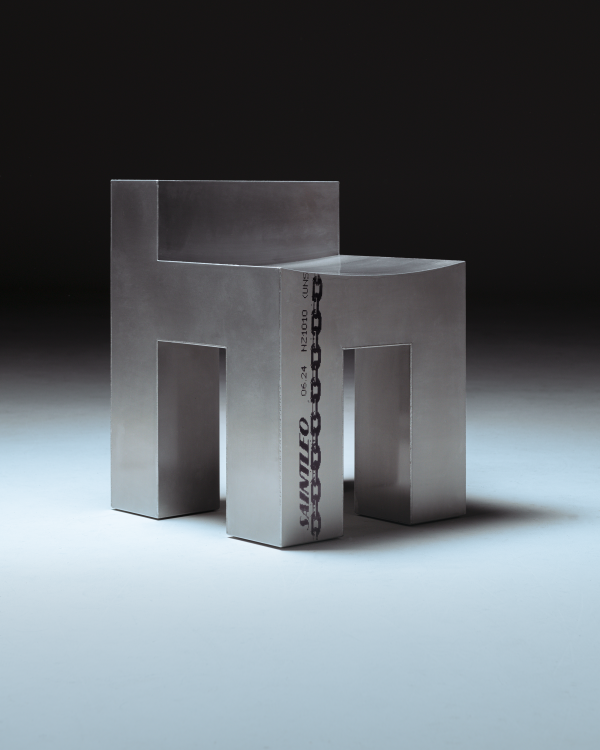
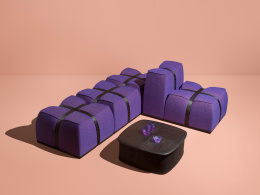
The Box Seat is a feature chair formed by the boxy silhouettes and uncompromising stances found in a utilitarian design approach. Fabricated from aluminum, the form is intentionally direct.
“I wasn’t trying to reinvent the speaker. I was just trying to add my visual language to something I already thought was beautiful,” he says. “It’s like when someone works on a Porsche 911. At the end of the day, a lot of those cars are a representation of their owners, all the way down to the color.”
That same sensibility recently found a larger stage. Earlier this year, Saintleo was commissioned by Atlantic Records to design and fabricate a stainless steel installation for the label’s Grammys party in Los Angeles, a project built around the intersection of music, industrial material, and spatial presence. The project brought together everything Leon has been working toward: the hand work, the material language, and the world of music that has informed his practice from the beginning.
Leon has also recently taken up painting—drawn to it, he says, after years of standing in front of paintings in galleries. What he found was a mode of thinking that asks something of him fabrication never does. He tells me he’s currently absorbed by the process of mixing colors, discovering that the color you’re looking for doesn’t always come pre-made in any set. You often have to find your way toward it by hand.
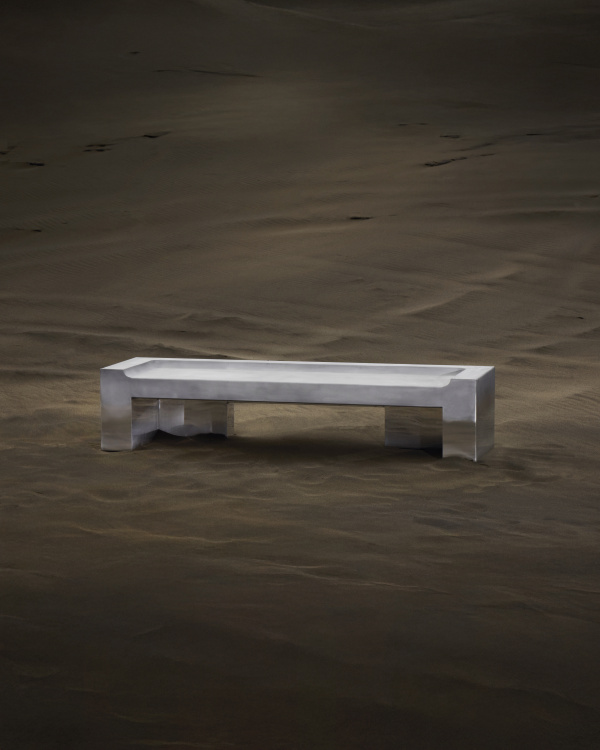
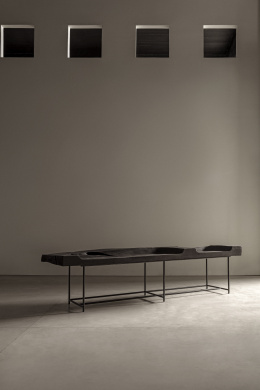
The Still Bench Seat was conceived as a low, elemental form. The piece reduces function to its most essential gesture. Fabricated entirely from aluminum, the bench features a sand-blasted upper surface and a mirror-polished lower half.
“In furniture, by the time I put the tools in my hands and start working, I already have the direction of exactly where it’s going,” he says. “With painting I have no idea. I have to surrender. I’m trying to let that happen naturally as opposed to forcing it. It feels like I’m using two different sides of my brain.”
All of it is pointing toward New York Design Week, where he plans to show a small collection of new pieces for the first time in the city. Though his fluency with the material runs deep enough that he can resolve a piece in his head before touching it, the new pieces he’s working on are teaching him to give some of that control up.
“Since I’m so fresh to New York, this is where I feel like I need to show first,” he says. “I’m going to pride myself on the work being made with my hands here in New York.”
The work itself is still developing while he simultaneously juggles commission pieces alongside his own. A chair he has been developing has already gone through four iterations, each one adjusted by an inch, teaching him something through his hands that he used to work out on a screen.
“The shape is easy to execute,” he says. “It takes several prototypes, tiny changes, and trying different techniques until you finally get there. To see it and feel it in real life is so much more important than how it looks on a CAD screen. But I’m excited about this slower process that is totally new to me.”