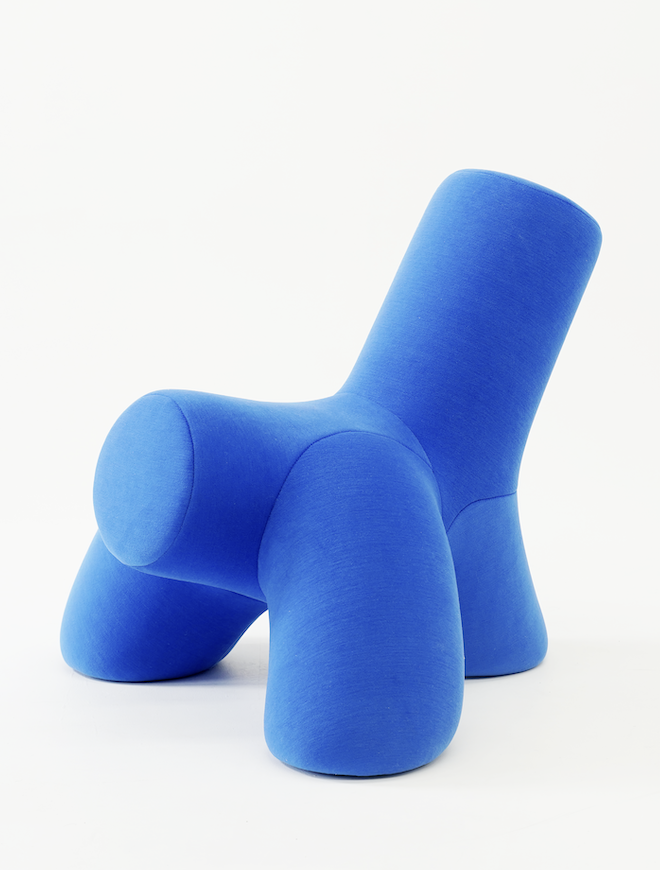
Designer Reggy St-Surin didn’t set out to create a chair in the traditional sense. Instead, he wanted to challenge expectations. “With the Tom Chair, I wanted to design something that didn’t immediately register as a chair, even though it was meant to be sat on,” he explains.
Drawing inspiration from monochromatic interiors, radical design, animals, and space-age aesthetics, the chair’s form evolved organically. “I like bold shapes,” Reggy says. “Initially, Tom was a bit skinnier, but I adjusted the proportions because I wanted people to feel at least somewhat comfortable sitting on it.” The final design embraces exaggerated curves and a creature-like form that invites interaction.
Material constraints also didn’t dictate Tom’s shape. “This was a passion project, so the only limits were my own standards for quality,” he says. Comfort wasn’t the top priority either, but ergonomics still played a role. “As an industrial designer, I couldn’t completely ignore comfort,” he admits. “I considered foam density, seat height, and the angle of the backrest—so while it looks unconventional, it still works as a seat.”
Tom’s name comes from one of Reggy’s favorite childhood movies, and even its logo subtly nods to the design. “When I was working with graphic designer Simon Lemarié, we realized the lowercase ‘t’ resembled Tom when viewed from above. That made the decision easy.”
The Tom Chair isn’t about being the most practical seat in the room—it’s about sparking curiosity. “I wasn’t trying to create something that just demands attention,” Reggy says. “I wanted it to feel unexpected, like some of my favorite pieces.” He draws inspiration from unconventional designs like the Pratone sofa by Giorgio Ceretti, Pietro Derossi, and Riccardo Rosso, the Shadow armchair by Gaetano Pesce, and the Living Tower by Verner Panton. “I could go on forever,” he says.
“I don’t really care about how they feel or how they interact with Tom—as long as it makes them want to, I am satisfied!”
A version of this article originally appeared in “Nice Chairs” in Sixtysix Issue 14.