Most vehicles have a stereotype owner. Close your eyes and imagine a Harley-Davidson rider. Now do the same for, say, the driver of a Toyota Sienna. And who do you imagine driving a Ford F-150 with a Predator sticker on the windshield? If we took notes, we likely pictured very similar people. But who comes to mind behind the wheel of a Land Rover Defender, and what are they doing?
Is it Queen Elizabeth rolling around the Scottish Highlands with a flock of Corgis? Or is it a well-manicured tech entrepreneur with a left-hand driving, aluminum bodied version, carelessly parking across two spaces out back of Deus Ex Machina in Venice? Either way, while the Defender badge maintains its sense of refined British luxury, its public profile has become removed from its rugged, drive-anywhere, adventure-seeking roots.
Land Rover aims to change that with its new flagship model, Defender OCTA.
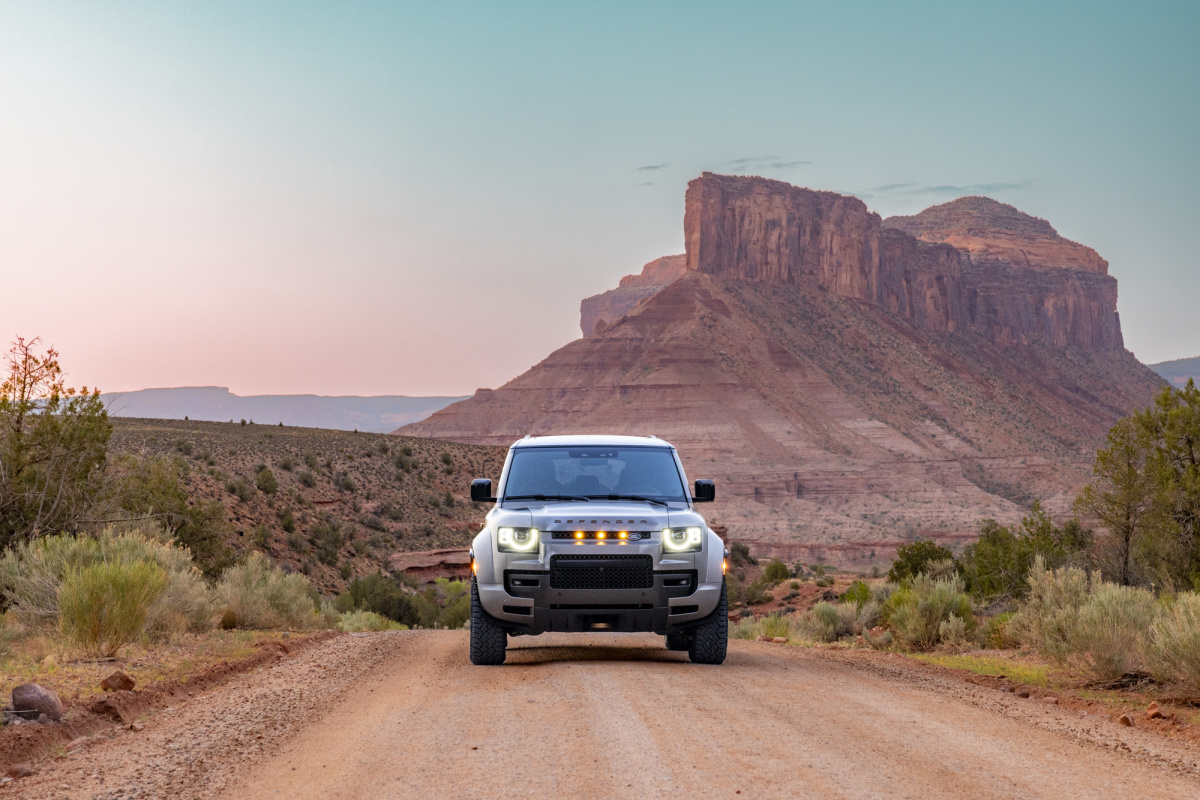
A 6,000-pound SUV capable of 0–60 in 3.8 seconds, Defender OCTA will take this power to Dakar next year. Photo by Chris Force
Land Rover bets on Dakar
Land Rover introduced Defender OCTA as the “toughest, most capable and most luxurious model in the unstoppable 4×4 family.” To prove they were serious about returning to their off-road roots when they unveiled OCTA to the public, they also announced they would race it at the infamous Dakar Rally next year.
This is perhaps the boldest “put your money where your mouth is” action a manufacturer can make. Dakar is considered the toughest endurance race in the world, forcing vehicles to survive thousands of miles of dunes, rocks, and extreme heat. Toyota and MINI have managed multiple wins at Dakar, while other major automakers like Porsche and Peugeot have tasted both triumph and disasters in the desert. Few completions expose weakness in engineering as quickly.
The takeaway? Land Rover built a tough car. And by the numbers, it appears to be a miracle of engineering: a massive 6,000-pound SUV running a 4.4L twin turbo V8, a top speed of 155 mph, and a 0-60mph sprint in 3.8 seconds. But what does that actually translate to on the road?
Land Rover devised a curious way for journalists to find out.
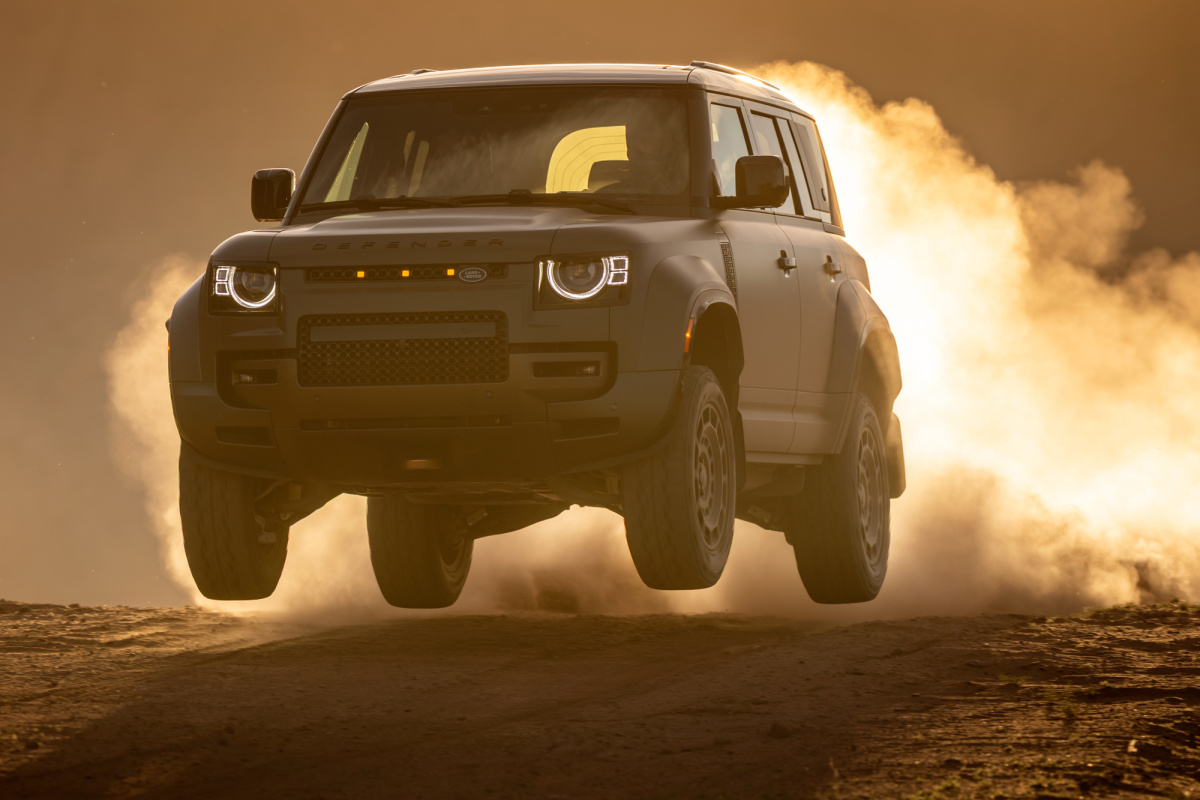
In the passenger seat with racer Davy Jones, the OCTA went airborne. The view from inside made the leap feel massive. Photo courtesy of Land Rover
First ride in OCTA mode
It is 103 degrees out. Dense red dust flows through the air so thickly I can only see a few feet in front of me. I’ve been flown into a remote race track near the border of Colorado and Utah, and I’ve seen the all new-OCTA for all of 60 seconds. I still have my luggage with me. “Here, put this helmet on,” someone says. I follow suit and then am quickly buckled into the passenger seat of the OCTA. The driver leans over, “Hi, I’m Davy. Let’s put this in OCTA mode and see what it can do.” “Um, sure,” I say.
I have no idea what OCTA mode is (it’s the car’s high-performance driving setting) or who Davy is (Davy it turns out, is legendary racer Davy Jones who won the 24 Hours of Le Mans back in ’96 among other races.)
The next three minutes are literally a blur as Davy, who I assume has something against me, attempts to time travel. We destroy the track flying around corners, launching over berms, and end our run airborne over a ramp. “Hey we caught some air,” Davy quietly mentions as we come to a halt and my soul slams back into my body.
This car rips. It’s an absolute monster and I can’t wait to drive it some more the following day.
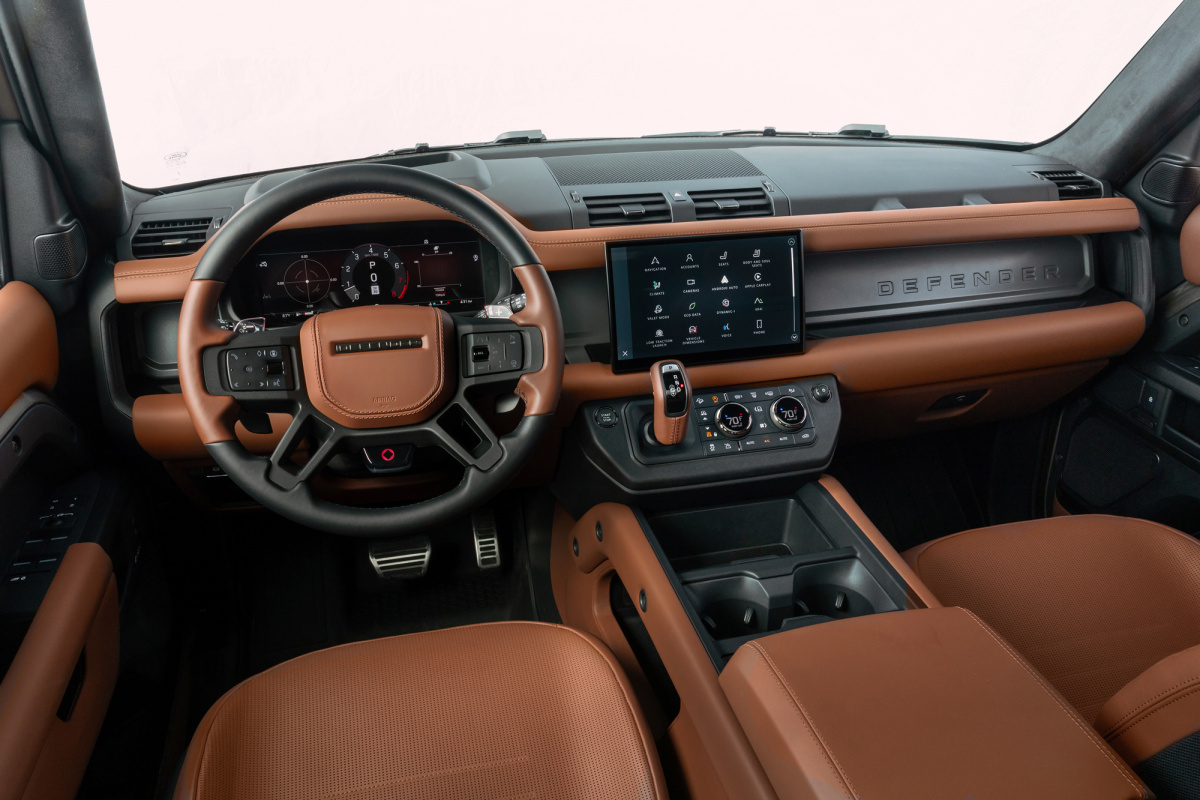
A closer look at the OCTA’s cabin, where premium materials meet practical controls designed for both high-speed runs and rock-crawling trails. Photo courtesy of Land Rover
A day behind the wheel of the Defender OCTA
The following morning I get a proper introduction to the Defender OCTA with a full-day driving experience across a mix of highway stretches, twisty two-lane pavement and plenty of off-roading including some gnarly dirt roads and rock scrambling—a highlight of which was a deep river crossing selected to flaunt OCTA’s ability to wade through water as deep as 39.4 inches (yes, deeper than the Bronco if you’re keeping score.)
With very little off-road driving experience I tackled the day’s routes with surprising ease. The car ate everything that was thrown at it. It offered a mix of drive-anywhere confidence while somehow delivering a relatively quiet and posh ride. The interior is loaded: a 14-way heated and cooled driver’s seat wrapped in Kvadrat and Ultrafabrics trim, sophisticated temperature and air filtration controls, and the unusual “Body and Soul” integrated speaker system developed with a Danish audio tech company. It sounded gimmicky, but I found it surprisingly immersive. There was a smart balance of touchscreen and physical controls on the dash and, yes, a refrigerated box in the center console.
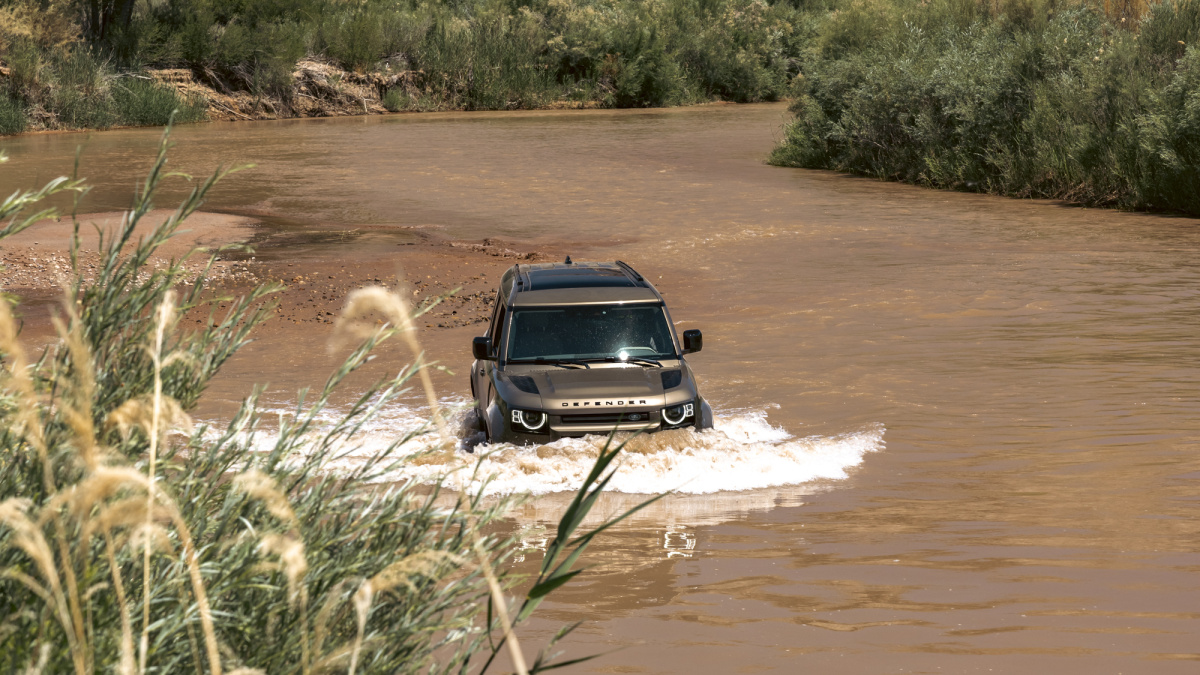
The Defender OCTA in action during a river crossing, its raised stance and advanced sealing allowing it to ford nearly four feet of water. Photo by Chris Force
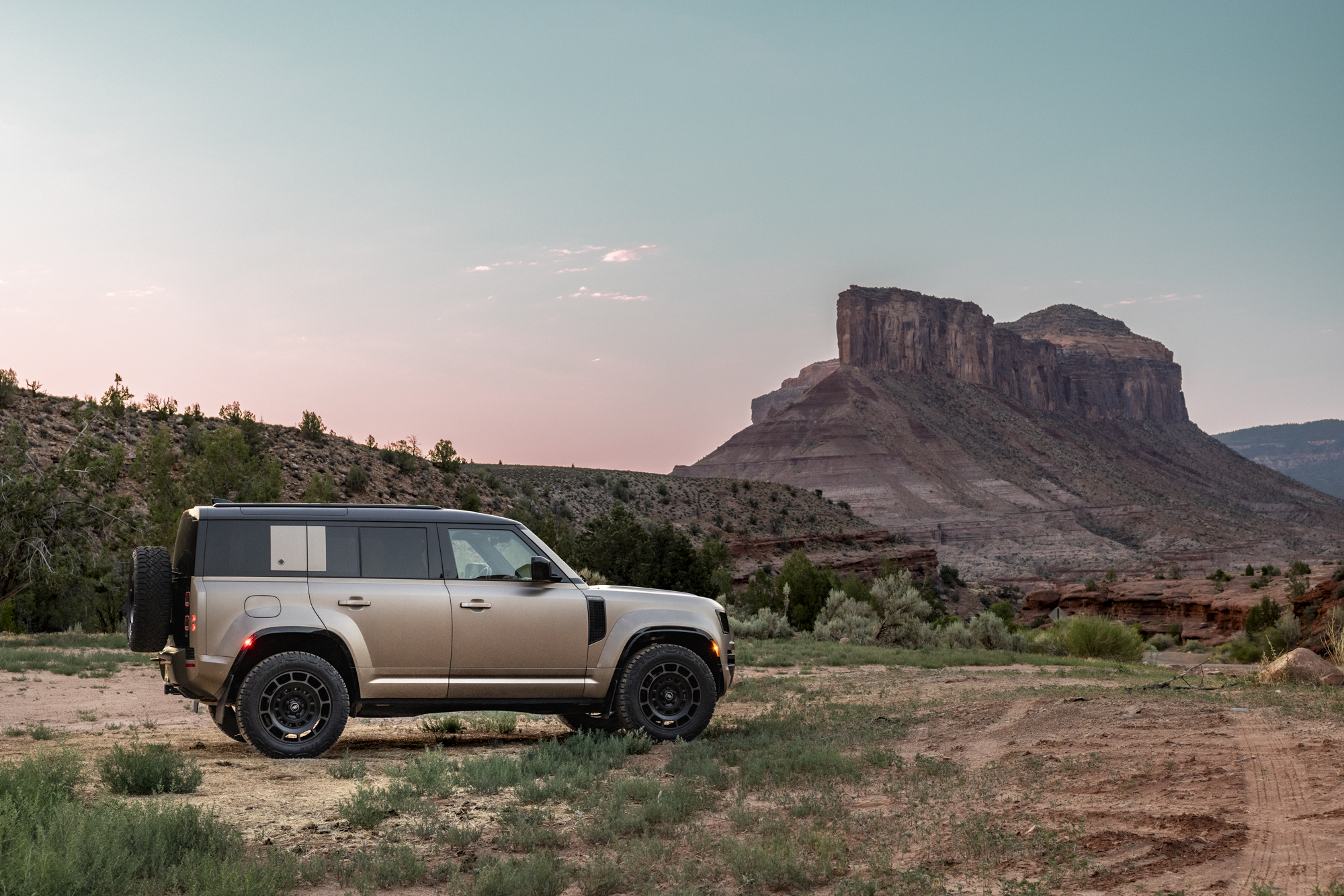
OCTA’s external presence is equally impressive and muscular. It has a tall, wide stance with a massive grill. I rode on the more all-terrain oriented 20-inch Goodyear DuraTrac tires with triple-layer sidewalls rated for a max speed of 99 mph, though the standard tires unlocked the full 155 mph potential. The engine is BMW’s 4.4-liter twin-turbo V8 (the same found in BMW’s M5), tuned here to 635 hp with quad exhaust outlets. As outfitted, the test car’s price tag sat at $167,000, firmly in the ultra-luxury category.
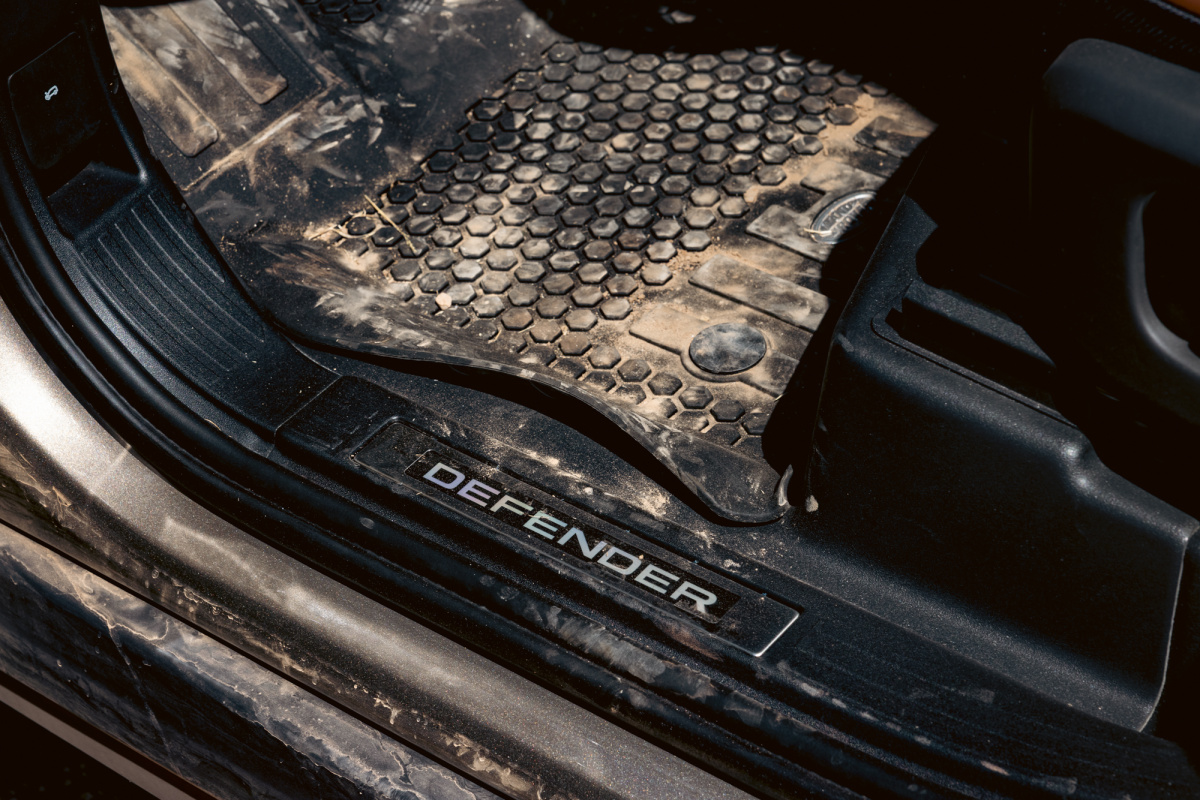
The Defender’s luxury details hold up just fine under dust and dirt, and somehow look better for it. Photo by Chris Force
After two days of driving I was curious what went into designing the OCTA, and how such a flagship vehicle for an iconic brand comes to life. So I wrangled a conversation with Sean Henstridge, Senior Design Manager from Jaguar Land Rover’s design studio in the UK.
How OCTA was born
Most automakers have a sub-brand for high-performance, limited edition, or bespoke vehicles. BMW has the M, Mercedes-Benz has AMG, Audi has RS, Toyota has GR. JLR’s equivalent is SV (special vehicle operations.)
Sean has been with JLR for over 25 years and has been a part of SV since its inception, with one of his very first tasks being to design the SV logo. The group started with fewer than seven people and grew into the team behind many of the company’s halo projects.
In 2023 JLR reorganized into a “House of Brands” identity. Each of the four lines—Range Rover, Defender, Discovery, and Jaguar—would receive its own halo branding, with SV reserved for Range Rover. That meant Defender needed its own flagship.
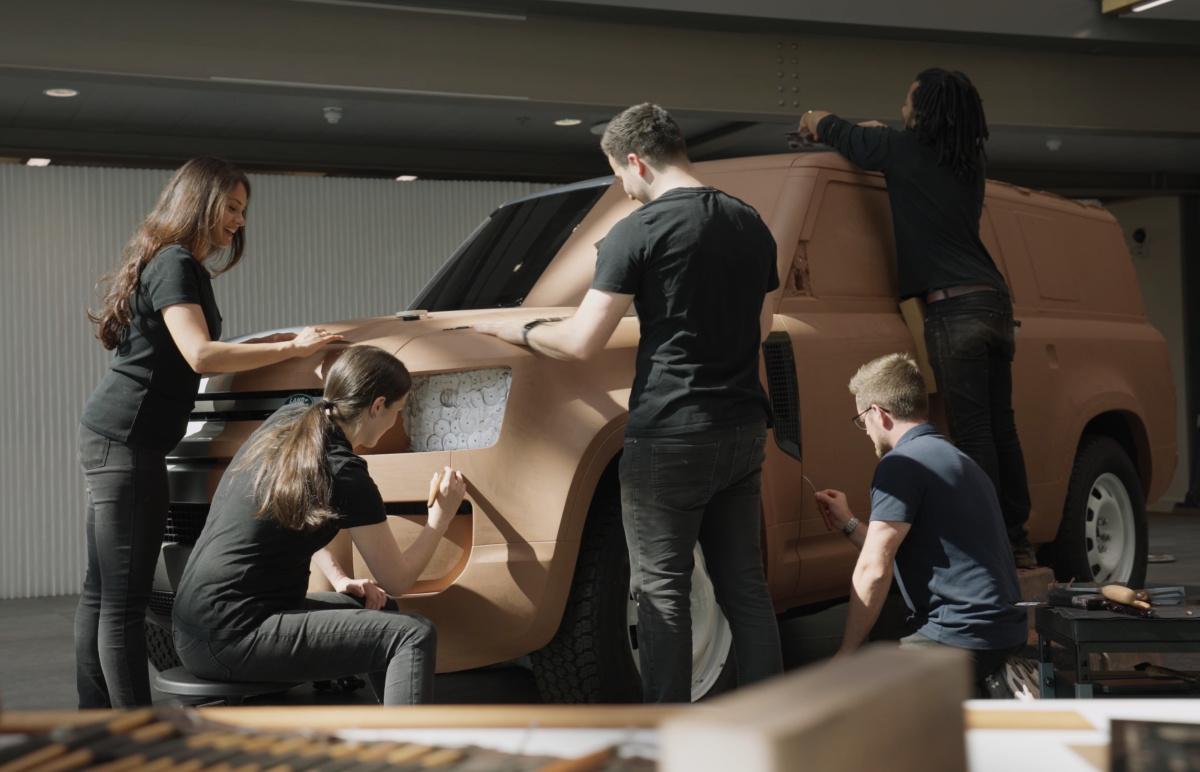
Months before the first prototype, the Defender OCTA existed as clay. Designers used it to test proportions, balance, and the presence they wanted the truck to project. Photo courtesy of Land Rover
The design for OCTA happened even before the name itself. “We had already done a side project as a study to see what Defender could evolve into,” Sean says. Early full-size “vision model” clays wore bigger arches and sat higher. The reason was pragmatic: if Land Rover didn’t envision an extreme Defender, the aftermarket would. Those studies meant that when a real brief arrived, the team could move with intent. “It was really important for us to start to progress that thought process internally in the creative team,” Sean says.
Many of the design and styling changes came from necessity. “We all know the saying ‘form follows function.’ The front bumper had to change to get the air flow. The arches needed to meet the new track. Then it became a design challenge to make everything more extreme, while keeping it in line with the core car. We thought, ‘if you fed a Defender steroids and you left it overnight, what would it evolve into?’”
-
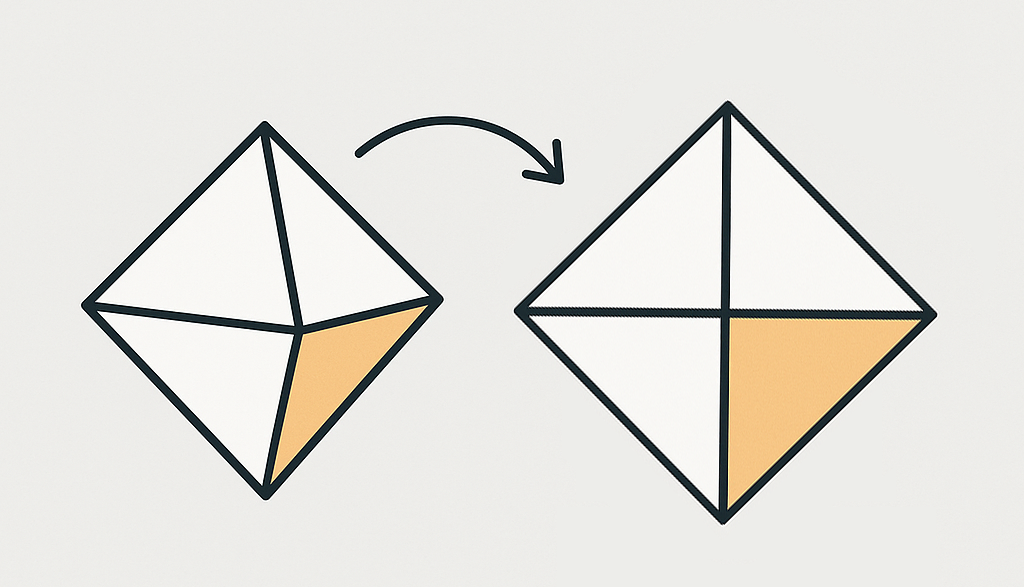
- It took a while to see how a four-sided graphic could represent an eight-sided form. The OCTA logo solves it with restraint, reducing a diamond’s geometry into a minimal mark. Photo and graphic by Chris Force
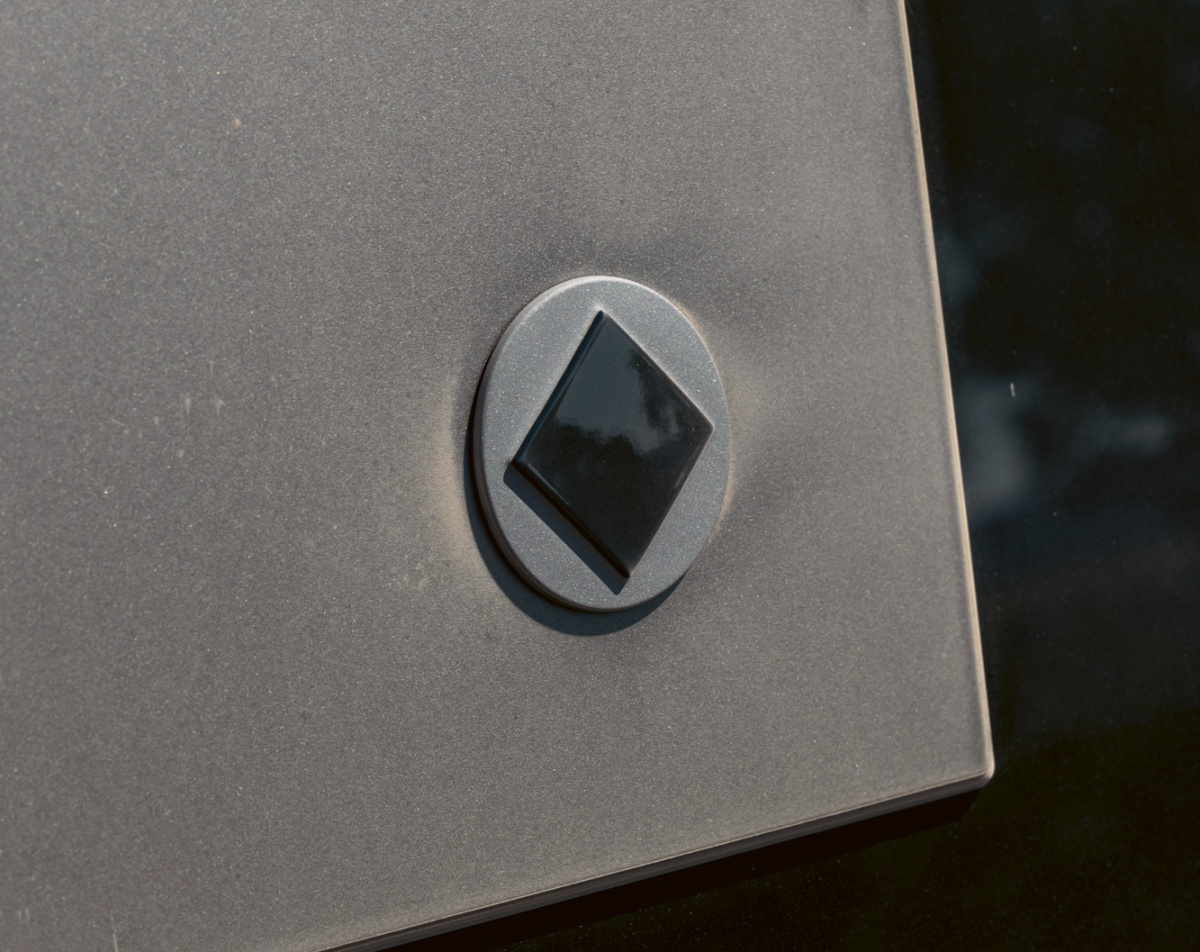
As the design of the car progressed the name OCTA, drawn from “octahedron,” the crystalline structure of a diamond, was chosen to convey toughness. The studio pursued the project with full-scale interior and exterior clay models milled with advanced five-axis machines. “You can leave stuff running and come in the next day and it’s there ready,” Sean says.
If the stance is what first telegraphs OCTA’s intent, that’s by design. The production car sits taller and wider than a standard Defender, with a 68-millimeter track increase and a greater ride height for both stability and ground clearance. Inside, the team discovered how the new performance level changed fundamentals such as seating. Sean shared an image of three prototypes and explained why one late change mattered. “The car was so powerful that people were rolling out of the original seat. So a very, very late design change came into play, where we increased the bolstering.” The final shells gained upper-torso and cushion support and adjustable bolsters.
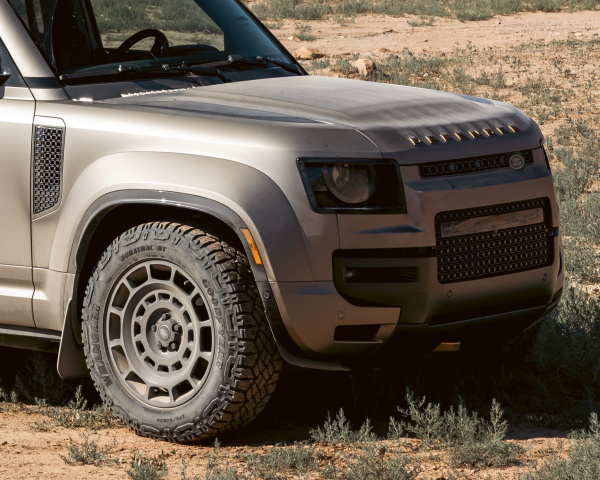
For once, bigger wasn’t better. The design team favored 20-inch wheels over 22s, saying the proportions reinforced OCTA’s tough character. Photo by Chris Force
Even wheel choice flipped a studio cliché. “Every designer always wants bigger wheels,” Sean says. “It was the weirdest thing on this car, because everybody loved the 20 inch more than the 22 inch. It spoke volumes to the importance of the message of how capable and tough and extreme this vehicle is.”
After days of dust, river crossings, and high-speed sprints, what lingers about the Defender OCTA is how much of its engineering and design is aimed at credibility. This isn’t a concept-car gimmick or a cosmetic off-road trim. Land Rover is strapping it into Dakar, the harshest test there is, and betting that its flagship Defender can live up to its diamond-tough name. If it succeeds, OCTA may do more than redefine the Defender, it may restore Land Rover’s claim as builder of the world’s most capable luxury SUV.