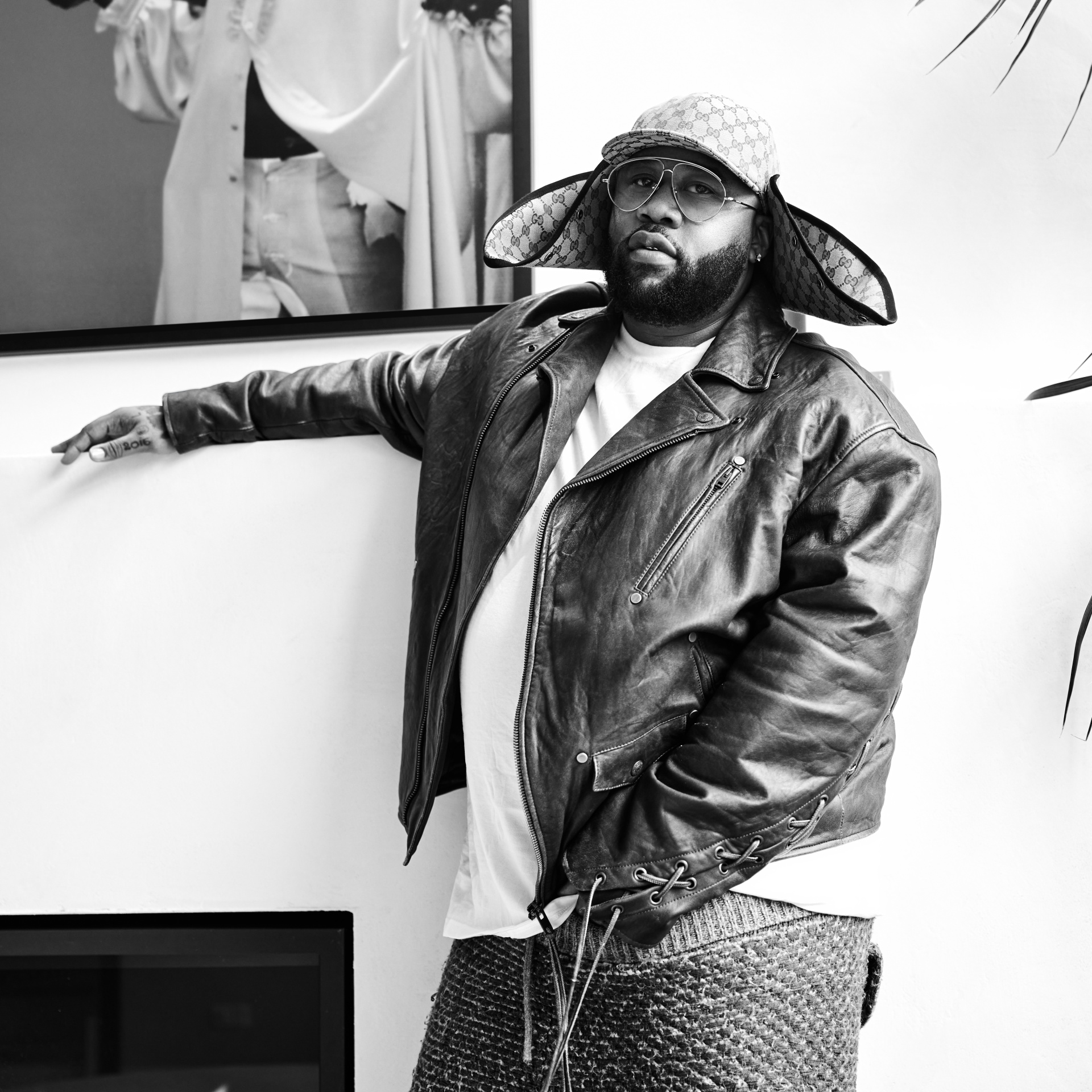
Joe Robinson, better known as Joe Freshgoods, is a designer, creative director, and the founder of one of Chicago’s most significant independent streetwear brands. From the west side’s Austin neighborhood to Fat Tiger Workshop in Noble Square to collaborations with New Balance that regularly sell out in seconds, Joe has built a brand and a business entirely on his own terms over nearly two decades. He has directed campaigns for some of the biggest names in streetwear and beyond and runs a nonprofit called Community Goods focused on arts and education on Chicago’s west side. His New Balance collaborations, including being the first to release the now-iconic 9060, have cemented him as one of the most important voices in the sneaker world.
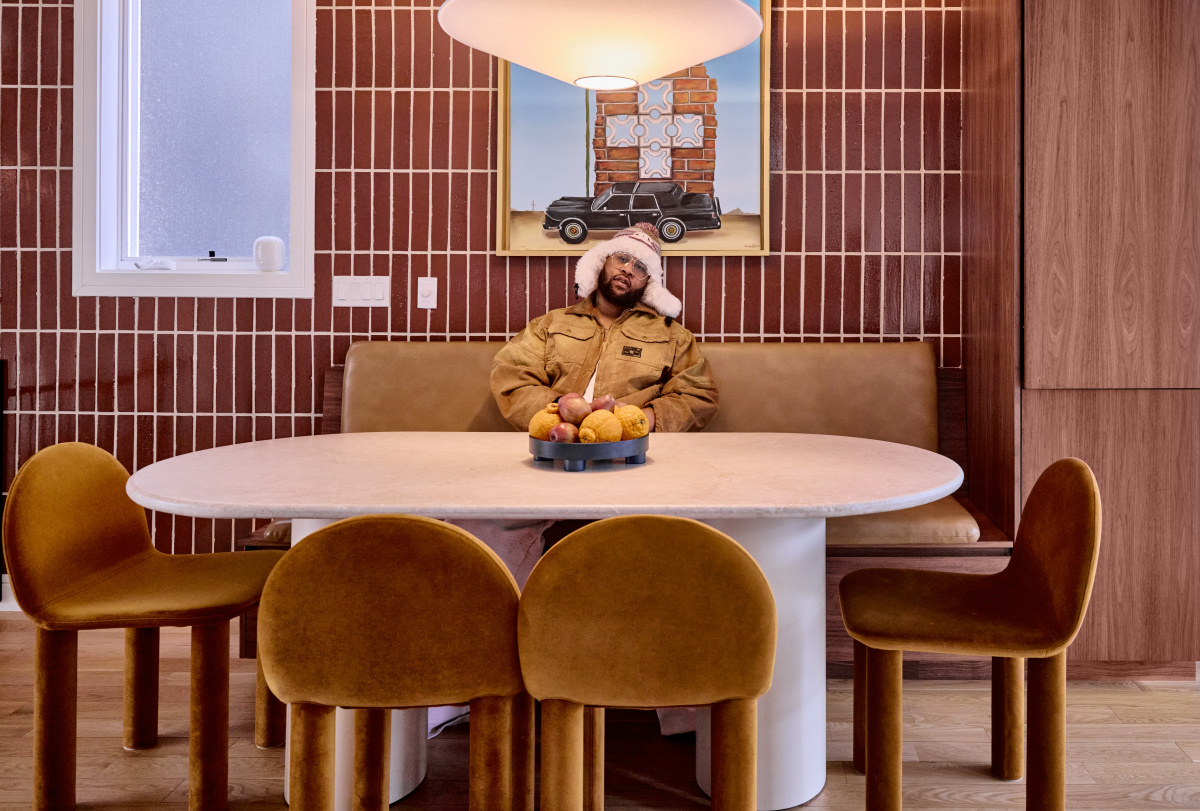
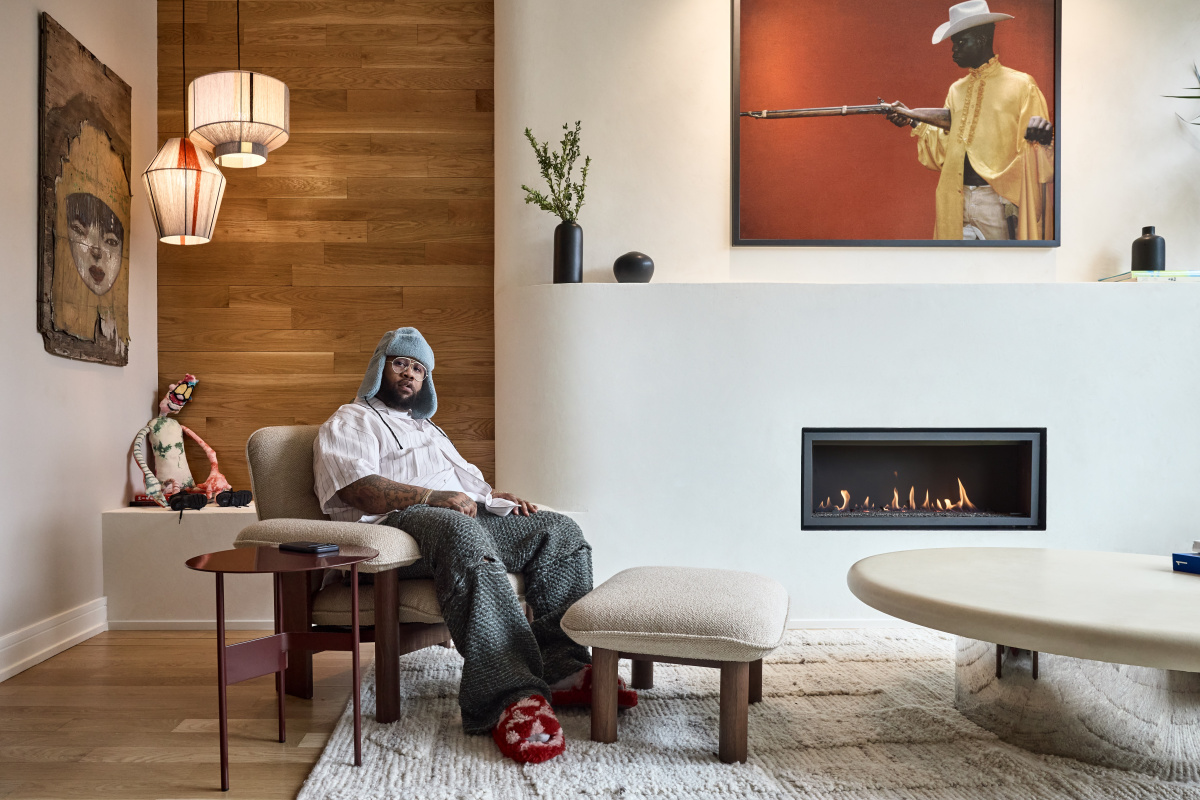
I visited Joe at his recently renovated home not far from our studio in Chicago. It was the first time the house had been documented since the renovation, and it’s a space that immediately reflects who lives there—modern, warm, and anchored by an impressive collection of work by Black artists, including a striking photograph by Gabriel Moses. The whole place has the rare quality of feeling like both a gallery and somewhere you’d actually want to sit down and stay a while. When I arrived, Joe’s Land Rover Defender was parked out front, and he and his partner were deep in a debate about who has the best burger for delivery in Chicago. (They never agreed. They made two separate orders.)
Here is our conversation, completely in Joe’s own words.
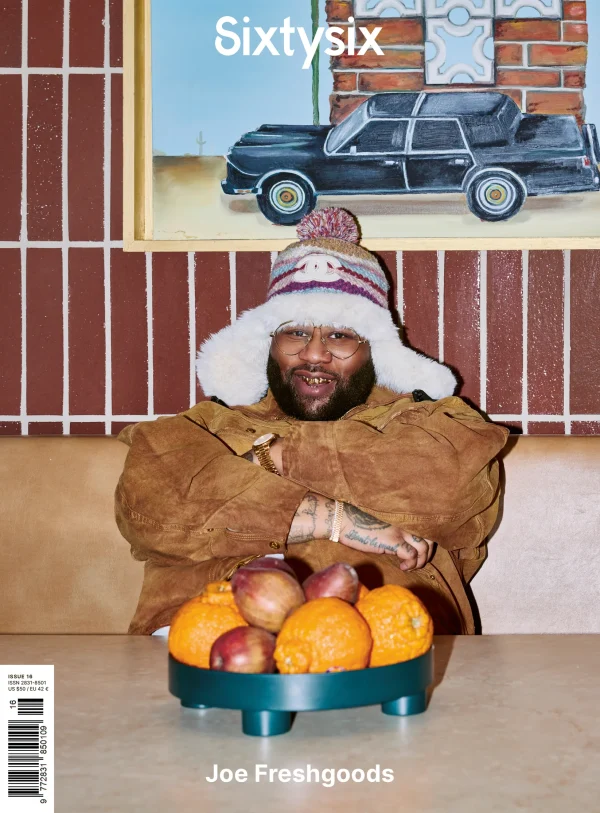
Joe’s recently renovated Chicago home reflects his eye for design: modern and warm, anchored by an extensive collection of work by Black artists.
I started making clothes because Cam’ron started wearing pink. I wanted to wear pink stuff, but there wasn’t really anything pink in the marketplace. It was an era of photo transfer tees and hip-hop tees, like the square image of Biggie on a T-shirt or Tupac. So it was easy to start making clothes because if I could find a picture on the internet, use my mom’s home computer, print something out, and iron it on a T-shirt, I was in business. That’s kind of where it all started.
Every six years it grows to a bigger level. 14-year-old Joe just starting off. 20-year-old Joe working at Leaders, starting a brand called Dope Boy Magic, pulling up to people’s crib selling T-shirts and hoodies. It just keeps scaling up.
I don’t think I have just one of those “I made it” moments. The goalpost changes so much. The first early moment was getting a cease and desist. That meant somebody was paying attention. At 23, that was success. At 24, I made Hypebeast. That was success. At 25, I had people lined up for the first time. I used to think, “I want to make my first million, that means I made it.” Then I did that, and then it was onto the next thing. I don’t think I have just one of those moments. Every year––knock on wood––it’s still like that.
Whenever I press the button for my garage to open and pull into my parking lot, drive past one of my Broncos, and go to my office, I’m like, “This shit is kind of ill.” That feeling hasn’t gone away.
All of my shortcomings have made me stronger. If I can sum up this era, it’s like I’m streetwear. I’ve never needed investors. I’ve always robbed Peter to pay Paul. My whole career has just been scraping and grinding. Buying my headquarters, having as many employees as I have, dealing with somebody requesting PTO–I didn’t sign up for that, but it sharpened my skills.
I had a big “aha” moment in New York. I did a pop-up shop there. A lot of brands I thought were really popping and cool, once I got to talk to friends out there, I realized I’m actually in a really good spot. That inadvertently taught me to ignore Instagram. I might not curate my feed as cute as a younger brand can, but I’m a real business. I left that New York pop-up thinking I was going to be intimidated, but I walked away thinking, “Damn, I’m kind of getting it.” I just don’t post my success anymore. As I’ve gotten older, I’ve become more private.
I just creative directed Coco Gauff’s campaign. A video came out. I didn’t even know how to talk about it. I don’t even know how to talk about the stuff I do. I try not to let social media get to me and try to block out the noise of what other people are doing, because it can affect a lot of our peers in the creative industry.
“Longevity sometimes just means knowing your place in the marketplace. Knowing when to say ‘no,’ knowing when to say ‘yes,’ knowing when to tell brands to ‘fuck off.'” -Joe Freshgoods
Chicago and the Midwest “get it out the mud” mentality? That’s cute. I love Chicago for everything it’s done for me, but in my world of fashion, I’ve kind of maxed out. A lot of my top people on my team don’t live in Chicago. The way I’ve grown my brand independently, I have a production manager, a warehouse manager, a retail space, a café space, and we ship our own shoes. I don’t really have that many peers I can ask, “How’s business going?” There’s nobody in Chicago doing it like this, on this scale.
Even my OGs are downsizing when I’m going like this. I’m buying my headquarters. I’m opening up a café. It’s tough. If I was in New York or LA, I know I could go get wine with one of my homies dealing with the same thing. In Chicago I’m kind of an anomaly.
The Chicago scene is so small. If I’m looking for a photographer, I know all the good ones. There’s probably only 10 that are good at product photography, and I’m not talking about shooting on white poster board. In New York or LA there’s hundreds of them that are so talented. Even for models, if I’m shooting a lookbook in New York, LA, or Paris, you can go outside and find somebody at your local grocery store. I’m not saying people here aren’t attractive. I’m just saying the talent pool is different.
That’s made me a better creative director. I’m used to working with people, molding them, telling them what I want, and growing with them. There are pros and cons. More cons, but the pros have been pretty dope.
My rent for a storefront in New York was $38,000 a month, and I couldn’t even do it that long. Imagine that every single day. Me being on Chicago Avenue and Damen is manageable. If you have two or three bare months in New York, you’re literally laying off staff. Here I can do a warehouse sale. I can figure it out. That’s a major advantage of being in your hometown.
Longevity sometimes just means knowing your place in the marketplace. Knowing when to say “no,” knowing when to say “yes,” knowing when to tell brands to “fuck off,” knowing when to ask for more money. I’ve been really good at that the last 10 to 15 years.
The perfect example was during the pandemic. Everybody was throwing money at Black designers and creatives. If you were Black and had a following, somebody was knocking on your door because they felt bad. I got offered the most money I’d ever been offered before. The pitch deck had a Black fist on it. I knew I was going to say “no,” but I wanted to see my worth. That thing would have ruined my career. I knew somebody who took that deal, and it messed their brand up. Sometimes you align with one entity, you make decent money, but it messes up a bunch of other opportunities.
Through his nonprofit Community Goods, Joe repurposes unused school rooms into creative spaces and runs an annual back-to-school drive on Chicago’s West Side.
I’m Joe Freshgoods. I can’t afford to get corny. If you hit the gas station and see me pumping gas, if you see me at Mariano’s, I have to say “no” to a lot of shit. Chips Ahoy collab? The collab world is kind of ruined right now. Not every call I get is worth it. But people know not to even speak to me if they don’t have $100K. That’s on the small side. That’s kind of made people scared to talk to me, but as I’ve gotten older, it’s weeded out the wrong people.
I probably do less projects now, but the projects I do are worth it. All my no’s have been the best no’s.
Right now I’m on spring 2027. All my partnerships for the next year-and-a-half to two years, I’ve figured out. A legendary movie reached out to me to do the merch, and I had to turn it down. They wanted it by April. Seven years ago I would have said yes, but I would have had to tell my graphic designers to stop all their other work to focus on something the family might not even approve, and I’d have to split it four different ways. You’ve got to reach out to me 12 months in advance.
I look at everything like a pie chart. That’s the culture one—it’s not much money, but it’ll go viral. That’s the one that’s meaningful, a great story for Black people. Profitable? Who cares—how was I able to get this story off? This is a passion project. This is a profitable project. But even my profitable projects, everything in my world, I’m proud of. I wouldn’t do it otherwise. It’s just now the math includes time, effort, and profitability.
With New Balance, I basically have two Super Bowls a year. That funds other stuff. It allows me to say “no” to a lot because I know I’m probably going to release $10,000 of something that’s going to sell out twice a year. So I get to be picky.
I was the first person to release the 9060 in April 2022. Since then it’s become one of New Balance’s biggest silhouettes in streetwear. I or somebody else makes the shoe hot, and then they sell all the general release cuts off the back of that. It’s tough sometimes, but I really care about the craft, my visuals, my lookbook, my storytelling. Fuck the colorways and the material. All the other stuff comes first. I think people feel proud when they wear Joe Freshgoods shoes.
If it’s sitting on a shelf, we don’t want it. But if you can’t get it, you want it more. I hate that we think like that as humans, but it’s supply and demand.
I’d rather build my own luxury than work for a fashion house. Too many people of color aren’t really pushed in that world. If I love hats and all my hats are $1,000 and up, I’m not going to partner with a luxury brand—I’ll just make my own luxury hat.
My nonprofit is called Community Goods. I started it in 2022. When you have power in this city, a lot of people look up to you. If I’m shooting a commercial in a neighborhood that’s kind of sketchy, I’ve got to call the gangbangers. I can call the mayor’s office too. I can talk to politicians and I can talk to the hood. That’s a very good place to be in life.
I did a big pop-up in Chicago’s Garfield Park a couple of years ago. Thousands of people lined up on the West Side to buy shoes. That’s cool, but it’s also kind of scary that I have that pull. I have to use that power for good.
Community Goods focuses on arts and education on the West Side of Chicago. We partnered with the Blackhawks, and this will be our 5th year doing our back-to-school drive. We repurpose unused rooms in schools across the west side into workshops and creative spaces. We donate to teachers. My biggest thing is that kids need to see somebody who might smell like weed, has tattoos on their neck, and is still doing this. That’s important. That’s the main reason I never left.
I’m from the Austin community in Chicago. I went to Lane Tech. Now I’m buying property where I used to ride the bus to school. I didn’t grow up with financial literacy, but it’s possible. I’m really just here to show people that this shit is possible. You could do it your way, not be a cornball, stay in your city, not go to New York or LA, and still do it.
The biggest advantage I have is that people in Chicago are like, “Damn, Joe’s still doing it, huh?”
A version of this article originally appeared in Sixtysix Issue 16.