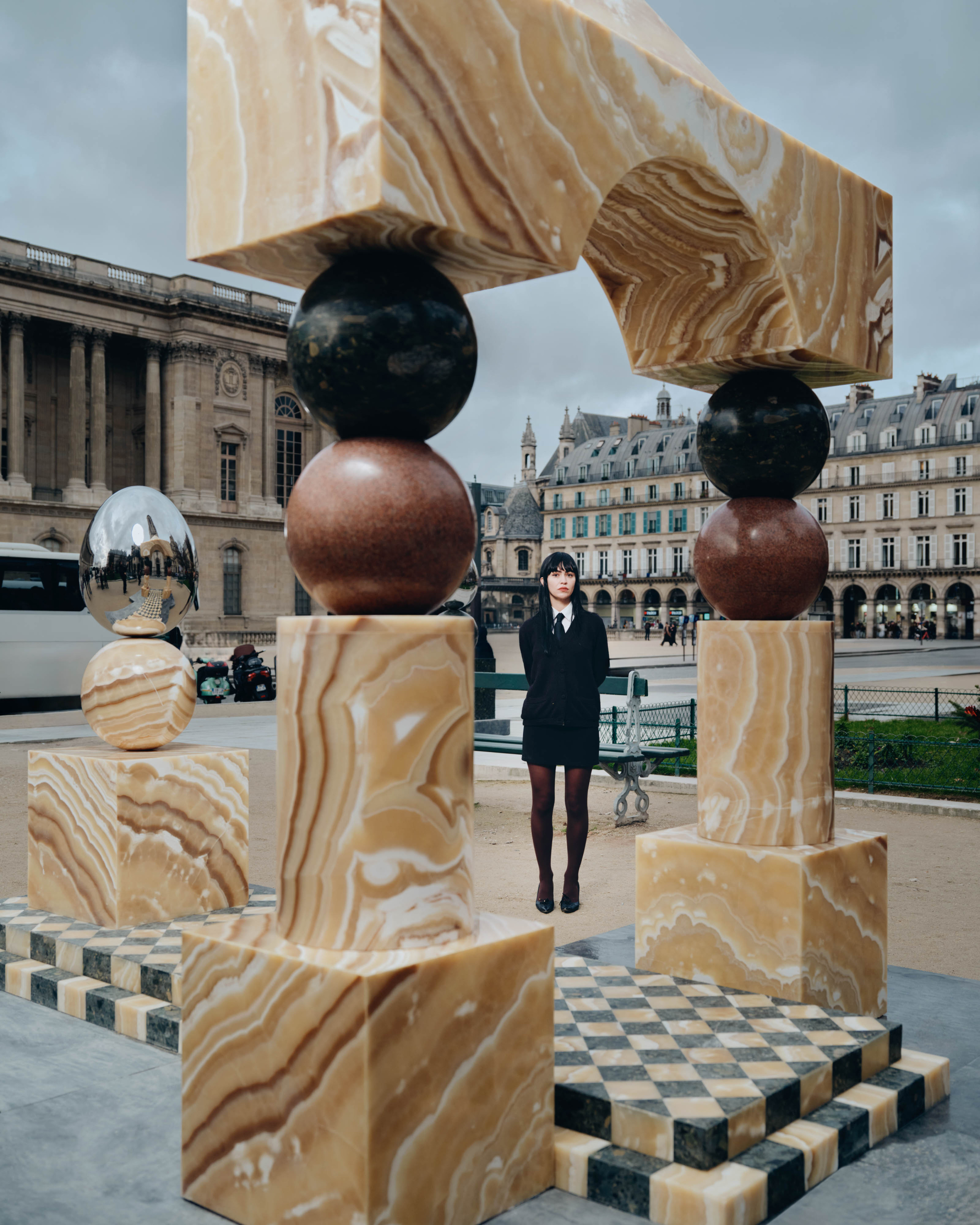
They couldn’t tick just one box even if they tried. French interior designer Elizabeth Garouste began her career in the late 1970s when she and her husband, French painter Gérard Garouste, were commissioned to design the interior of the iconic Parisian club Le Palace. In the 1980s she formed a long-lasting partnership with Mattia Bonetti, together creating what they called “Barbarian” furniture—a bold, expressive style that stood in stark contrast to the trends of functionalism and minimalism in French design at the time.
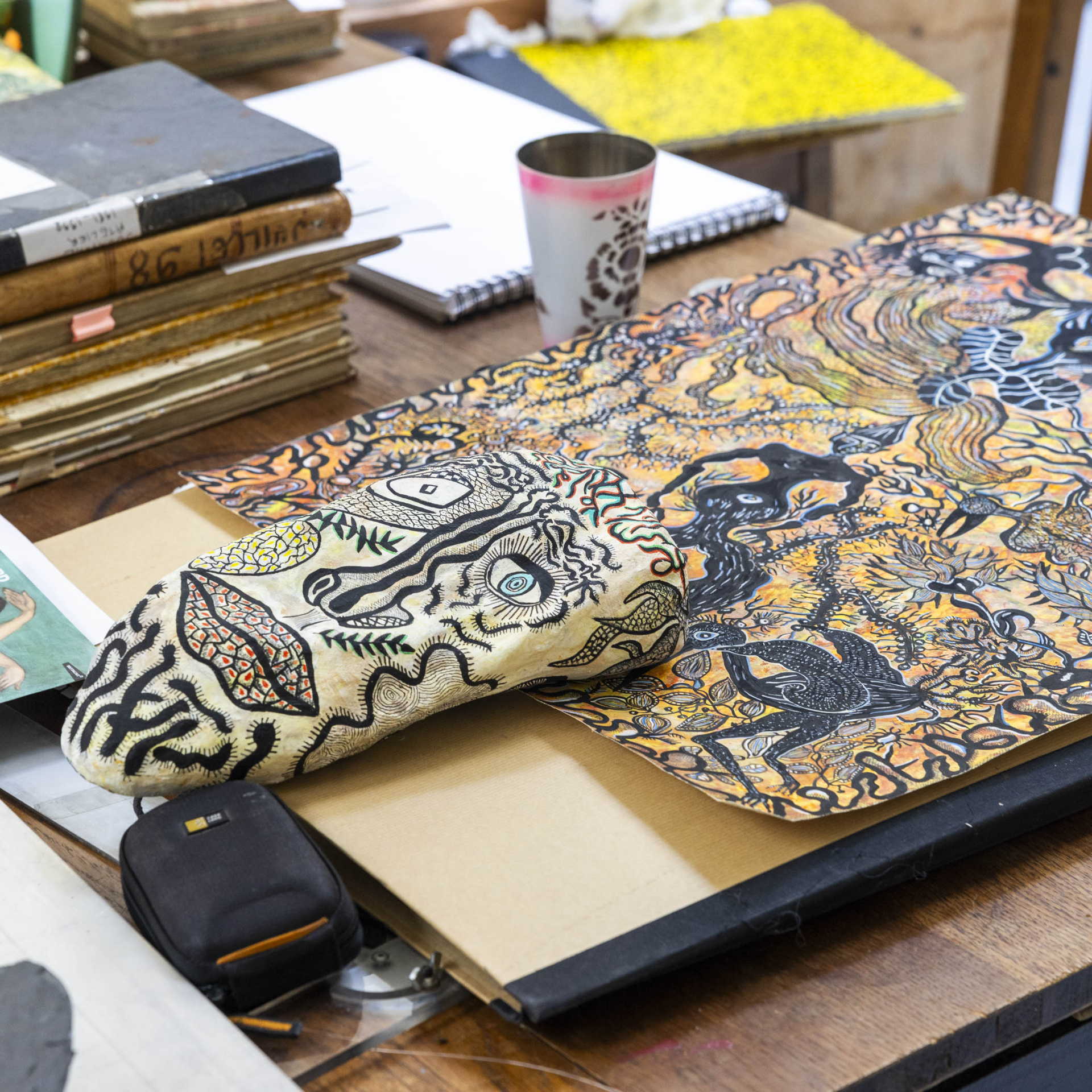
Over the years Elizabeth gradually expanded her creative scope beyond furniture and explored various mediums like drawing, collages, paintings, and sculptures. Encouraged by Gérard, she revealed the full range of her artistic sensibilities. She created a one-of-a-kind universe of both two- and three-dimensional works, ranging from black and white to full-color pieces.
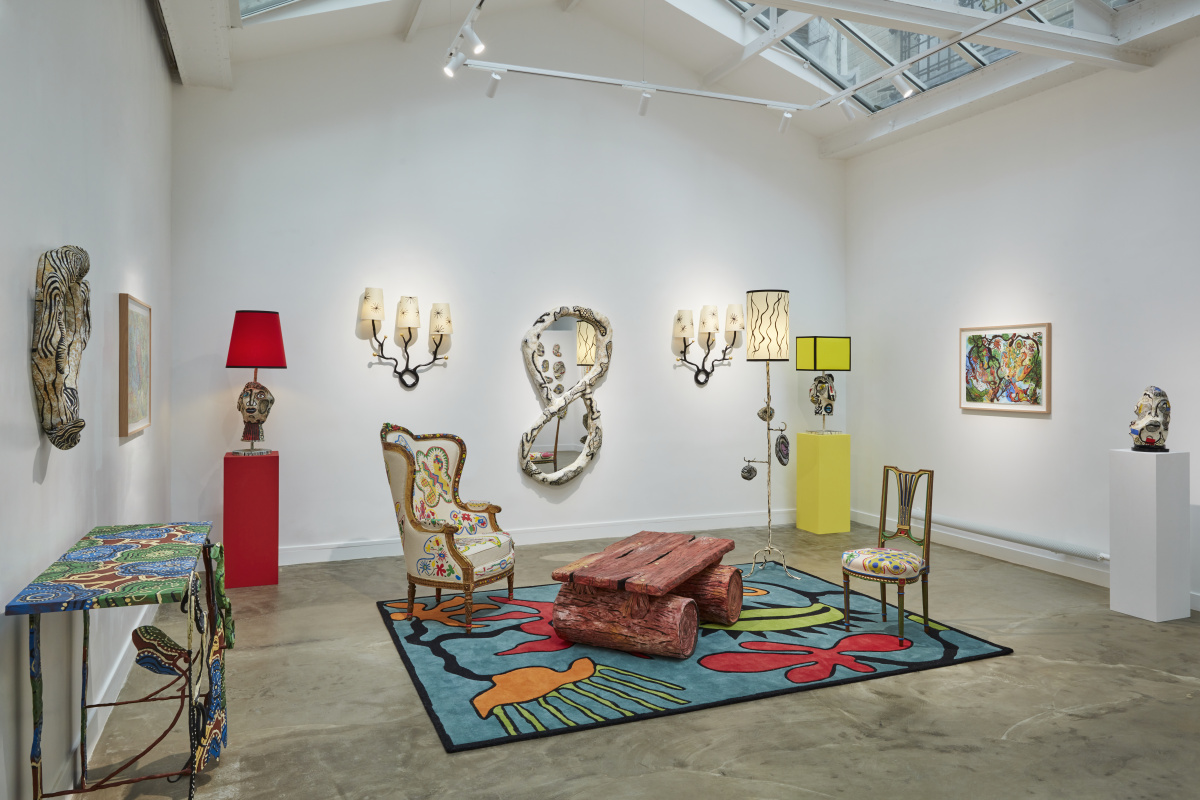
A room shot of Elizabeth’s “Escapades” exhibition at Ketabi Bourdet. Photo by Studio Shaprio
“Full of color” is a phrase that aptly describes Ara Starck’s universe. Full of color, full of light, bigger-than-life—her abstract pieces of art can hardly fit into a gallery space. Her work finds its true home on ceilings, gigantic walls, or windows. Ara’s free-spirited state of mind drove her multidisciplinary work into new dimensions, where it seems anything could morph into something else: from multifaceted portraits to stained glass windows and textiles, the shapes she draws never seem to settle for too long.
They are artistes. They are also related—not by blood per se, but by something stronger: the bond of chosen families. But this is a story they will tell themselves.
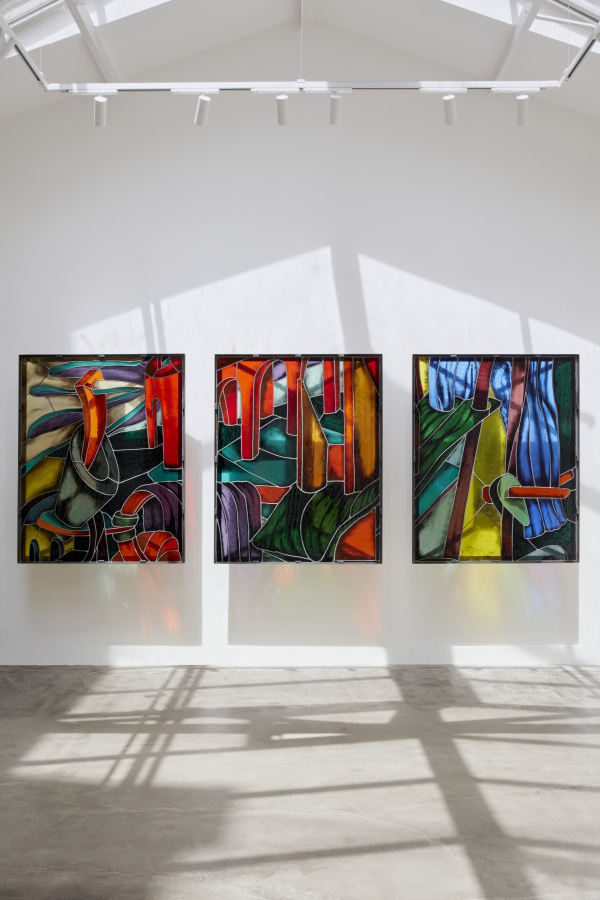
“Phaos VI,” 2023; “Phaos V,” 2023; “Phaos IV,” 2023. Art by Ara Starck, photos courtesy of Ketabi Bourdet gallery in Paris
Elizabeth Garouste: I attended École Camondo, the school of product design and interior architecture in Paris, alongside your father Philippe Starck. We both embarked on different paths—Philippe’s approach is quite distinct from mine.
I’m also your aunt Pascale Laurent’s best friend, so I’ve been able to watch you grow over the years. We’re very close. We’ve known each other since your birth, I would say.
I feel fortunate to have had you and your husband Gérard in my life from the very beginning—like two fairies watching over my cradle. You’ve given me so much, often without realizing it. You instilled in me a sense of curiosity and discipline, both of which are equally vital. Your generosity in sharing knowledge and experiences has always inspired me.
I remember once Gérard told me, “If you wash my brushes in the workshop I’ll give you lessons on impasto and glazing.” I must have been 14, and I looked at him like he was the Messiah. He explained things to me without judgment or style direction, saying, “If you want to be a good craftsman, you need to know your tools.”
-
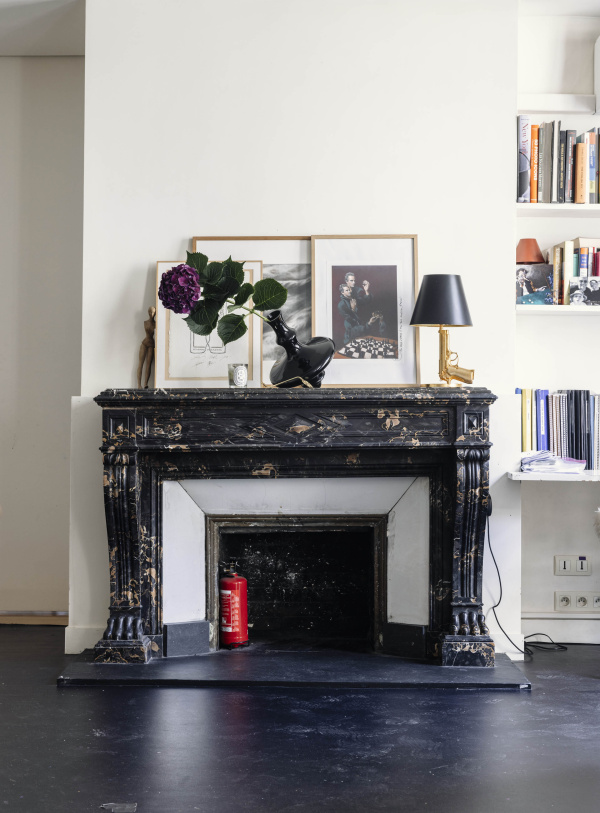
- A glimpse into Ara Starck’s home studio, where her fireplace marks the epicenter of her creative space. “My studio is at the center of my apartment—the more I see people passing by, the more life I feel,” says Ara. On the mantel from right: Vase Toupie by Christian Tortu; A portrait of Ara’s husband, David Furst, by EBB x Gerard Garouste for La Source Garouste; Gun lamp by Philippe Starck for Flos.
-
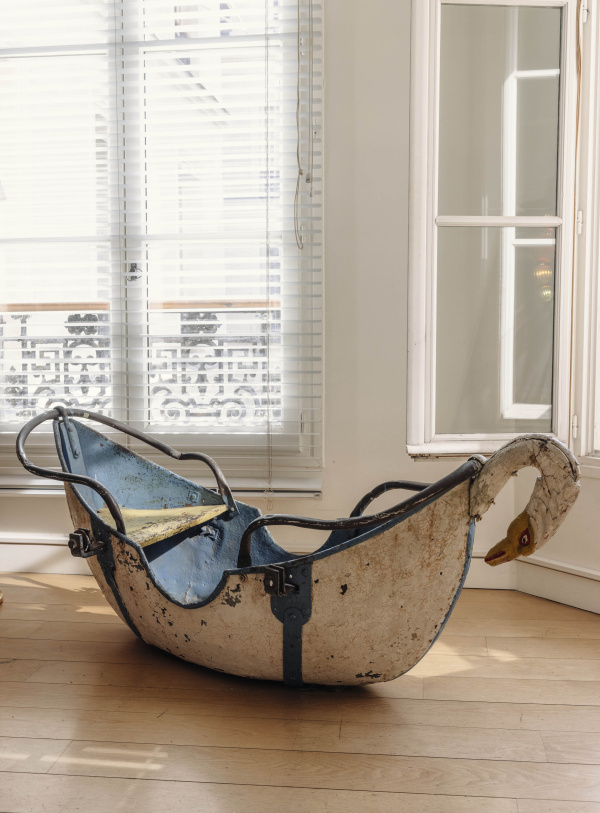
- A vintage carousel from the Saint Ouen flea market.
He also once gave me a mirror and asked me to create a self-portrait. I’m not sure it was my best work, but the experience of creating it under his guidance has influenced me throughout my artistic journey.
Similarly Gérard was the one who had the brilliant idea of framing some of my drawings and presenting them to galleries.
I’ve always secretly wanted to draw, though for me, it’s really a way to relieve anxiety. He always told me, “You have thousands of drawings and sketches—you need to show them.” And I said, “No, never. I will never show things like that.” Though that’s how I ended up in a gallery in the first place.
I think you might be closer to Gérard in your approach as an artist than you are to me.
Of course I was guided by him; he was like a little light in the somewhat dark hallway of my artistic education, and even in life generally. But you were the first person who truly allowed me to be myself—and more importantly, gave me that “click” into multidisciplinary work, which goes beyond just painting and sculpture.
-
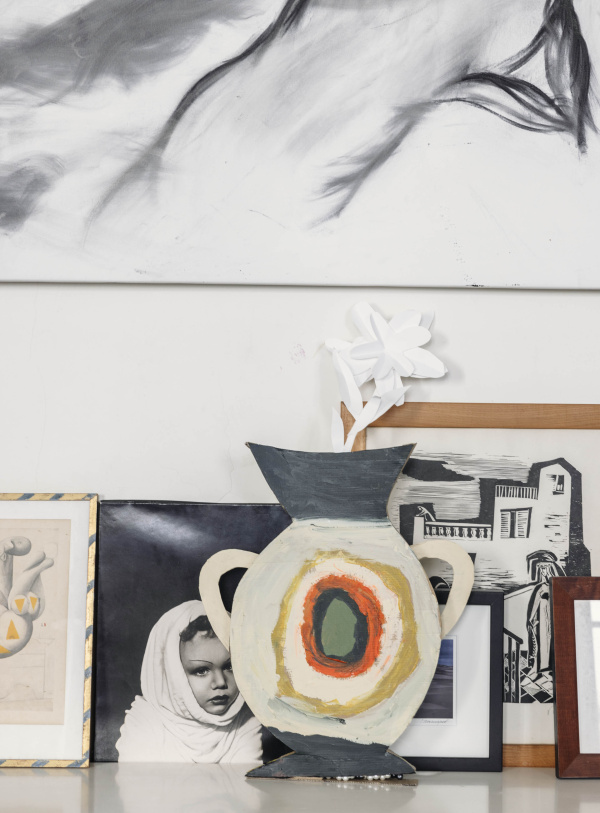
- Cardboard vase by Ara’s son, Amo.
-
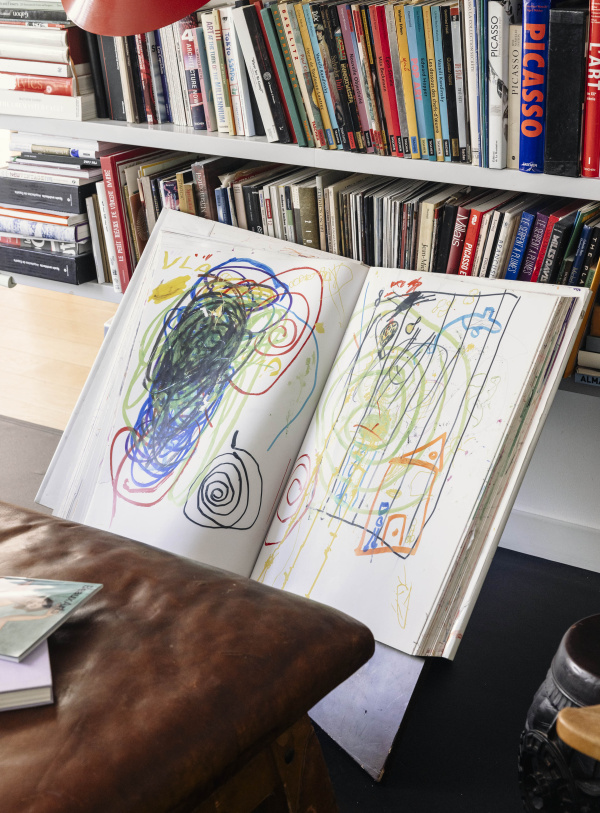
- Sketchbook drawings by her children Amo and Alta on top of a Tadao Ando book stand for Tashen.
One could say painting and sculpture are multidisciplinary, but you went further. You broke the codes and the barriers that seemed set in stone. When you did that people began questioning the roles of the artist, the artisan, and the designer. You reshuffled the deck, and that’s what helped me the most.
I was uncomfortable when in art school they told me I had to decide whether I was going to focus on painting, sculpture, or step into another medium. Stepping out of the box made everything more complicated—I had to position myself. They made me feel like I was almost schizophrenic, when in fact it was just curiosity you had instilled in me.
I’ve never told you this before, but it’s that freedom of action that really gave me a breakthrough.
I understand the feeling. Often when I was doing exhibitions of objects and furniture I was tied to galleries. I felt I was somewhat beholden to what the gallery wanted, and I found that restrictive because I preferred total freedom.
-
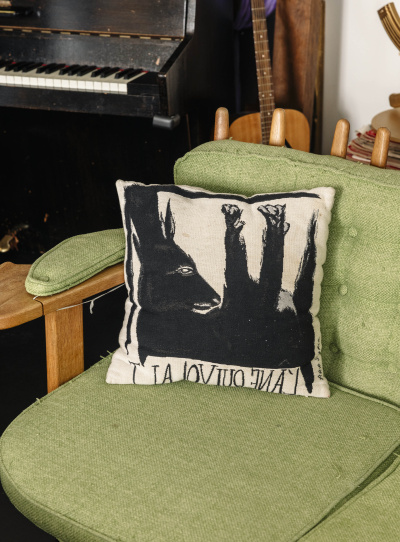
- A lime green chair and throw pillow.
-
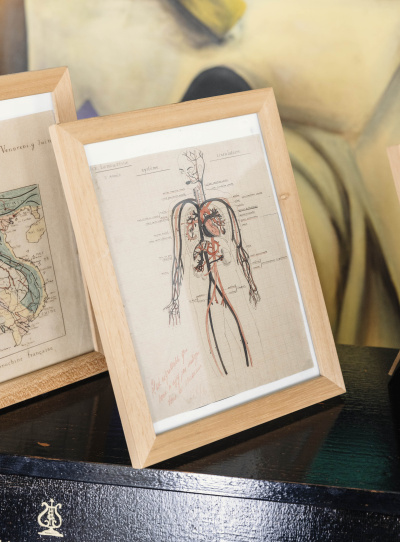
- School drawings by Ara’s grandmother Jacqueline Starck.
-
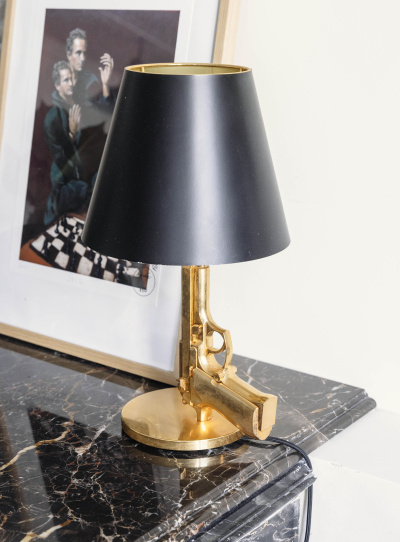
- Gun lamp by Philippe Starck for Flos.
For example, if my choice of fabrics wasn’t preferred, I needed to find a compromise. I was only guaranteed total freedom when I was working on things for the pleasure of making them.
I do a lot of metalwork in the workshop in the countryside. We are lucky enough to have a workshop, so I take advantage and create things like that. That’s total freedom—but when it comes to furniture, there are constraints.
I used to work on many projects where I didn’t have control. When I was asked to paint a ceiling for a hotel, a house, or a museum, most of the time I’d work with an artistic director or an architect who already had some ideas. Even though I usually had free reign each time, there were restrictive specifications—whether or not it’s flammable, whether it will stand the test of time, and so on.
I usually try to make the best of it. Either I allow myself to be completely crushed by the specifications, or I can interpret them like a puzzle.
-
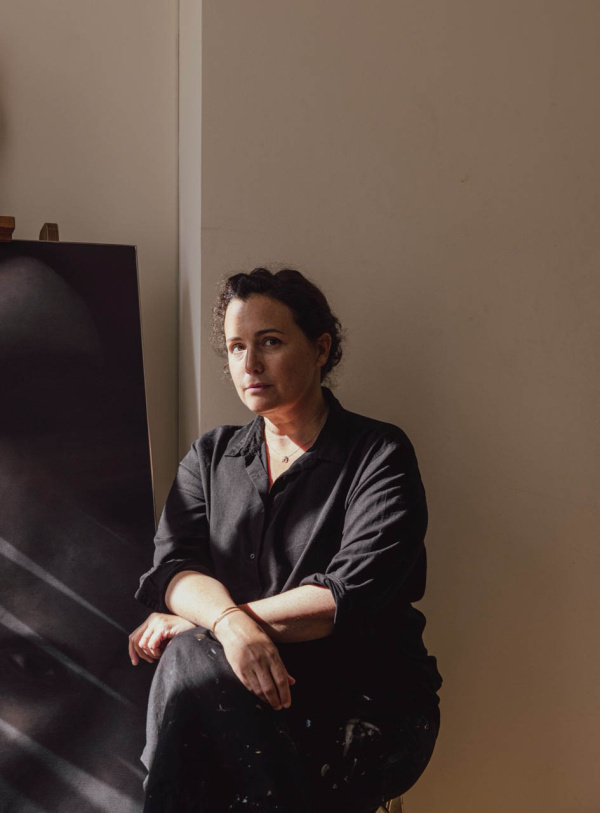
- A portrait of Ara in her home foyer. “I think what nourishes me most [within my studio] is having my family and friends around,” she says.
-
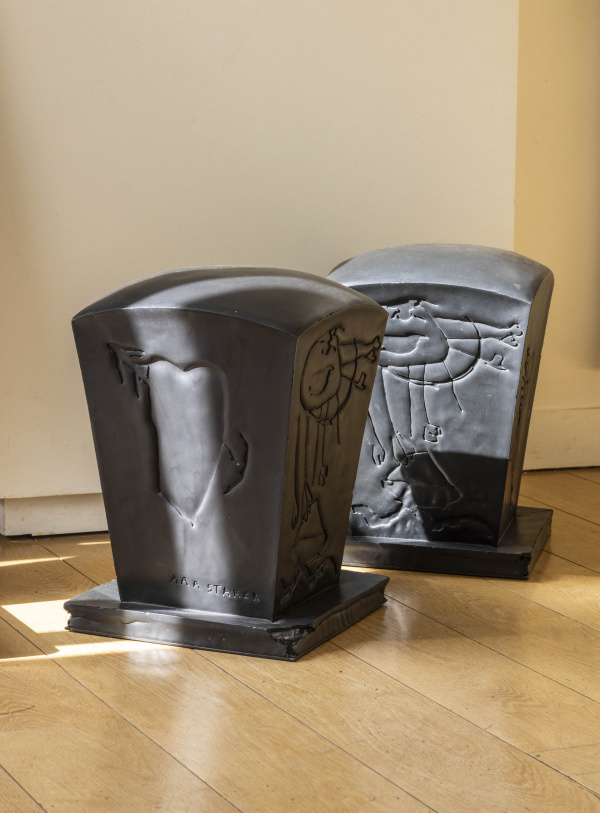
- The Ara stool, designed by Philippe Starck in 1985, features childhood drawings by Ara herself cast into its rubber surface.
Small formats also stress me out. I think there must be an inferiority complex related to my size that makes me need that physicality where the canvas is bigger than me. My pieces are difficult to fit into other people’s places, let alone mine or yours!
Your way of doing things, your intuition of the work—that’s what comes naturally to you in your personal expression.
Do you have places you can create art in without any boundaries?
No, I feel like I’m dull and disciplined. I need to start working early, and I work at my desk. Even though I have a large dining table for eight people, there comes a moment when everything I’m working on falls to the ground. My husband sees me in the morning when he leaves, and I’m at the table looking very put together—but by the end of the day I’m sort of on the floor.
I’ve seen you with lots of drawings on the floor and all around your space. They’re everywhere!
-
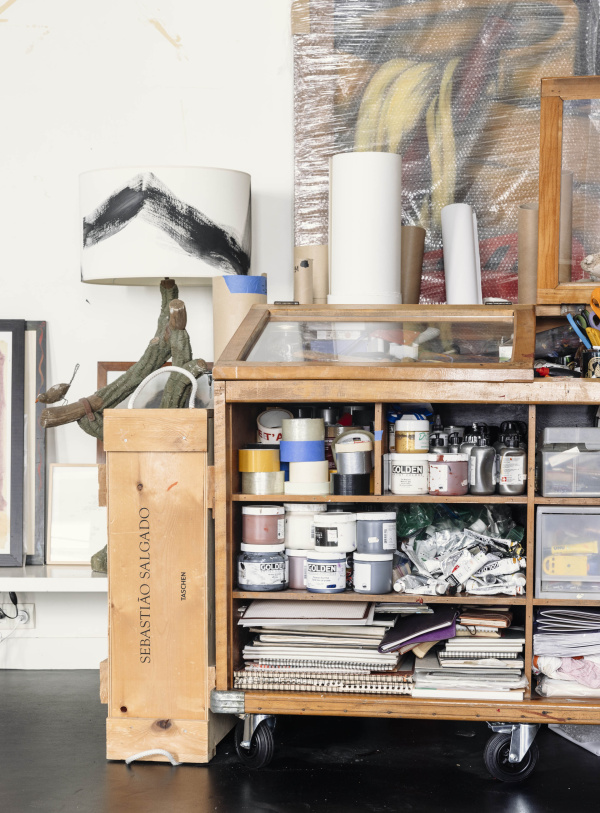
- Vintage chest of drawers on wheels organized with Ara’s art supplies.
-
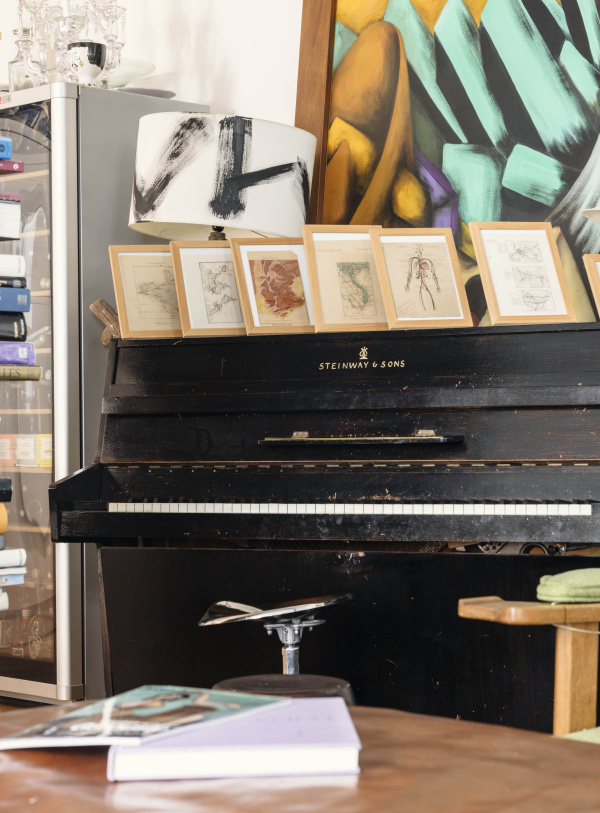
- Ara painted her piano black and carefully recreated the Steinway & Sons logo by hand.
I have two places: I work here at home in Paris, and I have a space in the countryside. The countryside is much bigger, and I have a large room to myself, so things are different there. I also use a lot of natural materials; old branches, wood, shells, leaves—things I don’t use in Paris.
I’ve been back in Paris for three years, but I lived in New York for 12 years. It’s like comparing two pieces of cheese—both cities are vibrant in their own ways. I’ve realized that I don’t have a strong sense of geolocated belonging; I could be here, there, or anywhere—it doesn’t really matter to me.
I think what nourishes me most is having my family and friends around. That’s why my studio is at the center of my apartment—the more I see people passing by, the more life I feel.
I’m the opposite—I’m like a dog hiding its droppings. I don’t want to be seen, I don’t want anyone to see my work, and I definitely don’t want people around me. I can’t draw when there are people around.
-
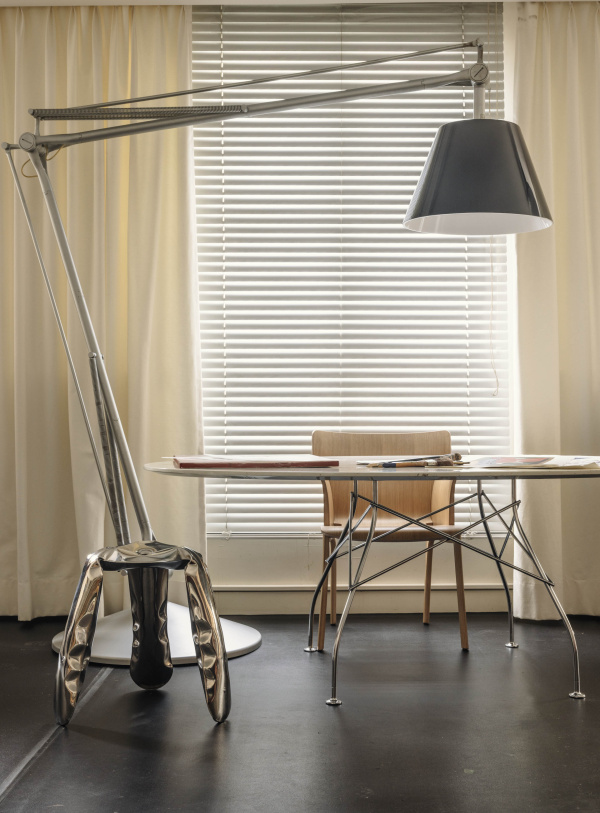
- Chair by Philippe Starck for Andreu World, the Super Archimoon lamp by Philippe Starck for Flos, and the Plopp stool by Zieta Studio.
-
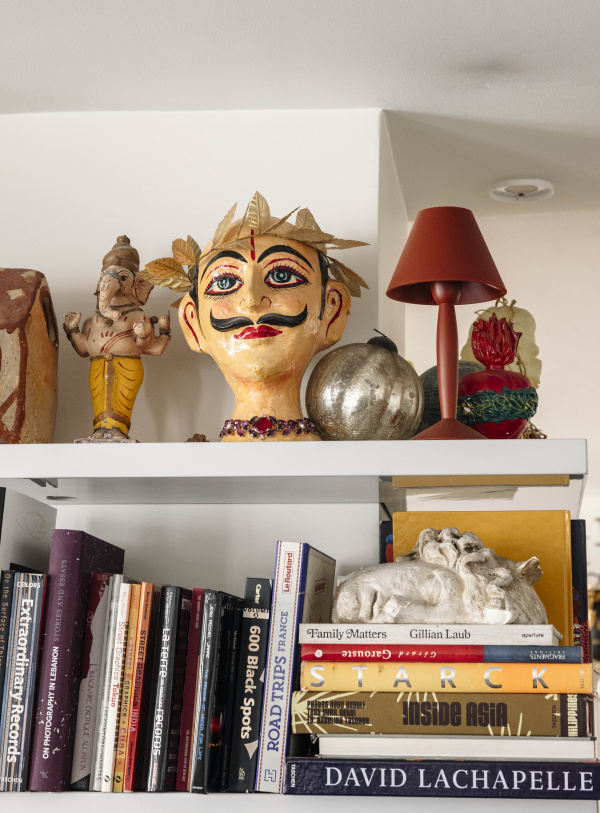
- The Miss Sissi lamp by Philippe Starck for Flos surrounded by Ara’s personal book and object collection.
We both grew up in a creative environment—a rich breeding ground where art was already present. About 10 years ago Pascale and I began conducting workshops for children at La Source. It’s an association Gérard and I established in the ’90s to help children living in socially precarious situations. We believed practicing art could break their solitude but also help bring these children’s ideas to life and restore their self-confidence.
While Pascale would like to continue this work, we’re both starting to feel tired.
She would’ve liked to continue. I think she’s channeling all her energy from La Source into my children now. Except at La Source she had 15 kids and here there are just two.
La Source also represents the admiration I have for both of you—beyond the fact that our two families are connected. It passed on to the next generation, too, because your son, Guillaume, is my best friend. I admire him like crazy, and he’s now the director of La Source.
-
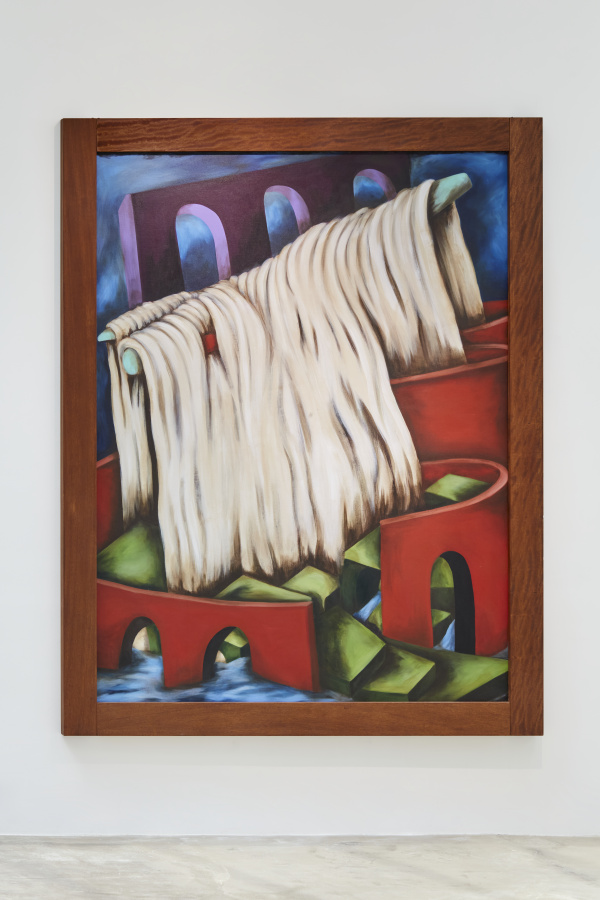
- “L’Eau,” 2023
-
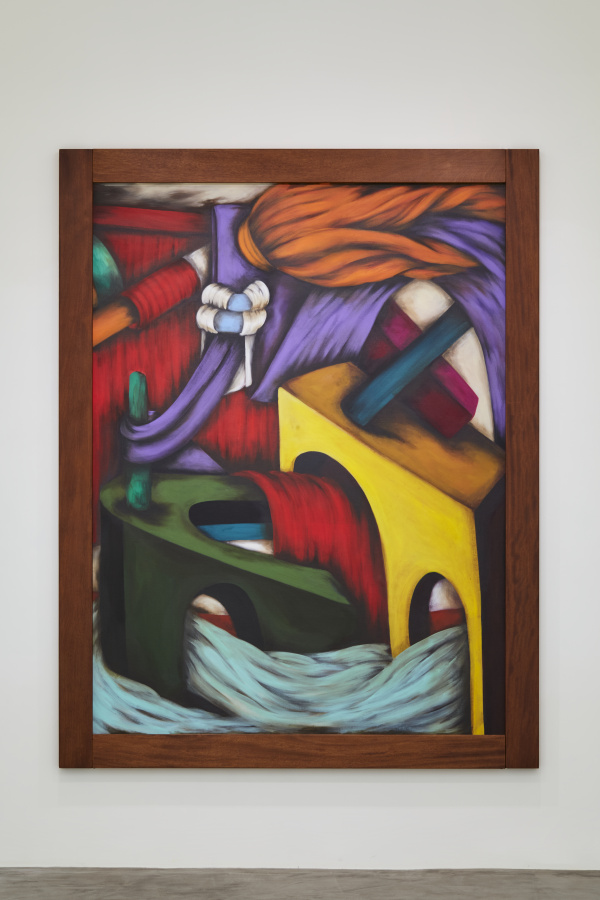
- “La Brume,” 2023. Art by Ara Starck, photo courtesy of Ketabi Bourdet gallery in Paris
La Source is a big organization, too. In Paris we have offices and staff, and there are 10 locations across France. We’d love for there to be a La Source in every region, but financially it’s very difficult. It really started in our village. At the time we met one or two families with children in really terrible situations, and we thought, “What could we offer them?” Well, we have art.
We believe art and social work are really important together. We work with families through social programs and schools, supporting children often labeled with that horrible term “dropout.”
While I was younger when you and Gérard founded La Source, I quickly understood its significance. La Source truly cares for children who don’t fit into conventional boxes. These are future adults who might miss out on life—not necessarily due to a lack of resources, but simply because no one opened the right doors for them and said, “Your life doesn’t have to be just this narrow path.”
-
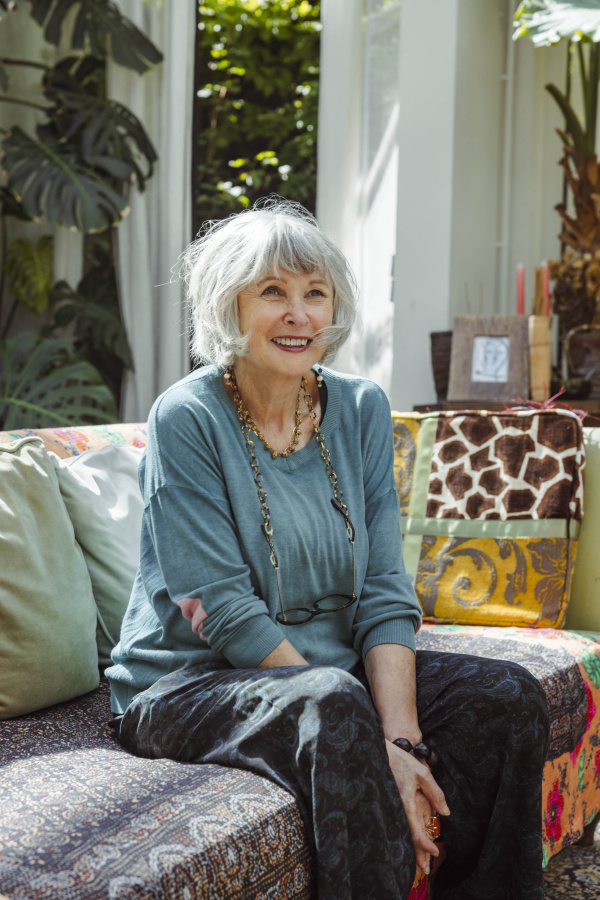
- Elizabeth sits amid her home’s bold patterns and rich textures on the outskirts of Paris.
-
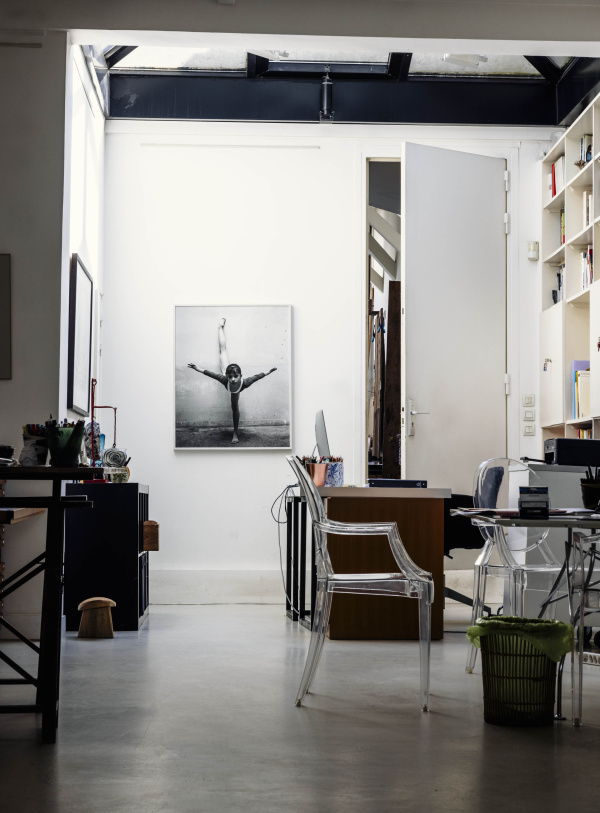
- Philippe Starck’s Ghost chairs for Kartell are arranged around a table. “Though we went to school together, Philippe Starck and I both embarked on different paths—his approach is quite distinct from mine,” Elizabeth says.
What’s quite moving about La Source is that whenever I can, I go to the annual exhibition. There you get to see all the workshops—absolutely mind-blowing creations. Of course, it’s under the guidance of an artist, but you can really see how strong the children’s imaginations are and how they manage to work together. It teaches them more about collective work, not just individuality.
Would you have imagined all of this when you started?
I actually began my journey in a duo with Mattia Bonetti. However, my true start was with Gérard at the famous Le Palace club, where he was quite successful. We created sets for various events and sought a quick, vibrant approach, asking friends to contribute clay masks, lights, and more.
When I met Mattia he was somewhat of a photographer but didn’t have a job. He went to École Camondo, too. I suggested we collaborate, and we did so for 20 years.
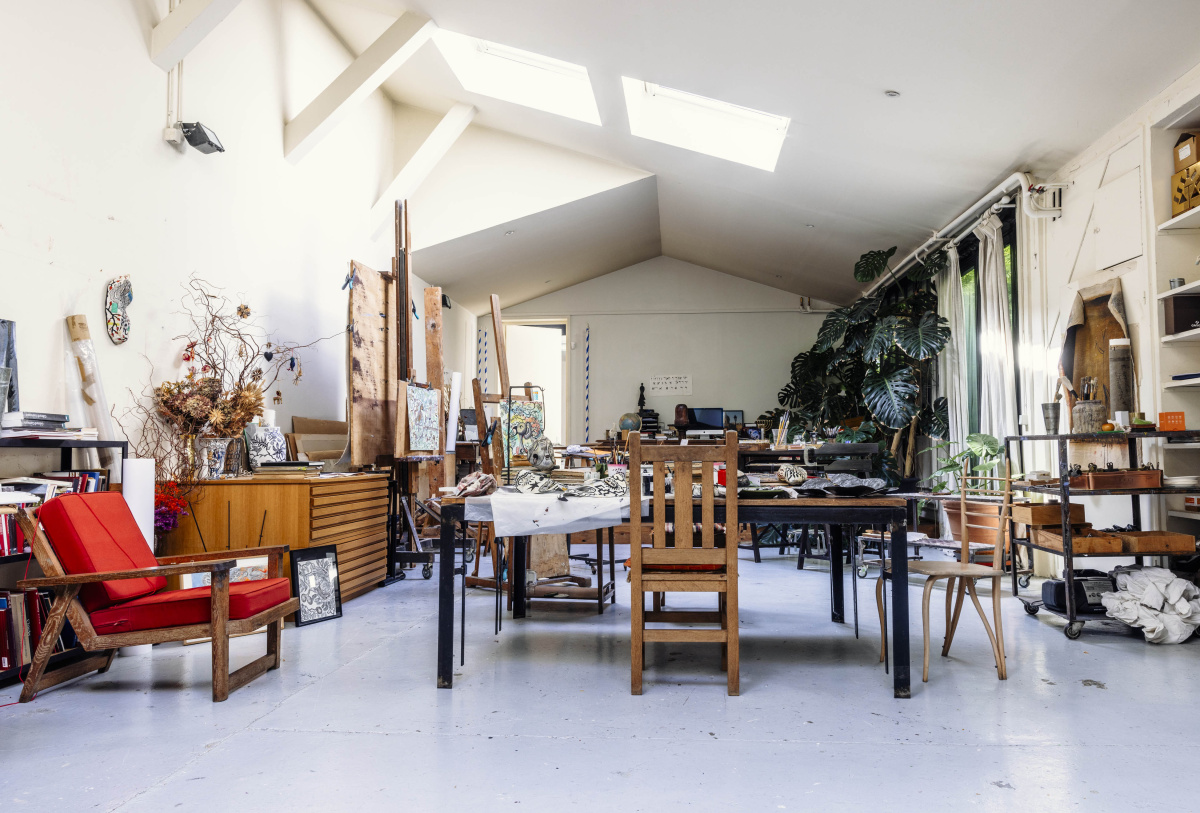
A walk through one of the three areas comprising Elizabeth Garouste’s home studio. Large skylights illuminate her desk, tools, and work with a natural glow. A window overlooking her private garden is visible on the right. “I can’t draw when there are people around,” she says.
We started during a time when everything felt gray and rigid. We brought color back into art, reviving what was then seen as decorative art. This approach was new and led to significant success, including a double page spread in the Herald Tribune and exhibitions in the United States.
I don’t feel nostalgic for a time I didn’t experience, but hearing about it sounds quite amusing. Just considering all the talent in one school feels like a stroke of luck.
It’s interesting to note that whether now or in the past, many women are found in art schools, yet very few make it outside of them. It reminds me of how in Paris you see a lot of pigeons, but never baby pigeons. In art schools around 90% of the students are women, whether in England where I studied or in Paris. Once you leave those institutions the ratio shifts dramatically.
-
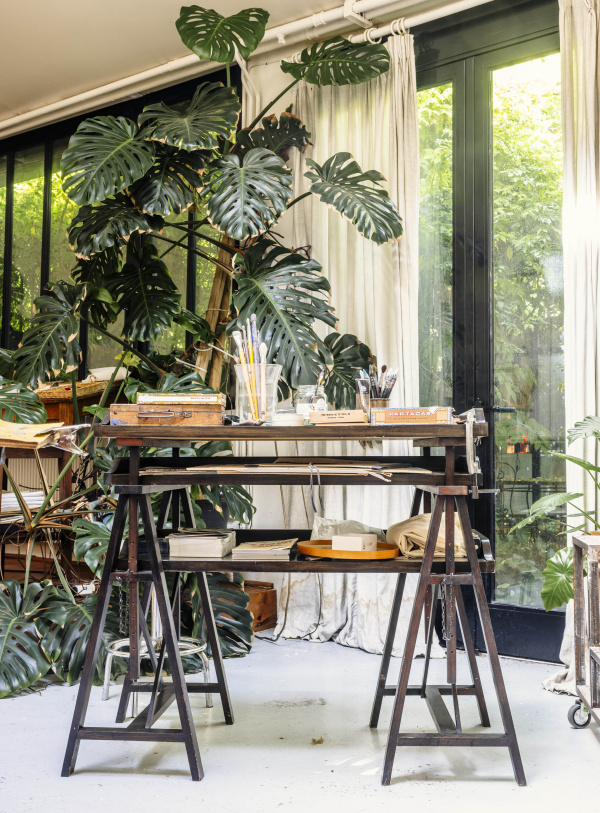
- A drawing table overlooking the courtyard.
-
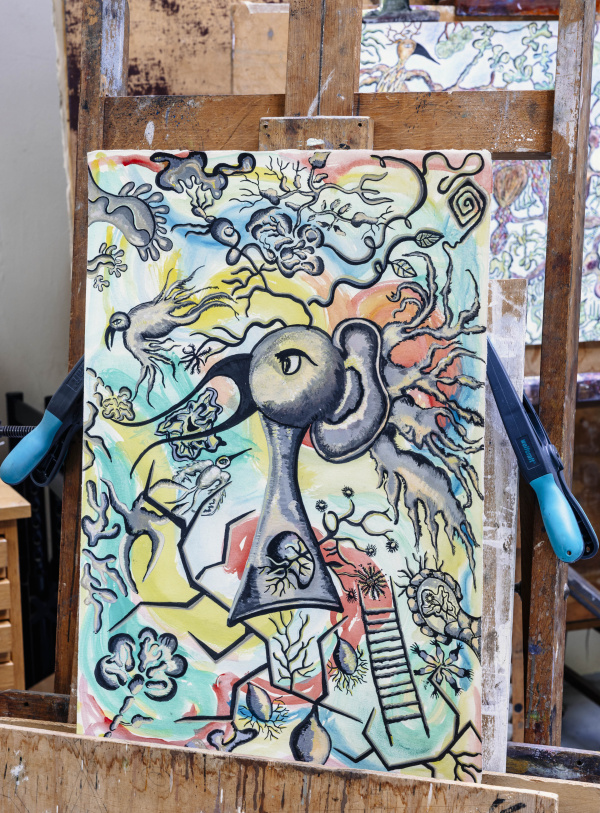
- A gouache by Elizabeth.
I’m not sure if this is an issue; I’m not saying women are underrepresented because there’s a reluctance to promote them, but this disparity still exists today. There are contemporary artists like Claire Tabouret, Laure Prouvost, and Inès Longevial who are making significant contributions, but when it comes to percentages…
There has been a huge evolution. When I was a designer I was almost the only woman. Even at the Centre Georges Pompidou now, which was not the case before, there used to be one woman among 100 artists. Now they try to have more variety everywhere.
With a name that is typically male and Armenian, I often encountered assumptions when I first started working. Whenever I met the site manager—who was usually a gruff character—I would ask, “So, can we set up the scaffolding?” They would reply, “Yes, but we’re waiting for the artist.”
This led them to assume I was the artist’s assistant. I decided to play along with that; I became my own assistant, while the artist became a ghost who never showed up. They thought this mysterious artist was quite arrogant for rarely being onsite, and by the end of the week, they would think, “Wow, this must be tough work.” I would just smile and say, “Yes, it is.”
-
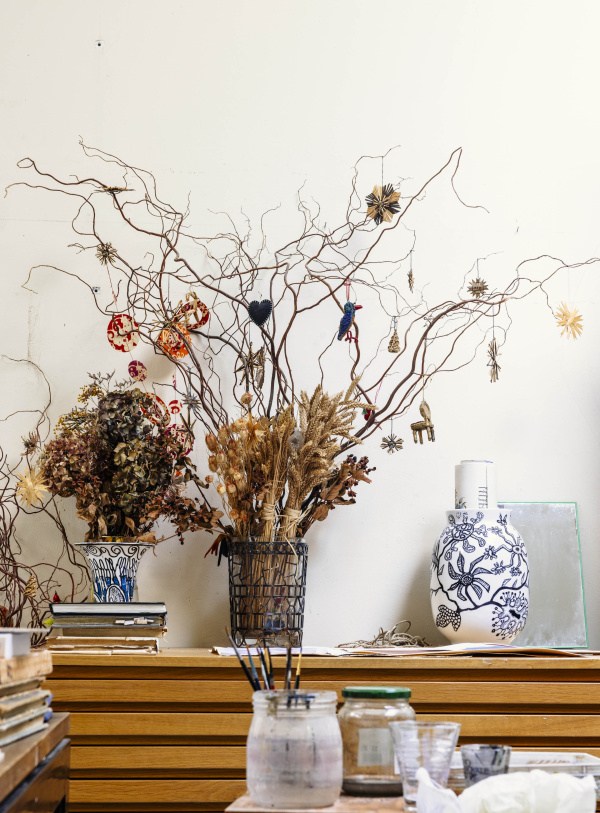
- “I’ve always secretly wanted to draw, though for me, it’s really a way to relieve anxiety. My husband Gérard always told me, ‘You have thousands of drawings and sketches—you need to show them.’” Above: Dried florals arranged atop her flat file cabinet.
-
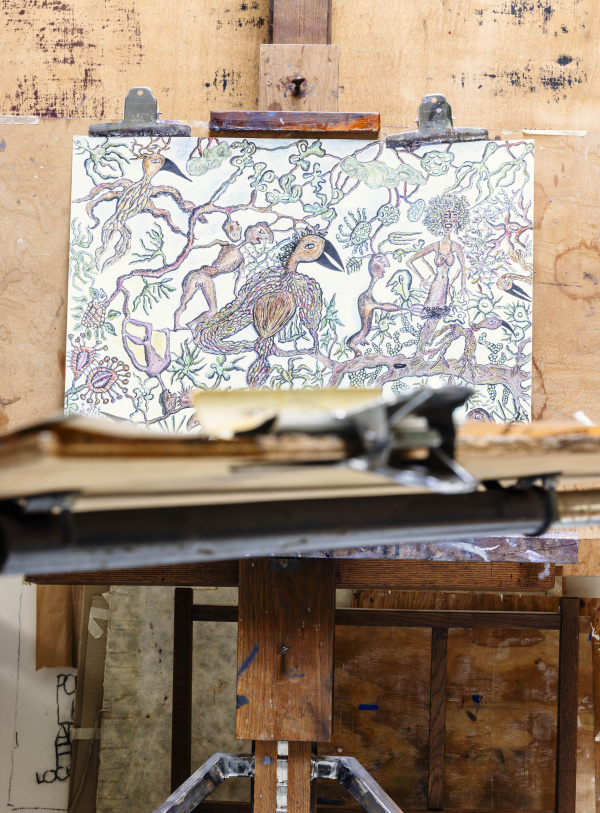
- A drawing by Elizabeth.
At the time I started figurative art was also very much looked down upon. It didn’t have the right image. Now it’s almost coming back.
It reminds me of the first time I showcased my lenticular portraits in 2008. I don’t know how it happened, but an art critic came to my studio to see all the pieces. It was quite an innovative approach, combining lenticular techniques with oil painting, and all the works were portraits. He looked at me and said, “The technique is quite perfect.” I responded, “Well, thank you.” Then he added, “But I hate portraits.”
It was amusing, yet I could tell he felt a bit sorry about it. It was funny that he explained that he liked what he saw, but that his preconceived dislike of figurative art made hard for him to fully embrace the work.
-
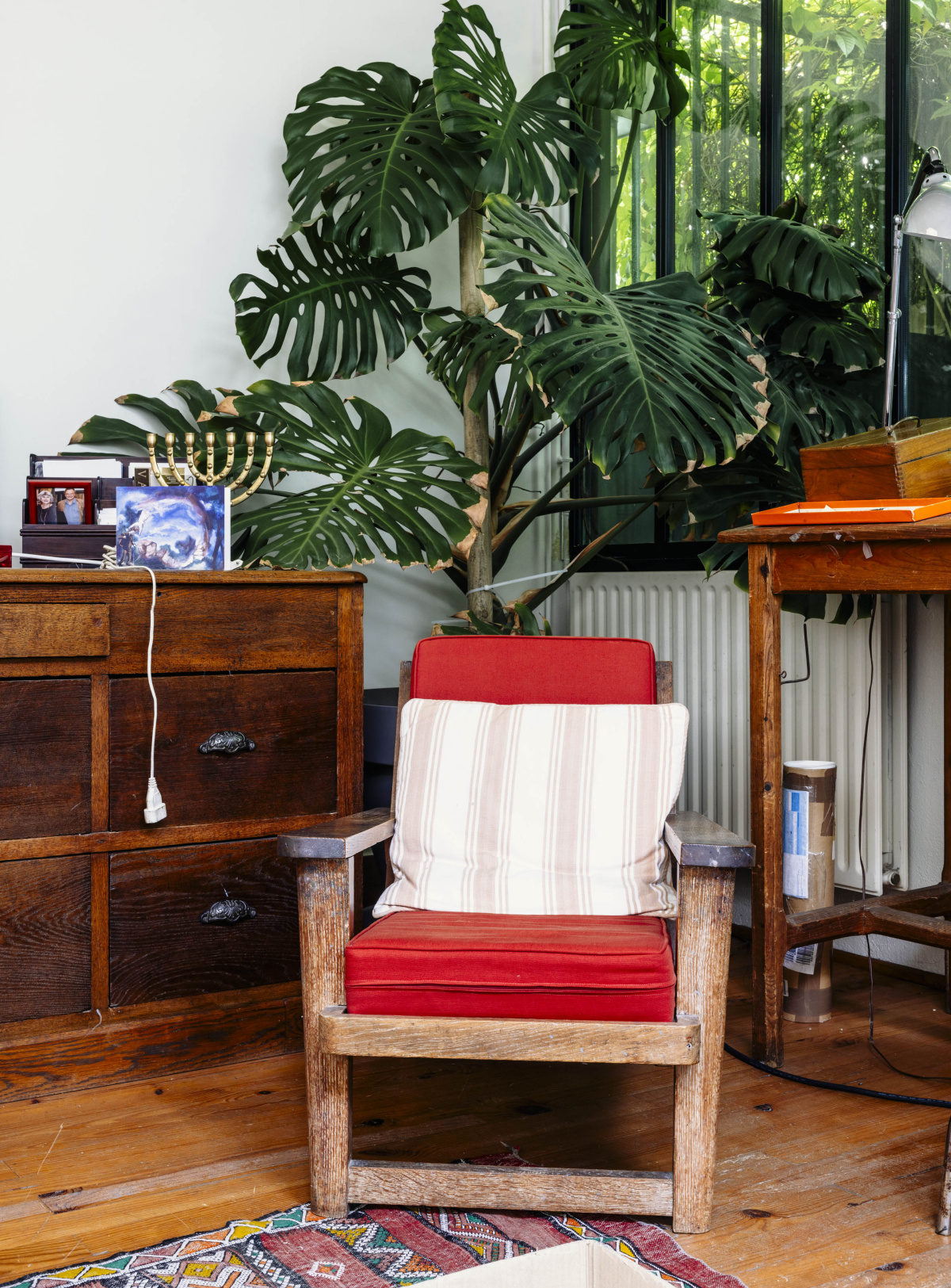
- An armchair in the main workshop.
-
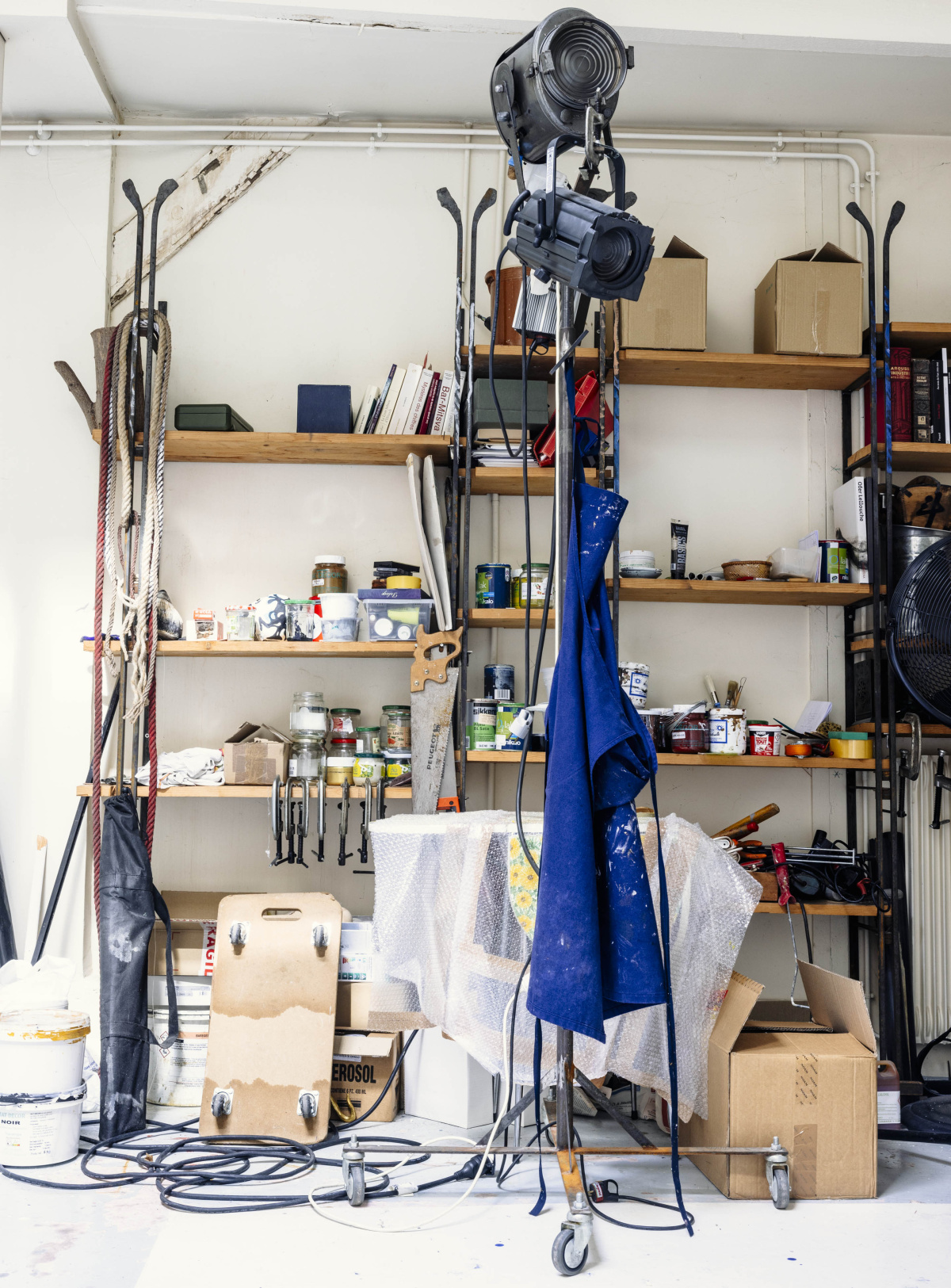
- Elizabeth’s paint pots, apron, cyclorama, and photography corner set up in the studio.
Yes, when you ask me how I imagine things, I always tell myself a story. For example, this turtle that’s an ashtray—I imagined a little turtle going on a jog. You see, it has a seatbelt underneath. I always imagine something; I always tell myself a little story.
That’s what we have in common—the narrative is at the root of the process.
With my father one would expect the transmission of artistic knowledge to come from the paternal side. He has imparted a lot to me: honesty in what we do, flair, and things like that. But he’s not the king of transmission either.
When they say, “It takes a village,” it truly does take a village to raise a child. I grew up in that village. It’s true that the transmission comes from there, whether in a professional context—with guidelines for what I wanted to do—or in human relationships. Today I want to raise my children well because I’ve seen how it was done.
-
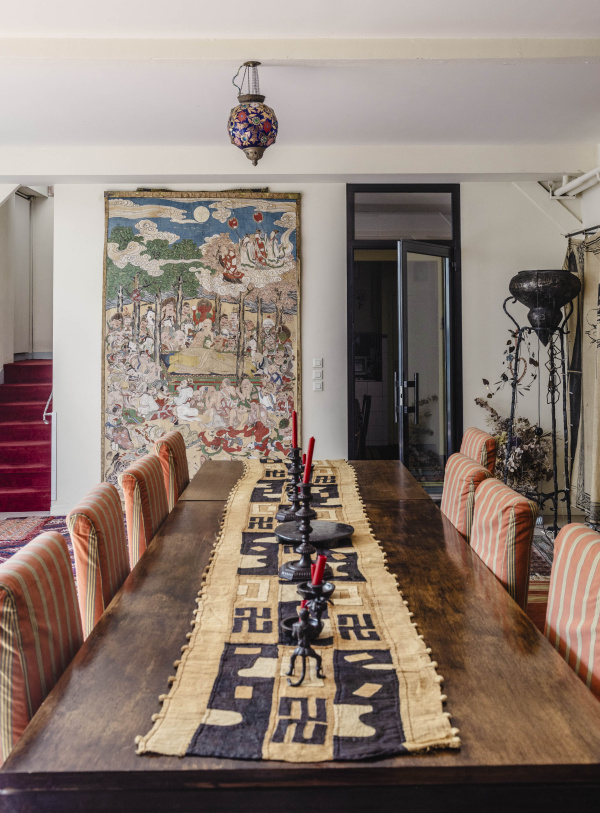
- Patterned carpets line the floor under a long dining room table.
-
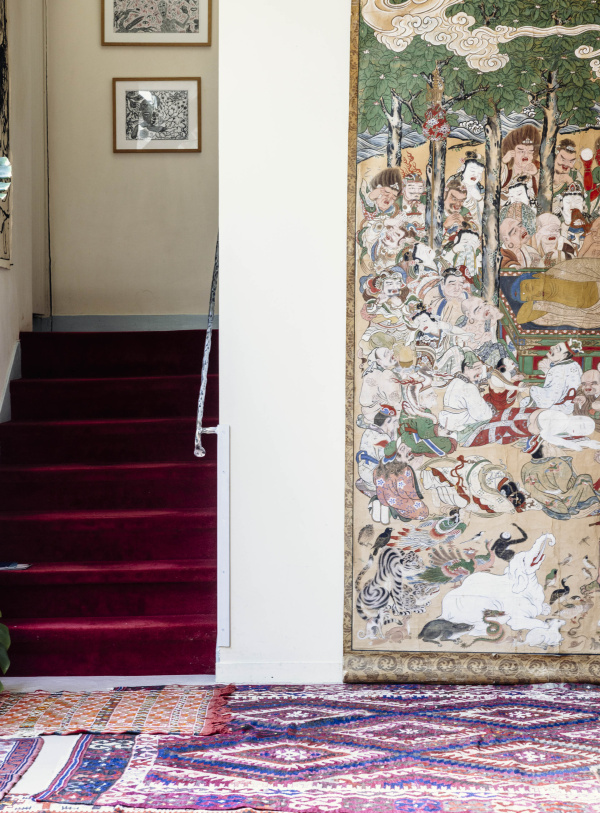
- According to Elizabeth, the painting on the wall represents Buddha’s death.
-
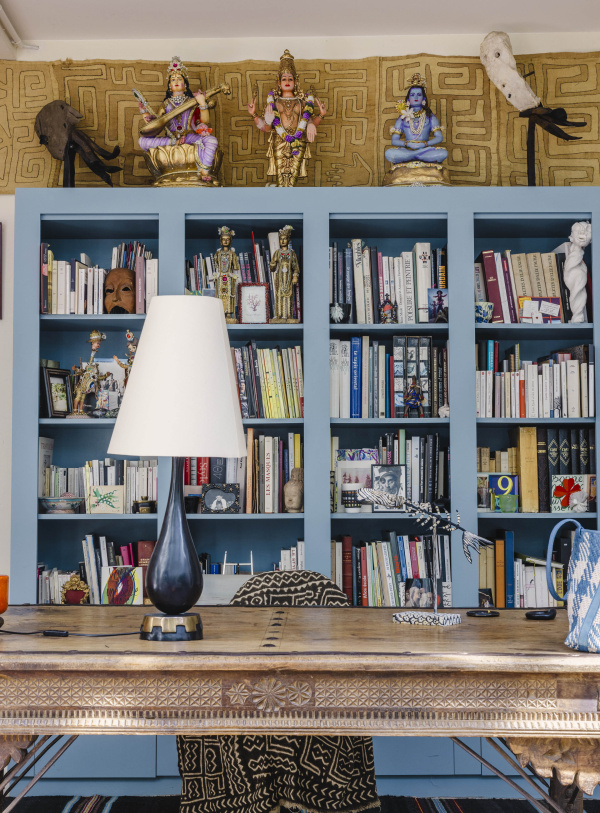
- “Mattia Bonetti and I started during a time when everything felt gray and rigid,” Elizabeth says. “We brought color back into art.” A blue bookshelf and carved desk inside Elizabeth’s living room. A lamp by Garouste & Bonetti sits on top.
-
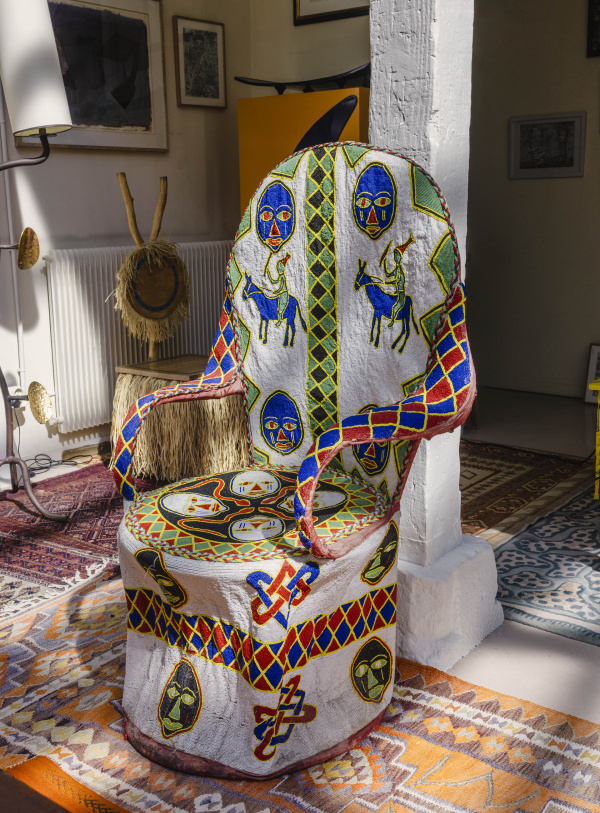
- A beaded throne armchair from Nigeria next to a Prince Impérial chair by Garouste & Bonetti in the main salon.
-
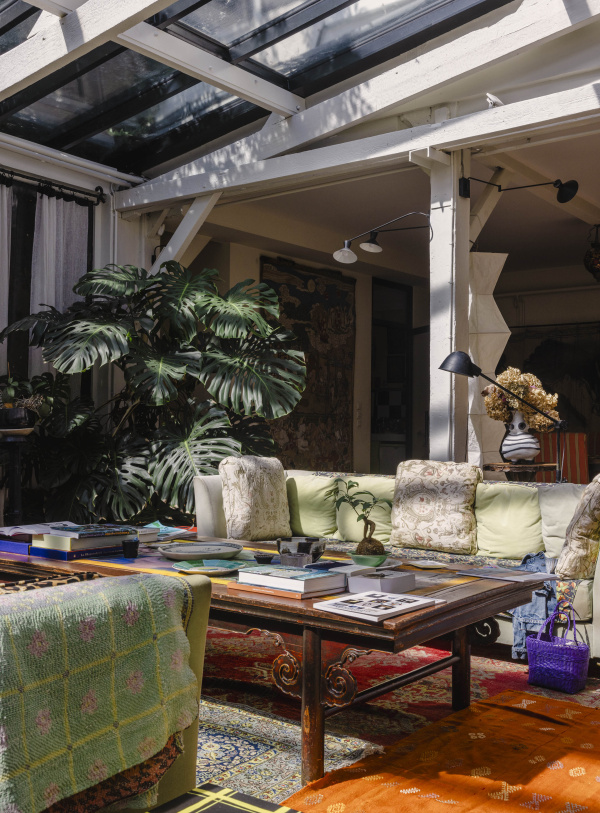
- Elizabeth’s main living room seating area features a Chinese-style table painted by Gérard Garouste and sofas draped with various patterns.
-
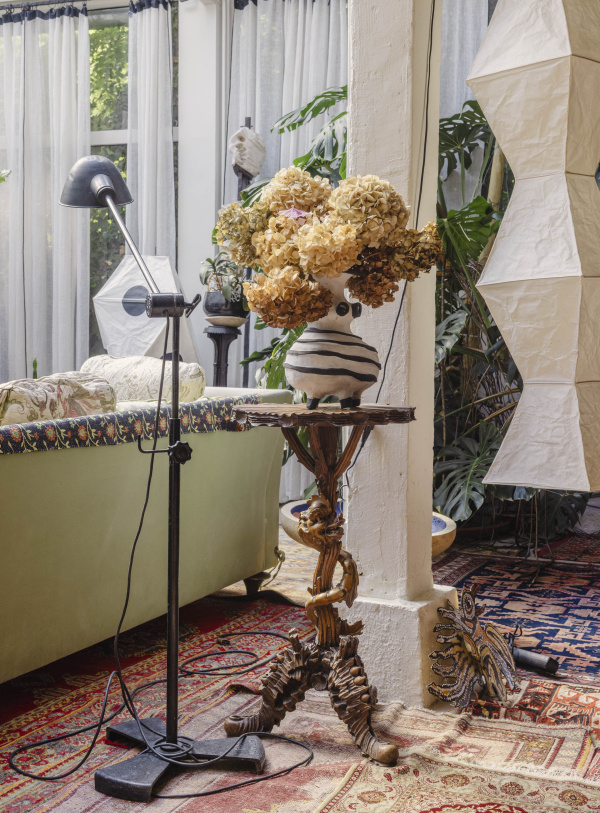
- A side table and Jieldé lamp.
-
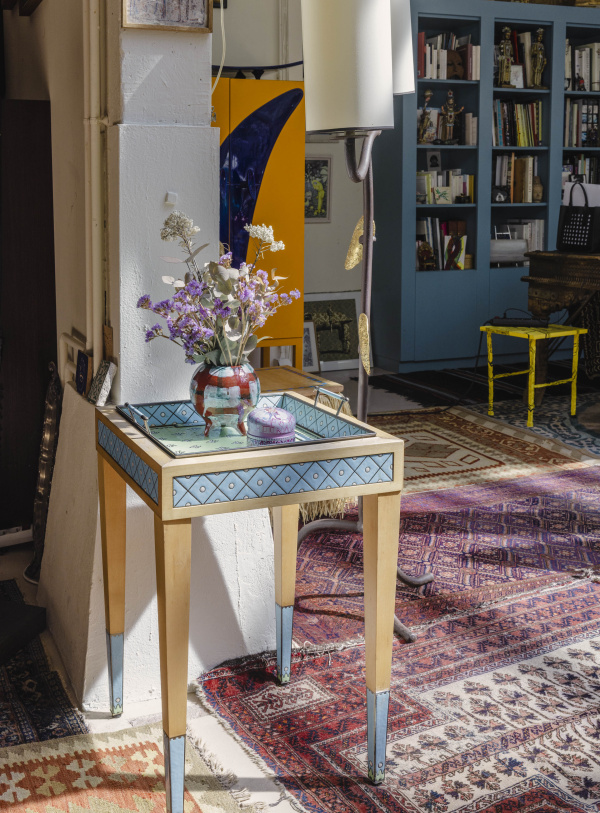
- In the living room, a wood and enamel table by Garouste & Bonetti circa 1980.
-
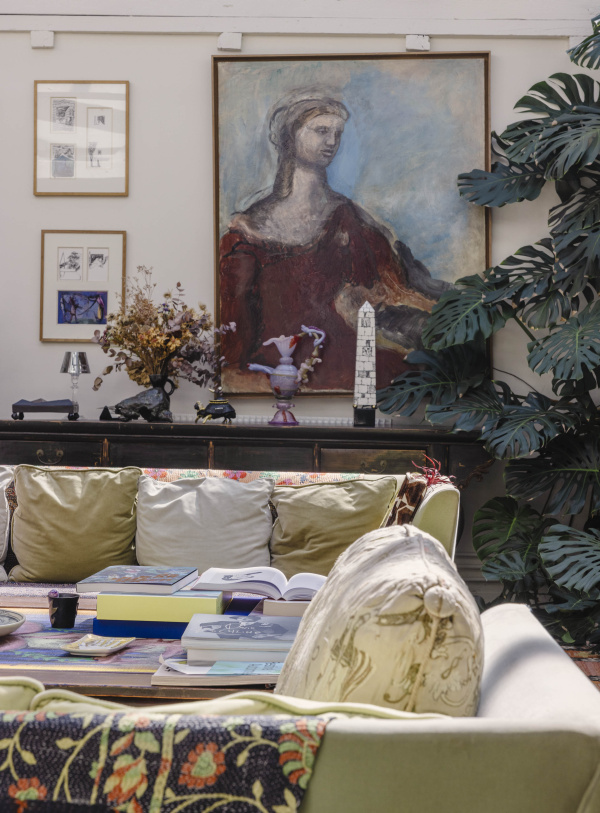
- A painting by Elizabeth’s husband, artist Gérard Garouste.
-
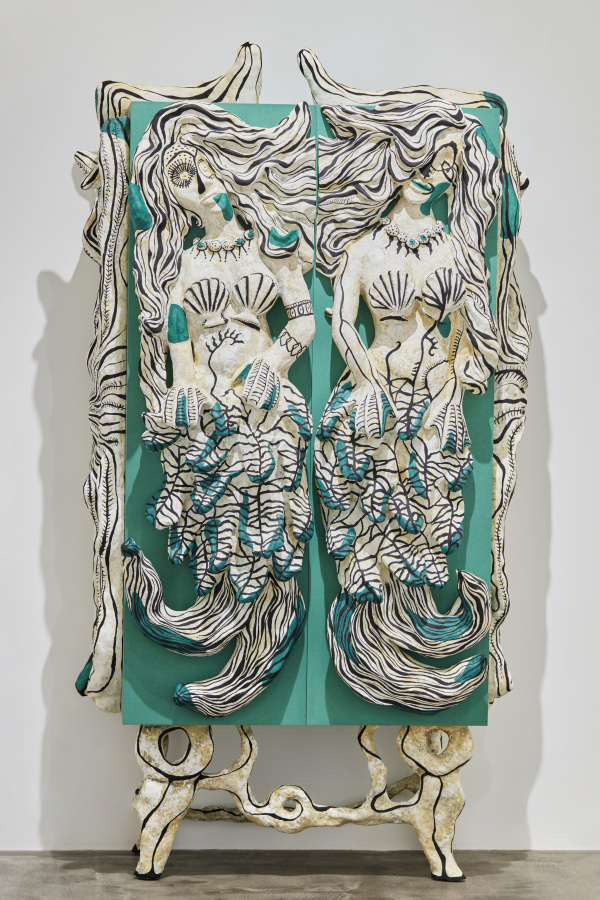
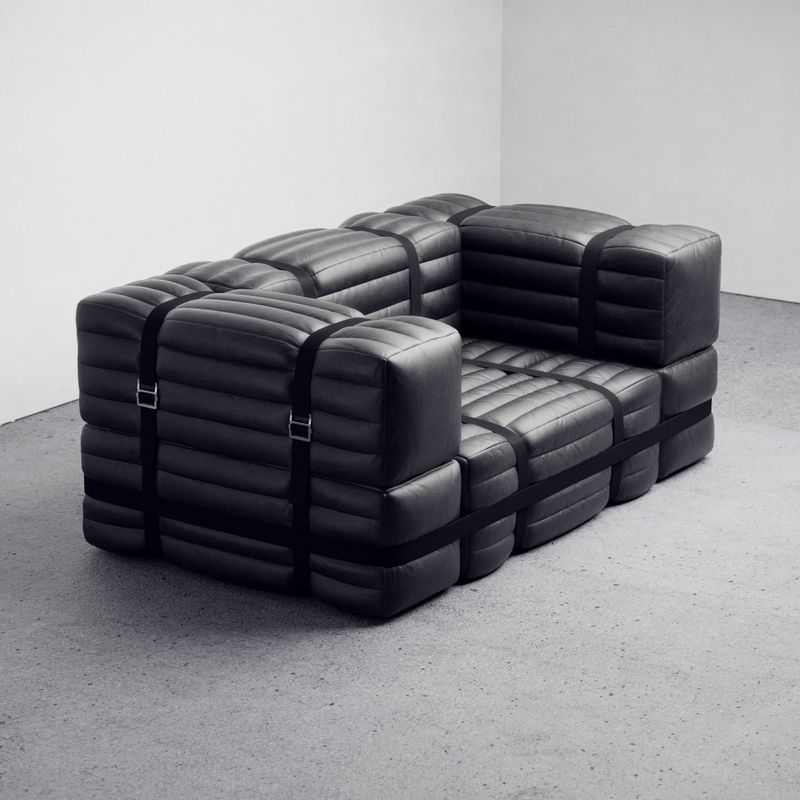
- Elizabeth is known for turning everyday ob- jects into extraordinary pieces of art within her practice. Above: Leucosie and Ligée wardrobe, 2024
-
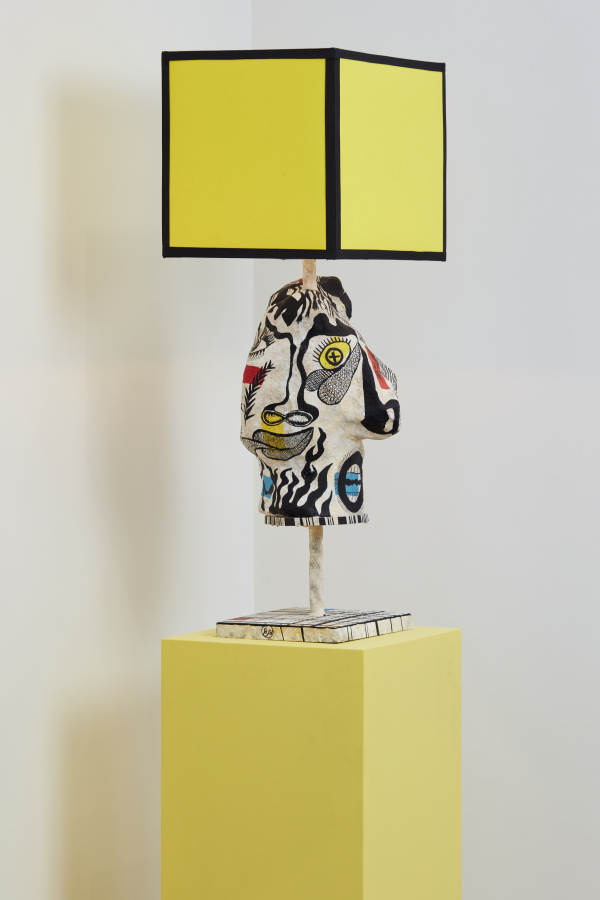
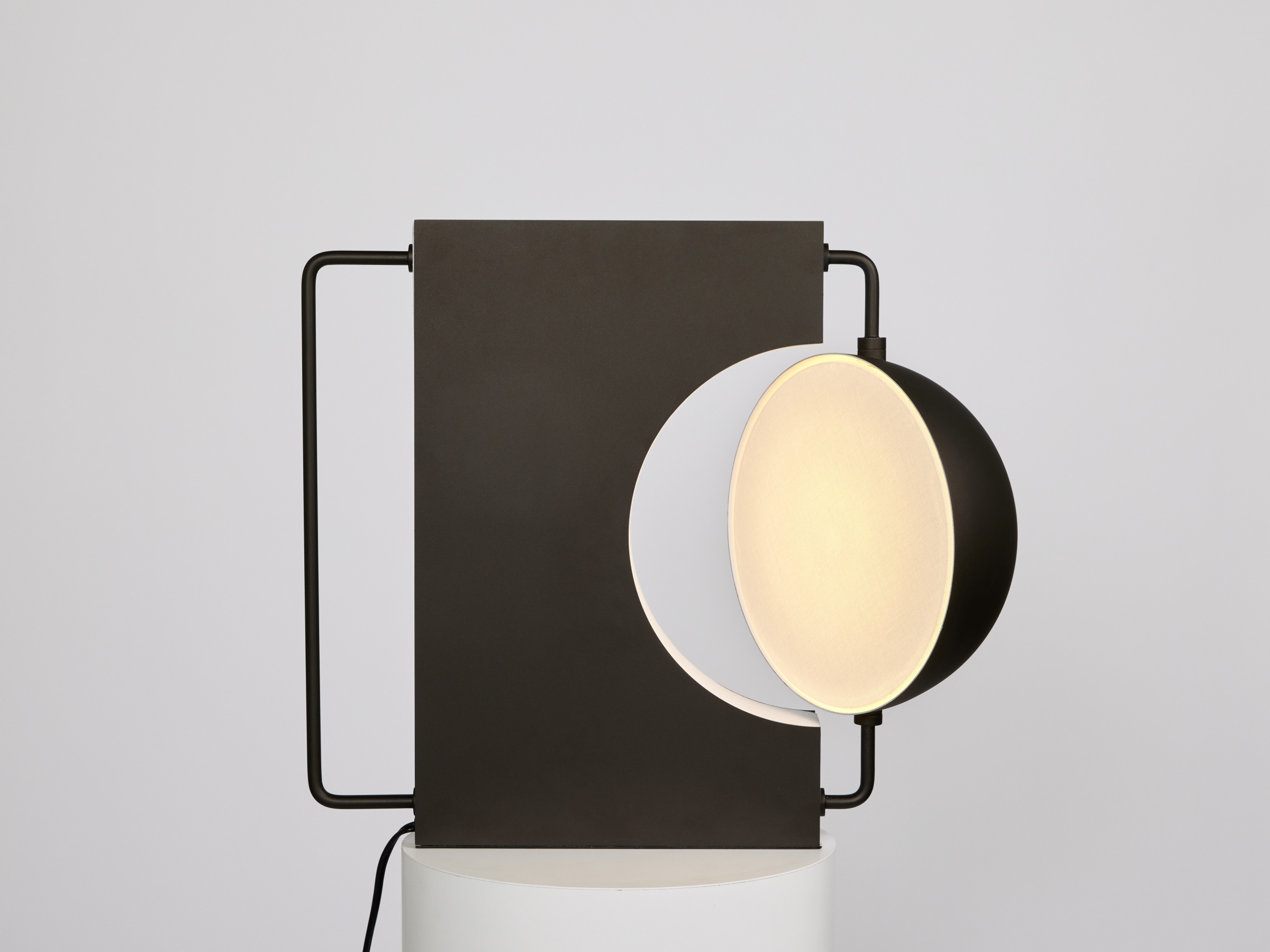
- Hector lamp, 2023.
arastarck.com, ketabibourdet.com/elizabeth-garouste
A version of this article originally appeared in Sixtysix Issue 13.