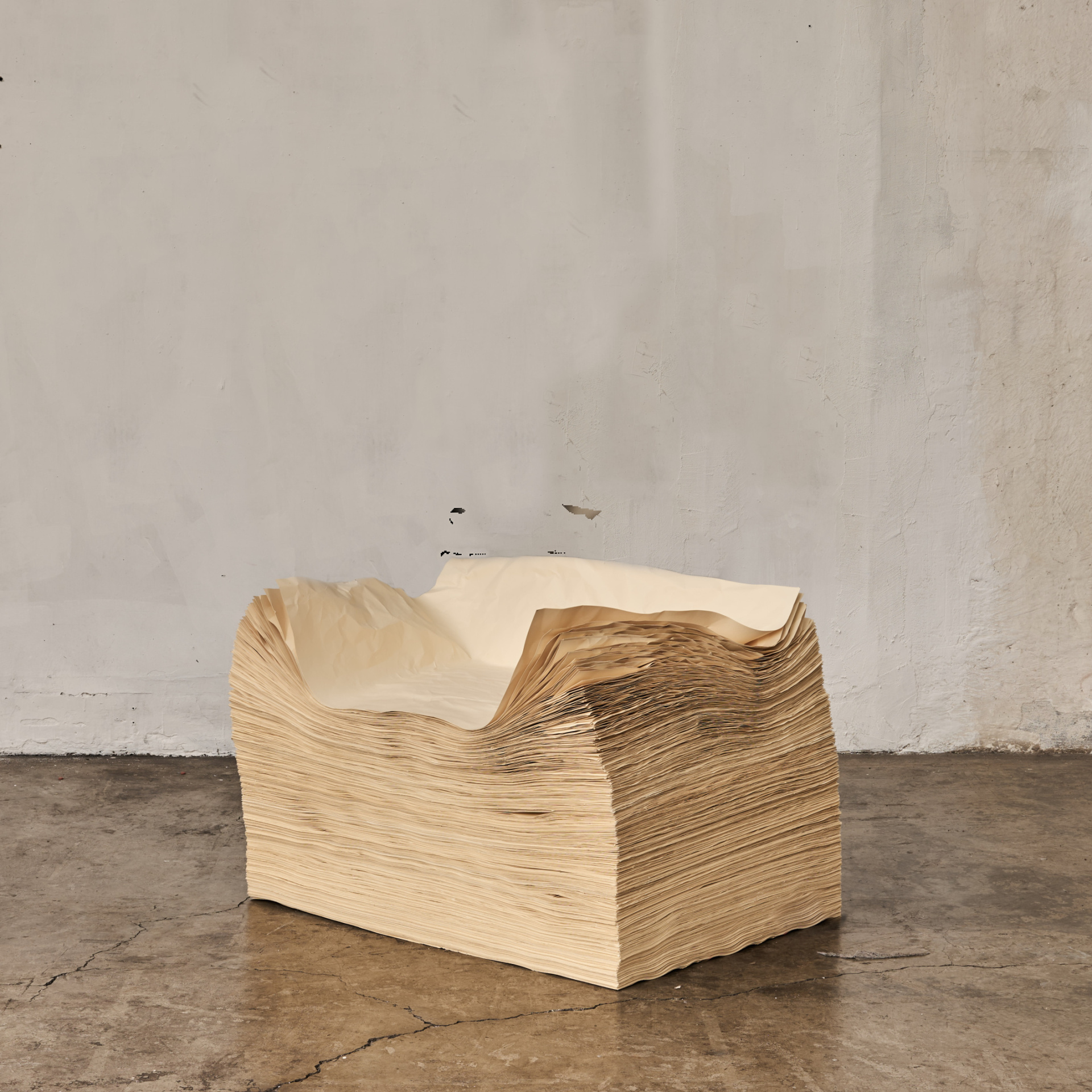
Brian Thoreen’s Paragraphic Single Stack Chair stemmed from his long-time experimentation with paper, a material he’s always found intriguing because of its familiarity.
“I have been experimenting with paper for a long time,” he says. “It is probably the most ubiquitous material in the world over the last 1,000 years until the digital age. It immediately feels personal. As I generally do, I try to challenge and question the immediate feeling a material conveys.”
The concept of stacking materials has always been central to Brian’s work, he says. He explored the idea previously in a project called Paperweight with One Meter Stack.
“It’s about staying playful,” he says. “The details of this chair came as an experiment with tar paper, where I would wrinkle each sheet first and then glue the layers together with tar, but only glue in one area, so the areas without glue would naturally curl or fold out. That would release the tension trapped in the wrinkles but remain strained by the glued sections, revealing the geometric shape.”
While Brian typically uses black tar paper for his work, his switch to manila paper here brought new visual elements to the chair’s design.
“In using around 1,000 stacks of manila paper, as we built the layers, the shadows and tonal shifts became much more important and much more dynamic visually,” he says. “You get a depth in the patterns that emerge in the sides of the chairs that is very pleasant. With the tar paper you don’t get this. In the black of the tar paper the depth is right on the face of the paper and its texture.”
While the chair’s sculptural qualities are a big part of its appeal, the idea of function was squarely in the middle of art and design.
“Function being the deciding line between the two, most often, allows for making that line blurry and poking at it with a stick,” he says. “You can sit, but they function more like a stool than a club chair.”
A version of this article originally appeared in “Nice Chairs” in Sixtysix Issue 14.