Designers Julia Arvelo, Florence Barnabé, and Muriel Bentolila have been making objects in Montreal through Atelier Fomenta since 2022, working by hand with local artisans to create collections for residential and commercial spaces. The three share what they call “a constant curiosity towards industrial and accessible materials,” focusing on materials like rubber, steel, and aluminum that don’t typically make it into homes.
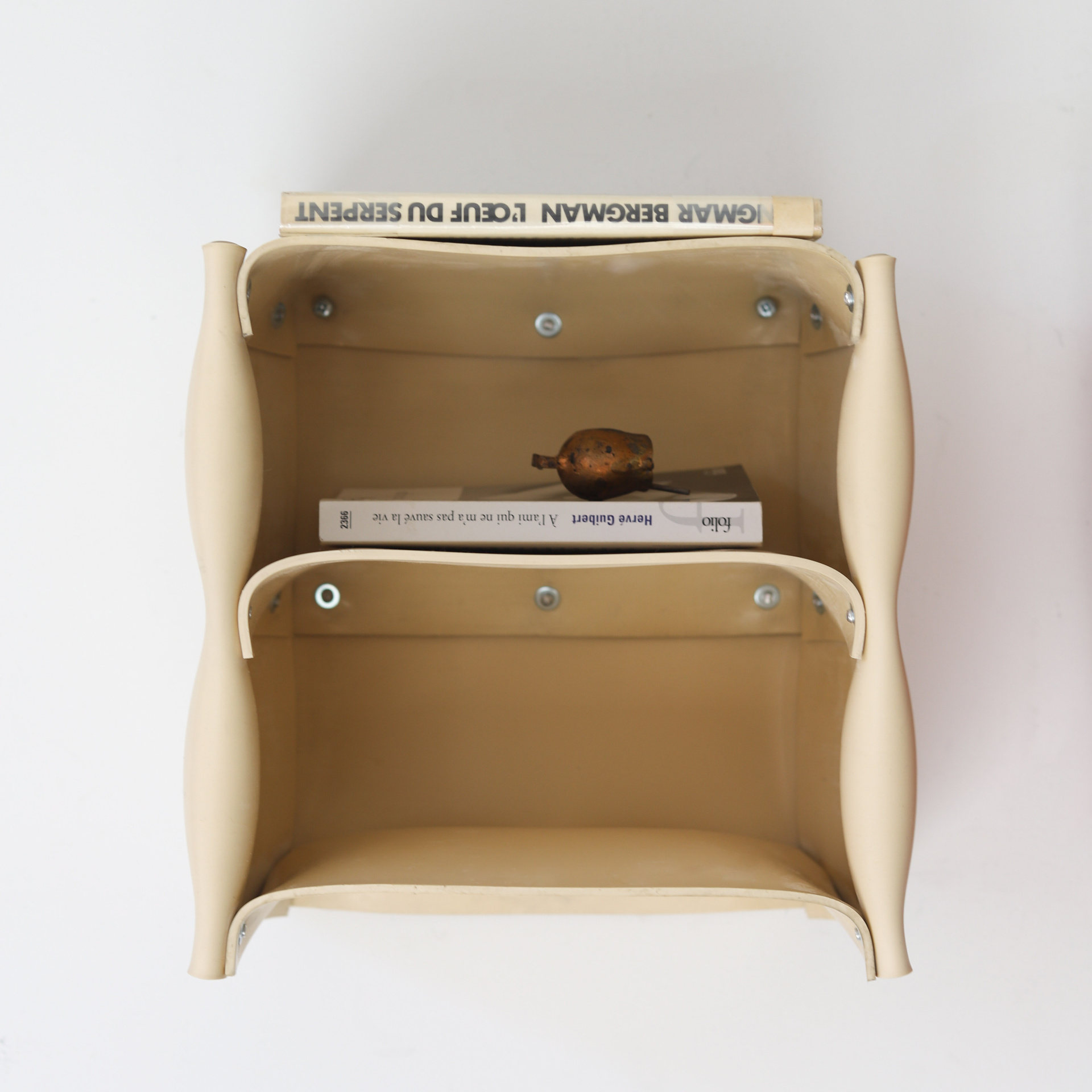
The group’s Rubber Libraries bookshelves consist of a black rubber sheet and aluminum rivets, nothing else. No hidden frame, and no metal armature doing the actual work. Just rubber cut and riveted like fabric, holding weight and functioning as furniture.
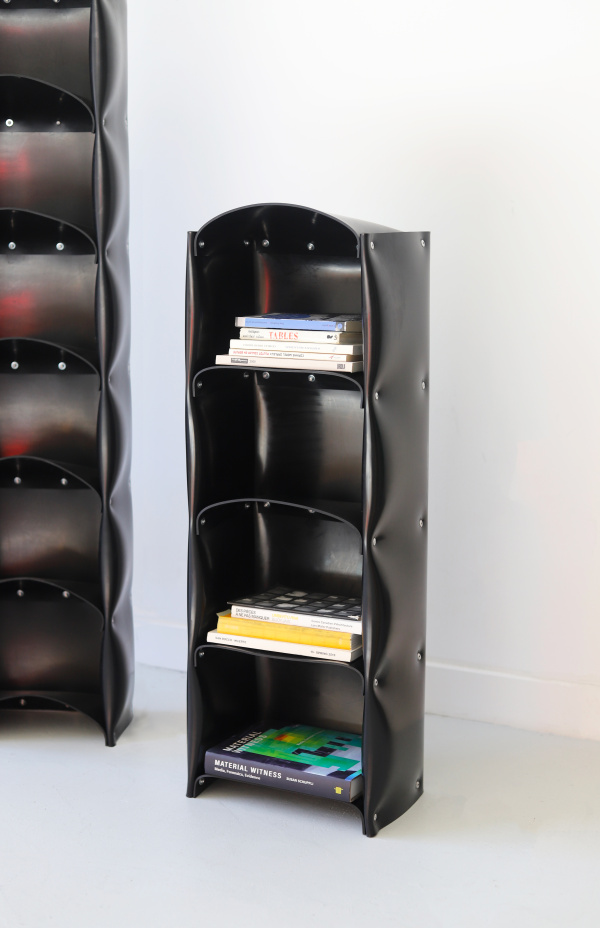
The group’s Rubber Libraries bookshelves consist of a black rubber sheet and aluminum rivets, nothing else. No hidden frame, and no metal armature doing the actual work. Photo courtesy of Atelier Fomenta
“When it came to this project, we wanted full access to the production process and the ability to fabricate everything in house,” says designer and co-founder Julia Arvelo. “The Rubber Libraries took over a year to refine from initial concept to final product.”
That timeline came from “teaching” rubber to do something new, since the material naturally wants to stay flat and two-dimensional.
“We began to understand very early on that rubber sheet as a material is akin to textiles or leather,” Julia says. “The way it’s cut or riveted in our Rubber Libraries alludes to button-tufted sofas or the construction of denim garments.
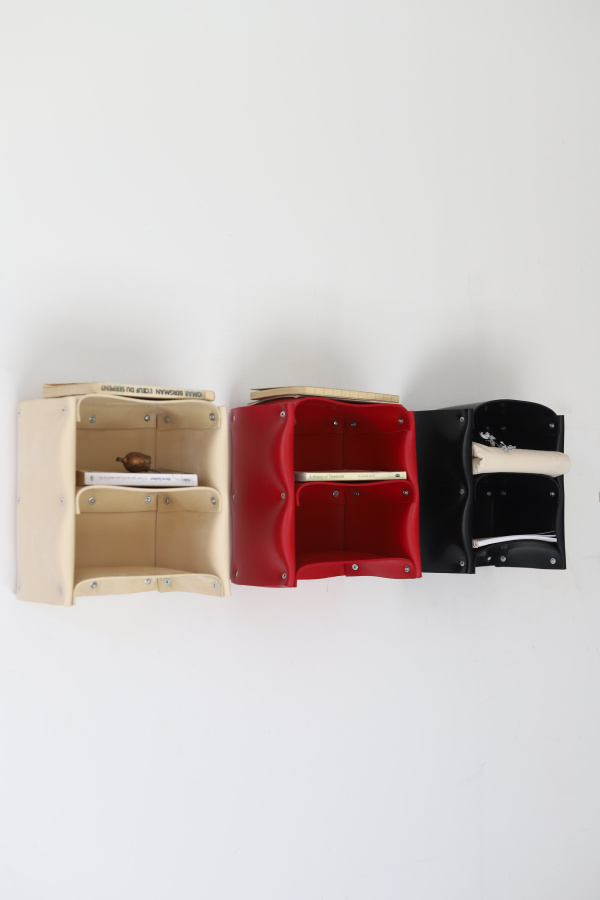
“When it came to this project, we wanted full access to the production process and the ability to fabricate everything in house,” says designer and co-founder Julia Arvelo. “The Rubber Libraries took over a year to refine from initial concept to final product.” Photo courtesy of Atelier Fomenta
“Our practice is informed by a range of influences, from historical design to more recent movements, such as certain strands of European design from the ‘70s to the ‘90s, that challenged conventional ideas of product, luxury, and what is allowed to enter the domestic sphere.”
Gaetano Pesce spent much of his career pushing synthetic materials to do structurally unexpected things. His I Feltri chairs used felt soaked in polyurethane resin, stiff at the base and soft at the top, so the material itself created the form. His Senzafine series for Meritalia takes continuous polyurethane cord, tangles it into a mold, and lets the entanglement become the seat. More recently, Chamar Studio’s Baldric Chair for Æquō, made from recycled rubber in Mumbai, approaches the same territory from a fashion angle, with rubber layered and stitched like garments and oversized seams doing structural work.
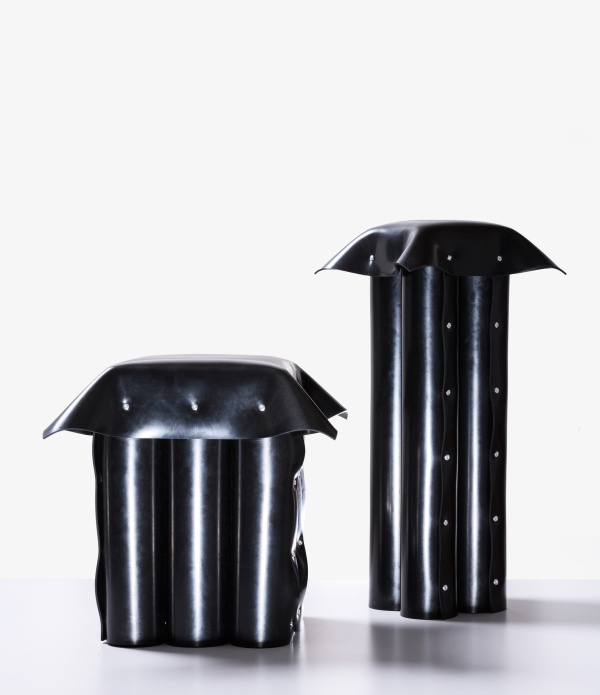
The studio has since expanded the Rubber Collection into Rubber Tables, now available in three formats, carrying the same material approach as the Libraries. Photo courtesy of Atelier Fomenta
The real challenge with the Rubber Libraries was combining both flexibility and strength, according to Julia. “We were interested in the idea of a flexible structure, how something that appears soft can carry weight and stand on its own,” she says. Solving this meant working with rubber’s properties instead of fighting them.
“Starting from a flat rubber sheet, we wanted to introduce dimension and volume, working with its inherent properties like softness and reflectivity.” The reflectivity creates subtle surface shifts that change how the piece reads in different light.
The studio has since expanded the Rubber Collection into Rubber Tables, now available in three formats, carrying the same material approach as the Libraries.