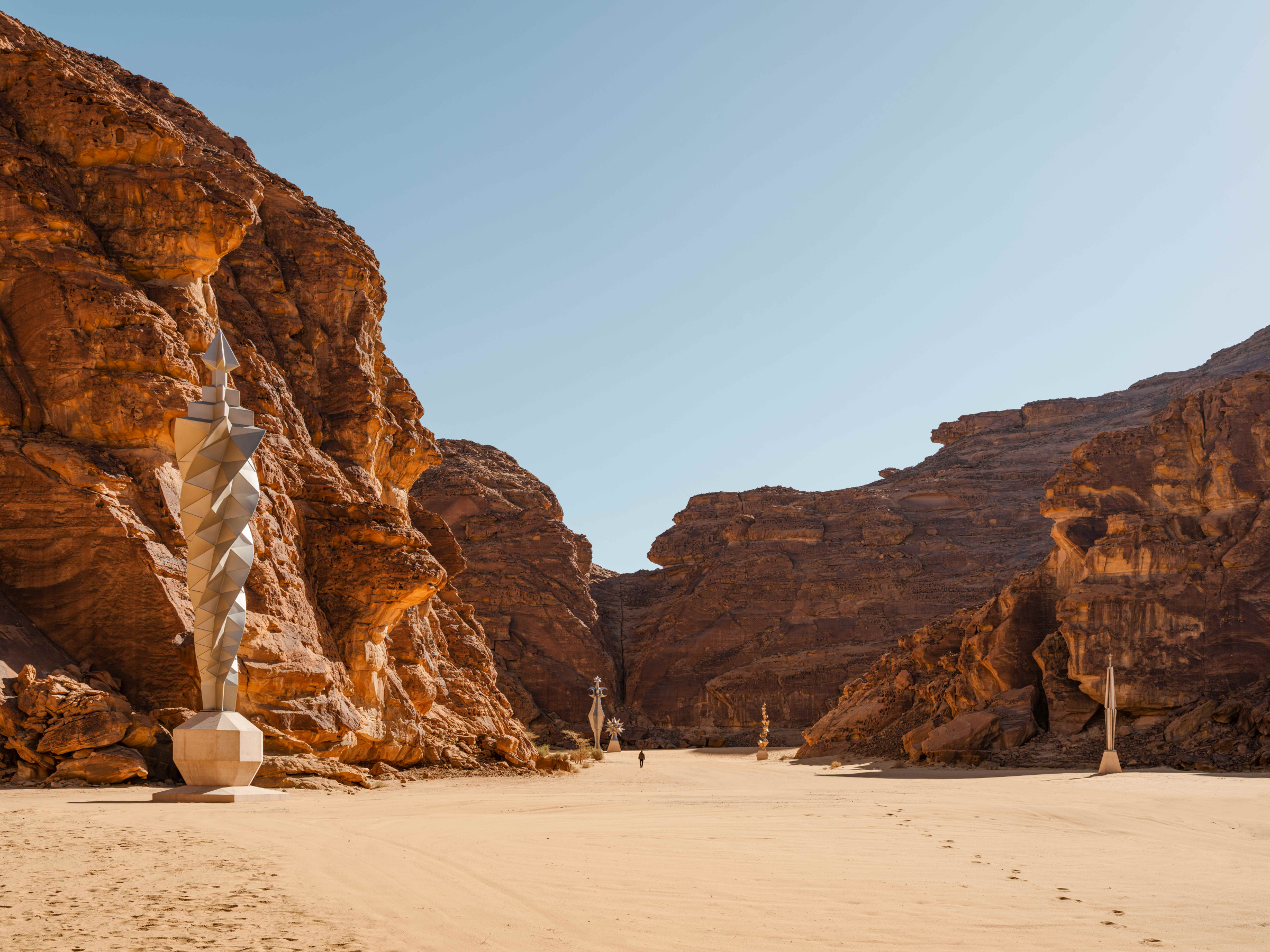
It’s silent in the Saudi Arabian desert, where sandstone formations scrape the sky, capped with boulders like heads. Loose sand ripples with waves from the wind, disturbed only by the footprints of desert foxes—and now, humans. High above circles an eagle, a symbol of immortality and the gods’ protection to the ancient Nabataeans who once lived here and carved these mountains in the oasis city AlUla.
Today it is James Turrell, Agnes Denes, Manal AlDowayan, Michael Heizer, and Ahmed Matar who plan to sculpt the natural formations into something wondrous, that will stand for thousands of years as a testament to art and humanity. In the heart of Wadi AlFann, or Valley of the Arts, British curator Iwona Blazwick and Annette Gibbons-Warren, the Director of Wadi AlFann for the Royal Commission for AlUla (RCU), paint the future of the valley, soon to be a living museum. The plan is part of the RCU’s larger vision for development in the region, as well as a continuation of the long tradition of the desert as ground for divine levels of inspiration.
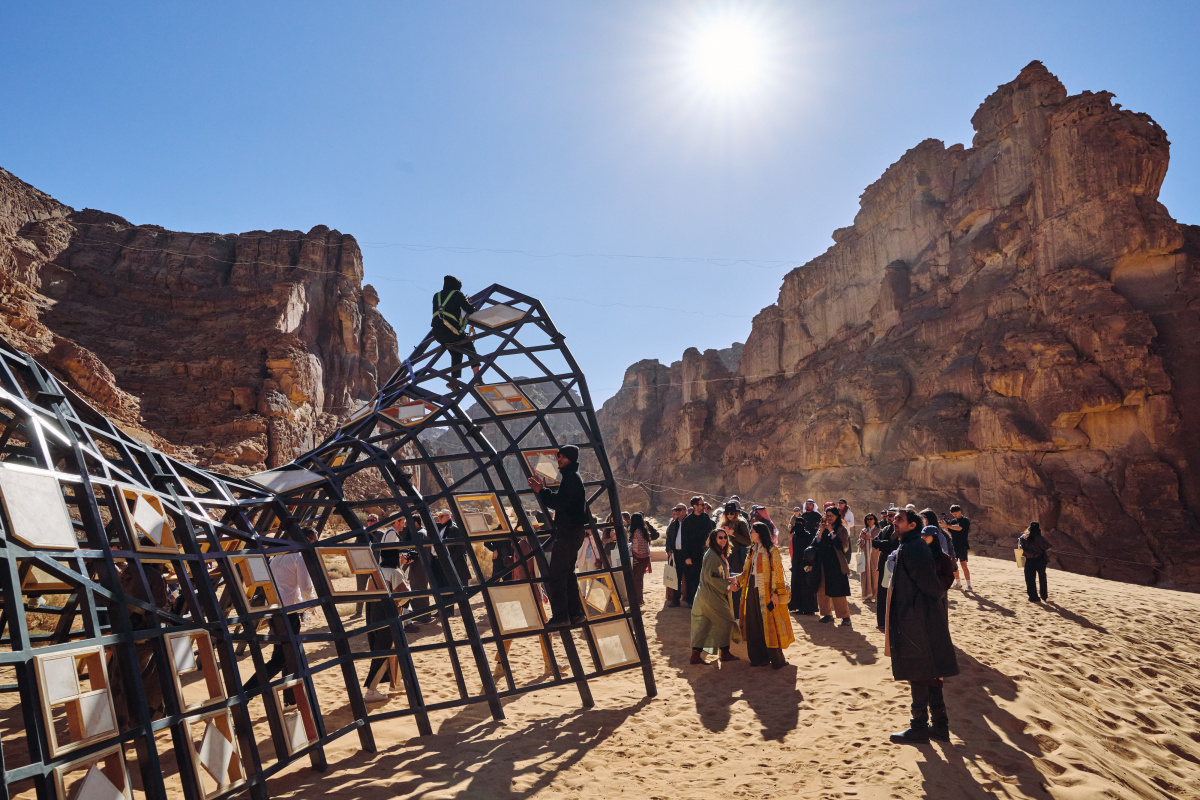
Hector Zamora’s “Tar HyPar.” Photo courtesy of Arts AIUIa and AIUIa moments
The vision for Wadi AlFann is still years away from realization. But today, just down the road, AlUla Arts Festival has activated spaces throughout the city, its rock formations, and its palm groves. Works inspired by the setting amplify the artistic identity of a region with 7,000 years of human history. Highlights include an exhibition curated from this year’s AlUla Artist Residency, the biennial Desert X AlUla (presented in collaboration with Desert X Coachella,) as well as performances, panel discussions, screenings, and more, running from January 16 to February 14, 2026. The artists and curators, hailing from Saudi Arabia and around the world, share a reverence for the landscape and a desire to engage the people and history of AlUla, to shape an artistic legacy that echoes the past while forging a modern identity for the oasis.
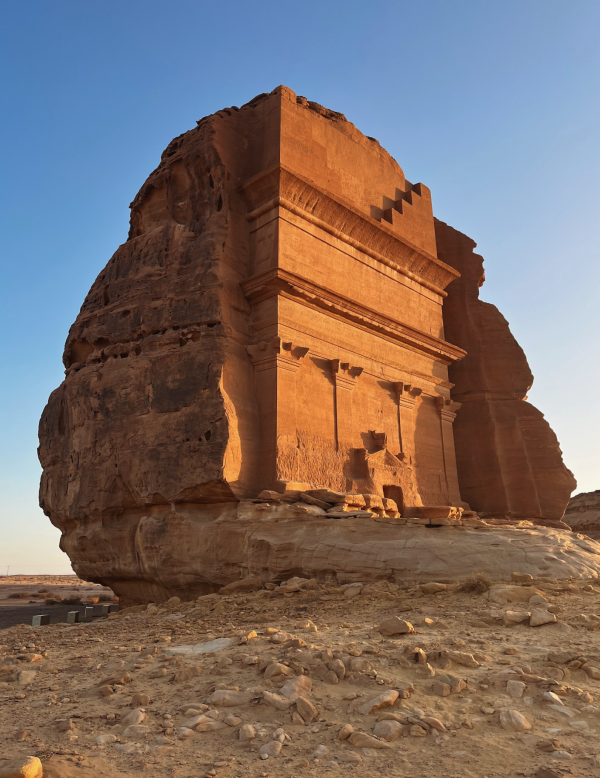
The artists and curators, hailing from Saudi Arabia and around the world, share a reverence for the landscape and a desire to engage the people and history of AlUla. Photo by Lark Breen
AlUla Artist Residency: Emerging talents engage the desert in material explorations
In AlUla, 7,000 years of history offer endless texture, points of entry, and inspiration for new interpretations. This year’s residents in the annual AlUla Artist Residency Programme largely chose the material route, finding inspiration in the breathtaking Saudi landscape.
“Materials are not a neutral resource. They hold traces and records of time, history, climate,” said the show’s lead curator, Dominique Petit-Frère, founder of Limbo Accra. “I noticed immediately that the designers had a shared sense of sensitivity and intention within their practices that I felt was relevant to bring out in the works that they would create. This idea of designing from within is inherent in their individual practice, but it’s also obvious in the context of AlUla. That’s what we’re celebrating with the exhibition at hand.”
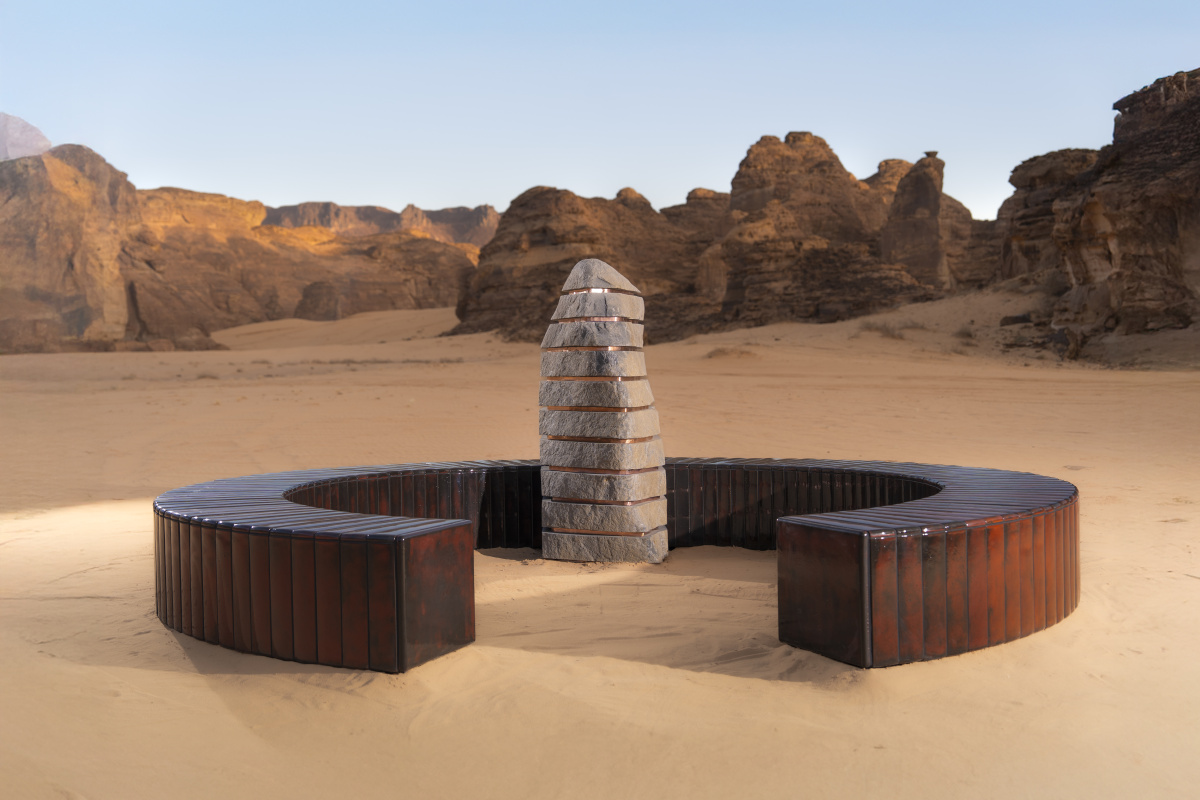
Studio ThusThat, AIUIa design residency artwork. Photo courtesy of the Royal Commission for AIUIa and Lorenzo Arrigoni
Material Witness: Celebrating Design From Within, showcased works from residents Altin Studio, Aseel Alamoudi, Ori Orisun Merhav, Paul Moustapha Ledron, and Studio ThusThat inspired by and envisioning the future of their physical surroundings, alongside projects from other local and international designers.
Conscious materiality is especially apparent in the work of Studio Thus That, a practice by Kevin Rouff and Paco Böckelmann. The studio specializes in explorations of the processes behind basic materials: metal refinement, for example. “These kinds of hidden narratives fascinate us, we sort of geek out over it. We think it tells something more about the broader systems beneath our consumption and extraction,” Kevin says.
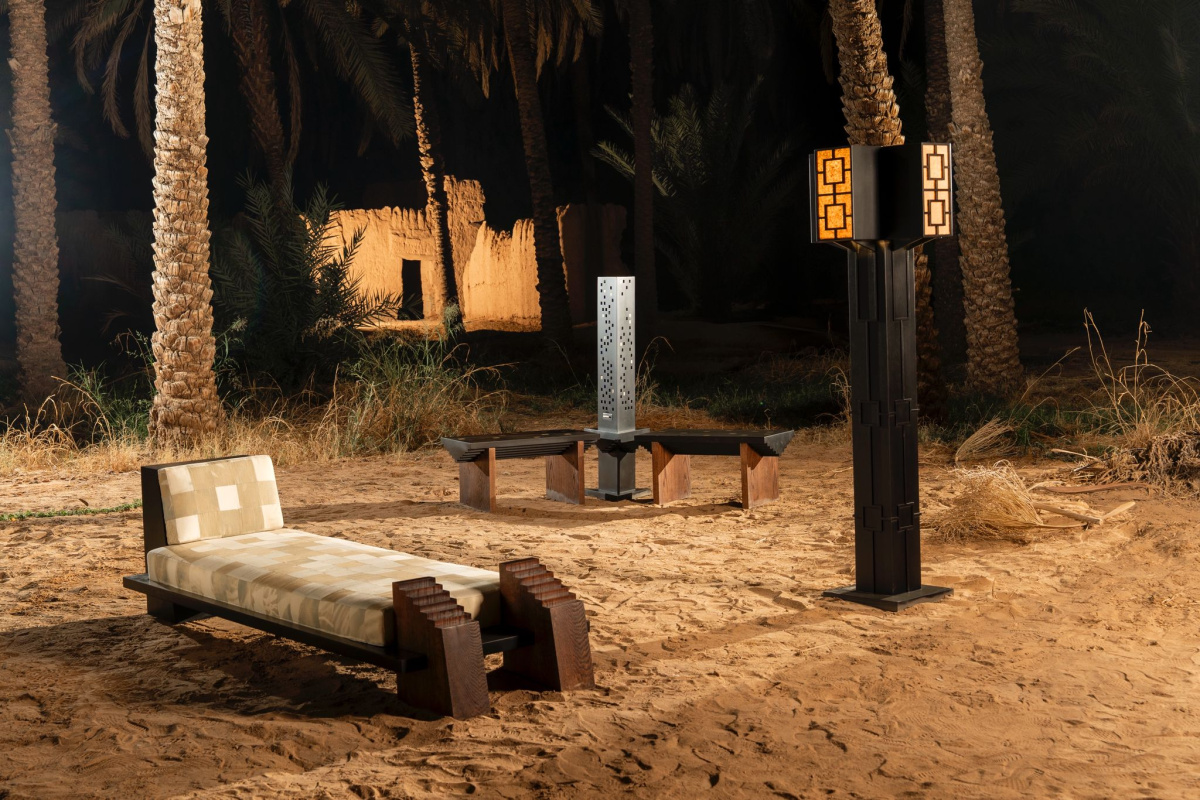
Paul Moustapha Ledron, AlUla Design Residency Artwork 2025. Photo courtesy of the Royal Commission for AlUla and Lorenzo Arrigoni
In their work, the studio combines AlUla-found basalt, refined copper, and copper slag generated in its production to create a material dialogue that is both beautiful and functional: the copper byproduct is transformed into a beautiful tile.
The project offers a functional new product to Saudis as they reimagine their larger society as part of Saudi Vision 2030, a government initiative to diversify the kingdom’s economy, society, and culture. Hundreds of new developments are underway, including arts-related initiatives like Wadi AlFann, under the leadership of the Royal Commission for AlUla (RCU).
The other artists in residence also offer tangible products to aid future developments. Stunning lamps from Ori Orisun Merhav reconstruct the layered, intelligent structure of the date palm, proliferant in AlUla, into glowing amber orbs. Beyond material possibilities, the lighting and furniture designs of Paul Moustapha Ledron or shelves by Franco-Tunisian Altin Studio have the potential for incorporation in future hotels and businesses in the area.
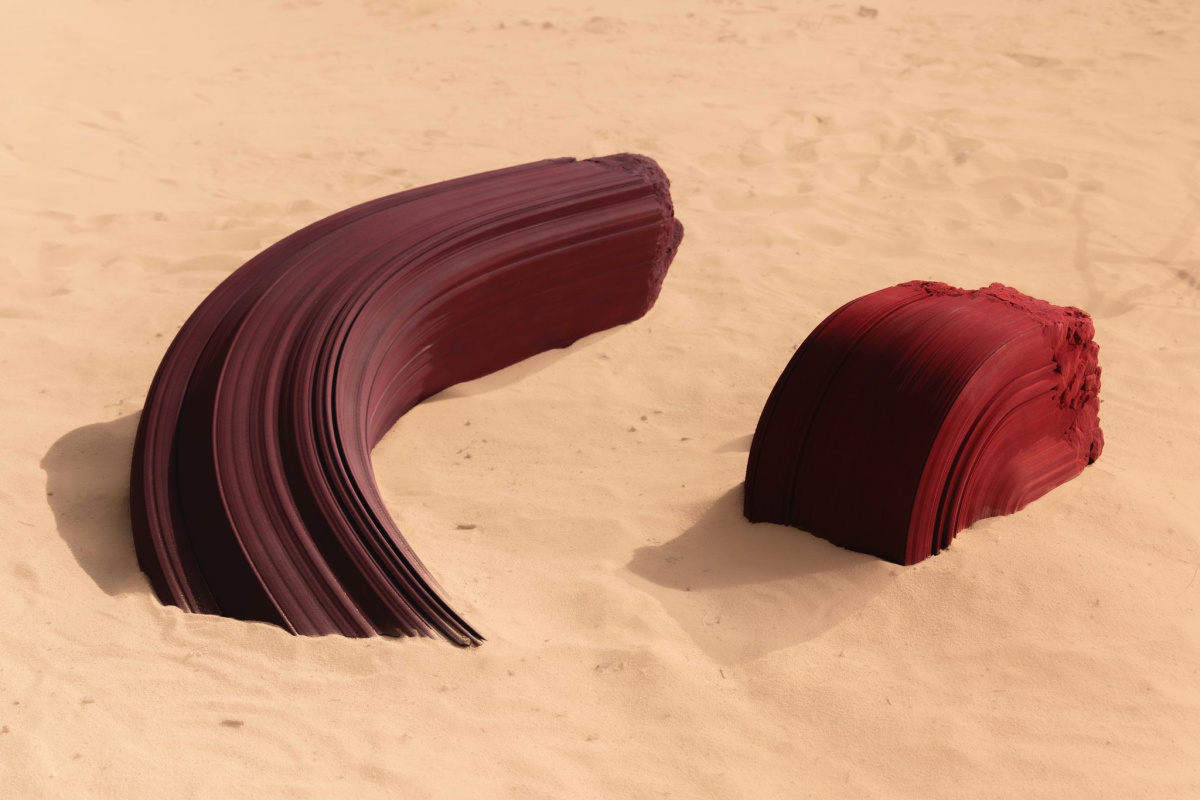
Aseel Alamoudi, AlUla Design Residency Artwork 2025. Photo courtesy of the Royal Commission for AlUla and Lorenzo Arrigoni
Aseel Alamoudi began her residency observing the children of the city engaging in freeform play in open spaces. At the same time, she explored the texture of the region’s sandstone formations in material extrusions. The two ideas merge in the vibrant red bench and stool she showed at ’Material Witness,’ alongside a miniature mockup of her complete vision: a full-size material extrusion in the shape of a curved, slidable, climbable, sculptural play structure.
For Aseel, her fellow artists, and the show’s leadership, ‘Material Witness’ is just the start of what could be possible when merging design and development in a city continually strengthening and defining its voice.
Desert X AlUla: 11 designs that engage with their surroundings
Adding to the conversation, Desert X AlUla presents ’Space Without Measure,’ a curation of 11 sculptural works that engage their surroundings under the theme ’Space Without Measure,’ inspired by poet Kahlil Gibran. Imagination trickles into the nooks and niches of the AlUla desert, near Wadi AlFann and the future Living Museum.
But while plans for Wadi AlFann are monumental, permanent, experiential works of environmental art that intend to stand for millennia, Desert X is purposefully transient. The works on display are reflective and personal, thoughtful and rooted in the here and the now. They note the land’s history, and contemplate its future, while relating to it exactly as it is today.
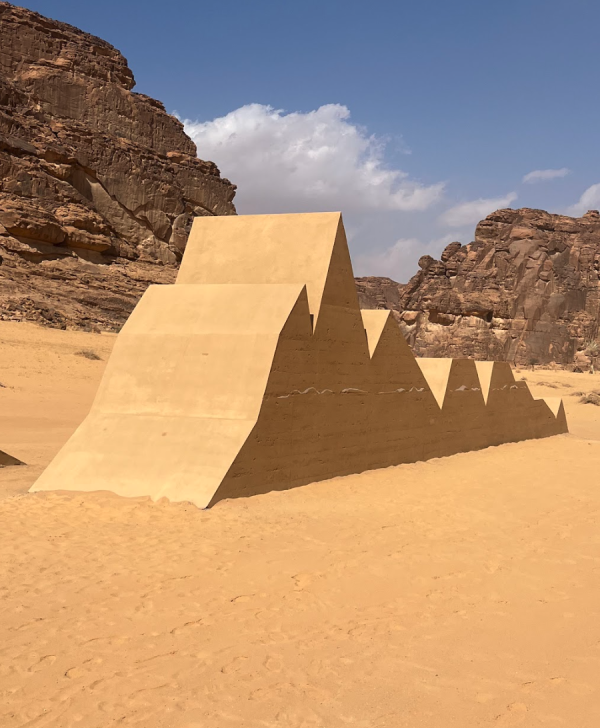
Sara Abdu built a mountain range of rammed earth, Saudi and Yemeni sand impacted and sealed into the soundwaves her voice made when speaking a poem. Photo by Lark Breen
Some of the works are soundly rooted in Saudi Arabia, implementing, reflecting, and reimagining the land and its people.
Closer to the Al-Jaddidah arts district, Agnes Denes designed the Living Pyramid. It is part of the biennial Desert X, but also a longer term fixture of AlUla and a preamble to the future installations at Wadi AlFann. Agnes has returned to the pyramid motif throughout her career for its symbolism.
“Philosophically the pyramid is interesting because it’s both about hierarchy—about something which narrows towards the top to create an elite—and about aspiration, about climbing up towards an achievement. Metaphorically, it’s also a connection between the cosmos and the planet, heaven and earth. So it’s a very, very rich form,” explains Iwona.
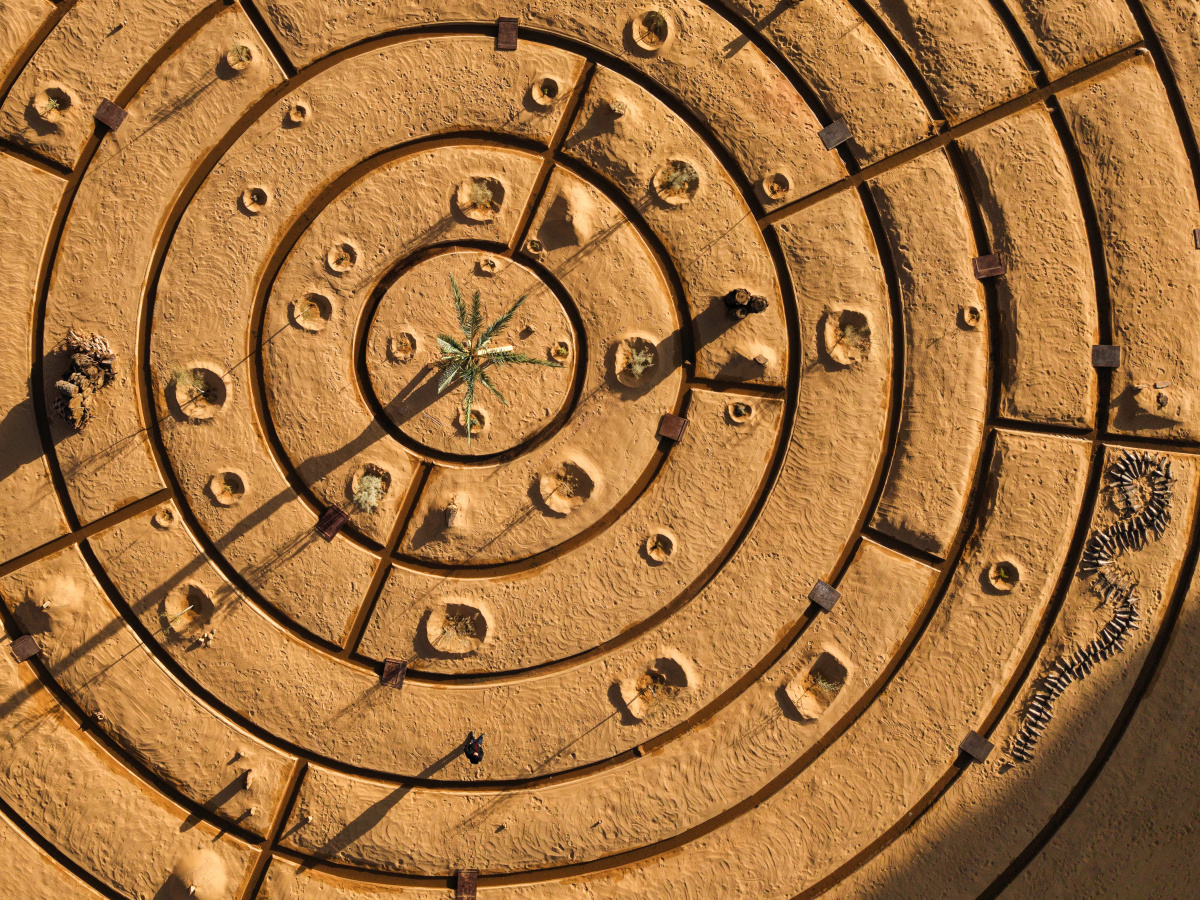
Mohammad Alfaraj took inspiration from his upbringing surrounded by palms, building a labyrinthine space using date palm farming techniques and mythologies from his native Saudi Arabia. Photo by Lance Gerber
Together the 11 works in Desert X Alula create a landscape of their own—I easily logged 10,000 steps treading the hot sand to see each of the installations up close. The mountainous rocks became behemoth, towering over manmade structures that were already very large. If the desert is the ultimate inspiration, it is also the ultimate competition. To live up to its beauty and awe is no small task.
Wadi AlFann and the future of art in AlUla
The festival is working deliberately to build a creative community, rooted in history and culture but with totally new vigor and modernity. With the artist residency and Desert X initiatives, AlUla’s arts scene fosters new ideas from emerging talents. Another piece of the puzzle is Wadi AlFann, the Valley of the Arts, with curation spearheaded by Iwona Blazwick and the RCU’s Annette Gibbons-Warren. While other AlUla arts endeavors aim to engage young talents, Wadi AlFann is working with the pioneers of artistic languages to build something monumental, to stand for generations like the tombs of Hegra.
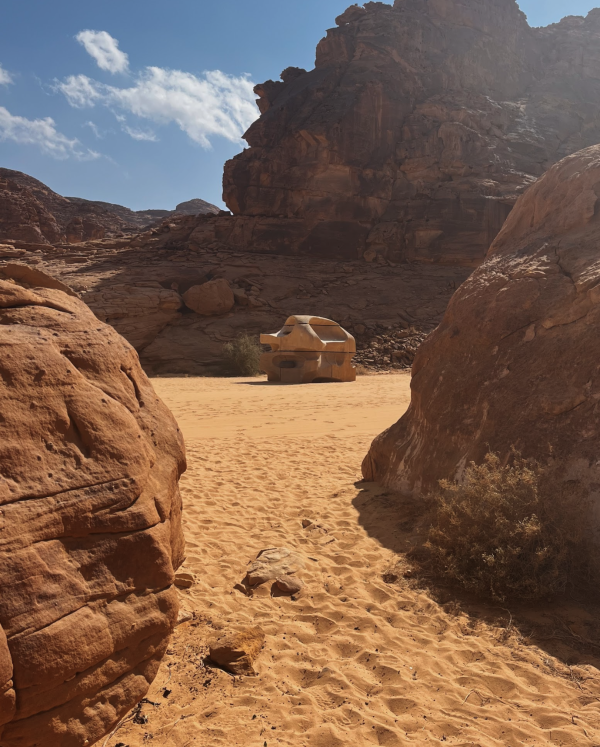
This year’s residents in the annual AlUla Artist Residency Programme largely chose the material route, finding inspiration in the breathtaking Saudi landscape. Photo by Lark Breen
Currently the 65-square-kilometer valley is wide open to the public, but also empty of almost any evidence of its future masterpieces. Geological markers in the sand are the only indication of a future development.
Come 2030, fingers crossed, visitors should be able to walk the winding topography of Wadi AlFann. The valley will host massive-scale site-specific works from Agnes Denes, James Turrell, Ahmed Mater, Manal AlDowayan, and Michael Heizer designed in tribute to and in amplification of the history, culture, and natural phenomena of the valley.
“We’ve intentionally engaged the pioneers and icons of land art, the mothers and fathers of the light and space movement for Turrell, land art and earth works for Michael Heiser, and environmental ecological art in Agnes Denes,” Annette says. “Certainly for Agnes, this will be the most enduring, most permanent legacy of her work. She’s now 95, so we are privileged and slightly terrified by the responsibility to create this lasting monument to her incredible legacy.”
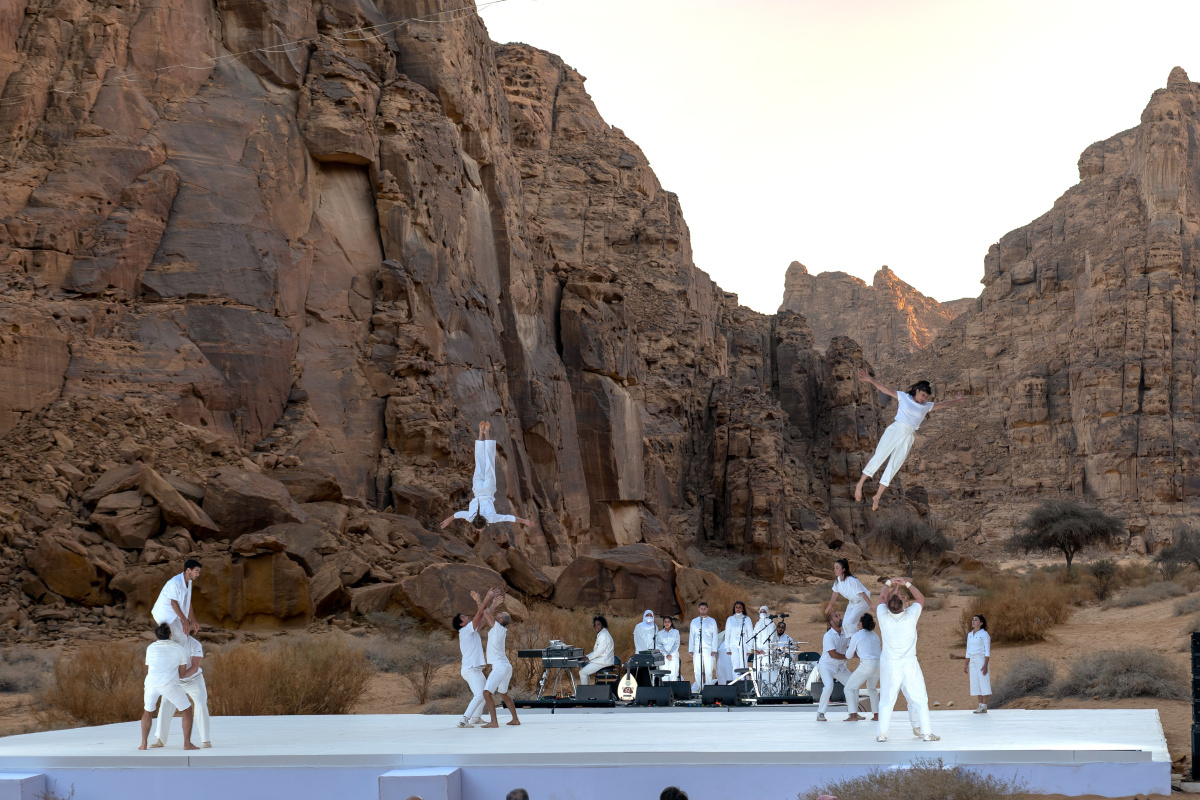
Vertifo, AIUIa Arts Festival 2026. Photo by Villa Hegra
The proposal from Agnes Denes incorporates six massive rock carvings executed by local stonemasters and a crystal pyramid. James Turrell will create an open sky viewing chamber at the center of a mountain, marked by a map of the constellations and an obelisk that doubles as a sundial, accessible via tunnels that also lead to rooms of infinite color. Michael Heizer will reflect on his formative childhood experience of seeing the Nazca Lines in Peru, tracing giant petroglyphs over a great distance, revealing their complete form from different distances and angles.
Each of the great works is designed to last for millenia, a permanent testament to these artists and their impact on the world. The other two artists slated to join the first wave of installations at Wadi AlFann meet the challenge with installations that are just as ambitious. Saudi Arabian artist Manal AlDowayan plans a recreation of AlUla’s 900-year-old Old Town village executed in white concrete and covered with modern etchings drawn by locals. Ahmed Matar combines science with art in his proposal: an underground chamber where visitors’ images will be reflected into a mirage hovering above the desert sand above for a magical but entirely scientific experience.
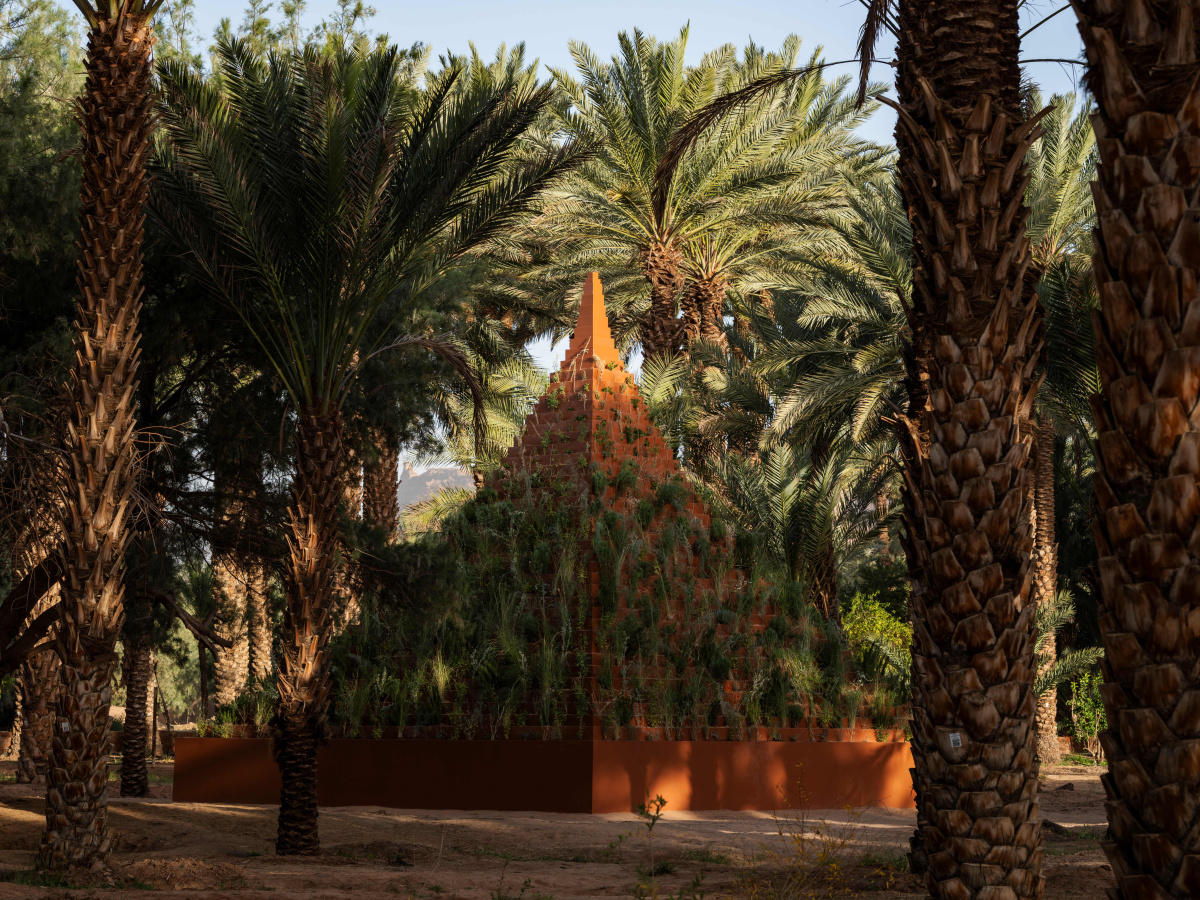
Agnes Denes, The Living Pyramid, Desert X AlUla 2026. Photo by Lance Gerber
Imagining the resulting landscape of artworks is both impossible and incredibly easy from my perch atop a sandy desert dune. Similarly to how artists have for years gone to Joshua Tree to find themselves and put pen to paper, or flocked to Nevada with wacky sculptures in tow for Burning Man, AlUla is a place where anything seems possible. Anything could happen in this 65-square-kilometer valley, so who’s stopping James Turrell from hollowing out a mountain, or Ahmed Matar from making essentially a live hologram?
In a vast natural landscape host to magnificent rock formations, thousands of years of culture and history, and the inherent mesmerizing quality of a bonafide oasis, inspiration abounds. Down the road, designer in residence Paul Emilieu Marchesseau is inventing speakers and modular workspaces at artist haven Villa Hegra; at Design Space AlUla the products and wearables recognized in the AlUla Design Awards are on display; and the history of moving arts is presented in “Arduna,” an exhibition by the forthcoming AlUla Contemporary Art Museum in collaboration with Pompidou.
As the city continues to develop so will its art scene. In a place where anything can happen, a whole lot is, in fact, going on.