Isamu Noguchi designed the Akari light sculpture series beginning in 1951 in Gifu, Japan. Built from washi paper and bamboo, the lamps married an ancient chochin lantern craft with modernist form, and seventy-five years on, they remain the most widely recognized Japanese-American design of the twentieth century. Every authentic example is still hand-produced by the Ozeki workshop that made the first ones.
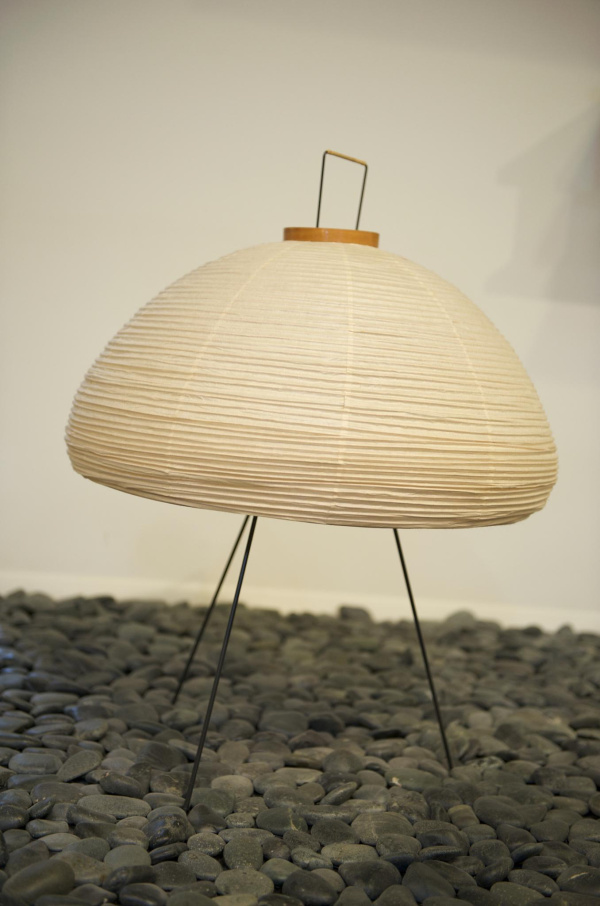
An Isamu Noguchi Akari light sculpture showing the characteristic washi paper construction and bamboo ribbing. Isamu Noguchi, Akari light sculpture. Photo via Wikimedia Commons / CC BY 2.0.
Origins, 1951
In spring 1951, on his way to Hiroshima to work on a memorial cenotaph for Kenzo Tange’s Peace Memorial Park, Noguchi stopped in Gifu at the invitation of the city’s mayor. Gifu had been a center of chochin manufacture for centuries. The postwar economy had hammered the industry, and the mayor wanted modern design help to revive the craft. Noguchi was traveling on a Bollingen Foundation fellowship that had taken him through Asia for much of 1949 to 1951. Noguchi spent several days in Gifu. He met with the Ozeki family at their workshop, walked the Nagara River area where the chochin had been hung for generations, and saw the lanterns in their working context. He began sketching on the spot, replacing the traditional folded accordion silhouette with rounded organic profiles consistent with the abstract sculpture he had been making for two decades. The Hiroshima cenotaph commission collapsed in 1952. His design was rejected, reportedly because the memorial was deemed to require a Japanese rather than a Japanese-American designer. The Gifu visit endured. The first models entered production by late 1951 under the name akari, Noguchi’s chosen term for “light” or “lightness” in Japanese. Ozeki & Co. has produced every authentic Akari continuously since. That arrangement places the series among the longest-running design objects of the modern era, on the same shelf as Marianne Brandt’s HMB pendant lamp from the Bauhaus metal workshop, which preceded it by two decades and is still in production today.
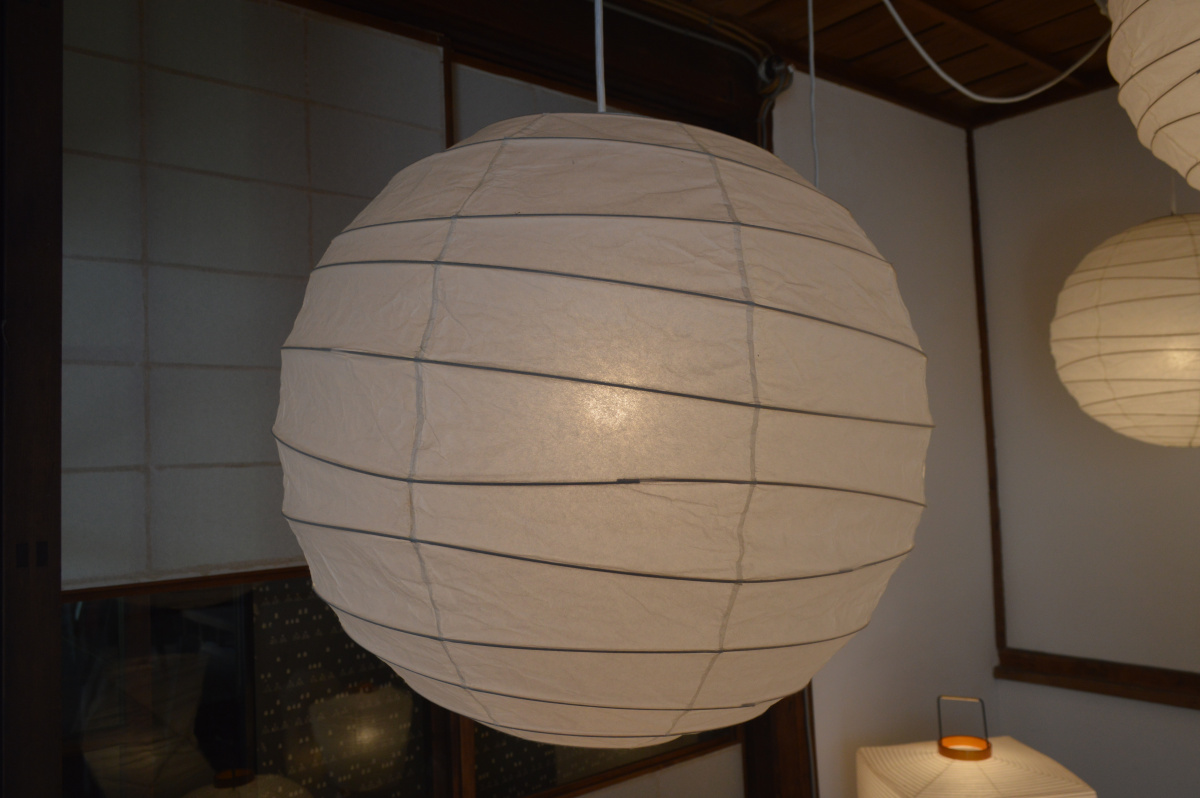
An Isamu Noguchi Akari light sculpture showing the characteristic washi paper construction and bamboo ribbing. Chochin paper lantern craft, Gifu, Japan. Photo via Wikimedia Commons / CC BY-SA 4.0.
Materials and Craft
Washi paper comes from kozo, the paper mulberry. Bark is stripped from the tree, the inner fibers are steamed and beaten by hand, sheets are formed on a bamboo screen, and the sheets are dried on wooden boards. The washi used for Akari is traditionally Mino paper, made in the Mino region a short drive from Gifu. UNESCO inscribed the Mino paper-making technique on its Intangible Cultural Heritage list in 2014. Kozo bark is harvested in winter when the tree is dormant, then stored, soaked, and processed through early spring. The Mino paper-making season runs from December through April, before warm weather makes the fibers harder to control. Bamboo strips are split, planed, and curved into the ribbing that gives each lamp its skeleton, selected for the straightness of the fibers and the springiness that lets the lamp collapse for shipping and recover its shape on the buyer’s side. The Ozeki construction process has changed little since the 1950s. A wooden mold cut to the lamp’s intended form is set up. Bamboo strips are wound around the mold in a continuous spiral and glued in place. Washi sheets are applied to the bamboo skeleton wet, smoothed flat, then trimmed. Once the paper dries, the mold is removed and the lamp can be collapsed for shipping. Each form returns to its expanded shape when reassembled, the bamboo ribbing acting as a soft spring. The technique is essentially unchanged from pre-industrial chochin manufacture. Noguchi did not modernize the craft. He commissioned new shapes from it.
The Series
Noguchi designed over 200 distinct Akari models between 1951 and his death in 1988. The series spans table lamps, floor lamps, pendants, and ceiling fixtures. Noguchi referred to the work as “light sculptures” rather than lamps, a distinction he maintained throughout his life and one the Noguchi Foundation preserves in its current catalogue. The naming convention combines a number indicating size or family and a letter indicating variant. Small table models carry the number 1 with letter suffixes: 1A, 1AB, 1AD, 1AY. Each is a teardrop or oval form, similar in silhouette but varied in proportion. Larger table units run through 2A, 3A, 5A, 9A. Floor lamps appear in the BB series (BB1, BB2, BB3, BB4), ranging from roughly waist-height to nearly two meters, each on a tripod of bent bamboo or steel. Pendants are spread across the A, L, and similar letter families, hanging from a single cord. The largest ceiling fixtures are dropped on long pendants and resemble inflated paper sails. [VERIFY: precise letter-code conventions for BB, UF, A, L families; sources differ on what each prefix stands for.] A small number of models exist only as single units or short editions, made for specific installations Noguchi designed. The current Ozeki catalog runs to around fifty standard models. The 1A teardrop is the most widely owned. Larger sculptural pieces like the 75A or the UF4-L8 are rarer and more often seen in museum settings than in private homes.
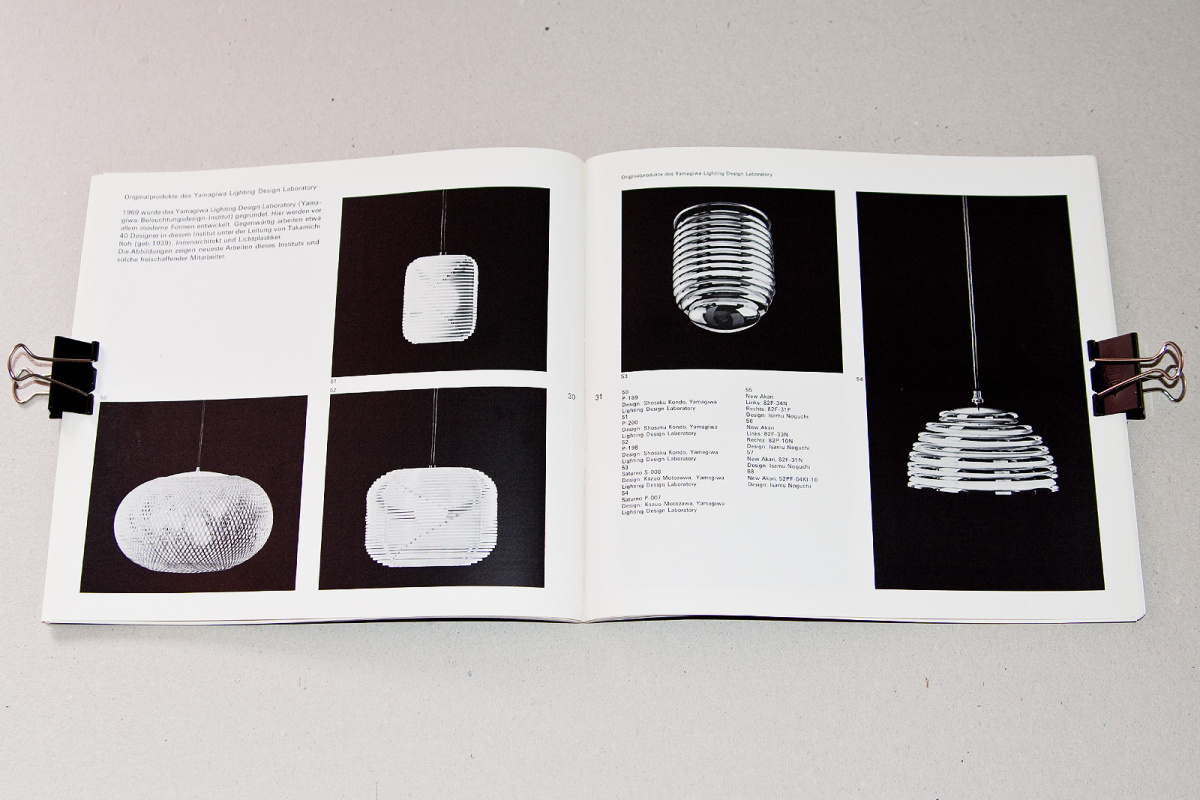
A grouping of Akari lamps showing different shapes from the Noguchi series. Akari series, multiple variants. Photo via Wikimedia Commons / CC BY-SA 2.0.
Cultural Context
The word akari is a Japanese term for light in two senses: illumination and lightness, as in weightlessness. Noguchi chose it for its atmospheric character. He wanted the noun, not the appliance. He was born in Los Angeles in 1904 to the Japanese poet Yone Noguchi and the American writer Léonie Gilmour, and split his childhood between Japan and the United States. He apprenticed in Constantin Brâncuși’s Paris studio in 1927 on a Guggenheim Fellowship, and the abstract sculptural vocabulary he absorbed there shaped the rounded organic profiles he later commissioned in Gifu. During the Second World War, he voluntarily entered the Poston War Relocation Center in Arizona in 1942 to start an arts program for the interned Japanese-American population, then spent months trying to be released after the program collapsed. His Japanese-American identity remained a complicated argument with both countries for the rest of his life. The Akari lamps, made six years after Hiroshima and Nagasaki, were a deliberate work of reconciliation through craft.
Authenticity
Every authentic Akari carries the Ozeki red sun-and-moon stamp. The stamp is a small circular emblem of a stylized sun paired with a crescent moon, applied to the paper near the base of the lamp or to the cord housing on smaller models. Lamps without this stamp are not Ozeki-made and not authentic Akari, regardless of what the seller calls them. Counterfeits are widespread. The basic construction is centuries-old chochin technique, not patentable in itself, so the open question for Ozeki has always been the name and the silhouette rather than the underlying craft. The Akari name is trademarked by the Noguchi Foundation in cooperation with Ozeki, but enforcement is uneven outside Japan and the United States. The trademark covers the name and the red sun stamp, not the silhouettes themselves, which is why the most convincing fakes reproduce a recognizable shape without claiming the name. Common giveaways of fakes include paper that lacks the visible kozo fibers of true washi, bamboo replaced with thin metal wire or printed paper-on-plastic, joins that show seams instead of overlap, the absence of the red sun-and-moon stamp, and silhouettes that are close to a Noguchi profile but proportionally wrong. Authorized retail is the safest route. The Noguchi Museum’s online shop. The Vitra Design Museum shop. The MoMA Design Store. Specialist mid-century dealers carry confirmed stock. On the secondary market, lamps with documentable provenance, vintage Ozeki tagging, and visible washi grain are reliable. Pieces sold as “Noguchi-style” or “inspired by Akari” are almost always replicas. The price gap is large: a basic 1A from authorized retail costs roughly 200 USD, while convincing replicas sell for thirty.
Where to See Them
The Noguchi Museum at 9-01 33rd Road in Long Island City, New York, at the corner of Vernon Boulevard, opened in 1985 in a converted photo-engraving factory that Noguchi designed himself to display his sculpture, models, and lamps in one building. The Akari section anchors a dedicated room on the second floor and rotates examples from the museum’s reference collection. The Museum of Modern Art holds Akari in its Architecture and Design Collection. The Vitra Design Museum in Weil am Rhein, Germany, includes the lamps in its broader twentieth-century lighting collection, where they sit on the timeline alongside Ingo Maurer’s YaYaHo system and Italian icons like Vico Magistretti’s Eclissé. The Vitra reference collection is publicly accessible by appointment and contains one of the most extensive concentrations of Akari outside the Noguchi Museum itself.
Akari in the Present
The Ozeki workshop continues to produce every authentic Akari to original specification. Noguchi designed his last models before his death in 1988, but the original molds and ribbing techniques remain in use, and the lamps reach the market in the same way they did in 1952. Sixtysix’s feature on the Akari lamps covers the contemporary production line and the ongoing Ozeki partnership.
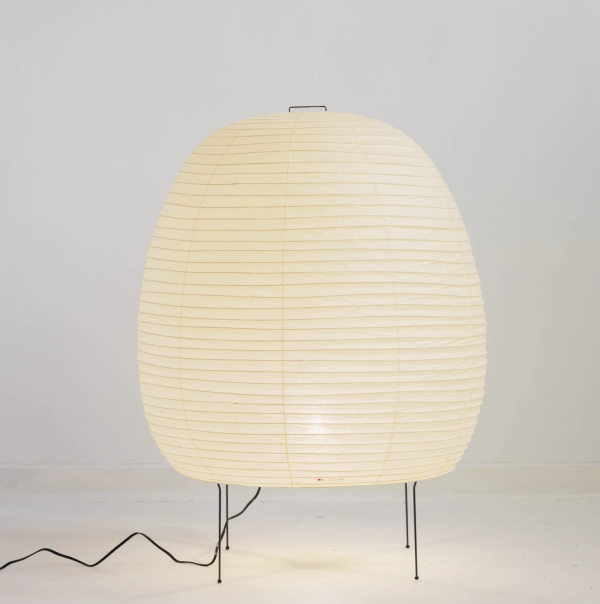
Akari lamp, photo by Chris Force
A genuine Akari is not a vintage object. It is a current one, made the same way it was seventy-five years ago, by the same workshop, in the same town, from the same paper.