Omer Arbel is interested in what happens when materials that shouldn’t coexist are forced together. His Vancouver studio, Bocci, is equal parts design practice, research lab, and fabrication facility, a setup that makes the boundary between experiment and product intentionally blurry. The 93 Series is the latest thing to come out of that setup: a series of lights and vases built around a material combination that, by most measures, shouldn’t hold.

The creation process starts with a thick-walled glass sphere, blown by hand. While the glass is still hot, a glassblower manually pours molten aluminum into the vessel and begins to rotate it. Photo by Elliot Black
The process starts with a thick-walled glass sphere, blown by hand. While the glass is still hot, a glassblower manually pours molten aluminum into the vessel and begins to rotate it. The aluminum moves across the interior surface, oxidizing and cooling as it travels, leaving behind a record of its own path. No two pieces follow the same route.
“The form emerges from the interaction between glass, aluminum, heat, and gravity,” Omer says. “The object is essentially a record of that interaction.”
Glass and aluminum expand and contract at different rates, which typically means one destroys the other.
“Bringing them together usually results in failure,” Omer says. “The challenge was finding a way to calibrate that relationship so the materials could coexist without breaking apart.”

Glass and aluminum expand and contract at different rates, which typically means one destroys the other. “Bringing them together usually results in failure,” Omer says. “The challenge was finding a way to calibrate that relationship so the materials could coexist without breaking apart.” Photo by Elliot Black
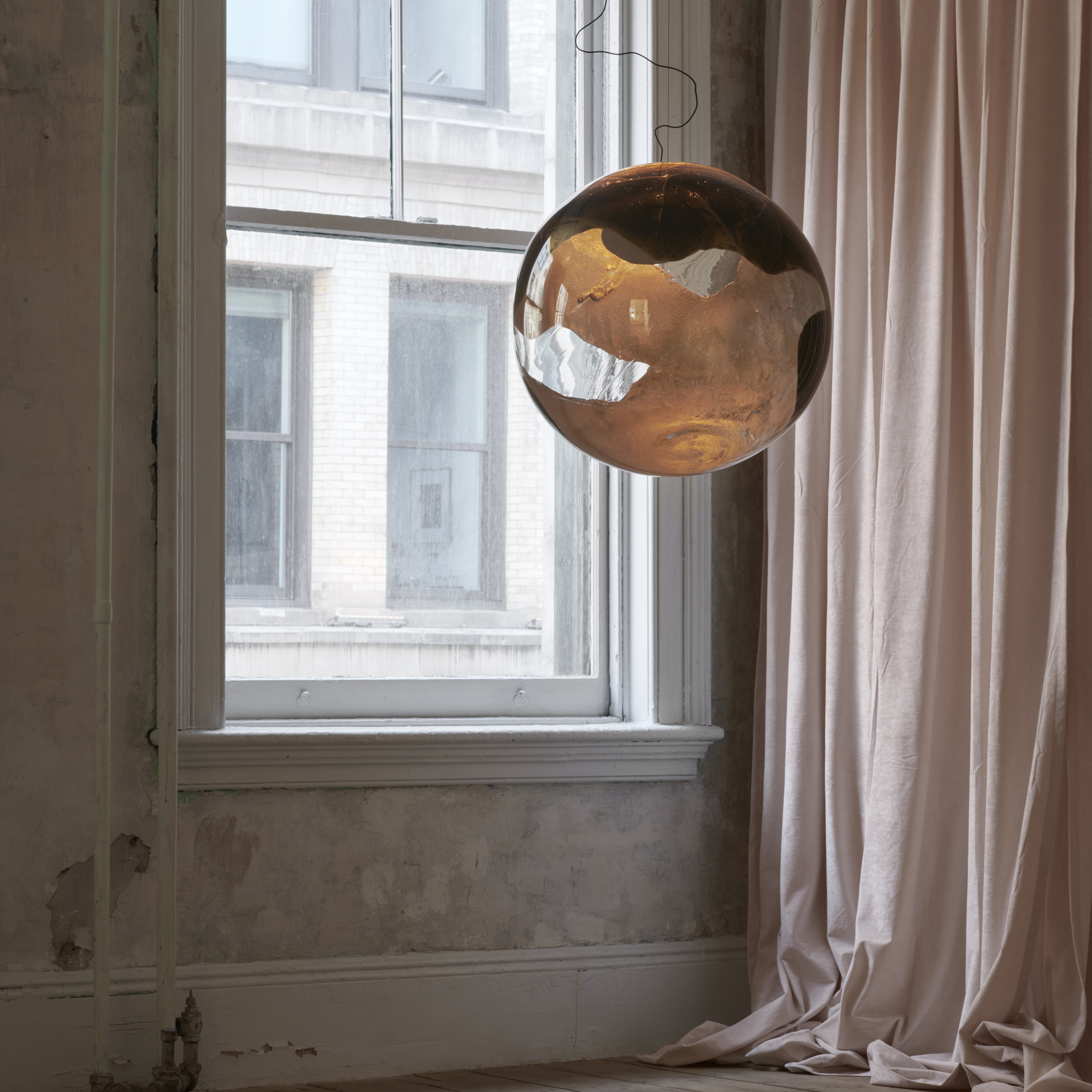
An earlier experiment, Bocci’s 113, deliberately pushed the same relationship to its limit. The glass separated from the metal form, and that work was shown at the Victoria & Albert Museum in 2022. With 93, the balance holds. The aluminum remains suspended inside the glass permanently, invisible until the piece is illuminated.
“When illuminated, the light travels through the glass and reveals the aluminum inside,” Omer says. “The object continues to express the moment of its making.”
Each piece takes roughly two days to fabricate, including annealing time to stabilize the glass. Electrical components and an LED system are integrated afterward. The forming itself is entirely manual, carried out at Bocci’s Vancouver studio. A single museum-scale edition was also produced at the Museum of Glass in Tacoma, Washington.

Electrical components and an LED system are integrated afterward. The forming itself is entirely manual, carried out at Bocci’s Vancouver studio. Photo by Elliot Black